
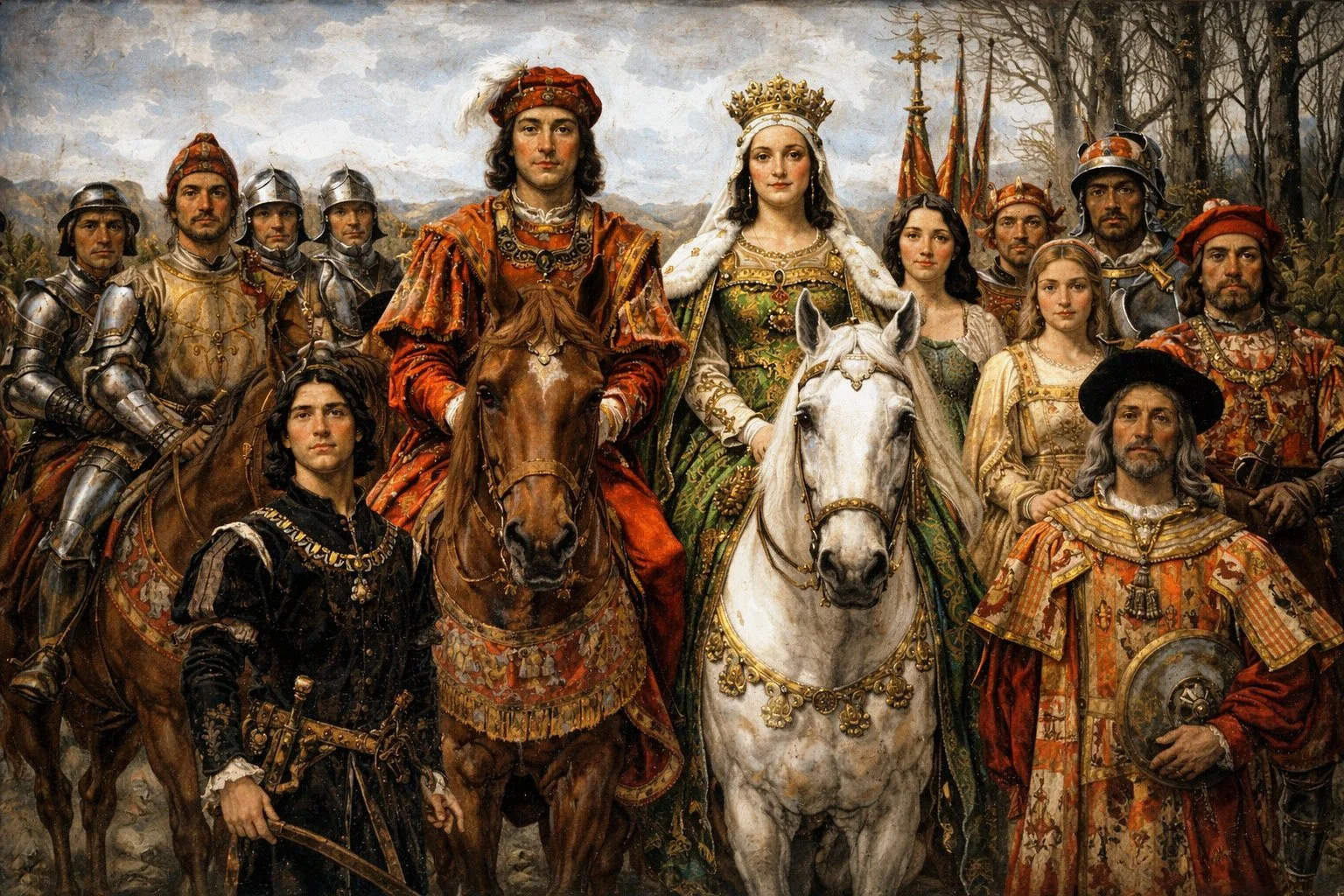
Ferdinand and Isabel with their travelling court (an impression, generated with AI).
Seen through the letters of Peter Martyr d’Anghiera
When Peter Martyr d’Anghiera came to Spain in the late 1480s, he entered a court that was anything but calm or settled. This was not a quiet medieval palace frozen in ritual. It was a place of constant movement, argument, prayer, ambition, and fear. His letters—known as the Epistolae—allow us to step inside this world and see daily life at the court of Ferdinand of Aragon and Isabella of Castile as it was actually lived.
Peter Martyr did not write official history. He wrote letters to friends across Europe. He complained, observed, admired, worried, and sometimes doubted. That is why his voice feels so close to us today. Through him, the Spanish court becomes human.
An Outsider at the Heart of Power
Peter Martyr was not Spanish. He was born in Lombardy, in northern Italy, and educated as a Renaissance humanist. He loved classical authors, clear reasoning, and moral debate. When he arrived in Spain, he was drawn into royal service—as a teacher, diplomat, and advisor.
This made him an insider and an outsider at the same time. He stood close enough to see how power worked, but far enough away to think critically about it. His letters are full of sharp observations, casual remarks, and moments of unease. He was impressed by Spain’s rulers—but never blind.
A Court That Never Stood Still
One of the first things Peter Martyr noticed was how much the court moved. Ferdinand and Isabella did not rule from one fixed capital. They traveled constantly: Segovia, Valladolid, Zaragoza, Granada. Wherever the monarchs went, the court followed.
Imagine it: hundreds of people on the road—nobles, priests, soldiers, clerks, cooks, musicians, petitioners. Horses, carts, chests full of documents and clothing. Temporary lodgings in monasteries, castles, or borrowed town halls. Letters written late at night because the court would move again at dawn.
Martyr often apologizes for rushed letters. News arrived slowly or out of order. Decisions were made between journeys. Power, in Spain, was mobile.
Queen Isabella: Faith and Firm Decisions
In Peter Martyr’s letters, Queen Isabella stands out strongly. He describes her as deeply religious, disciplined, and serious. She attended Mass daily and believed that ruling was a duty given by God, not a personal privilege.
But she was no passive figure. Isabella listened carefully, asked questions, and made firm decisions. She sat in councils, followed legal cases, watched finances, and took responsibility seriously. Her faith gave her strength, not softness.
Martyr respected her deeply. At times, he was troubled by the results of her policies, but he never doubted her conviction or her sense of duty.
King Ferdinand: Strategy and Control
Ferdinand of Aragon appears very differently. Where Isabella is driven by moral certainty, Ferdinand is guided by strategy. Martyr describes him as quiet, cautious, and calculating. A man who listens more than he speaks. A ruler who thinks long-term.
Together, Ferdinand and Isabella ruled as a partnership. They were different in character, but complementary. Martyr finds this balance fascinating. Through their marriage, Spain became a union of kingdoms held together by negotiation as much as force.
Scholars, Letters, and Rivalries
Peter Martyr belonged to a small group of scholars who brought Renaissance learning to Spain. Latin was their shared language. Letters were their lifeline. They discussed ancient authors, ethics, education, and the meaning of power.
But court life was risky. Patronage mattered. A poorly chosen word could ruin a career. A well-written letter could open doors. Martyr often hints at rivalry, jealousy, and exhaustion. Learning was respected—but only if it served the crown.
The court was not just a place of power. It was a place of competition.
News That Changed the World
Again and again, extraordinary news reached the court. The fall of Granada. Reports from the Canary Islands. Letters from Christopher Columbus describing unknown lands across the ocean.
Martyr records the excitement—but also the uncertainty. He asks questions. Who lives in these lands? How are they ruled? What does conquest mean for those who conquer—and those who are conquered?
In his letters, the Spanish court feels like a listening post at the edge of a rapidly expanding world.
Fear, Faith, and What Is Not Said
There is also a darker side. Martyr writes—sometimes carefully, sometimes indirectly—about forced conversions, expulsions, and the growing power of the Inquisition. He is not an open critic, but his discomfort is clear.
Certain topics are handled with caution. Some are avoided altogether. Silence often speaks louder than words. Faith defined belonging, and doubt could be dangerous. Martyr lived within these limits, never fully free, but never entirely silent.
A Living Court, Not a Monument
What makes Peter Martyr’s letters so powerful is their honesty. He admires, but he also questions. He participates, but he reflects. Through him, the court of the Catholic Monarchs becomes alive: full of prayer and ambition, hope and fear, confidence and contradiction.
These letters remind us that history is not only made in battles and decrees. It is made in conversations, journeys, doubts, and hastily written notes. At the court of Ferdinand and Isabella, the future of Spain—and much of the world—was taking shape, often without anyone fully understanding where it would lead.