The famous 16th-century tapestries depicting the life of Saint Remigius are housed in the Musée Saint-Remi (Reims, France), where they can still be admired today.
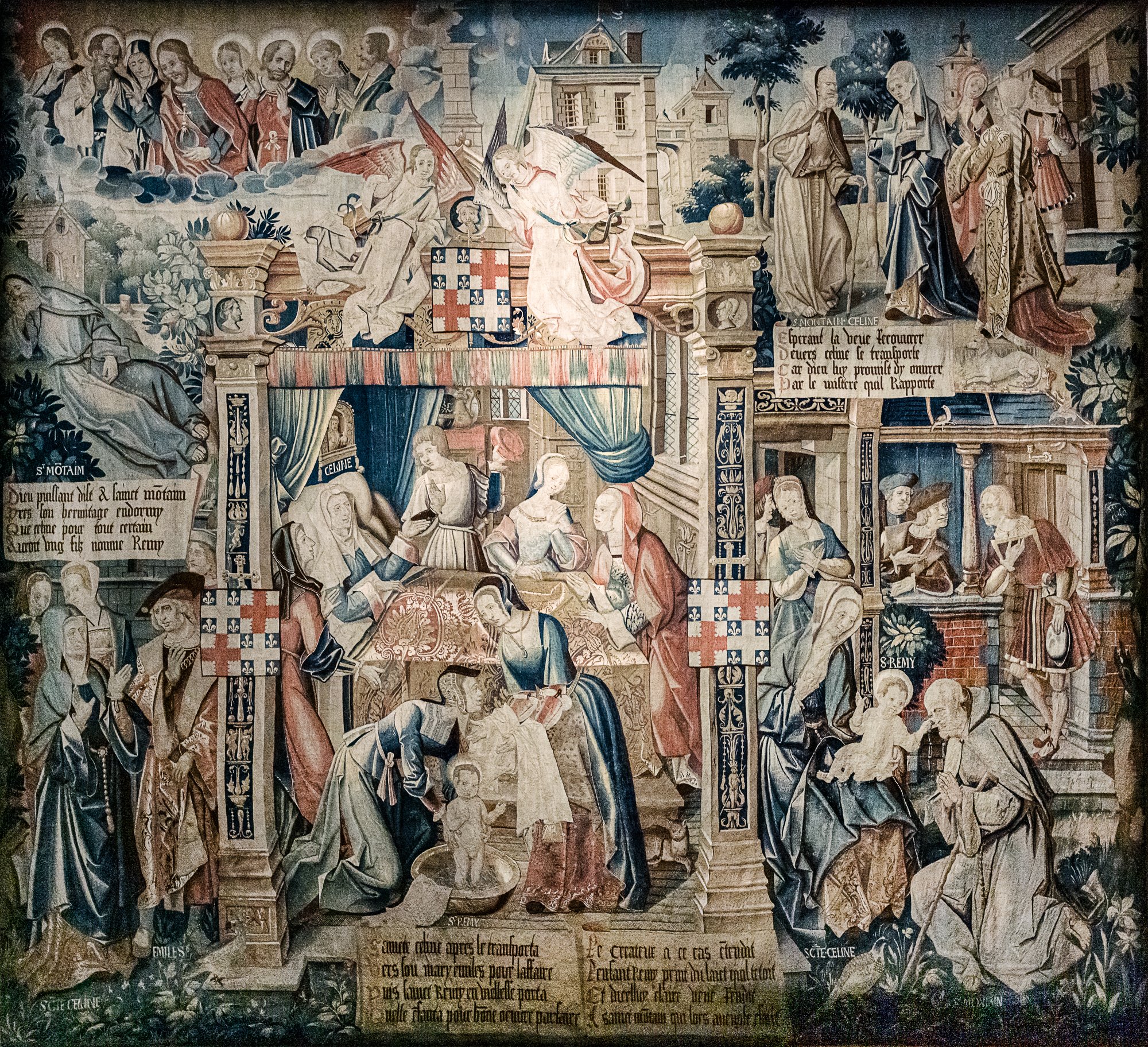
Birth of Saint Remy — The story unfolds in multiple scenes. At the center, Céline gives birth, surrounded by women attending both mother and child. Below, the infant is washed and presented. Around them, figures gesture and converse, suggesting that this is no ordinary birth. The imagery hints at prophecy and expectation: this child will grow into a figure of importance. The quiet domestic setting contrasts with the historical weight of what is to come.
The life of Saint Remy (Remigius of Reims) is not only preserved in texts—it was also woven, quite literally, into fabric.
In the early 16th century, a remarkable series of large tapestries was created for the city of Reims: the “Tentures de la vie de Saint Remi.” Comprising 10 monumental tapestries, the cycle tells the story of the bishop who baptized King Clovis and helped shape the religious and political identity of early medieval Europe.
These tapestries function like a visual narrative—almost like a medieval graphic novel. Each panel contains multiple scenes, accompanied by short texts in Middle French. Rather than showing a single moment, they unfold events step by step: birth, recognition, miracles, conflict, kingship, and justice.
What follows is the life of Saint Remy, told through these woven images—where history, legend, and moral teaching come together.
1. A Child Born into a Changing World
The story begins with the birth of Remy, presented as an event of quiet but profound significance. His mother, Céline, is surrounded by attendants, while the newborn child is carefully received and examined.
This is more than a domestic scene. It signals that this life is part of a larger design. In a world where the Roman order is fading, figures like Remy are presented as anchors—individuals through whom continuity and meaning are preserved.
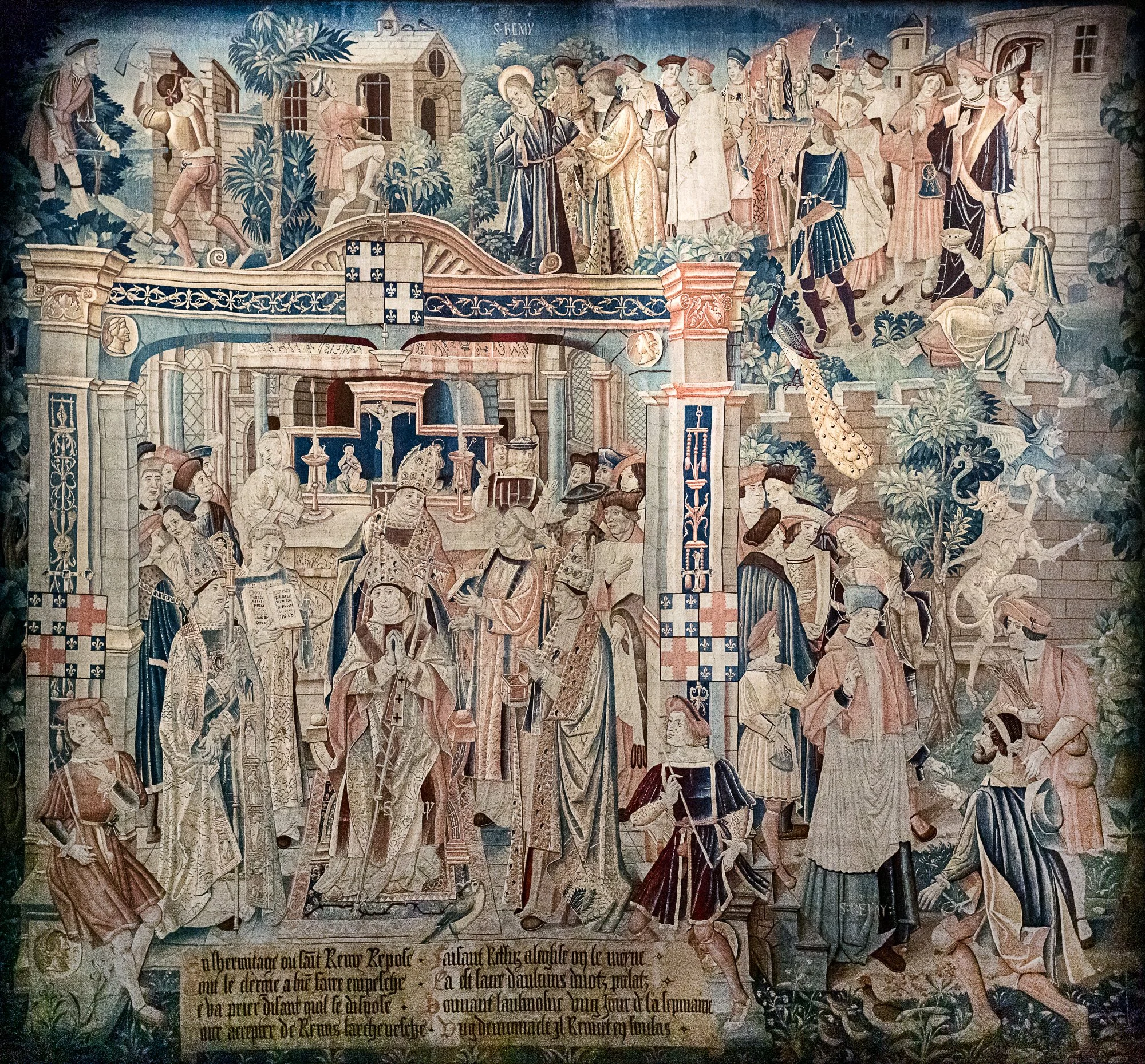
The Calling of Remy as Bishop — Different scenes show the recognition of Remy’s authority. Clergy gather, gestures indicate acceptance and blessing, and Remy is placed within a structured ecclesiastical setting. The architecture—columns, altars, and enclosed spaces—reinforces the institutional nature of the moment. This is not a sudden rise, but a collective acknowledgment. The young man becomes bishop, stepping into a role that is both spiritual and political.
2. Authority Recognised, Not Claimed
Remy’s elevation to bishop comes early and unexpectedly. The tapestries show a collective act of recognition: clergy and people gather, acknowledging his authority.
From this point onward, Remy is not only a religious figure. He becomes a mediator in a fragmented society—someone who can restore order where political structures are weakening.
His early miracles reinforce this role. Healing, intervention, and acts of restoration appear in sequence, building trust in a world where certainty is scarce.
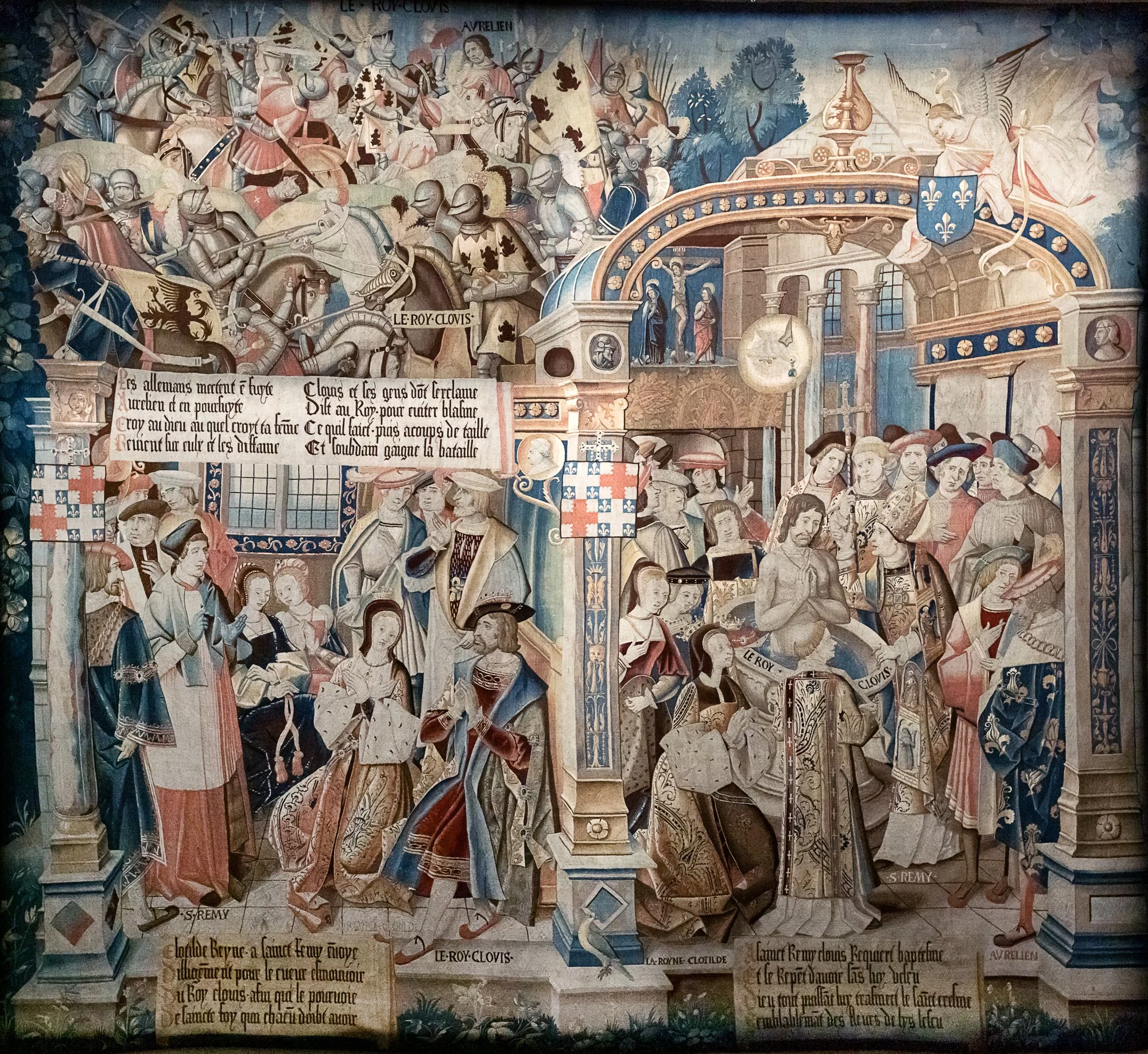
The Baptism of Clovis — In a richly structured interior, the baptism takes place. Clovis kneels, stripped of royal distance, as Remy performs the ritual. Around them, a carefully arranged audience witnesses the act—nobles, clergy, attendants. Architectural elements frame the scene, giving it a sense of permanence and order. This is both a religious ceremony and a political declaration: a king aligns himself with a new faith.
3. The King Who Changes Everything
The narrative shifts dramatically with the arrival of Clovis, king of the Franks.
The tapestries show a progression:
persuasion at court
crisis in battle
a vow made under pressure
At the Battle of Tolbiac, Clovis promises to convert if he is granted victory. The battle is won, and the promise is kept.
The baptism that follows—one of the most iconic scenes in the series—marks a turning point. In a carefully staged ritual, Clovis kneels before Remy. This is not just a spiritual act. It is a political transformation that will shape the future of Western Europe.
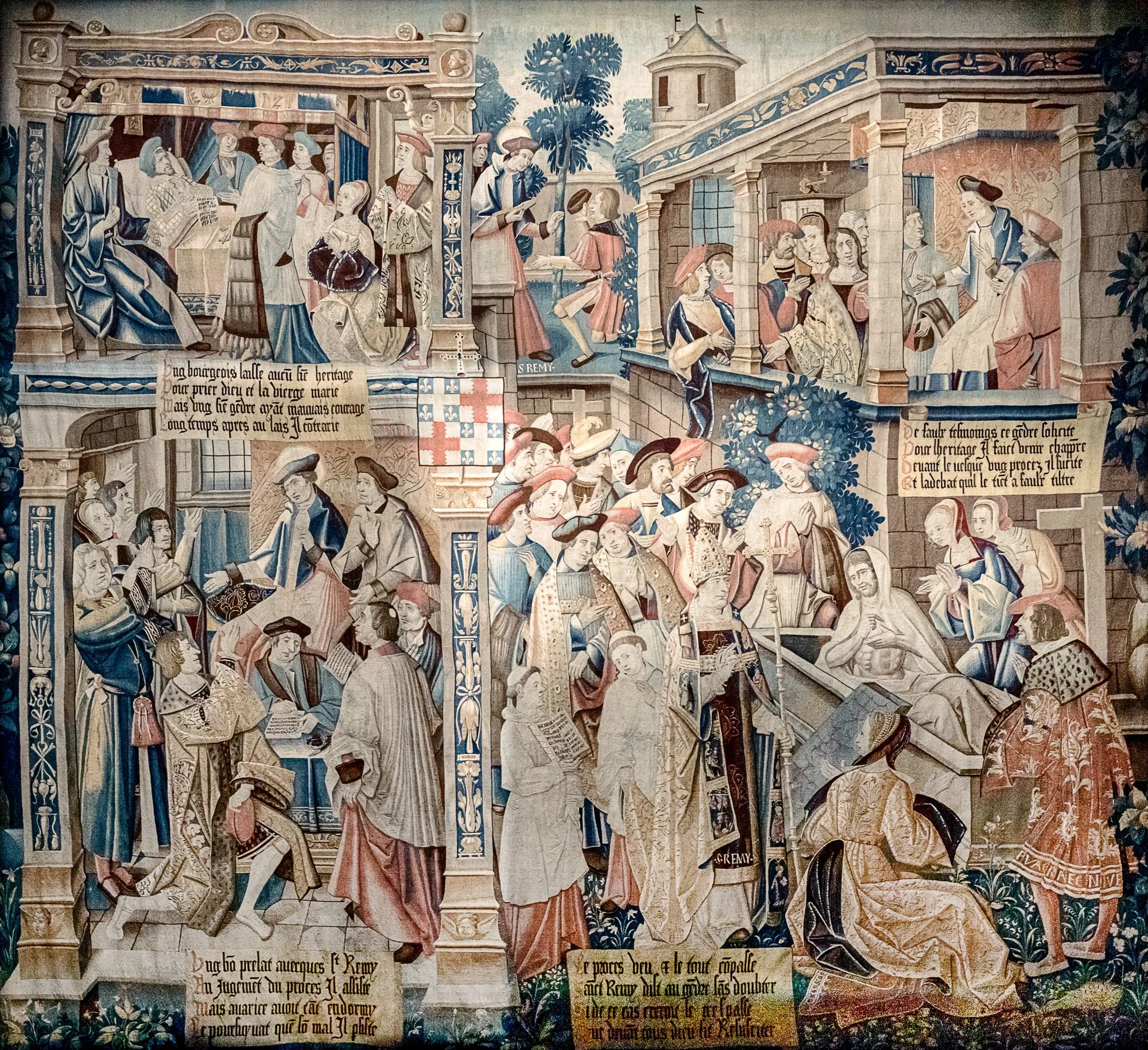
The Dispute Over the Inheritance —This tapestry unfolds like a legal drama. In one scene, a dying man lies in bed while family members gather—his wealth and intentions at stake. Elsewhere, documents are exchanged, and discussions take place around a table. Another scene shows a figure presenting arguments, possibly supported by false witnesses. Finally, authority intervenes—Remy and the king appear within a formal setting where judgment is rendered. The sequence moves from private death to public justice, revealing the fragile line between faith, property, and power.
4. Justice in a Human World
The final part of the story moves away from kings and into everyday life.
One tapestry presents a dispute over an inheritance. A dying man’s wishes are contested, false witnesses are brought forward, and legal arguments unfold. The scenes progress from private spaces—bedrooms and family gatherings—to public judgment.
Remy appears here not as a miracle worker, but as a moral authority. The case reaches royal power and is resolved. Justice is restored, but only after conflict and deception.
This closing note is significant. It reminds the viewer that holiness is not only about miracles or kings—it is also about how people act, argue, and live together.
A Life That Connects Worlds
Across the tapestry cycle, Remy stands at the intersection of worlds:
Roman and medieval
spiritual and political
divine intention and human action
His life is not told as a sequence of isolated miracles, but as a continuous engagement with society. These tapestries do not just celebrate a saint—they explain how order itself is created and maintained.