
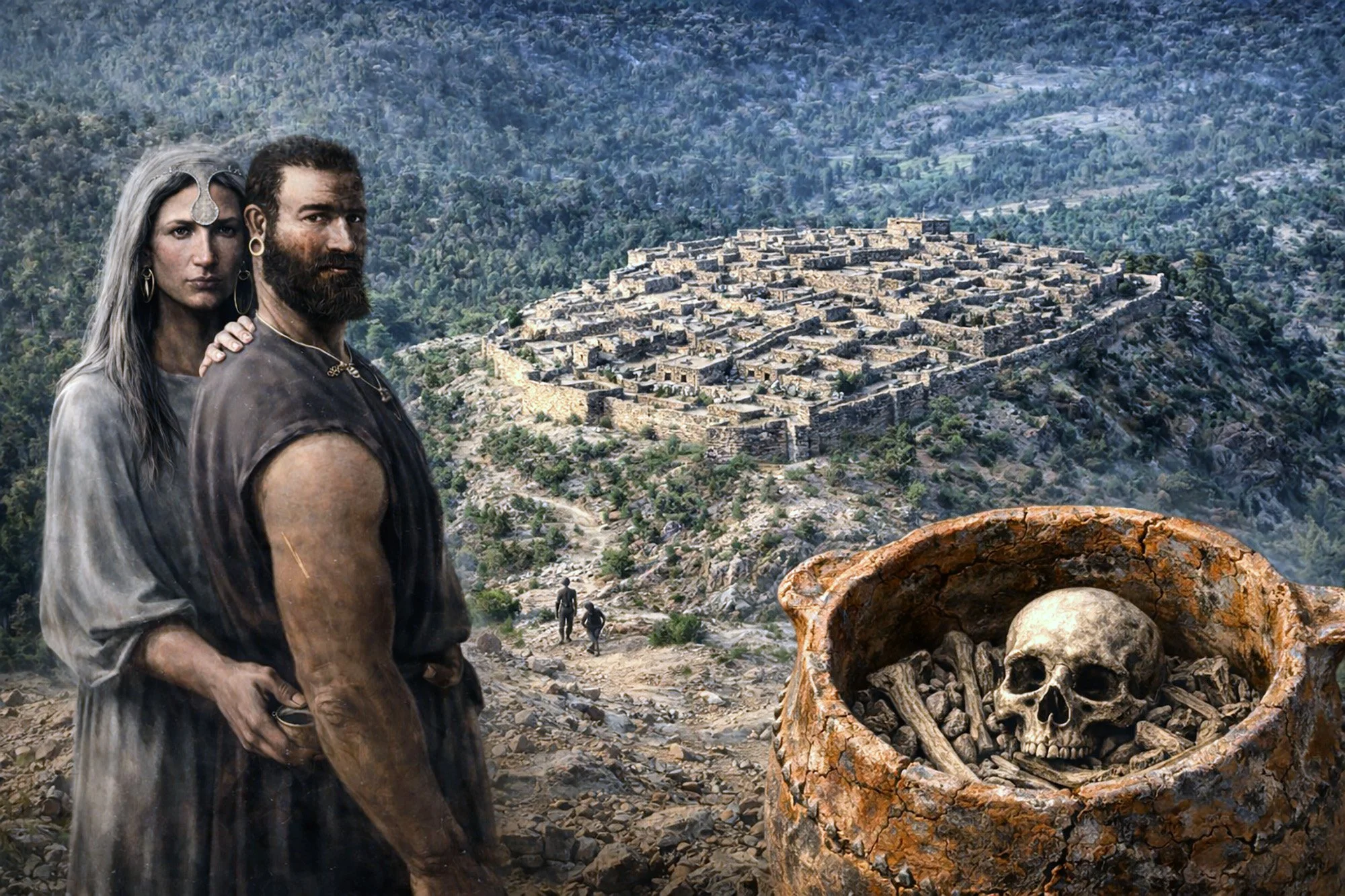
Image created with AI.
When people think about the Bronze Age, they often picture the great palaces of Greece, the kings of Egypt, or the empires of the Near East. Yet on the far western edge of the Mediterranean, another remarkable experiment in power and society was unfolding.
Between about 2200 and 1550 BC, southeastern Iberia—today part of Spain—was dominated by a culture archaeologists call El Argar. For more than six centuries this society built fortified hilltop settlements, controlled regional economies, and developed one of the most complex political systems in prehistoric Western Europe. But just as suddenly as it rose, this system collapsed. The story of Bronze Age Iberia is therefore not just about metallurgy and trade. It is about the rise of power, the fragility of complex societies, and the networks that connected Iberia to the wider world.
The Rise of the Argaric World
Around 2200 BC, new settlements began appearing in the dry hills of southeastern Iberia. Unlike earlier Copper Age villages, these communities were carefully planned and often heavily fortified. Sites such as El Argar, La Bastida, and La Almoloya were built on defensible hilltops overlooking agricultural valleys. Massive stone walls, towers, reservoirs, and large storage buildings suggest that these settlements were not merely villages but regional political centers. Archaeologists believe that these hilltop sites controlled surrounding farming communities. Grain, livestock, and metal goods were collected and redistributed through these centers, creating an economy that was unusually centralized for prehistoric Europe. Burial practices reveal a society that was strongly hierarchical. Beneath houses and public buildings archaeologists have found graves containing carefully standardized sets of objects. Some individuals were buried with bronze weapons, silver ornaments, and elaborate pottery, while others received only a simple vessel—or nothing at all. This suggests a rigid social structure: a ruling elite, a middle stratum of workers and craftsmen, and a lower class that may even have included slaves. In fact, some archaeologists describe El Argar as the earliest state-like society in Western Europe.
Control of Land, Water, and Grain
The power of the Argaric elites appears to have rested on control over resources—especially food. The arid landscape of southeastern Iberia required careful management of water. Reservoirs, irrigation systems, and terraces allowed farmers to cultivate crops in a difficult environment. At the same time, grain—especially barley—became the dominant crop. Large storage jars found in settlements suggest that harvests were collected centrally, stored in fortified buildings, and redistributed by the ruling elites. In effect, grain functioned as a kind of tax system, tying farmers to the political centers that controlled storage and distribution. Over time this system produced increasing inequality. Wealth and power concentrated in a few dominant families whose authority was passed down through the male line. Women often married into other settlements, creating alliances between elite groups across the region. For several centuries the system worked. Argaric society expanded, settlements grew larger, and political control spread across much of southeastern Iberia.
A Fragile System
Yet the very system that allowed El Argar to flourish also made it vulnerable. The economy increasingly relied on large-scale barley cultivation. Forests were cleared to create new farmland, and soils were pushed to their limits in order to produce enough grain to support the centralized system. Unlike Egypt or Mesopotamia, Iberia lacked large river systems that could naturally replenish agricultural soils. Over time, the land became exhausted. Environmental stress may have worsened during periods of drought in the later Bronze Age. When harvests failed, the entire political system built around grain storage and redistribution would have been threatened.
The Collapse of El Argar
Around 1550 BC, the Argaric world came to an end. Many settlements were abandoned. Others show signs of destruction by fire, suggesting violent conflict. Yet there is little evidence for invasion by outside populations. Instead, the collapse appears to have been largely internal. As environmental pressures grew and agricultural production declined, the centralized system may have broken down. The elites lost their ability to control food supplies and labor, and the social hierarchy that sustained their authority dissolved. In the aftermath, the elaborate burial traditions disappeared. Monumental architecture was no longer built. Society reorganized into smaller, more egalitarian communities.
For centuries afterward, southeastern Iberia would not see a political system of similar complexity.
Iberia and the Atlantic World
Yet Iberia did not become isolated. During the later Bronze Age, communities along the western coast participated in an expanding maritime trade network that connected Portugal, Galicia, Brittany, Ireland, and Britain. Bronze swords, axes, and ornaments found across these regions share striking similarities, suggesting the movement of goods, ideas, and craftsmen along Atlantic sea routes. These networks linked Iberia to distant parts of Europe and laid the foundations for later Mediterranean trade.
By about 900 BC, Phoenician sailors from the eastern Mediterranean began establishing trading posts along the southern Iberian coast, attracted by the peninsula’s rich mineral resources. This marked the beginning of a new chapter in Iberian history—one in which the region would become a bridge between the Atlantic and Mediterranean worlds.
Lessons from an Ancient Experiment
The Bronze Age of Iberia shows that complex societies were emerging across Europe long before classical civilizations appeared. The Argaric culture demonstrated that centralized power, economic control, and social hierarchy could develop even in relatively small prehistoric communities. But its collapse also reminds us how fragile such systems can be. Environmental pressures, economic imbalance, and social inequality can undermine even the most sophisticated political structures.
More than three thousand years later, the rise and fall of El Argar still reads like a familiar story.
Further Reading
Margarita Díaz-Andreu & Simon Keay — The Archaeology of Iberia: The Dynamics of Change
Katina T. Lillios — The Archaeology of the Iberian Peninsula
Barry Cunliffe — The Atlantic Bronze Age
Vicente Lull — The Argaric Society
Josephine Quinn — In Search of the Phoenicians
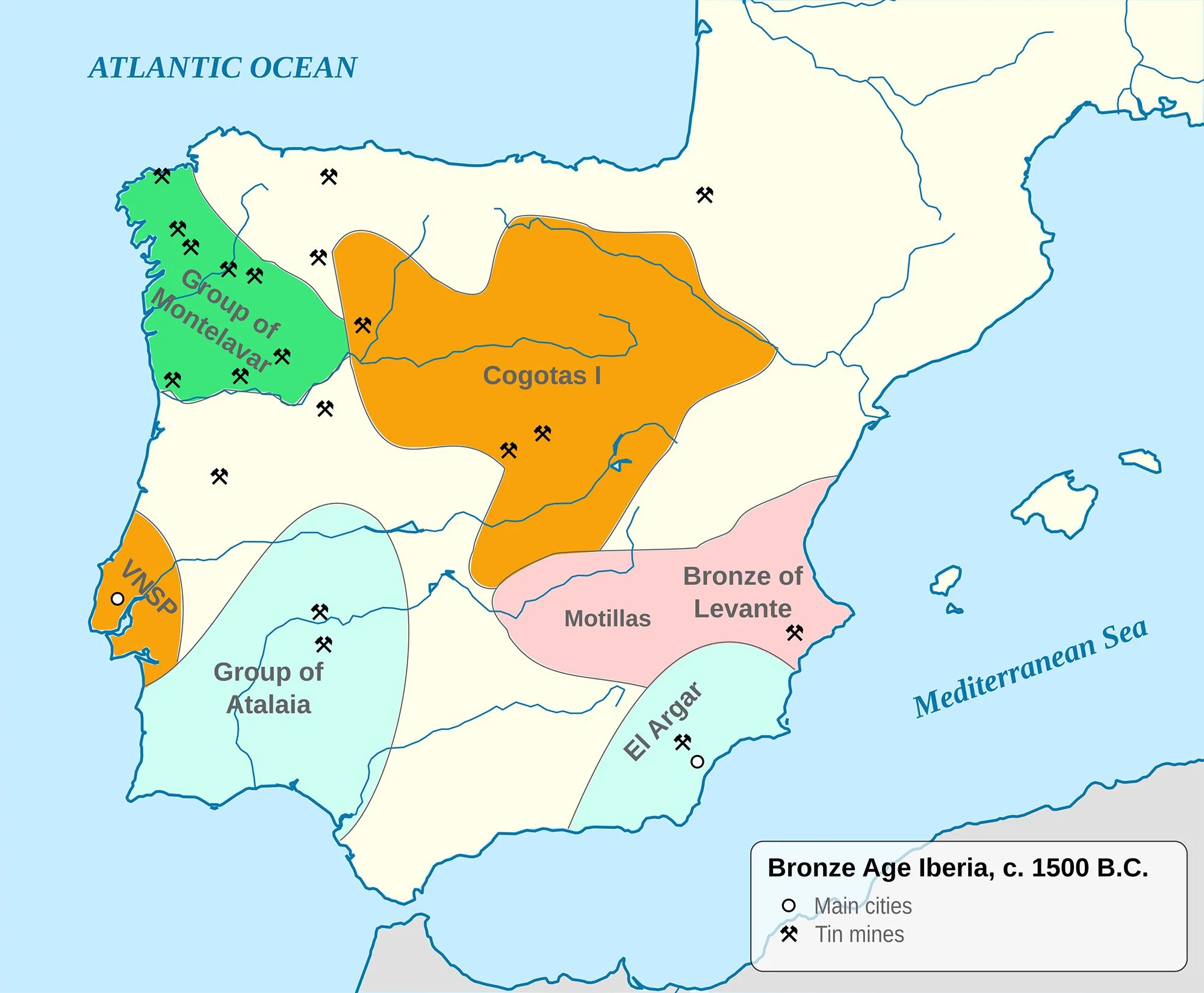
Map of Iberian Middle Bronze Age c. 1500 BCE. (Wikipedia)