
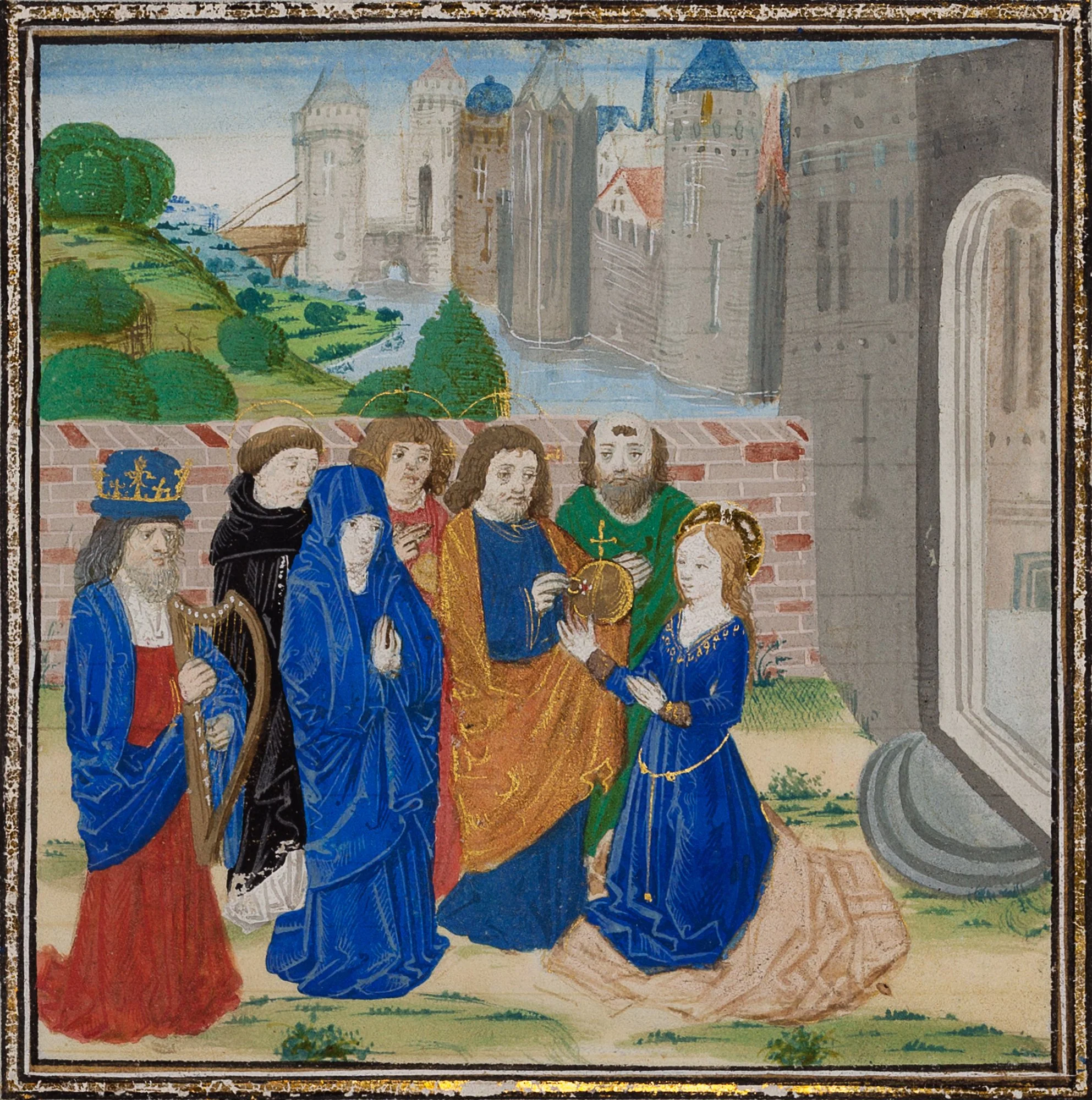
The Mystic Marriage of Catherine of Siena, painted by the Master of Margaret of York in a manuscript created for Louis of Bruges in the late 15th century.
In the narrow streets of medieval Siena, amid plague, political violence, and religious fear, a young woman began speaking with an authority that kings, bishops, and even popes found difficult to ignore.
She was not a noblewoman. She had no formal education. She never led an army, ruled a city, or held office in the Church. Yet centuries later, Catherine of Siena remains one of the most powerful female figures of medieval Europe.
For travellers wandering through Tuscany, visiting Gothic churches, or standing before weathered statues in old Italian towns, Catherine is everywhere. But who was she really, and why did her voice matter so much?
A Child of Crisis
Catherine was born in 1347, the very year the Black Death arrived in Europe. The world around her was collapsing. Entire families disappeared within days. Trade faltered, trust weakened, and many believed divine punishment had descended upon Christendom.
The Italy into which she grew up was fragmented and violent. City-states fought one another constantly. Mercenary armies crossed the countryside. The papacy itself had abandoned Rome and ruled instead from Avignon under strong French influence.
Amid this chaos, Catherine developed an intense religious life. According to tradition, she experienced visions from an early age and refused marriage despite strong pressure from her family. Instead, she joined the Dominican Third Order, remaining technically a laywoman while living a life of prayer, fasting, and service.
Yet Catherine was never simply withdrawn from the world. The remarkable thing about her life is how quickly mysticism turned into action.
The Woman Who Wrote to Popes
By her twenties, Catherine had become an unlikely political force.
She dictated hundreds of letters to rulers, bishops, merchants, and military leaders. Her most famous correspondence was with Pope Gregory XI, whom she urged to leave Avignon and return the papacy to Rome.
To modern ears, it is difficult to grasp how extraordinary this was. A young laywoman from Siena was openly advising — and at times reprimanding — the supreme leader of the medieval Church.
And yet people listened.
Part of Catherine’s influence came from timing. Europe was desperate for moral authority. Corruption inside the Church was widely discussed, and many feared Christianity itself was entering a period of decay. Catherine’s fierce sincerity gave her unusual credibility.
When the pope finally returned to Rome in 1377, many contemporaries saw Catherine as one of the voices that had helped make it happen.
But peace did not follow. Soon after came the Western Schism, when rival popes claimed legitimacy. Catherine strongly defended the Roman papacy, throwing herself into the struggle with exhausting intensity.
She died in Rome in 1380, only thirty-three years old.
Recognising Saint Catherine in Art and Statues
For travellers visiting churches and museums across Italy, Spain, France, or elsewhere in Europe, recognising Catherine is easier once you know her symbols.
She is most often shown wearing the black-and-white habit of the Dominicans. Several attributes commonly identify her:
A lily, symbolising purity.
A book, representing her writings and spiritual teaching.
A crucifix held close to her chest.
A crown of thorns, referring to her mystical union with Christ.
The stigmata — wounds corresponding to those of Christ — sometimes shown subtly on her hands.
A heart, because medieval tradition described her mystical “exchange of hearts” with Christ.
A miniature church or papal tiara, symbolising her role in defending and reforming the Church.
In paintings, she is often portrayed in ecstatic prayer, gazing upward while receiving visions. In sculpture, particularly in Italy, her expression is frequently intense and inward-looking — less serene than many saints, more like someone wrestling with the fate of the world.
One of the most memorable images of Catherine can still be found in Siena itself, where her presence remains deeply woven into the city’s identity.
A Voice from a Fractured Europe
What makes Catherine fascinating for modern travellers is not only her spirituality, but the world she reveals.
Through her life we glimpse a Europe shaken by plague, political division, fear of decline, and arguments over authority — themes that still feel strangely familiar today. Her letters show medieval Europe not as a silent or static world, but as a continent alive with debate, crisis, and competing visions of the future.
Catherine herself stood at the centre of these tensions. She comforted plague victims, negotiated between rival factions, challenged Church leaders, and tried to hold together a society she believed was drifting toward chaos.
For visitors walking through Siena today, she is more than a saint in a niche or a name attached to a basilica. She is one of the clearest human faces of the late Middle Ages: passionate, uncompromising, deeply political, and impossible to ignore.
Further Reading
Catherine of Siena: A Passion for the Truth — Ralph McInerny (1996)
The Life of Catherine of Siena — Raymond of Capua (14th century)
Catherine of Siena — Karen Scott (2009)
The Dialogue — The Dialogue by Catherine of Siena (14th century)