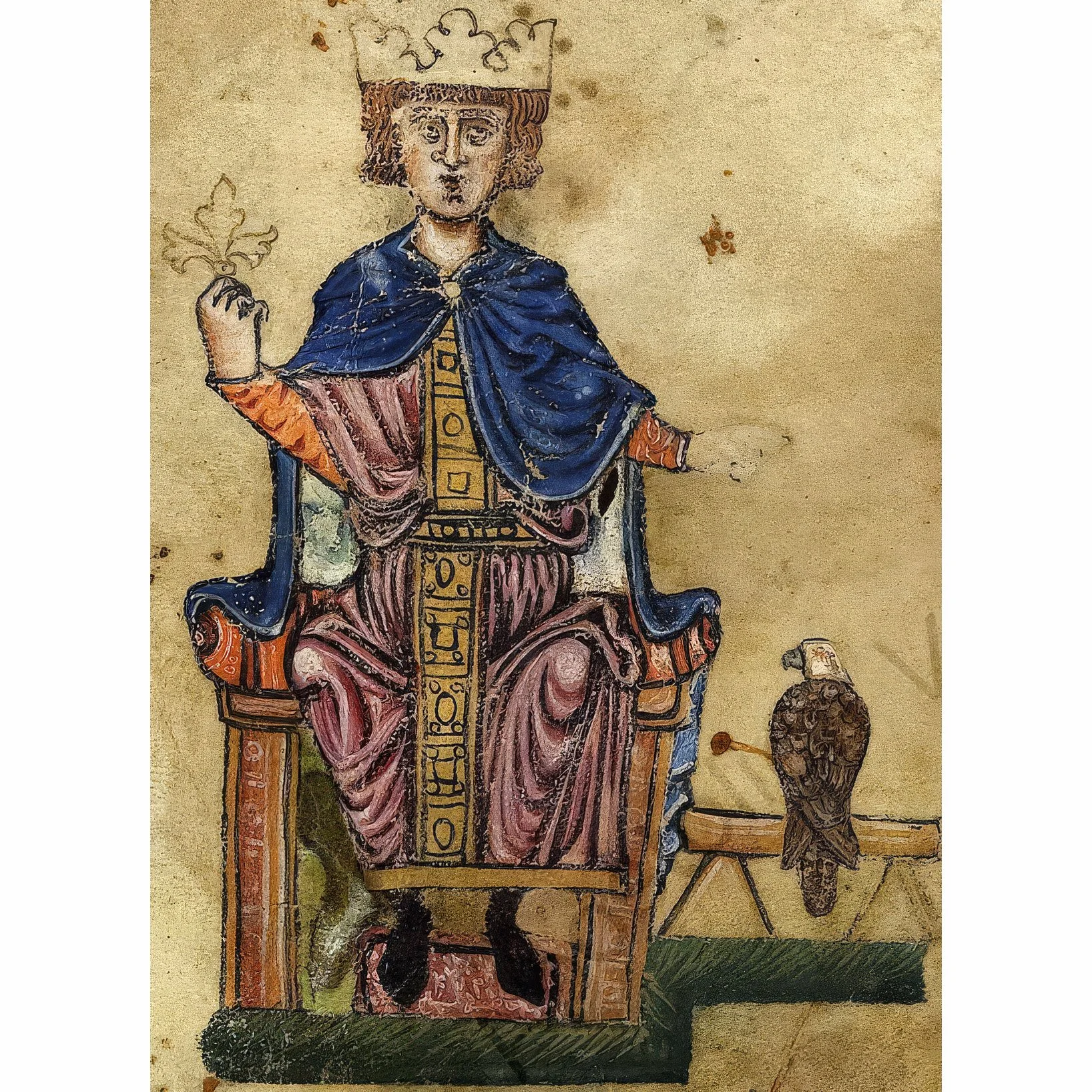
Emperor Frederick II with his falcon. Illustration from De arte venandi cum avibus (The Art of Hunting with Birds), Frederick's celebrated treatise on falconry. Manuscript, late 13th century. Biblioteca Apostolica Vaticana, Pal. lat. 1071, fol. 1r.
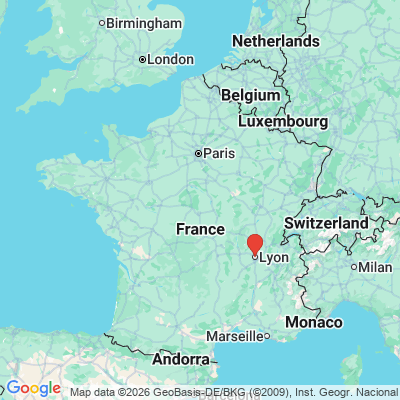
In the summer of 1245, bishops, abbots and ambassadors from across Europe gathered in Lyon (France) for one of the most important Church councils of the Middle Ages. Before the meeting was over, Pope Innocent IV would make an extraordinary announcement: Emperor Frederick II was deposed.
Whether the pope actually had the power to remove an emperor was fiercely debated at the time—and it remains one of the most remarkable constitutional questions in European history.
One of our best guides to this dramatic period is Salimbene de Adam (1221–c.1290), a Franciscan friar from Parma (Italy). Salimbene travelled widely through Italy and France, met many leading figures of his age, and wrote one of the liveliest medieval chronicles that has survived. His Cronica is filled with eyewitness accounts, political observations and memorable stories. Although he strongly supported the papacy, his work offers a fascinating window into one of Europe's greatest power struggles.
The Emperor Who Fascinated Europe
Frederick II (1194–1250) was one of the most remarkable rulers of the Middle Ages.
He was born in Jesi (Italy), the son of Emperor Henry VI and Queen Constance of Sicily. When Frederick was only four years old, both of his parents had died. The young prince inherited the Kingdom of Sicily, with its capital in Palermo (Italy) and came under the protection of Pope Innocent III.
Growing up in Palermo exposed him to an extraordinary mix of cultures. Latin Christians, Greek Christians, Muslims and Jews all lived and worked in the city. Frederick learned several languages, developed a lifelong interest in science and philosophy, and became famous for his curiosity about the natural world. His book on falconry is still regarded as one of the finest scientific works of the Middle Ages.
In 1212, German princes invited Frederick to claim the German crown. He crossed the Alps, defeated his rival, and was crowned King of the Romans. Ten years later, in 1220, Pope Honorius III crowned him Holy Roman Emperor in Rome (Italy).
At the height of his power, Frederick ruled an empire stretching from the North Sea to the Mediterranean. Besides Germany, he controlled the Kingdom of Sicily, making him master of territories both north and south of the Papal States. To many popes, this looked dangerously close to surrounding the Church politically and militarily.
When Frederick died in 1250 at Castel Fiorentino in southern Italy, his son Conrad IV succeeded him as King of Germany and King of Sicily. Conrad died only four years later, leaving the dynasty weakened. Frederick's illegitimate son Manfred continued the struggle in Italy until he was defeated and killed at the Battle of Benevento in 1266. With Manfred's death, the Hohenstaufen dynasty effectively lost its grip on Italy, bringing an end to the long conflict that Frederick had dominated for decades.
The Road to Lyon
The struggle between Frederick and the papacy lasted for much of his reign.
The emperor believed that his authority came directly from God and that he should be free to govern his empire without papal interference. The popes, on the other hand, argued that even emperors had duties towards the Church and could be judged if they endangered Christendom.
The disagreement led to repeated excommunications, diplomatic crises and military campaigns, particularly in northern and central Italy. Cities such as Parma, Milan and Bologna often found themselves caught between imperial and papal interests.
By 1245, relations had broken down completely.
The Trial at Lyon
Pope Innocent IV summoned a great council in Lyon.
The pope accused Frederick of breaking solemn promises, persecuting the Church, interfering in papal territory and threatening the unity of Christendom. Frederick defended himself through envoys, arguing that the accusations were politically motivated, but he was not present when the final judgement was delivered.
The verdict stunned Europe.
The pope declared that Frederick had forfeited his imperial office.
Never before had a pope so openly claimed the authority to judge and depose the most powerful secular ruler in Christian Europe. Whether this declaration had legal force was immediately disputed, but symbolically it was an event of enormous importance.
Salimbene's View
Salimbene leaves little doubt about where his sympathies lay.
To him, Frederick's troubles were not simply political setbacks. They were signs of God's judgement upon an emperor whose pride had grown too great. Throughout his Cronica, he repeatedly returns to Frederick's defeats as evidence that the sentence pronounced at Lyon was being fulfilled by divine providence.
Only three years after the council, in 1248, Frederick suffered one of the greatest humiliations of his reign. During the siege of Parma the citizens stormed and destroyed his enormous fortified camp, called Victoria. The emperor escaped, but he lost treasure, military equipment and much of his prestige. For Salimbene, who came from Parma himself, this was clear proof that God's judgement had begun to unfold.
Who Really Won?
In reality, the Council of Lyon did not end Frederick's reign.
Many princes continued to recognise him as emperor, and the wars continued until his death five years later. Yet something fundamental had changed.
The conflict was no longer simply about territory or political influence. It had become a struggle over a much deeper question: Who stood highest in Christian Europe? Could a pope judge an emperor, or did an emperor answer only to God?
That question would continue to shape European politics for centuries.
Visiting Lyon Today
Modern Lyon is famous for its gastronomy and its beautifully preserved old town, but it also witnessed one of the most dramatic political events of the Middle Ages.
Walking through Vieux Lyon, crossing the Saône River, or climbing to the Basilica of Notre-Dame de Fourvière, you are exploring the city where Europe's spiritual and secular powers confronted one another in 1245.
If you visit Lyon today, you are not just exploring another beautiful French city—you are standing where one of the greatest political dramas of medieval Europe unfolded.
For Salimbene, the verdict was clear: God had spoken through the pope. Modern historians tend to see a more complicated picture. Yet nearly eight centuries later, the Council of Lyon remains one of the defining moments in the long struggle between Church and Empire.