
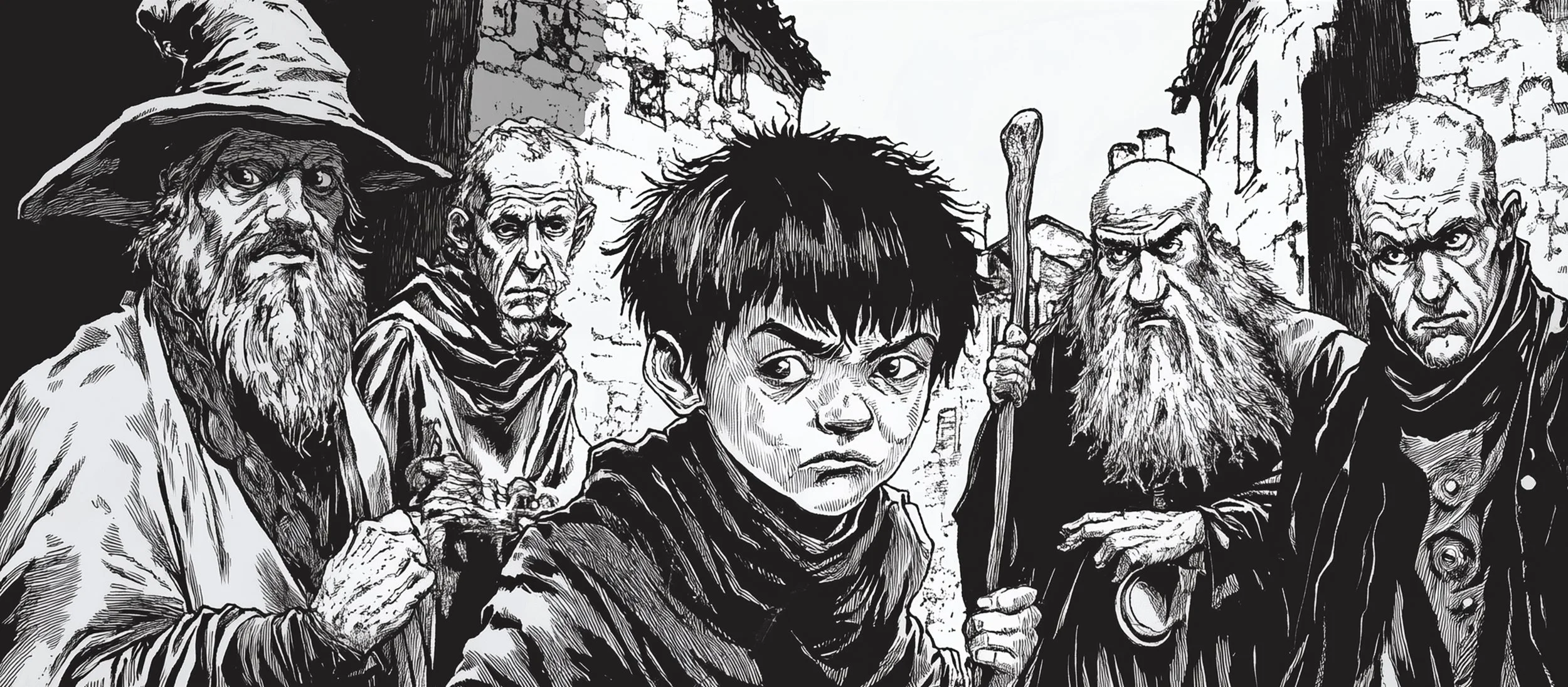
Lazarillo de Tormes is a Spanish novel, published anonymously in 1554, that exemplifies the picaresque genre—a style of storytelling that follows the adventures of a roguish yet resourceful protagonist, often of low social standing, who must rely on wit and cunning to survive in a corrupt and unjust society. The story revolves around Lázaro, a poor boy born near the river Tormes, who, after losing his father at a young age, is sent by his mother to serve as an apprentice to a blind beggar. This cruel master forces him to endure hardship, but in doing so, also teaches Lázaro the harsh realities of life. Quickly, the boy learns that deception and trickery are sometimes his only means of survival.
Like many picaresque protagonists, Lázaro moves from one master to another, each encounter offering a glimpse into the different layers of Spanish society. He serves a miserly priest who hoards food while his servant starves, compelling Lázaro to develop clever ways to steal. Later, he becomes the attendant of a proud yet destitute nobleman who values his dignity above basic survival, leaving Lázaro to beg on his behalf. He also crosses paths with a corrupt seller of indulgences, whose manipulative schemes reveal the deep-seated hypocrisy within religious institutions.
Throughout his journey, Lázaro adapts, using whatever means necessary to improve his circumstances—whether through deception, strategic flattery, or sheer resilience. Eventually, he secures a stable position as a town crier and marries a woman with ties to a local priest, seemingly achieving some level of social respectability. However, true to the picaresque tradition, his success is tinged with irony, as it comes at the cost of his moral integrity and forces him to accept the very corruption he once struggled against.
With its sharp satire and unfiltered realism, Lazarillo de Tormes exposes the hypocrisy of the church, the rigid class divisions, and the daily struggles of the lower classes in 16th-century Spain. As one of the earliest and most influential picaresque novels, it presents a world where survival depends not on noble ideals, but on the ability to navigate a society built on illusion and deception.