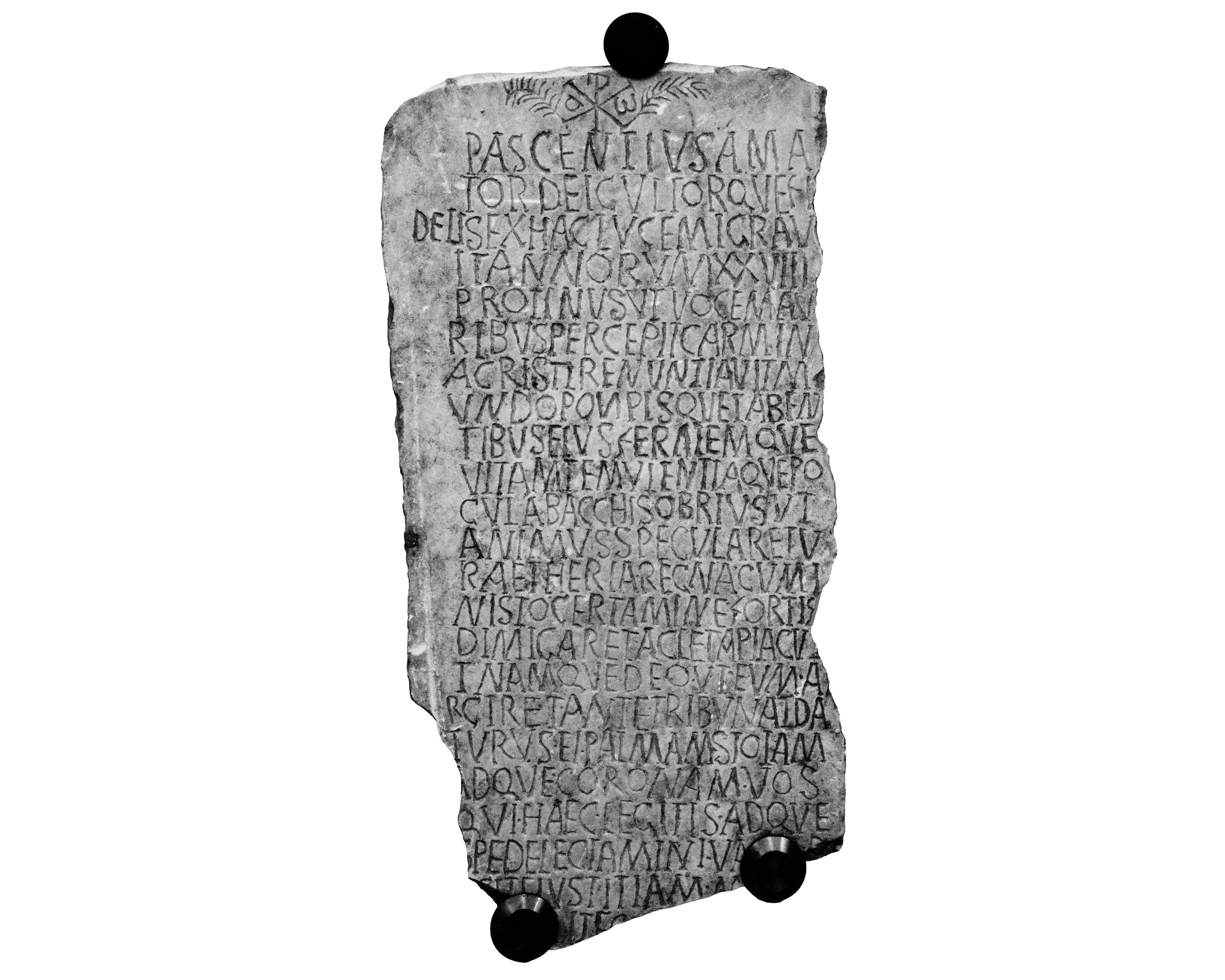
The tombstone of Pascentius (Archaeological Museum of Badajoz, Spain).
In the Archaeological Museum of Badajoz, a single limestone slab gives us an unusually intimate glimpse into late Roman life in the 4th century AD. Found in the necropolis of Torrebaja near Pueblonuevo del Guadiana, the tombstone of Pascentius reflects a moment when Christianity was reshaping the spiritual landscape of Roman Hispania.
Beneath a Chrismon carved between two palms, the text unfolds in long, elegant lines. Here is the core of the inscription:
Latin Text
PASCENTIVS AMA
TOR DEI CVLTORQVE FI
DELIS EX HAC LVCE MIGRAV
IT ANNORVM XXVIII
PROTINVS VT VOCEM AV
RIBVS PERCEPIT CARMIN
A CRISTI RENVNTIAVIT M
VNDO POM PISQVE LABEN
TIBVS EIVS FERALENQVE
VITAM TEMVLENTIAEQVE PO
CVLA BACCHI SOBRIVS VT
ANIMVS SPECVLARETV
R AETHERIA · REGNA · CVM I
N ISTO · CERTAMINE · FORTIS
DIMICARET · ACLETA PLACVI
T NAMQVE · DEO · VT · EVM · A
RCIRET · ANTE · TRIBVNAL DA
TVRVS · EI · PALMAM · STOLAM
ADVQVE · CORONAM · VOS
QVI · HAEC · LEGITIS · ADVQVE
SPE DELECTAMINI · VANA · D—
—SITE IVSTITIAM · M—
—OLITE C—
Translation
Pascentius, lover and devoted servant of God, departed from this light at the age of twenty-eight. As soon as he heard in his ears the voice of Christ, he renounced the world and its fading vanities, the pleasures of life, and the intoxicating cups of Bacchus, so that with a sober spirit his soul might contemplate the heavenly realms.
He fought bravely in this struggle, and since it pleased God, he was summoned before His tribunal to receive the palm, the robe, and the crown.
You who read this, and who delight in a vain hope—do not allow injustice to be done to him.
Even in its brevity, the inscription reveals a full story: a young man turning decisively toward the Christian life, rejecting the social spectacles and indulgences of the Roman world, and entering what his community saw as a spiritual contest. The final line—addressed directly to the reader—reminds us that tombstones were not only memorials but moral messages, intended to shape the living as much as to honor the dead.
Sixteen centuries later, Pascentius’ voice still reaches us from his stone in Badajoz.