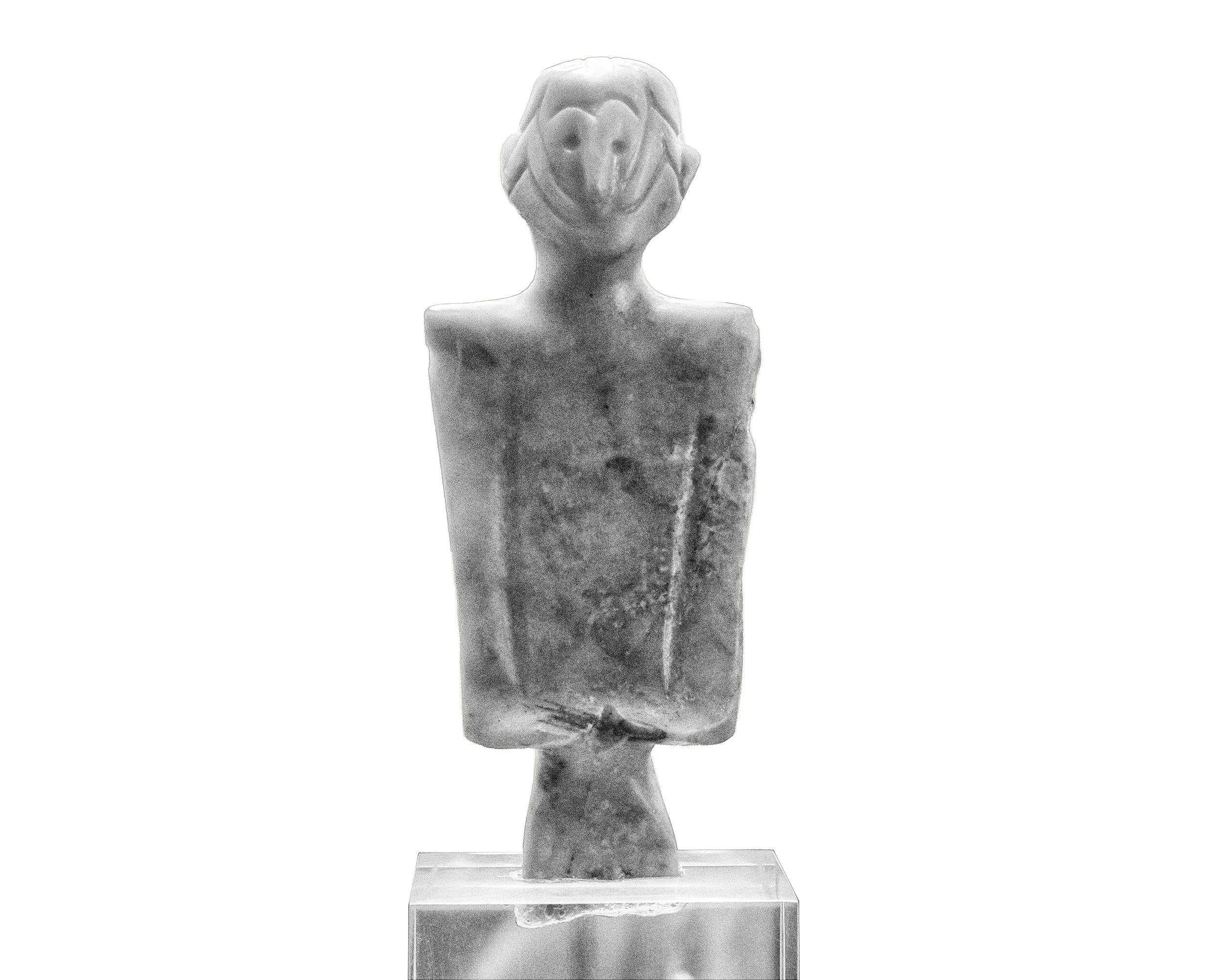
The idol of Rena (Archaeological Museum of Badajoz, Spain).
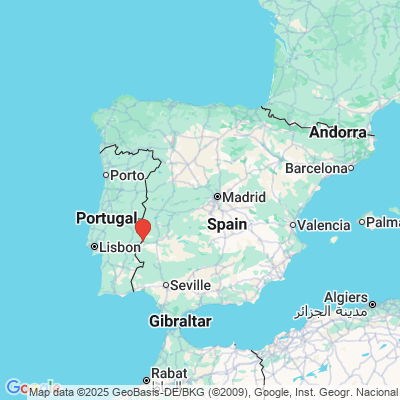
If you travel through the quiet plains of Extremadura, it is hard to imagine that beneath this landscape lay some of Europe’s richest Copper Age communities (about 2500 BCE). Among their most intriguing creations is the Idol of Rena—a small, beautifully carved human figure now displayed in the Archaeological Museum of Badajoz.
Carved from pale, marble-like stone, the idol shows a stylised human form: straight legs, a narrow torso, and arms bent inward at the waist. The incised face suggests brows, a strong nose, and faint tattoos. On the back, zigzag lines evoke hair or a head covering. It is unmistakably human, but abstract enough to feel symbolic and enigmatic.
A Regional Tradition of Human-Shaped Figures
The Rena idol belongs to a remarkable group of anthropomorphic figures found across southern Iberia. These objects are rare and carefully crafted, usually discovered in or near significant Copper Age settlements. Extremadura stands out as the region with the largest concentration, especially around the great site of La Pijotilla.
Although similar idols appear in Almería, Jaén, Cádiz, Sevilla, and Portugal, the marble idols of Badajoz have a distinct style and a strong sense of local tradition. Most show the same rigid posture, emphasised brows, tattoo-like markings, and stylised hairlines.
Symbol, Ancestor, or Social Marker?
What these idols represent remains uncertain. Earlier generations imagined gods or a Mother Goddess, but modern interpretations see them more as expressions of identity, status, or leadership emerging within increasingly complex societies. The consistent posture—arms forward, gaze direct—may have conveyed authority or belonging rather than depicting a literal individual.
Whatever their meaning, these figures sit within a broad symbolic world that also produced slate plaque idols, engraved cylindrical figures with large eyes, and many other ritualised objects. Taken together, they show a society experimenting with the human image as a powerful carrier of meaning.
Why the Idol of Rena Endures
Today, the Idol of Rena feels small, quiet, and intimate. Yet it speaks of a world in transition—one where early farming communities were reshaping their landscapes, forming new social ties, and expressing their beliefs through stylised art.
In the absence of writing, figures like this are among the few messages we have from those communities. And the Idol of Rena, with its calm presence and careful craftsmanship, still carries a trace of the human stories it once embodied.
Further Reading
J.J. Enríquez Navascués – Nuevos ídolos antropomorfos calcolíticos de la cuenca media del Guadiana.
Víctor Hurtado – Ídolos, estilos y territorios de los primeros campesinos en el sur peninsular.
K. Lillios & V. Gonçalves – Studies on Iberian plaque idols.
C. Scarre – The Human Past.