
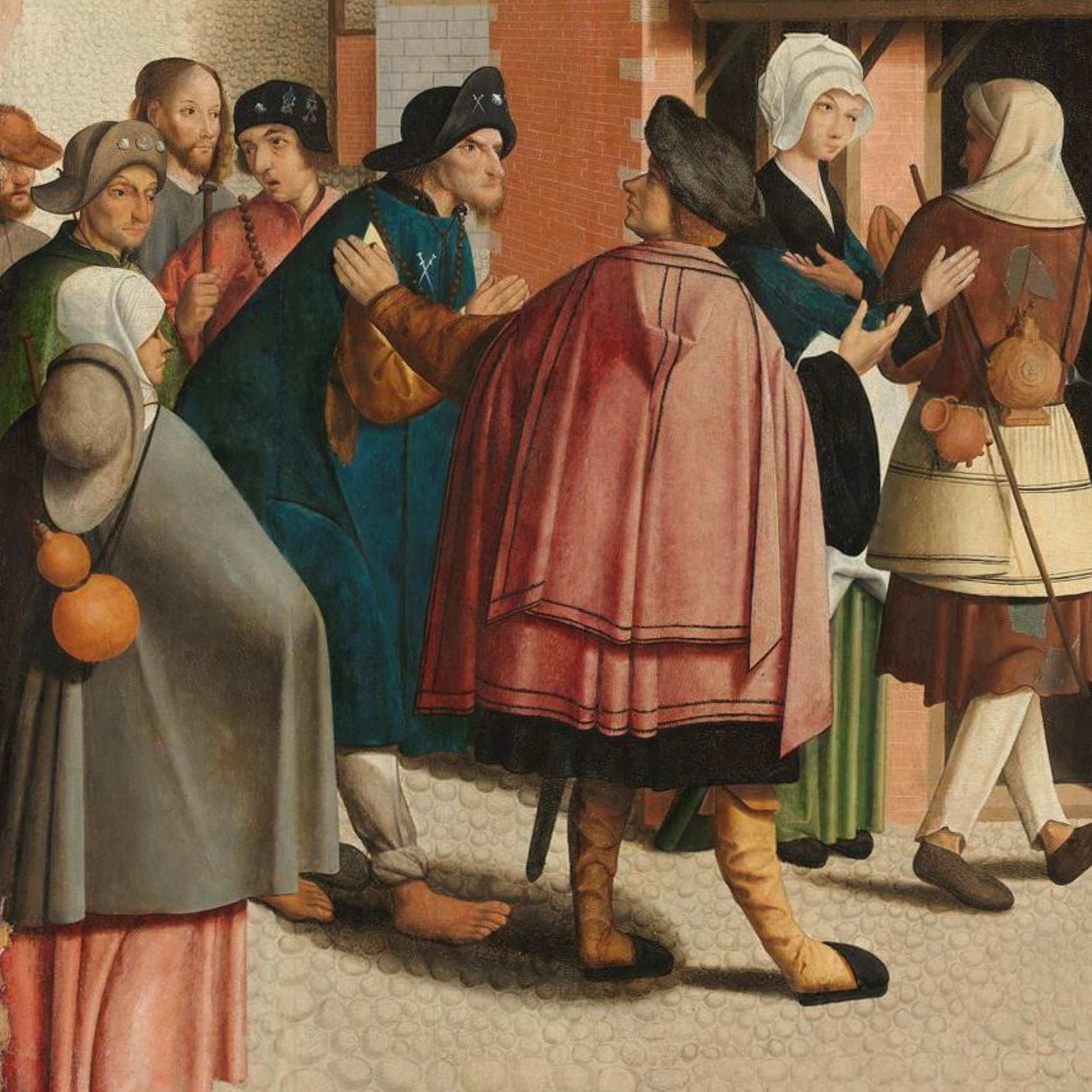
Detail from The Seven Works of Mercy (1504) by the Master from Alkmaar.
(What follows is a retelling of Arent Willemsz’s journey, based on his own travel diary from 1525.)
Walking Through a Collapsing World: From Delft to Venice, 1525
In April 1525, Europe was not a safe place to walk.
The old certainties still stood—saints’ relics, pilgrimage routes, Mass at dawn—but beneath them the ground was shifting fast. Monasteries were being looted, peasants were arming themselves, Luther’s ideas were spreading by word of mouth and pike-point, and authority was increasingly contested village by village.
It is into this world that Arent Willemsz, barber of Delft, stepped when he left his city before sunrise on 26 April 1525, having heard Mass and eaten a modest breakfast. His destination was Jerusalem. His route would take him through the Low Countries, the Rhineland, the German lands, the Alps, and finally to Venice. What he left us is one of the most alert and human pilgrimage narratives of the early sixteenth century.
Arent does not travel alone. His company is mixed: priests, craftsmen, townsmen from Haarlem, Alkmaar, Dordrecht, Gouda. They move as people did then—by foot, wagon, and boat—measuring the world in miles walked, inns reached before nightfall, and the quality of bread and wine along the way.
Almost immediately, danger intrudes. Near Roosendaal, armed men—snaphanen, mounted highway robbers—approach. Arent notes the moment carefully: weapons ready, nerves taut, each man alert. When the pilgrims stand firm, the attackers veer away. “God be praised,” Arent writes, and presses on. It will not be the last time God and readiness are mentioned in the same breath.
Cities offer temporary shelter and ritual reassurance. In Maastricht, the pilgrims are shown the treasures of Saint Servatius: staff, chalice, garments, even the cup from which the saint once drank. Arent lingers over these objects. His faith is not abstract. It lives in weight, texture, craftsmanship. You drink from a cup and feel yourself healed.
But beyond the city walls, the road has changed.
Again and again, Arent encounters armed peasants—often explicitly identified as Lutherans—occupying villages, blocking inns, tearing apart monasteries, interrogating travelers. Some number in the hundreds, others in the thousands. They ask questions. They seize weapons. They take money, food, wine. Sometimes they beat those they stop. Sometimes they let them go.
The pilgrims learn quickly that piety alone will not save them. They hire escorts for protection. They travel in formation. Firearms are kept visible. Numbers matter. Reputation matters. When warned that bandits are waiting on Gulpen hill to ambush pilgrims bound for the Holy Sepulchre, they delay just long enough that the robbers grow impatient and attack other, weaker travelers instead.
The social texture of the journey is rich and uneasy. In inns, they eat and drink with locals who are curious, suspicious, or frightened. They bargain constantly—over beds, meals, escorts, ferries, wagons. They hear rumours of battles, massacres, entire villages wiped out. In one place they are refused lodging outright; in another they are welcomed warmly by monks who know their days may be numbered.
Yet there are moments of relief and even joy. In Aachen and Cologne, Arent records relics with a craftsman’s fascination: crystal vessels, jeweled reliquaries, skulls with hair still attached, rings once worn by saints. In the Alps, exhaustion gives way to wonder when they see snow high on the mountains. Two companions scramble up simply to touch it, returning with handfuls of snow and laughter, and for a brief moment the world seems young again.
Gradually, Italy begins. Roads improve. Wine becomes better and more plentiful. The threat of armed peasant bands fades. The mountains end at Bassano. And then, after weeks of fear, hunger, prayer, negotiation, and sheer endurance, Arent reaches Venice.
Venice overwhelms him. A city without gates. Streets so narrow that three men cannot walk abreast. Houses rising directly from water. Boats everywhere—fifteen thousand of them each day. He marvels at the Arsenal, where thousands of workers can equip fleets at astonishing speed, and at the city’s discipline, wealth, and latent violence. Venice, he understands, is not merely rich. It is organized for power.
Here, at the edge of the lagoon, Arent pauses. The land journey is over. Ahead lies the sea, the Holy Land, and Jerusalem itself.
Source:
Based on Arent Willemsz, Bedevaart naar Jerusalem (1525), complete text preserved in the 19th-century scholarly edition (DBNL PDF).
Blog item and image choice inspired by “125: de pelgrimstocht van ambachtsmeester Arent Willemsz en zijn bezoek aan Maastricht” by Sandra Langereis and the book “Pelgrimage naar Maastricht” the article is published in.