
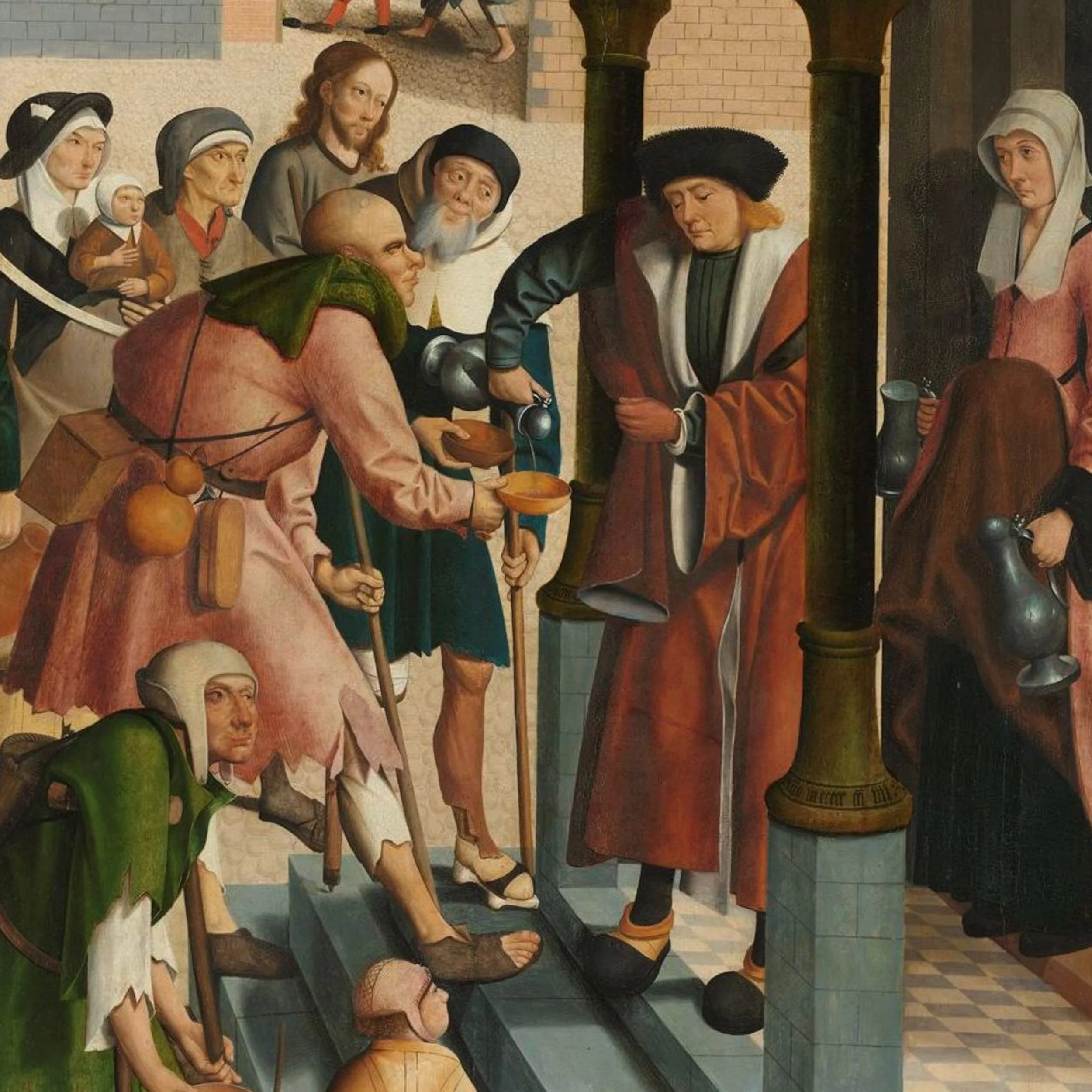
Detail from The Seven Works of Mercy (1504) by the Master from Alkmaar.
(What follows is a retelling of Arent Willemsz’s journey, based on his own travel diary from 1525.)
Faith Under Contract: From Venice to Jerusalem and Back, 1525
In Venice, devotion becomes paperwork.
Arent Willemsz quickly learns that a pilgrimage to Jerusalem is not only a spiritual undertaking but a legal and financial system. Passage is negotiated with shipmasters. Payments are split into instalments. Clauses are spelled out in chilling clarity: die before Jaffa, and half the passage money is returned; set foot in the Holy Land, and the full sum is owed—even if you die the next day.
Arent watches carefully and advises future pilgrims not to delay. Those who arrive late pay more, get worse terms, and suffer most at sea. Experience has made him cautious.
The voyage to Jaffa is hard. Pilgrims fall ill. Discipline aboard ship is strict. Space is cramped. Food is rationed. When land finally appears, they do not dock easily. Ships anchor offshore. Pilgrims are ferried in under watchful eyes. Jaffa itself offers no welcome—only control, fees, and guards.
From here on, the pilgrimage is choreographed.
Local guides take over. Armed escorts are mandatory. Routes inland are fixed. The pilgrims move from place to place—Rama, Jerusalem, Bethlehem—according to established patterns. Access to holy sites is regulated. Devotion is permitted, but never freely.
Jerusalem is approached with reverence and restraint. Arent does not indulge in rapture. Instead, he measures distances, records prayers, notes indulgences earned. The Holy Sepulchre is described soberly, as a place of obligation fulfilled. He reminds the reader that having stood where Christ suffered, one is now more accountable than before. Pilgrimage, he insists, increases responsibility.
One of the most demanding episodes follows: the journey to the River Jordan. It is dangerous, exhausting, and costly. Guards must be paid. The heat is punishing. Yet to bathe in the Jordan is to complete the pilgrimage properly. Arent records the rite calmly, noting both its spiritual meaning and its logistical burden.
Throughout the Holy Land, Arent’s tone toward non-Christians is practical rather than hostile. Muslim authorities control access; Christian pilgrims comply. Power, he understands, lies elsewhere now. Survival depends on cooperation, payment, and restraint.
The return begins almost immediately after the rites are completed. There is no lingering. Mortality is close at hand. The road back across the Mediterranean is as uncertain as the way out.
When Arent finally returns to Venice, the city feels different. He understands systems better now—contracts, authority, organization. He has learned that faith alone does not carry you through the world. Unity, preparation, and judgement matter just as much.
In his closing advice, Arent becomes a guide for others. He lists what to buy, what to avoid, how to negotiate, whom to trust, and when to stand firm. His pilgrimage has turned him from a traveler into a witness of a changing age.
What remains is not only a journey to Jerusalem, but a portrait of Europe in transition: medieval devotion moving through a world already becoming modern.
Source:
Based on Arent Willemsz, Bedevaart naar Jerusalem (1525), complete text preserved in the 19th-century scholarly edition (DBNL PDF).
Blog item and image choice inspired by “125: de pelgrimstocht van ambachtsmeester Arent Willemsz en zijn bezoek aan Maastricht” by Sandra Langereis and the book “Pelgrimage naar Maastricht” the article is published in.