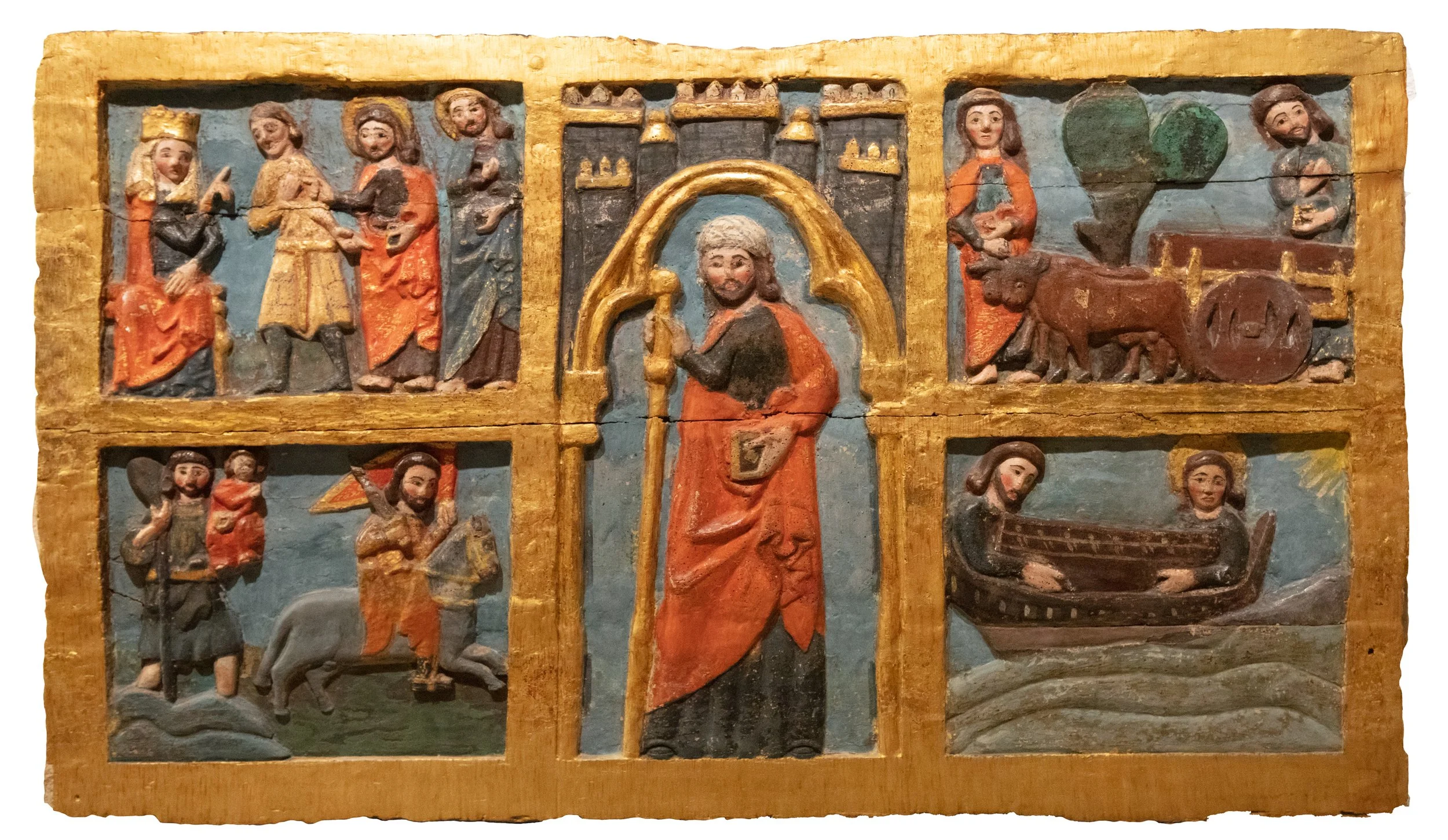
In the grandeur of León Cathedral, a striking frontal de altar from the 14th century tells a vivid story of faith, legend, and the enduring power of the pilgrimage to Santiago de Compostela. This polychrome masterpiece, painted on wood and richly adorned with gold leaf, weaves together key episodes from the legend of Saint James (Santiago), alongside the figure of Saint Christopher, protector of travelers.
The altar frontal is structured in five narrative panels, each depicting a crucial episode of the legendary transfer of Saint James' body to Galicia.
Top Left: Queen Lupa and the Disciples of Santiago
According to legend, after Saint James' martyrdom in Jerusalem, his disciples carried his body to Hispania. Seeking a burial place, they approached Queen Lupa in Flavia (modern-day Padrón). Initially resistant, she subjected them to trials before she ultimately converted to Christianity. The scene captures the moment of their plea before the queen, her regal posture contrasting with their humble gestures.
Lower Left: Saint Christopher and Saint James as the Warrior Pilgrim
A striking image shows a bearded figure wading through water with a child on his shoulder—Saint Christopher, the patron saint of travelers, who carried Christ across a river. Beside him, a knightly figure on horseback with a flag is likely Saint James in his Matamoros guise, a vision that was said to have inspired Christian forces in battle. This juxtaposition reinforces the protection of travelers and the role of Santiago as a spiritual and military guide.
Top Right: The Oxen and the Coffin
One of the trials Queen Lupa imposed on Saint James’ disciples was to give them a cart with wild, untamed oxen to transport his remains, hoping they would fail. However, through divine intervention, the animals were miraculously tamed, allowing the disciples to complete their mission. This scene captures the sacred nature of their journey, emphasizing the role of faith and divine guidance in overcoming obstacles.
Lower Right: The Boat Carrying Saint James
A small vessel with two figures—one possibly a disciple, the other haloed—holds what is likely the coffin of Saint James. This recalls the legend of his miraculous sea voyage from Jerusalem to Galicia, carried by divine will. The scene is rendered with simple, powerful forms, reinforcing the mystical nature of the tale.
Central Panel: A Pilgrim or a King?
The most enigmatic figure stands beneath an arched structure crowned with castle towers. Could this be a representation of King Alfonso II of Asturias, the first known pilgrim to Santiago de Compostela, paying homage to the saint’s newly discovered tomb? Or is it an anonymous pilgrim, embodying the devotion of countless travelers? The ambiguity invites contemplation, drawing the viewer into the world of medieval belief.
A Testament to Pilgrimage Culture
This altar frontal is not just an artwork; it is a testimony to the deep cultural and religious currents of medieval Spain. The Camino de Santiago was one of Europe’s most significant pilgrimage routes, and artifacts like this offered both instruction and inspiration to the faithful.