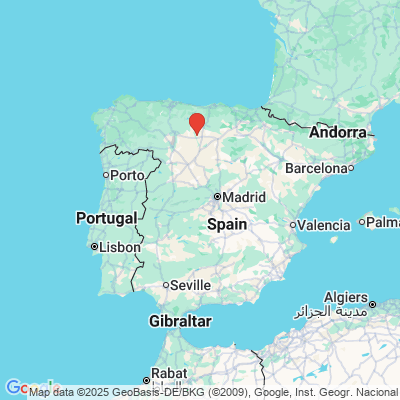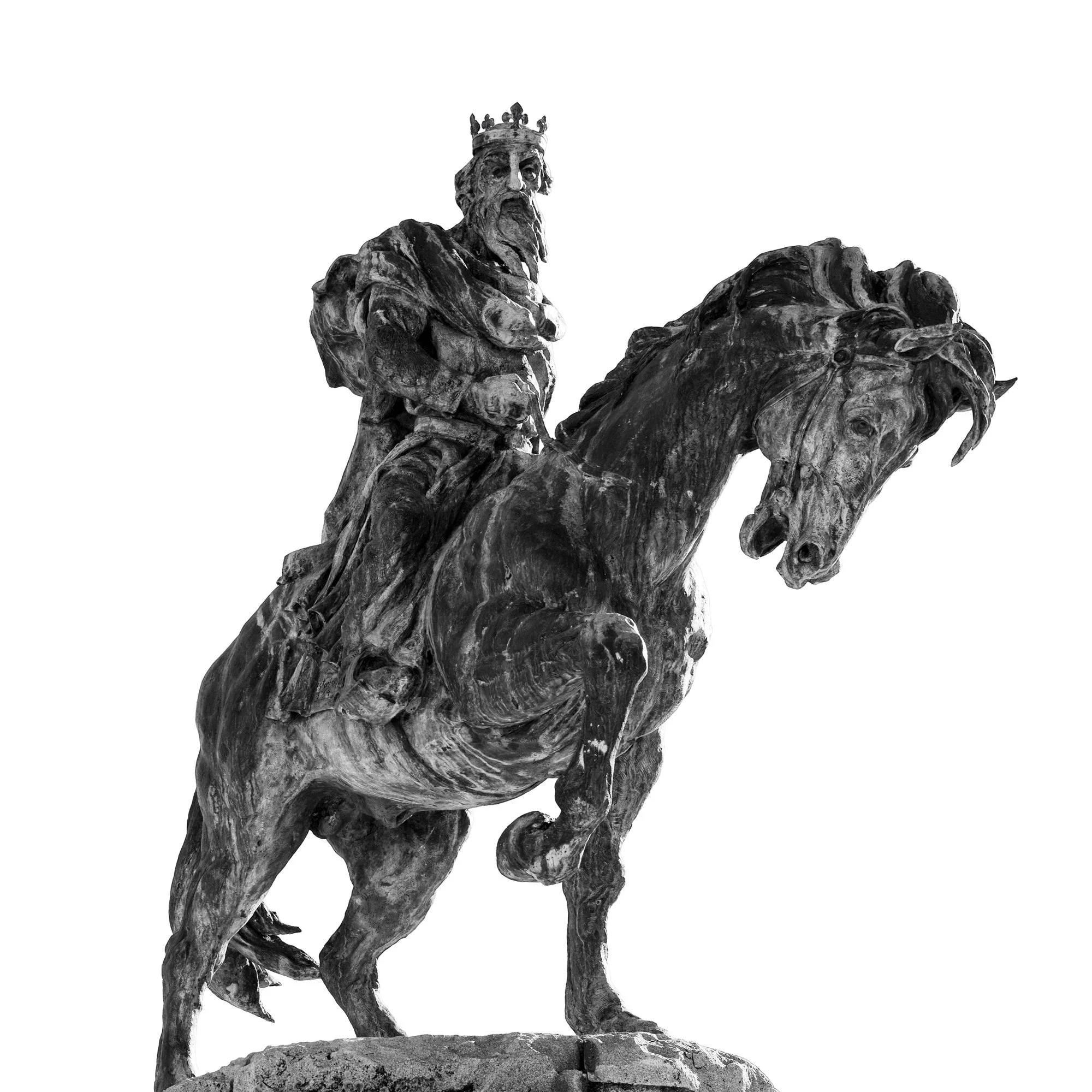
Alfonso VIII’s statue in Palencia (Spain).
Few medieval rulers left a deeper mark on Iberian history than Alfonso VIII of Castile (1155–1214). His life stretched from a fragile childhood as a contested child-king to a triumphant adulthood as the architect of a new political order on the peninsula. His reign was long, turbulent, and transformative — and the ripple effects reached far beyond Castile.
Born into Two Powerful Dynasties
Alfonso descended from two formidable bloodlines. On his father’s side, he belonged to the House of Ivrea, the dynasty that had shaped the kingdoms of León and Castile since the 11th century. His father, Sancho III of Castile, reigned only briefly, dying suddenly in 1158 and leaving the young Alfonso, barely three years old, as king.
His mother, Blanca of Navarre, connected him to the royal family of Pamplona, giving Alfonso political legitimacy on Castile’s northeastern frontier. But perhaps even more significant were the alliances forged through his marriage. In 1170, Alfonso wed Eleanor Plantagenet, daughter of Henry II of England and Eleanor of Aquitaine — two of the most influential figures in medieval Europe. This union tied Castile to the transcontinental Plantagenet empire and injected the Castilian court with new cultural and diplomatic currents.
A Kingdom He Fought to Keep
Alfonso’s early life was far from secure. Castile’s great noble houses — the Laras and the Castros — fought bitterly for control of the realm and for influence over the child-king. For years, Alfonso was moved between strongholds to keep him safe, and at one point he was even rumoured kidnapped. When he finally took full command in his teens, he inherited not a stable kingdom but a fractured one.
He spent the next decades imposing royal authority, building alliances, and expanding Castile’s reach. His conquest of Cuenca in 1177 marked one of the symbolic victories of his early reign, securing a strategic stronghold and cementing Castile’s position in central Iberia.
A Royal Family with Continental Echoes
Alfonso and Eleanor Plantagenet had a large family — at least ten children, many of whom played decisive roles in European politics:
Berengaria, his eldest daughter, briefly became Queen of Castile in her own right and then ensured the accession of her son, Ferdinand III, the monarch who would eventually unify Castile and León.
Blanche married Louis VIII of France; their son became Louis IX (Saint Louis), one of the most celebrated kings in French history.
Urraca, Leonor, and Constanza married into the royal families of Portugal, Aragon, and into major European noble houses, strengthening Castile’s diplomatic network.
Henry, Alfonso’s only surviving son, succeeded him as Henry I, though his reign was short.
Through these marriages, Alfonso became the patriarch of a web of dynastic ties that stretched across the continent, influencing France, Portugal, Aragon, England, and the future of united Spain.
The Battle That Changed Iberia
Nothing defined Alfonso’s reign more than the Battle of Las Navas de Tolosa in 1212. In a rare moment of unity, he persuaded the often-rival kingdoms of the peninsula — Castile, Navarre, and Aragon — to join forces, bolstered by crusading knights from across Europe. Their victory shattered the power of the Almohad Caliphate, the most formidable Muslim force in Iberia at the time.
This was no ordinary triumph. It ended a balance of power that had lasted generations and opened the door for the great southern conquests of the 13th century. After Las Navas, the Christian advance became almost unstoppable. Córdoba, Jaén, Sevilla — all would fall within decades. Alfonso VIII set the stage.
Why Alfonso VIII Matters for Spain
To understand the shape of medieval Spain, one must understand Alfonso. His reign marked the moment when Castile shifted from a contested frontier realm into the dominant force of the peninsula.
He was a stabilizer: a king who inherited chaos and methodically rebuilt authority. He was a diplomat: his Plantagenet marriage plugged Castile into the bloodstream of European power politics. He was a patron of learning: his foundation of the Studium Generale of Palencia signalled a dawning intellectual ambition. And above all, he was a strategist whose greatest victory reordered the Iberian world.
By the time he died in 1214, Alfonso had transformed Castile from a vulnerable kingdom ruled by baronial factions into a confident, outward-looking power — one whose heirs would eventually create a unified Spain.
A Legacy That Reaches into Modern Spain
Alfonso VIII’s life is a reminder that history often turns on the abilities of a single, determined ruler. His political instincts, his dynastic savvy, and his decisive military leadership reshaped Iberia’s future. Through his daughter Berengaria and his grandson Ferdinand III, his legacy lived on in the union of Castile and León — the nucleus of what would become the Spanish nation.
Alfonso VIII is more than a medieval king; he is a hinge in the story of Spain itself.