
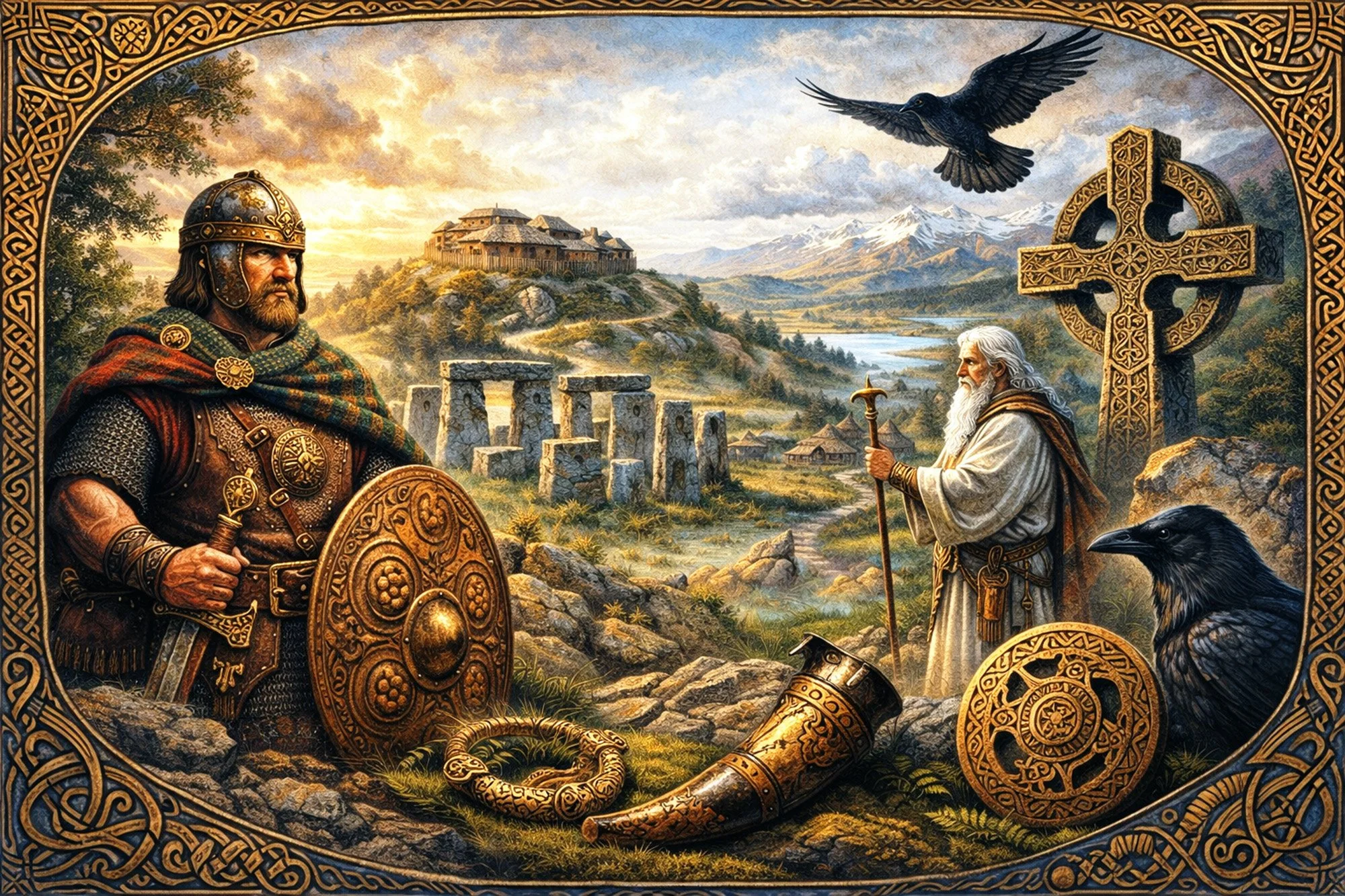
Image created with AI
When we travel slowly across Europe — as many culture lovers do — we begin to notice something curious. Landscapes change, languages shift, cuisines evolve. Yet certain patterns return: hilltop settlements, spiral motifs, sacred springs, warrior legends. Part of this shared layer goes back to a people who never built an empire and never wrote their own history, but who shaped Europe in lasting ways: the Celts.
A Cultural Europe Before Political Europe
The Celts were not one nation. They were a wide network of tribes who shared languages, beliefs, artistic styles and ways of life. At their height, they spread from Ireland to Anatolia in modern Turkey.
What they created was something like a cultural Europe long before any political unity existed. They travelled, traded, fought, and mixed with local populations. Rather than replacing earlier cultures, they blended with them. This is why so many regions in Europe still feel both different and strangely connected.
From Alpine Origins to a Continent
Their earliest roots lie in the Alpine world of the early Iron Age. These were skilled farmers, miners and traders. Salt, copper and tin brought wealth. Trade connected them to the Mediterranean, and prosperity encouraged expansion.
Over centuries, Celtic groups moved into Gaul, Iberia, the British Isles and Central Europe. They helped shape early versions of cities that would later become Paris, Lyon, Vienna and London. In many places, hybrid cultures emerged. In Spain, for example, Celtiberian societies combined Celtic and Iberian traditions.
Europe, even then, was a layered landscape.
Warriors, Poets and Craftsmen
Ancient writers often focused on Celtic warfare, but archaeology reveals a more complex society. The Celts valued beauty, craftsmanship and storytelling. Their jewellery and weapons were highly sophisticated. Poets and musicians held respected roles. Druids acted as religious leaders, judges and teachers.
Trade and craftsmanship were prestigious paths. Metalworkers and merchants enjoyed status close to that of elites. This world encouraged individuality and self-expression — something that still resonates in Europe’s regional cultures today.
Why They Never Built an Empire
Despite their vast reach, the Celts never formed a unified state. Loyalty remained local. Rivalries between tribes were frequent. When Rome expanded, Celtic resistance was fierce but fragmented.
The Romans brought organisation, discipline and long-term strategy. Gradually, most Celtic regions were absorbed. Yet conquest did not erase local traditions. Instead, Roman structures blended with Celtic cultures, creating new forms of society across Europe.
A Legacy That Never Disappeared
By the early centuries of our era, Celtic political power had faded. But their cultural influence remained. Languages survived in Ireland, Scotland, Wales and Brittany. Myths and artistic traditions shaped medieval Europe. Place names, landscapes and festivals still carry their imprint.
The Celtic story reminds us that Europe was never built only by empires. It grew through movement, exchange and cultural mixing. In that sense, the Celts were among the first to live the reality of a connected yet diverse continent.
If we travel with curiosity, we can still see their traces — not as isolated ruins, but as part of a shared European memory.
Further Reading
Barry Cunliffe — The Ancient Celts
Miranda Aldhouse-Green — The Celtic World
John Collis — The Celts: Origins, Myths and Inventions
Archaeological guides to major Celtic sites such as Hallstatt, Bibracte and Numantia