
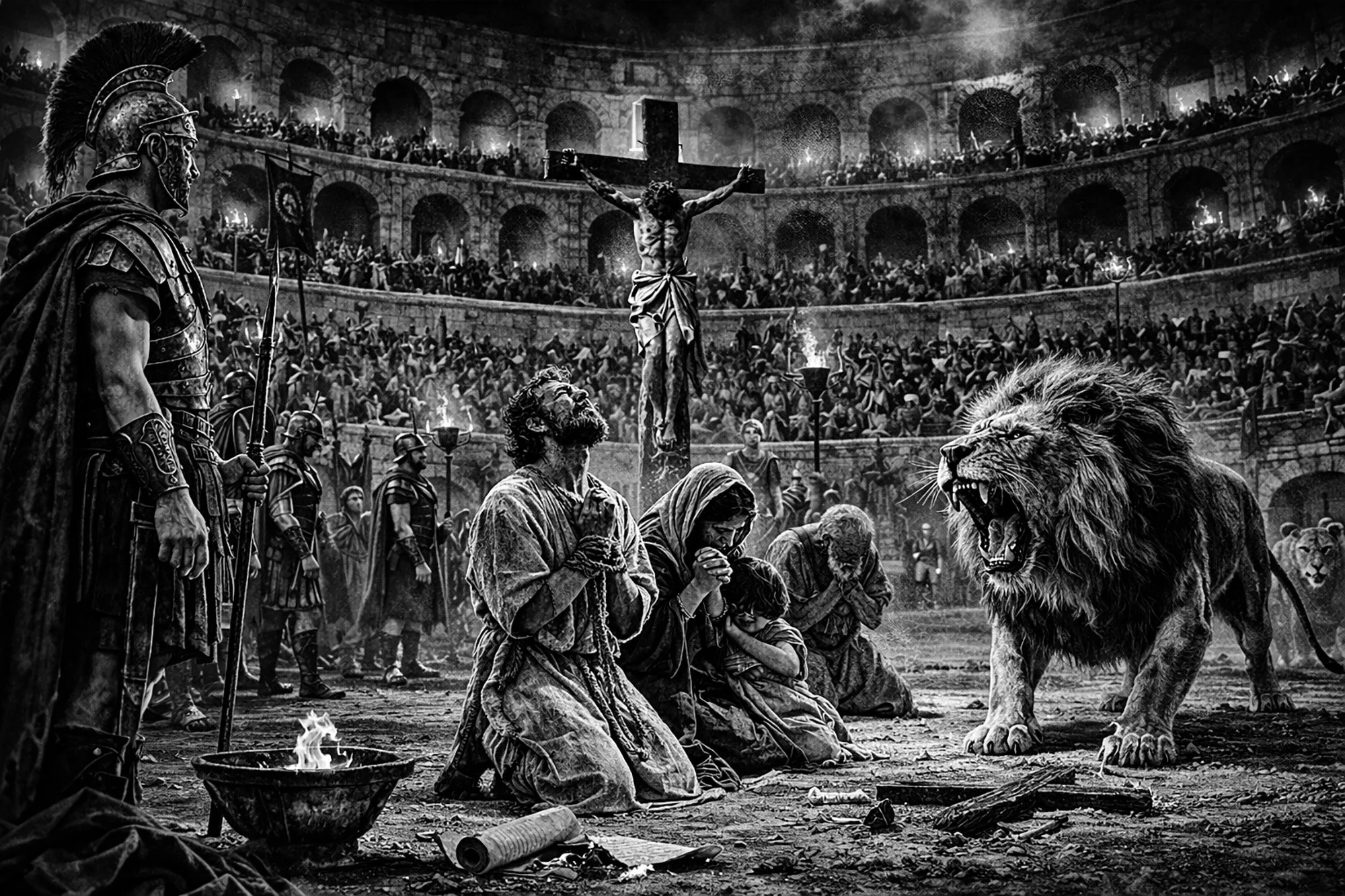
Image generated with AI.
In the early centuries of the Roman Empire, Christianity was a small and suspicious movement. Its followers refused to worship the traditional Roman gods or offer sacrifices to the emperor. In Roman society, where religion and loyalty to the state were deeply intertwined, that refusal looked like defiance.
And when suspicion grew, persecution often followed.
Nero and the First Martyrs
The first famous persecution occurred under Emperor Nero in AD 64. After a devastating fire destroyed large parts of Rome, Nero blamed the Christians. Many were arrested and executed in brutal public spectacles. Some were crucified, others thrown to wild animals, and some were burned alive as torches during imperial celebrations.
But persecutions were not constant. For the next two centuries they appeared sporadically, often triggered by local tensions rather than imperial policy.
Why Christians Seemed Dangerous
Roman religion was public and communal. Citizens were expected to participate in sacrifices, festivals, and rituals honoring the gods who protected the empire.
Christians refused.
They worshipped only one god and rejected the emperor’s divine status. To Roman officials this could look like disloyalty. Their private gatherings and unfamiliar rituals also fueled rumors. Some outsiders even believed Christians practiced cannibalism because they spoke symbolically about eating the “body and blood” of Christ.
In reality, they were sharing a sacred Christian meal, recalling Christ’s Last Supper.
From Local Hostility to Imperial Policy
For a long time, persecution depended largely on local governors. Christians were often given a simple choice: perform a sacrifice to the Roman gods and go free, or refuse and face punishment.
In the third century the situation became more serious. As the Roman Empire faced political crisis and military pressure, emperors increasingly demanded religious unity. Laws were introduced requiring all citizens to sacrifice to the traditional gods.
Christians who refused could be imprisoned, tortured, or executed.
The most severe wave came at the beginning of the fourth century under Emperor Diocletian. Churches were destroyed, scriptures burned, and Christian worship was banned across much of the empire.
The Unexpected Reversal
Only a decade later, everything changed.
In 312 the Roman general Constantine defeated his rival at the Battle of the Milvian Bridge. Soon afterwards he adopted a policy of tolerance toward Christianity. In 313 Christianity was legalized across the empire.
Within a few generations the once-persecuted religion had moved from the margins of society to the center of imperial power.
It is one of the most striking reversals in the history of religion.
Further reading
Candida Moss — The Myth of Persecution
W.H.C. Frend — Martyrdom and Persecution in the Early Church
Peter Brown — The Rise of Western Christendom
Eusebius — Ecclesiastical History