
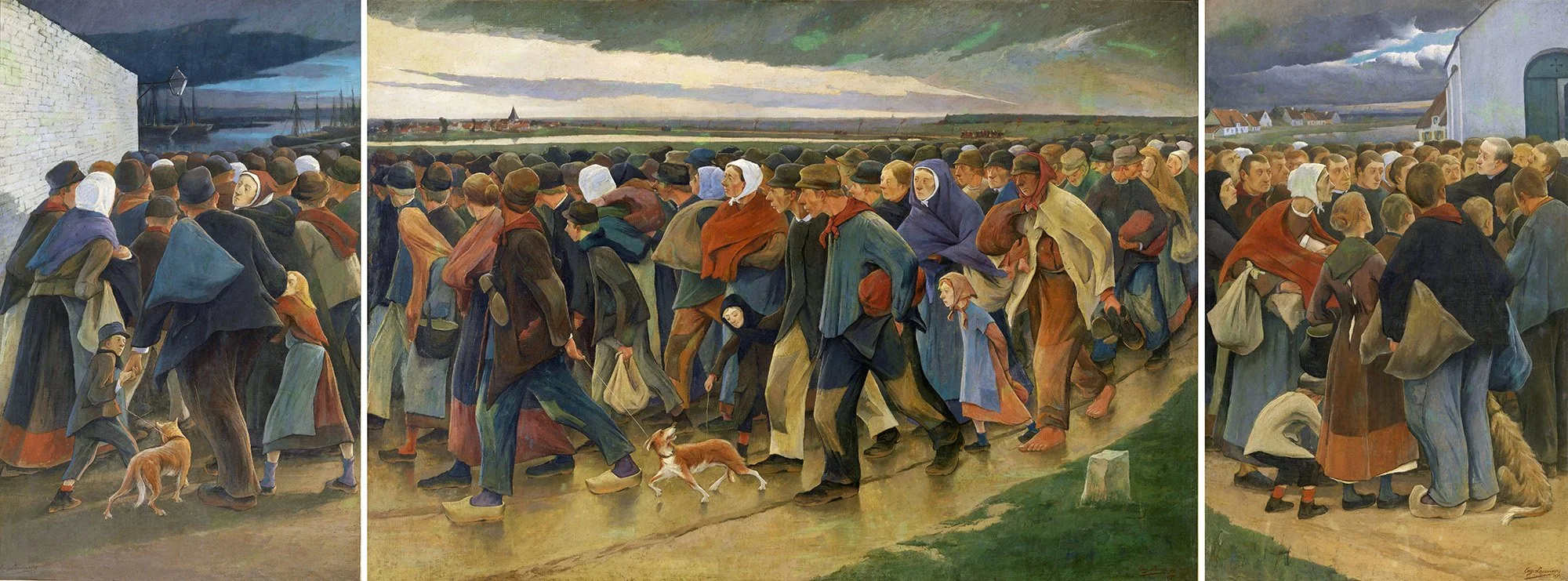
Landverhuizers (Emigrants), 1896, by Eugène Laermans (Royal Museum of Fine Arts Antwerp).
Europe likes to think of itself as ancient and rooted. But beneath the surface lies a different reality — a continent shaped again and again by people on the move. Its landscapes, languages and cities are the result of repeated waves of migration, voluntary and forced, slow and sudden, stretching back thousands of years.
This is not the story of a single crisis or a modern phenomenon. It is the long, structural history of Europe itself.
Farmers on the Move (c. 7000–4000 BC)
One of the first great migrations into Europe came quietly, with seeds rather than swords. Early farmers from Anatolia and the Balkans moved west and north, bringing wheat, barley, sheep and goats. Along the Danube and Rhine, forests were cleared and permanent villages appeared.
Archaeology shows how these newcomers lived alongside — and sometimes replaced — local hunter-gatherers. The longhouses of the Linearbandkeramik culture in Central Europe are among the clearest traces of this transformation.
Europe’s rural landscape begins here.
Horsemen and Languages (c. 3000–1000 BC)
From the Pontic–Caspian steppe came mobile herding societies who travelled with horses, wagons and a new social order. Their movement reshaped Europe linguistically.
From this process emerged the Indo-European languages: Celtic, Italic (Latin), Germanic, Slavic and Greek. When you hear echoes between words like mater, mother and mutter, you are hearing migration fossilised in language.
Burial mounds from this period — from Hungary to northern Germany — still mark the landscape.
Classical Mobility: A Mediterranean World (c. 800 BC–400 AD)
The ancient Mediterranean was astonishingly mobile. Greek settlers founded cities from Marseille to Naples and along the Black Sea. Phoenician traders linked Iberia to the Levant.
Under Rome, mobility became systemic. Soldiers from the Balkans guarded Hadrian’s Wall. North African merchants lived in southern Gaul. Slaves, craftsmen and administrators moved across the empire.
Roman Spain, Gaul and Britain were not provincial backwaters but cosmopolitan zones, stitched together by roads, ports and law.
The Age of Migrations (c. 300–700)
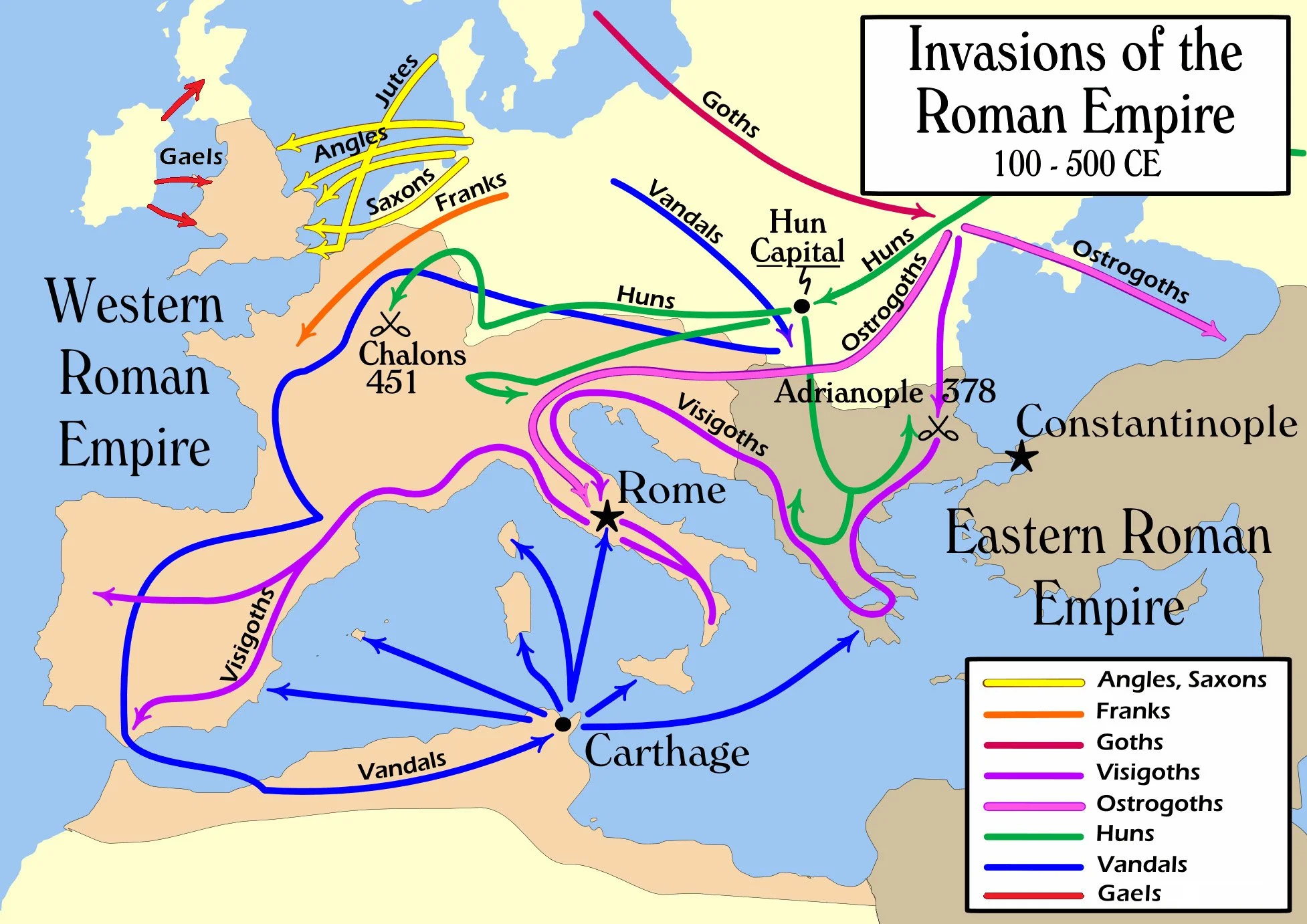
Map of invasions of the Roman state, simplified, AD centuries 2nd to 6th. (from Wikipedia)
As Roman power weakened, movement intensified. Goths crossed the Danube. Vandals travelled from Central Europe to Iberia and onward to North Africa. Slavic groups spread into the Balkans.
These migrations did not simply “destroy” Rome; they reassembled Europe. Many modern regions — Lombardy, Andalusia, Burgundy — still carry the names of migrating peoples.
Medieval Flows: Vikings, Monks and Settlers (c. 800–1300)
The Middle Ages were anything but static. Vikings moved from Scandinavia to Ireland, Normandy and Sicily. In the east, German-speaking farmers settled new towns in Poland and Bohemia during the Ostsiedlung.
Pilgrimage routes like the Camino de Santiago carried people, ideas and styles across borders long before nation-states existed. Monasteries became hubs of knowledge exchange.
Movement was slower — but constant.
Faith, Empire and Expulsion (c. 700–1600)
The Islamic expansion brought Arab and Berber populations into Iberia, reshaping cities such as Córdoba and Toledo into centres of learning and coexistence.
Later, Europe also generated forced migrations of its own: the expulsion of Jews from England, Spain and Portugal; the displacement of religious minorities during the Reformation.
Migration was increasingly tied to identity, belief and power.
Europe Empties — and Fills the World (1800–1914)
Industrialisation triggered one of the largest population movements in history. Tens of millions left Europe for the Americas and Australia. Entire villages in Ireland, Italy and Scandinavia were reshaped by departure.
At the same time, Europe’s growing cities absorbed rural migrants. Paris, Manchester and Berlin expanded at breathtaking speed.
Europe was exporting people — and importing labour.
War, Borders and Displacement (1914–1945)
Two world wars turned migration into catastrophe. Borders shifted, empires collapsed, and millions were uprooted. Refugees, prisoners and deportees reshaped the demographic map.
After 1945, ethnic Germans fled or were expelled from Eastern Europe, while displaced persons searched for new homes across the continent.
Modern refugee law emerged from this trauma.
Post-War Europe: Workers and Returnees (1950–1980)
Western Europe rebuilt itself with migrant labour. Italians moved north, Spaniards to Germany, Turks to the Ruhr. Former colonial subjects arrived in France, the UK and the Netherlands.
What was framed as “temporary” migration became permanent settlement.
Europe Today: Movement as a Constant
In the 21st century, Europe once again finds itself debating migration — often as if it were something new. Yet Ukrainians fleeing war, Syrians crossing the Mediterranean, and seasonal workers moving within the EU all fit a pattern that has repeated itself for millennia.
What changes from era to era is not the fact of movement, but the political, social and moral frameworks through which migration is understood and managed.
A Continent Shaped by Motion
Europe’s cathedrals, languages, cuisines and cities are the cumulative result of people on the move. Migration is not a footnote to European history — it is one of its central driving forces.
Seen in this long perspective, migration is neither an anomaly nor a temporary disruption. It is a structural condition of Europe’s past and present. The recurring question has never been whether people move, but how societies organise coexistence, rights and belonging in response.
To understand Europe, therefore, is not to imagine an immobile past, but to recognise a continent continually shaped by journeys, arrivals and encounters.
That — more than any single border or moment — is the European story.