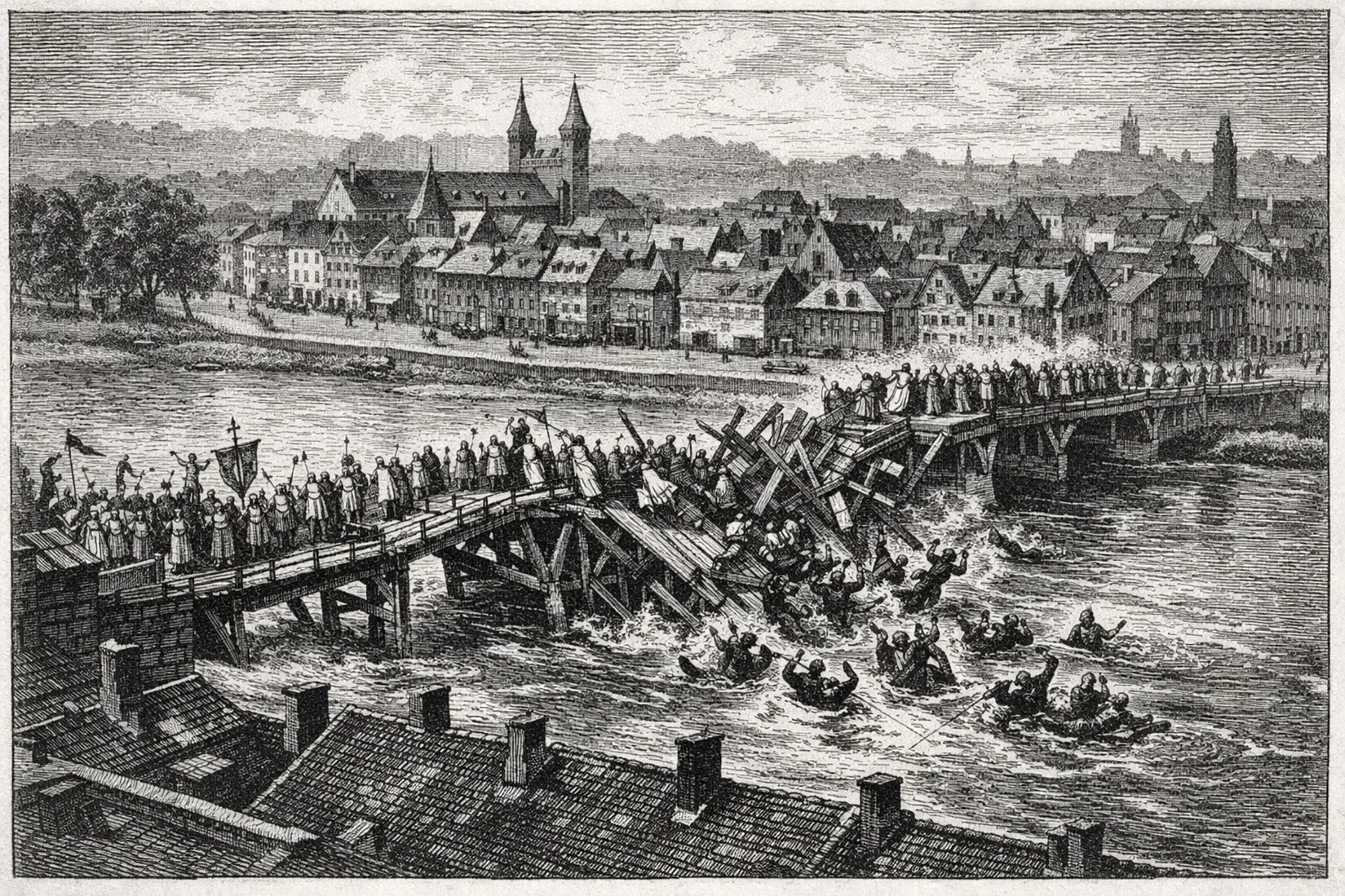
AI-generated impression of the disaster during the Heiligdomsvaart of 12 July 1275 in Maastricht. As thousands of pilgrims crossed the wooden bridge over the Maas, the central support gave way and the structure collapsed, throwing hundreds into the river.
If you cross the Maas river in Maastricht today over the tranquil Sint Servaasbrug, you are treading on a structure that has witnessed nearly two thousand years of European history—beginning with Roman ambition, shaken by medieval tragedy, and still standing as a symbol of connection in modern times.
A Bridge of Empires
The origins of Maastricht’s main river crossing go all the way back to the 1st century AD, when the Romans founded a settlement called Trajectum ad Mosam—“the crossing on the Maas.” To connect their expanding empire, they built a wooden bridge just south of today’s bridge, linking the Roman road between Cologne and Boulogne-sur-Mer. Trade, troops, and ideas flowed across it for centuries.
But rivers change, wood decays, and the Roman Empire fell. Yet the location remained strategic: Maastricht grew into a religious center after the death and veneration of Saint Servatius, the city’s 4th-century bishop, said to have been a distant relative of Jesus himself. The bridge now carried not only merchants and soldiers—but pilgrims.
Why the Bridge Mattered
By the Middle Ages, Maastricht was a hub of commerce, faith, and power. The bridge was no mere local crossing—it was a lifeline:
It connected Flanders with the German Empire, critical for regional trade.
It formed part of the Via Regia, a major route of imperial and religious travel.
It served as a gateway for pilgrims traveling to venerate Saint Servatius’ relics in the basilica on the west bank.
By the 13th century, the city had outgrown the original Roman bridge. A new wooden bridge, longer and higher, was built on stone piers to accommodate increasing traffic. But its spiritual and economic importance also meant it bore heavy loads—quite literally.
1275: The Day Faith Collapsed
On 12 July 1275, during a Heiligdomsvaart, the wooden bridge gave way under the weight of thousands of pilgrims. Eyewitness accounts describe the central pier collapsing, dragging over 400 people into the river. It was one of the worst civil disasters in medieval Dutch history. The victims were not just townspeople, but pilgrims from all corners of Europe—many of them carrying hopes for healing or salvation.
This wasn’t just a physical collapse. It was a rupture in the spiritual and economic heartbeat of Maastricht.
Stone and Symbolism: A New Bridge Rises
In the wake of the tragedy, the city responded swiftly. Between 1280 and 1298, the current stone bridge was constructed slightly upstream. It featured seven arches (later expanded), a fortified gate on the eastern side, and deep foundations—built not just to last, but to restore confidence.
The new bridge took the name of the city’s protector: Saint Servatius. In this way, the bridge itself became a monument of faith restored, and a channel of movement for centuries to come.
Witness to Time
Since its construction, the Sint Servaasbrug has quietly carried:
the boots of Spanish troops during the 16th-century Eighty Years’ War;
the footsteps of Napoleonic administrators;
the carts of industrial trade in the 19th century;
and the bicycles and strollers of today’s locals and visitors.
It even survived wartime sabotage: in 1944, retreating German forces blew up parts of the bridge—but Maastricht rebuilt it once again.
A Bridge Between Heaven and Earth
The bridge is named after a saint who, according to legend, received a key to the gates of Heaven from Saint Peter. That key, made of solid silver, is still displayed during the Heiligdomsvaart. In this light, the bridge is more than stone—it is metaphor. It binds past to present, the sacred to the worldly, the west bank’s basilica to the east bank’s bustling Wyck district.
Today’s Bridge, Yesterday’s Story
When you walk across the Sint Servaasbrug today, you walk in the footsteps of Roman legions, medieval pilgrims, and modern dreamers. It may not boast the grandeur of Florence or Paris—but few bridges in Europe carry such a layered story.
Stone by stone, it tells us this: cities survive not only by what they build, but by what they rebuild.