reflections

Europe’s Moment? Anne Applebaum’s Warning from Vienna

Anne Applebaum’s speech at Vienna’s Judenplatz, 14 May 2026 — YouTube video available online

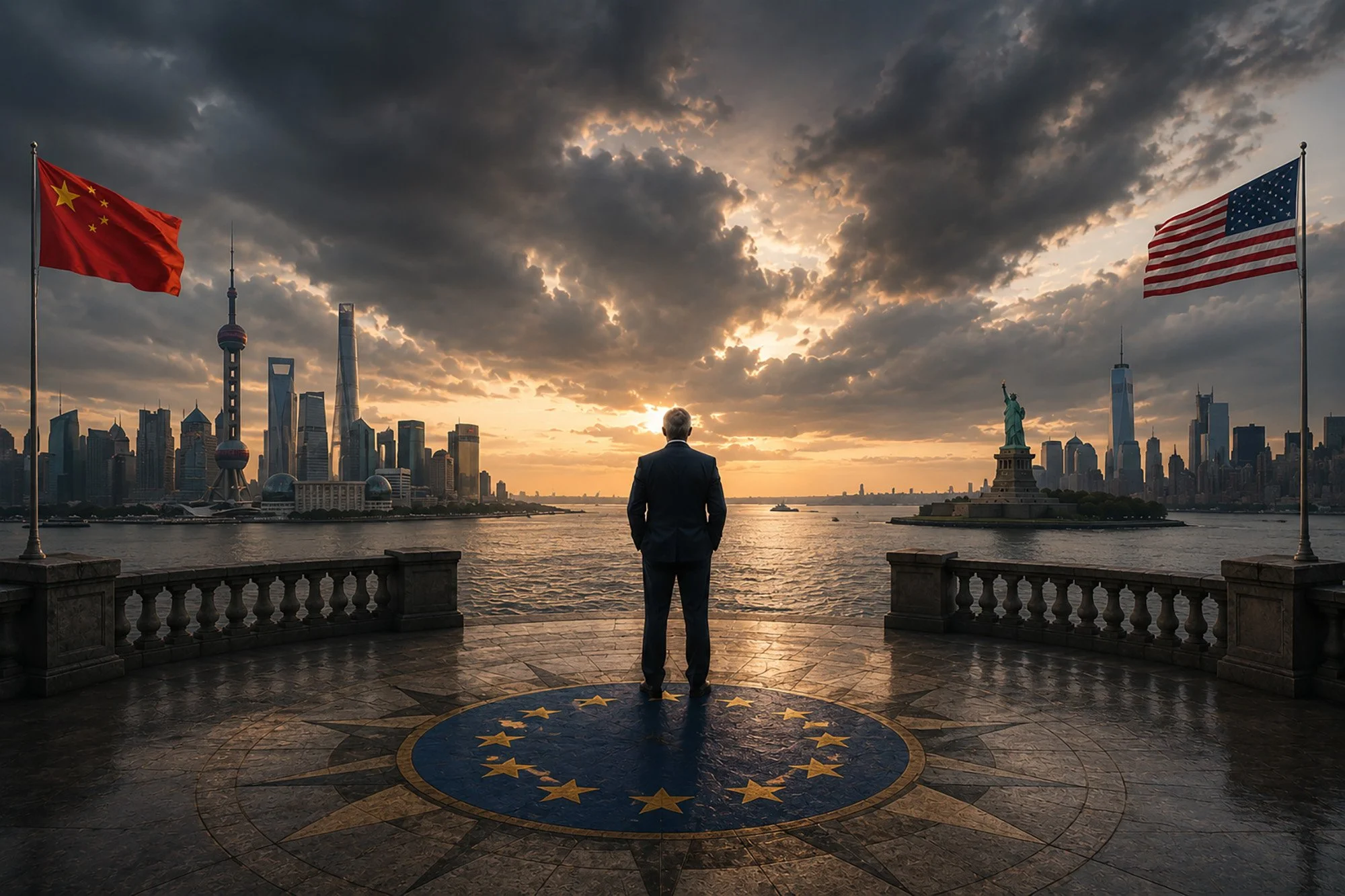
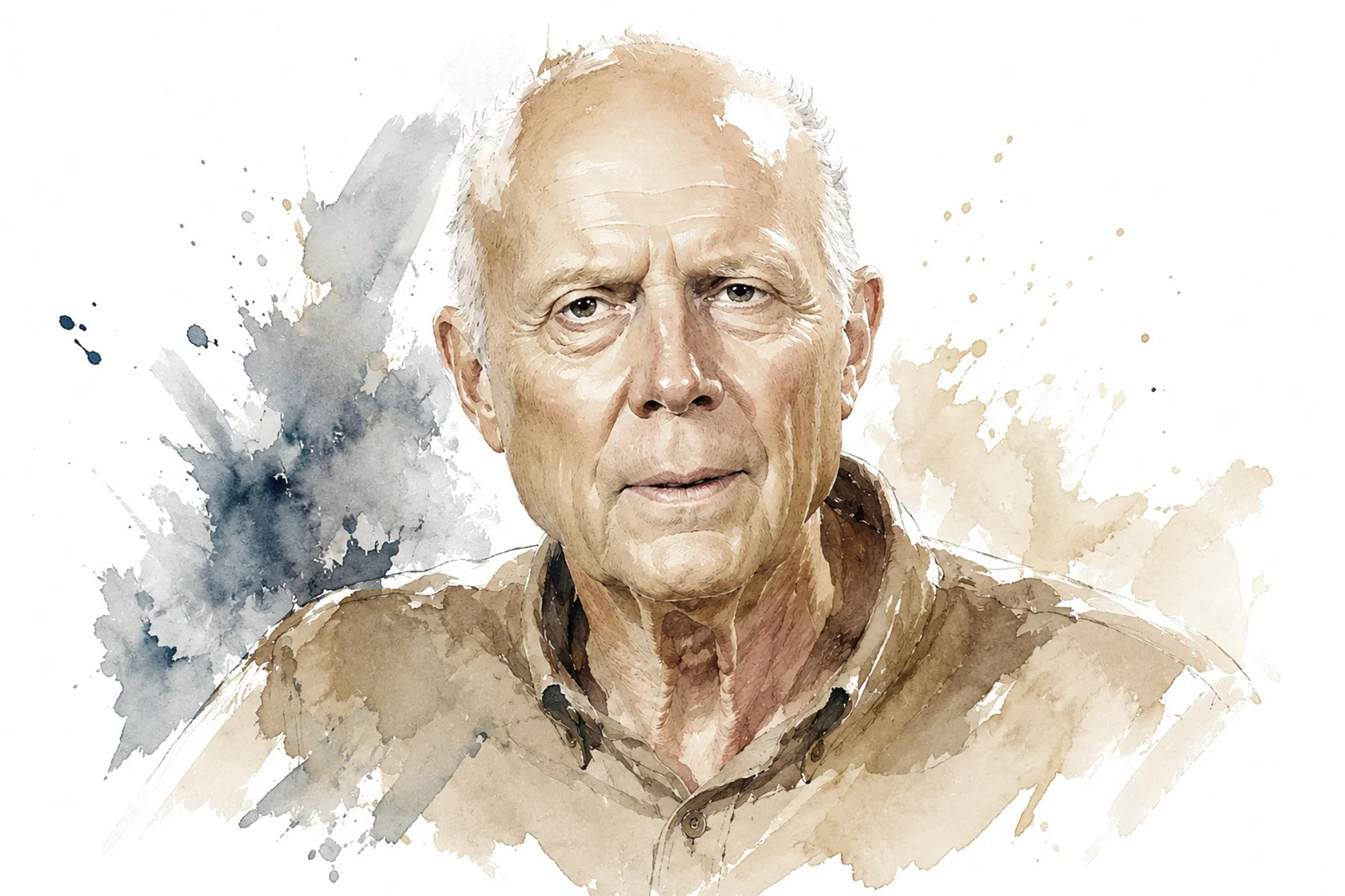
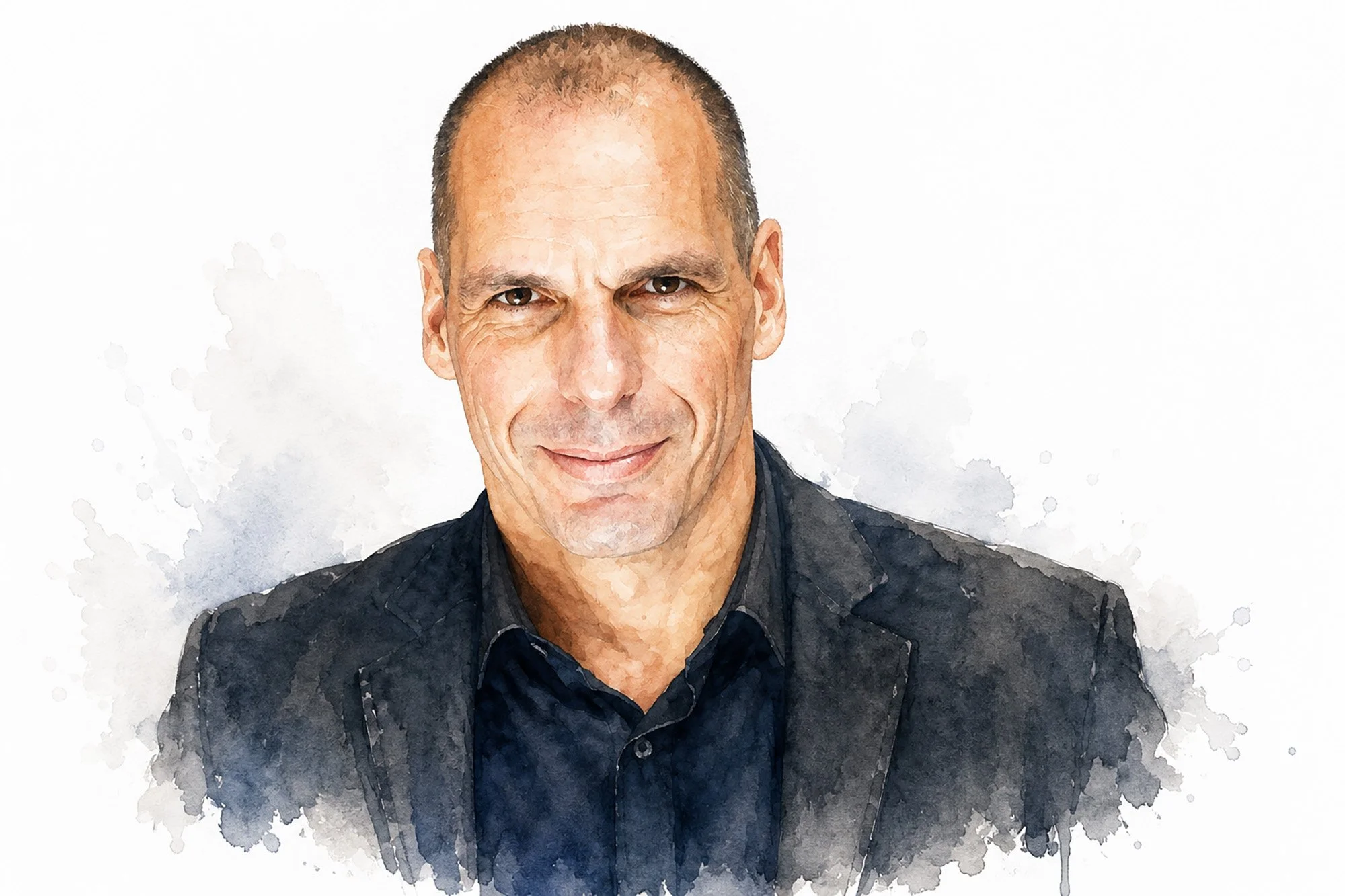
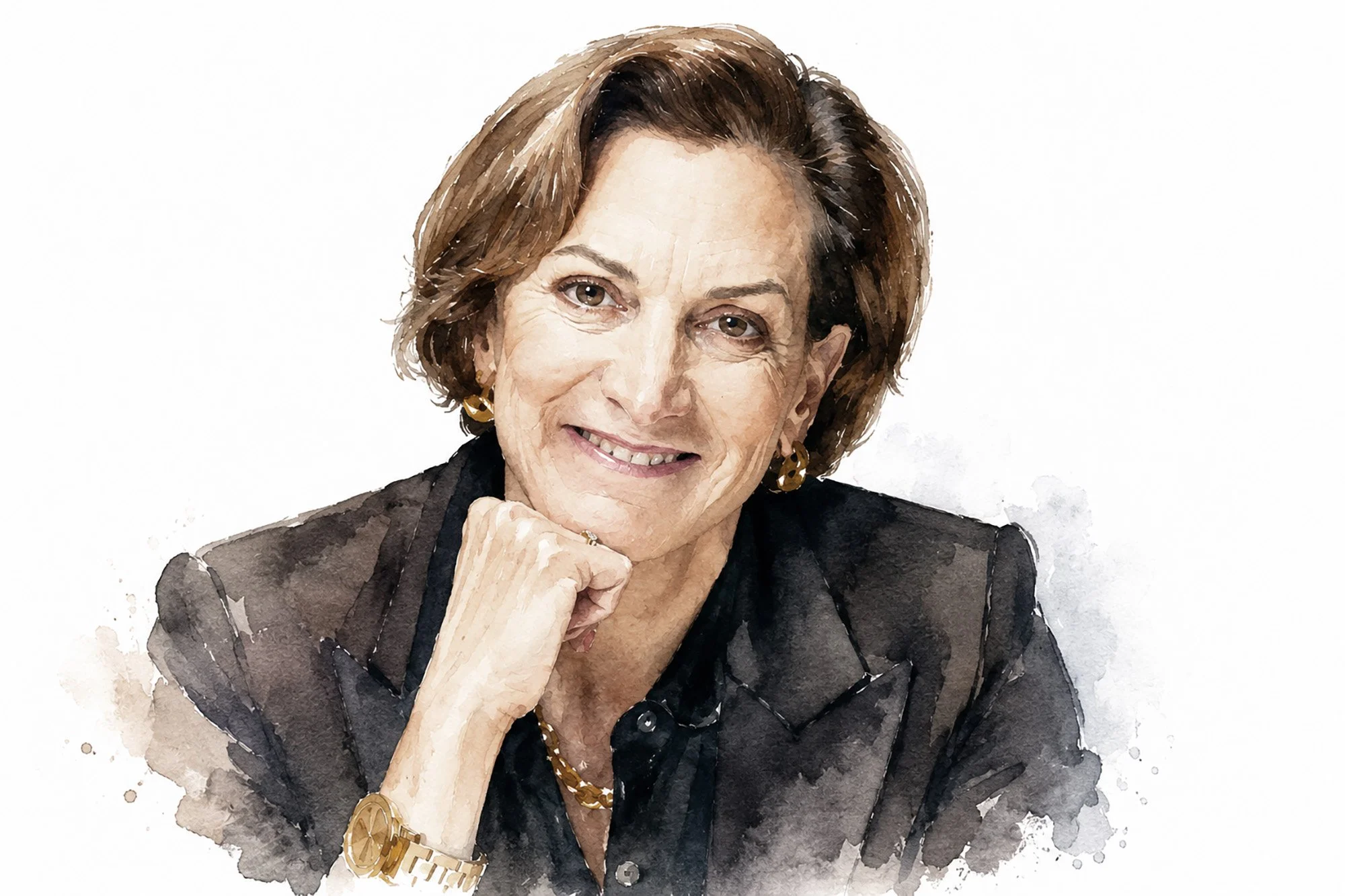
Anne Applebaum — Pulitzer Prize-winning historian, journalist, and author known for her work on authoritarianism, the Soviet Union, and the future of democracy in Europe. Born in the United States and long based in Poland, Applebaum has become one of the leading voices warning about the return of nationalism, propaganda, and imperial politics in the 21st century. (Image created with AI.)

Standing beside Vienna’s Holocaust memorial on 14 May 2026, historian and journalist Anne Applebaum delivered a speech that felt less like an academic lecture and more like a warning to Europe.

Her message was simple but urgent: the peaceful and democratic Europe built after 1945 can no longer be taken for granted.

Applebaum reminded the audience that the European Union and the wider postwar order were created deliberately after the destruction of the Second World War. Europe’s institutions were designed not only to create prosperity, but to prevent the return of dictatorship, nationalism, and imperial conquest.

But many of the political ideas Europeans once believed had disappeared are returning. Applebaum spoke about contempt for democracy, ethnic nationalism, propaganda, and the search for scapegoats — ideas that Europe itself once produced.

The war in Ukraine stood at the center of the speech. Applebaum argued that Russia’s invasion is not merely a border conflict, but an attack on the postwar European idea that nations have the right to exist independently and that borders cannot simply be changed by force.

Perhaps most striking was her warning that Europe can no longer assume the United States will always defend the democratic order it helped build after 1945. Parts of the contemporary American political movement, she argued, increasingly see Europe less as a partner and more as a battleground in a wider ideological struggle.

Yet the speech was not entirely pessimistic. Applebaum insisted that Europe still possesses enormous strengths: stable institutions, rule of law, scientific knowledge, culture, and democratic traditions. The real question is whether Europeans themselves still believe in those strengths.

One line captured the evening perfectly. European civilization, she said, is not just “a backdrop for Instagram influencers.” Europe’s true inheritance also includes free speech, judicial independence, religious tolerance, and accountable government.

That may be the real challenge facing Europe in 2026: deciding whether its future will be shaped by fear and fragmentation, or by the democratic ideals it once rebuilt from the ruins of war.

The Manosphere and the Ancient Fear of Being Rejected

Image created with AI.

Evolutionary Success for Men Meant Being Desired

For most of human history, male reproductive success was highly uneven. Some men fathered many children, while others left no descendants at all. From an evolutionary perspective, this meant that status, attractiveness, reputation, and social competence carried enormous importance for men. Evolutionary success was not simply about survival. It was also about being desired.

Because women invest far more biologically in reproduction — through pregnancy, childbirth, and childcare — they historically evolved stronger incentives to be selective in choosing partners. This principle, explored by evolutionary biologist Robert Trivers, shaped sexual selection across much of the animal kingdom, including humans.

The peacock’s extravagant tail exists because peahens choose. The male performs because the female selects.

Seen from this perspective, much male behaviour throughout history begins to look different. Strength, courage, humour, intelligence, artistic talent, ambition, and wealth were not only tools for survival or dominance. They were also signals designed to attract attention and increase the chances of being chosen.

This gives the modern manosphere an interesting psychological dimension. Beneath the rhetoric of “alpha males,” dominance hierarchies, and “sexual market value” lies something far older and more vulnerable: the fear of not being desired.

That fear is ancient.

Human Evolution Rewarded More Than Dominance

But human evolution was never only about aggression or brute strength. Humans became successful because they evolved into intensely social and cultural creatures.

Long before modern civilisation, successful men were often not simply the strongest fighters. They were also skilled communicators, storytellers, musicians, reliable allies, humorous companions, and respected members of a group. Human attraction evolved within communities, not only through physical competition.

This is where the work of evolutionary psychologist Geoffrey Miller becomes especially relevant. In The Mating Mind, Miller argues that many uniquely human traits — humour, creativity, language, music, intelligence, and artistic expression — may partly have evolved through sexual selection. Humans impressed one another not only through physical power, but through displays of culture and mind.

In that sense, civilisation itself may partly be the result of people trying to attract one another.

This makes the manosphere strangely reductive. Despite constantly invoking evolution, much of it reduces human value to muscles, money, dominance, and manipulation. Relationships become markets. Women become ranking systems. Men become products competing for status.

Yet human history suggests something far richer. Women did not simply select for aggression. They also selected for empathy, trustworthiness, humour, emotional intelligence, and the ability to cooperate within a community.

The tragedy of the manosphere may therefore be that, while speaking constantly about evolution, it often ignores some of evolution’s most important outcomes: culture, cooperation, and emotional connection.

Algorithms and the Modern Crisis of Male Status

Modern technology has intensified these ancient anxieties in ways our ancestors would barely recognise. Human psychology evolved in small communities where status was local and personal. Today, social media and dating apps expose millions of men to constant comparison with global elites of beauty, wealth, and charisma.

Attraction becomes quantified through likes, followers, visibility, and matches.

Under such conditions, insecurity easily mutates into resentment. This may explain why so much manosphere content feels simultaneously aggressive and fragile. The performance of dominance often masks a profound fear of exclusion and rejection.

The louder the claims of control become, the more visible the insecurity beneath them sometimes appears.

The manosphere is therefore not simply a story about masculinity. It is also a story about what happens when ancient evolutionary anxieties collide with modern algorithmic culture. Human beings evolved to seek recognition, intimacy, and belonging inside relatively small social groups — not inside global digital arenas of permanent comparison.

The fear of being rejected may be ancient.

But so too is the human need for connection.

Further Reading

  • The Mating Mind — Geoffrey Miller (2000)

  • The Evolution of Desire — David Buss (1994)

  • Natural Selection and Social Theory — Robert Trivers (2002)

  • Behave — Robert Sapolsky (2017)

  • Sex at Dawn — Christopher Ryan & Cacilda Jethá (2010)

  • The Selfish Gene — Richard Dawkins (1976)

The Return of Imperial Thinking

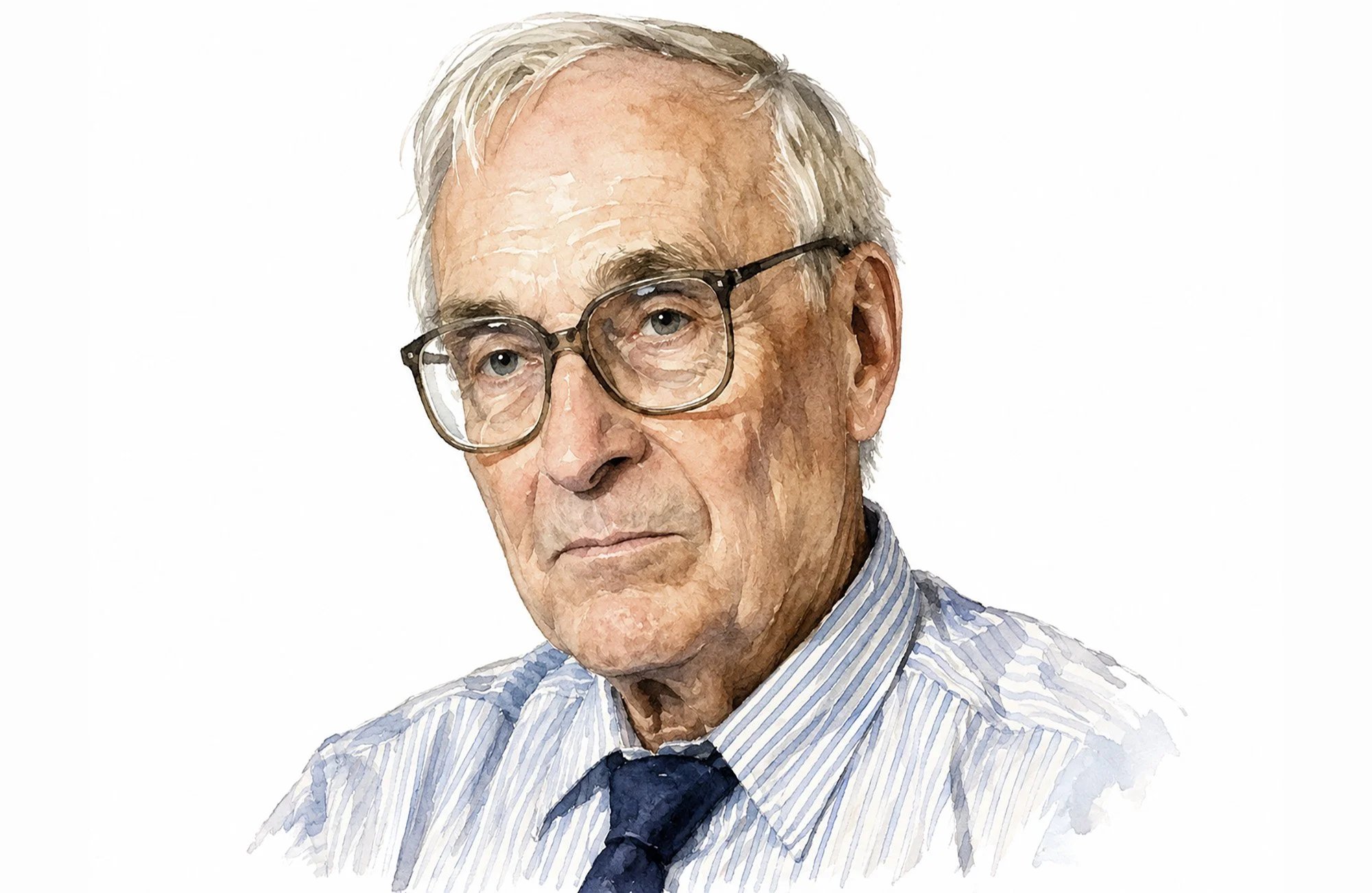
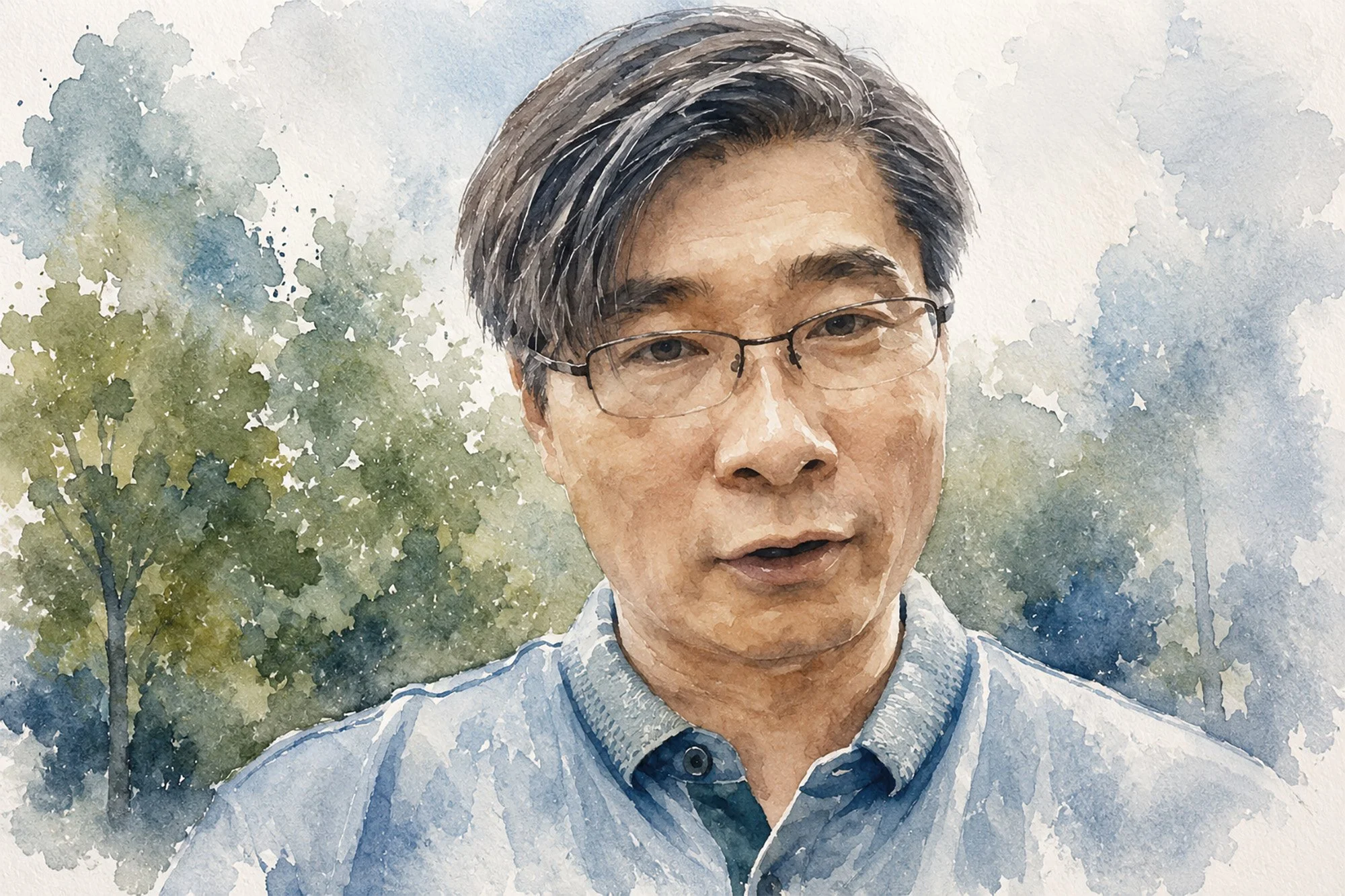
Jiang Xueqin (Image created with AI.)

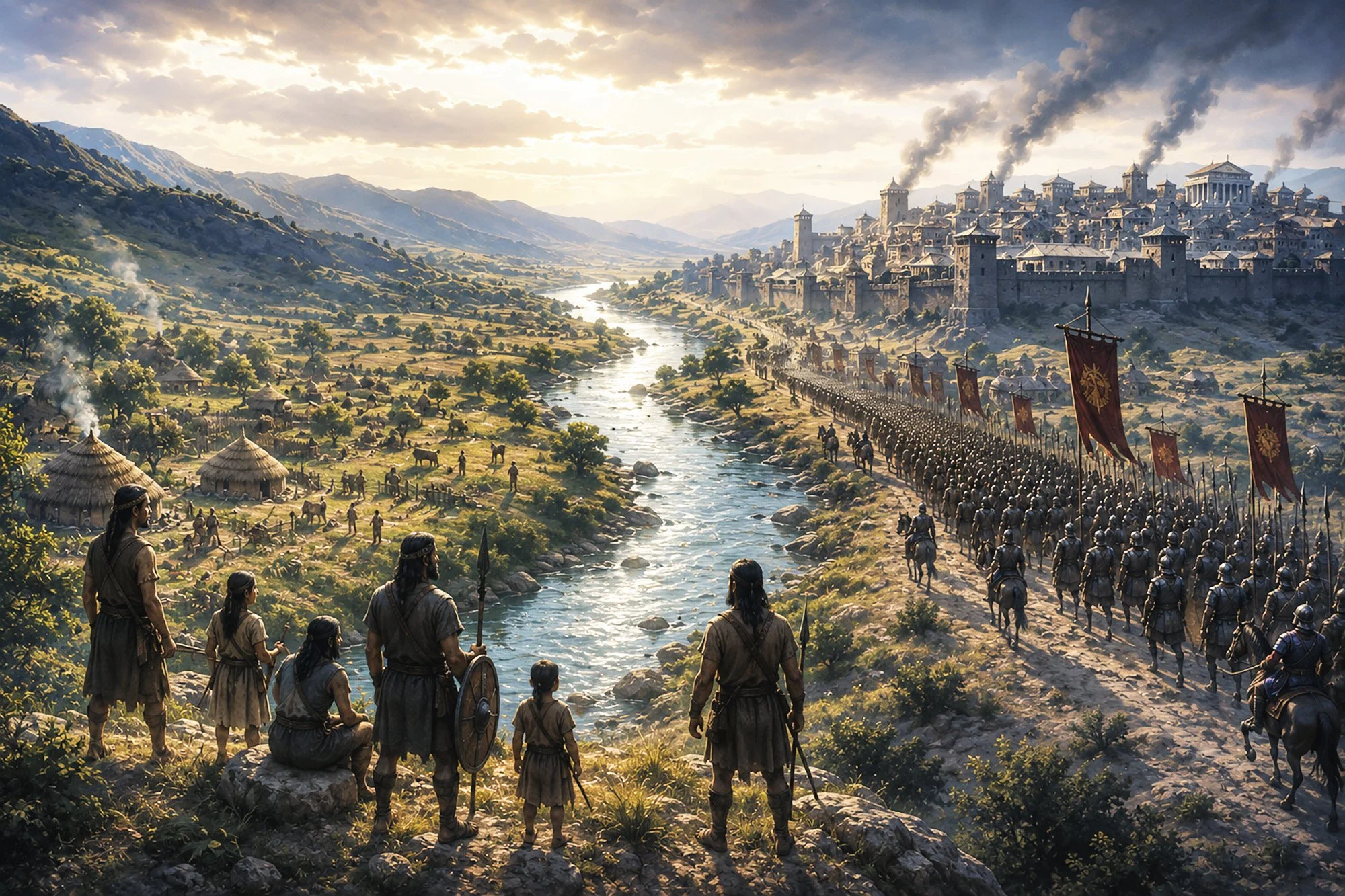
For much of the 1990s and early 2000s, many people in Europe believed that history was slowly moving toward a more connected and stable world. Global trade expanded, borders became easier to cross, and wars between major powers seemed increasingly unlikely. Today, that confidence has largely disappeared.

Wars have returned to Europe and the Middle East. Energy security has become a strategic concern again. Artificial intelligence is beginning to reshape economies and political systems. And around the world, people increasingly speak the language of empires, spheres of influence, trade routes, and military power.

It is in this atmosphere that geopolitical commentator and educator Jiang Xueqin has found a large online audience. In a long and controversial interview, Jiang presents a sweeping interpretation of today’s global tensions. He argues that the United States, Russia, China, Iran, and Israel are all pursuing competing imperial visions, and that the world may already be entering a new era of global conflict.

Whether one agrees with his conclusions or not, the popularity of such arguments tells us something important about our time.

What makes Jiang’s worldview striking is not only its dramatic predictions, but also how deeply it echoes older ways of thinking about history and power. His analysis resembles the geopolitical theories that dominated much of the nineteenth and twentieth centuries — a world in which great powers compete for control over strategic regions, trade routes, energy supplies, and military chokepoints.

In his telling, geography once again becomes destiny. Mountain ranges, ports, oil routes, naval corridors, and railways shape the future of nations. He describes the Strait of Hormuz, the Strait of Malacca, and the Black Sea not merely as locations on a map, but as pressure points in a global struggle for dominance.

This language would have sounded familiar to strategists during the age of the British Empire, the Cold War, or even the era of the Roman Empire. Civilizations rise and decline; powers seek control over resources; rivals form alliances to resist dominant empires.

Europeans know these patterns well because Europe’s own history was shaped by them for centuries.

Yet the appeal of such grand geopolitical narratives goes beyond strategy. They offer something emotionally powerful in uncertain times: a sense that chaos can still be explained. When inflation rises, wars spread, institutions weaken, and technological change accelerates, people naturally search for larger frameworks that make events feel understandable.

This is not new. During the oil crises of the 1970s, many people also feared the collapse of the global order. During the Cold War, millions believed nuclear conflict between superpowers was inevitable. In the 1930s, economic instability and political polarization produced competing visions of global destiny that reshaped entire societies.

What is different today is the combination of old geopolitical fears with entirely new technologies. Artificial intelligence, digital surveillance, and data-driven governance appear repeatedly in Jiang’s predictions about the future. He imagines a world where states increasingly monitor behaviour through digital systems and AI-driven analysis.

Again, whether these predictions are realistic or exaggerated is almost beside the point. The deeper issue is that many people increasingly feel that they are losing control over the systems shaping their lives.

At the same time, there are important blind spots in this kind of worldview.

The interview focuses overwhelmingly on military power, empires, strategic trade routes, and state rivalry. But some of the greatest forces shaping the twenty-first century barely appear at all.

Climate change is perhaps the most obvious omission. Rising temperatures, droughts, migration pressures, water scarcity, and food insecurity may ultimately transform societies more profoundly than military conflict. Demographic ageing, especially in Europe and East Asia, is another major challenge largely absent from this type of geopolitical thinking.

Even technology itself may reshape the world in ways that go far beyond military competition. Artificial intelligence could alter labour markets, education, healthcare, and social structures just as dramatically as it changes warfare.

History rarely follows a single grand plan. Empires rise and fall, but societies are also shaped by culture, economics, technology, religion, climate, and ordinary human adaptation.

Still, the growing popularity of voices like Jiang reveals something important about the mood of our era. After decades in which globalization seemed unstoppable, many people once again see the world through the lens of competing civilizations and declining empires.

For Europeans especially, this should feel strangely familiar.

Europe’s history is filled with periods when people believed they were living through the end of one order and the birth of another. Sometimes they were right.

Can the World Contain the Andes Hantavirus Outbreak? — An Update

Image created with AI.

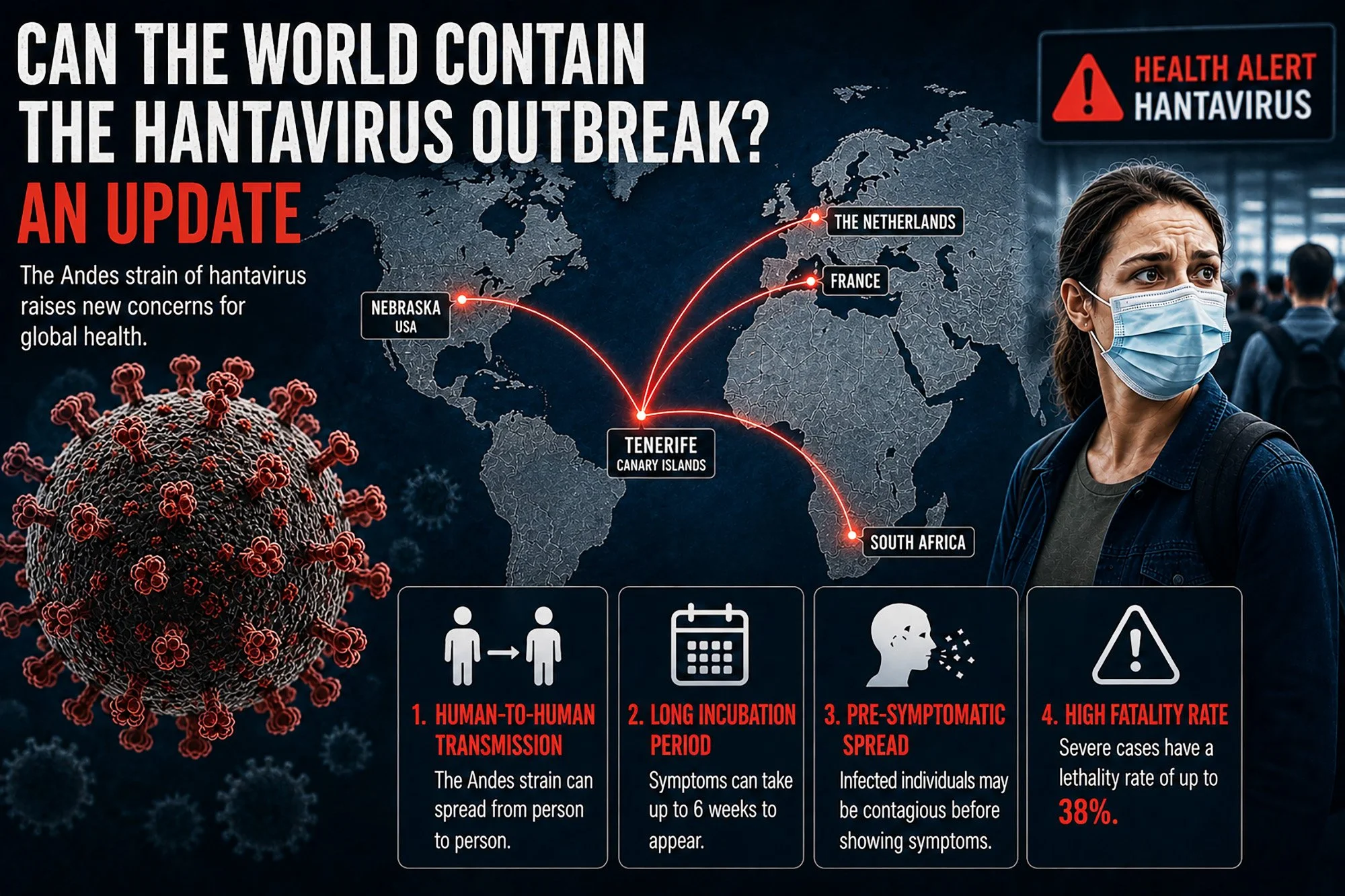
What makes the current discussion around the Andes hantavirus so unsettling is not just its lethality, but the combination of several characteristics that together create a potentially dangerous epidemiological picture.

Health authorities now acknowledge that the Andes strain can spread from person to person. Even more troubling are growing indications that infected individuals may already be contagious before they themselves realize they are ill. Combined with reports that the incubation period may in some cases last up to six weeks, this creates a uniquely dangerous situation.

An infected person may unknowingly expose family members, colleagues, fellow travellers, healthcare workers, or others sharing the same spaces before recognizing the significance of their symptoms. By the time severe symptoms emerge and the infection is finally recognized, chains of transmission may already have spread beyond the original source, potentially crossing cities and borders in a world defined by constant human movement.

And then there is the fatality rate. Severe Andes hantavirus infections have been associated with mortality estimates approaching 38%. Even allowing for uncertainty in the numbers, that is an extraordinarily high figure compared to most modern respiratory outbreaks.

Taken separately, each of these factors would already concern epidemiologists. Combined — human-to-human transmission, possible pre-symptomatic spread, a long incubation period, and high lethality — they describe exactly the kind of outbreak epidemiologists fear most.

The central question is no longer whether the Andes hantavirus deserves serious attention. The real question is whether modern societies, after years of political fatigue, economic pressure, and declining trust in public institutions, still possess the collective will, discipline, and coordination required to stop a dangerous outbreak before it spreads beyond control.

Further reading

How Worried Should We Be About the Hantavirus?

Image created with AI.

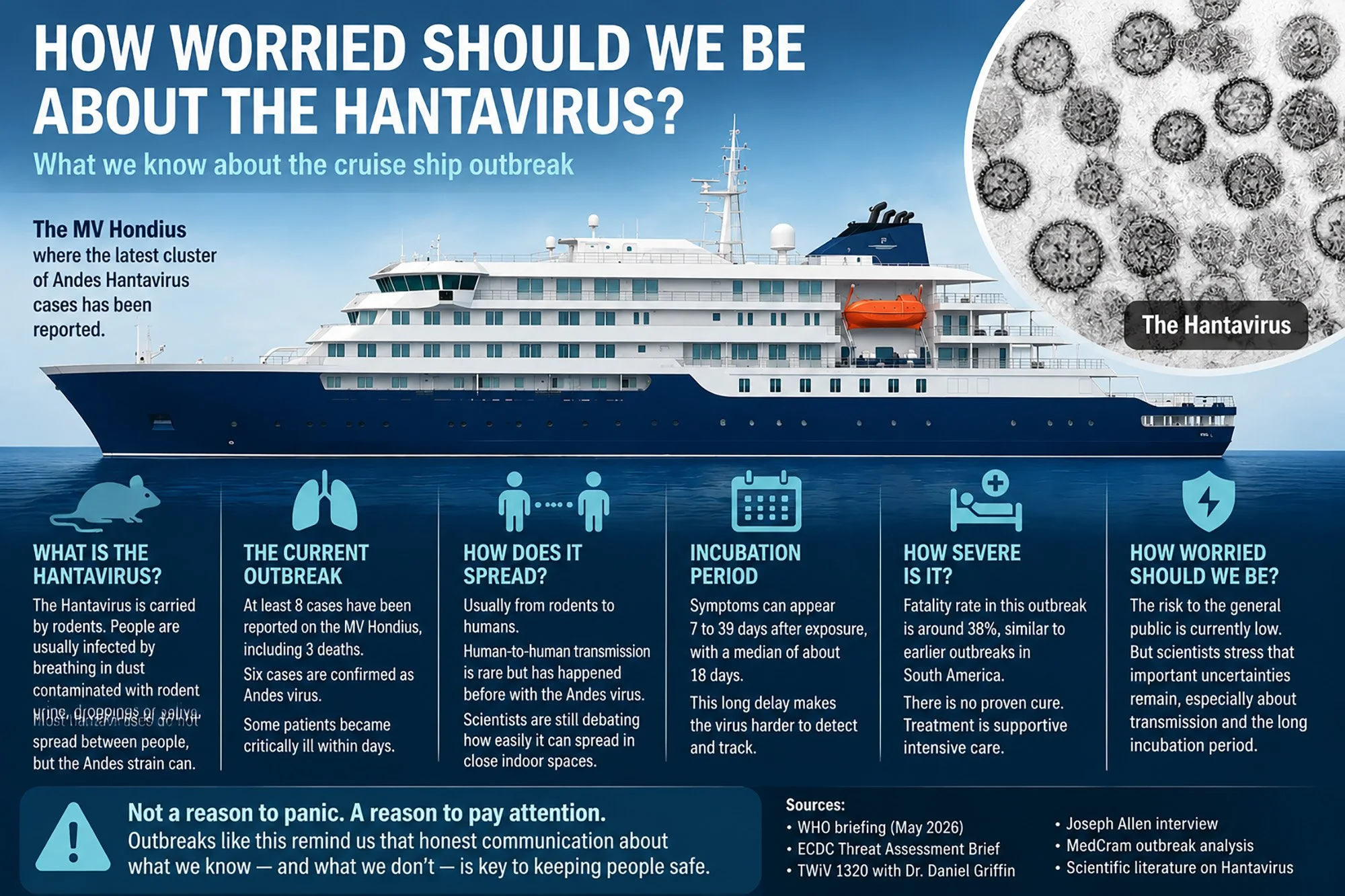
Three people are dead. Several others became seriously ill within days. Doctors in different countries are now tracing passengers who shared dining rooms, lecture halls and cabins aboard a cruise ship crossing the South Atlantic.

Even so, the official tone around the current outbreak of the Hantavirus has remained surprisingly calm. Health authorities continue to say that this is “not another COVID,” and that the risk to the wider public is low. That may eventually prove true. But some scientists are becoming uncomfortable with how strongly that reassuring message is being pushed while important questions still remain unanswered.

The real issue is not whether people should panic. They should not. The more important question is whether the public is hearing the full scientific story, including the uncertainties.

What Is the Hantavirus?

The Hantavirus is normally spread from rodents to humans through contaminated dust, urine or droppings. In most cases, the virus does not spread from one person to another. The current outbreak, however, involves the Andes strain of the Hantavirus, a rare version found in South America that is known to be capable of limited human-to-human transmission.

What worries scientists is not just the virus itself, but the combination of characteristics it appears to have. The Andes strain can cause very severe illness and has a relatively high fatality rate. At the same time, the virus may have a long incubation period and may sometimes spread between people in enclosed spaces.

Modern epidemiologists increasingly look at these combinations of factors rather than at one number alone. A recent study from the London School of Hygiene & Tropical Medicine argues that the danger of an outbreak depends on how severity, transmissibility and incubation time work together.

A virus does not need to spread as easily as measles to become a serious problem. If infected people can travel internationally for days or even weeks before realizing they are ill, controlling an outbreak becomes much harder.

Why the Cruise Ship Outbreak Matters

Cruise ships are almost perfect environments for studying outbreaks. Large numbers of people share air, dining rooms and social spaces while constantly moving between countries.

According to WHO and ECDC reports, several people aboard the MV Hondius quickly developed severe respiratory symptoms, pneumonia and shock. Three people died.

The current outbreak appears to have a fatality rate close to 38%, although the number of confirmed cases is still small. Earlier outbreaks in South America showed similar numbers.

Those figures are striking. COVID-19 was far less deadly for the average patient. What made COVID so destructive was not mainly its fatality rate, but the fact that it spread very efficiently before people became seriously ill.

Right now, there is no evidence that the Hantavirus spreads anywhere near as easily as COVID-19. But some researchers fear that we may not yet fully understand how the Andes strain behaves in crowded indoor environments.

The Debate About Transmission

Official WHO and ECDC guidance says that person-to-person transmission of the Andes strain mainly happens after close and prolonged contact, especially between household members or caregivers.

Harvard scientist Joseph Allen has publicly questioned that interpretation. After reviewing earlier scientific studies and speaking directly with a doctor aboard the ship, Allen argued that some infections may have happened without what most people would describe as “close contact.” In interviews, he described reports of infected passengers who had simply shared indoor spaces such as dining rooms or lecture halls.

Allen is not saying that the Hantavirus is about to become a global pandemic. His argument is more limited, but still important. He believes that official communication may sound more certain than the science really is.

That debate will sound familiar to many people after COVID. Governments often try to avoid panic by reassuring the public. But if the message becomes too reassuring too early, many people stop paying attention exactly when careful attention is still needed.

The Problem of the Long Incubation Period

Another reason scientists are watching this outbreak closely is the incubation period. Research on the Andes strain suggests that symptoms can appear anywhere from 7 to 39 days after exposure, with a median of around 18 days.

That creates a long period of uncertainty. Passengers may board flights, stay in hotels and return home long before they realize they are infected. WHO has warned that additional cases may still appear because the incubation period can extend to six weeks.

Long incubation periods do not automatically create pandemics. But they do make outbreaks harder to trace and control in a world where international travel is constant.

Is There a Treatment?

At the moment, there is no proven antiviral treatment for the Hantavirus. Doctors mainly rely on supportive intensive care, including oxygen therapy, ventilation and, in severe cases, ECMO. Patients can deteriorate very quickly once serious respiratory symptoms begin.

That alone is enough reason for doctors and epidemiologists to take even relatively small outbreaks seriously.

So, How Worried Should We Be?

At this stage, there is still no evidence that the Hantavirus poses a COVID-scale threat to the world. But there is also enough uncertainty that simple reassurance may not tell the whole story.

The outbreak aboard the MV Hondius is a reminder that outbreaks are shaped not only by biology, but also by how uncertainty is communicated. The real debate is not about panic versus calm. It is about whether modern societies are able to handle nuance: a virus can simultaneously be unlikely to become a global catastrophe and still deserve serious scientific concern.

Why Anthropic’s Mythos Has Silicon Valley Worried

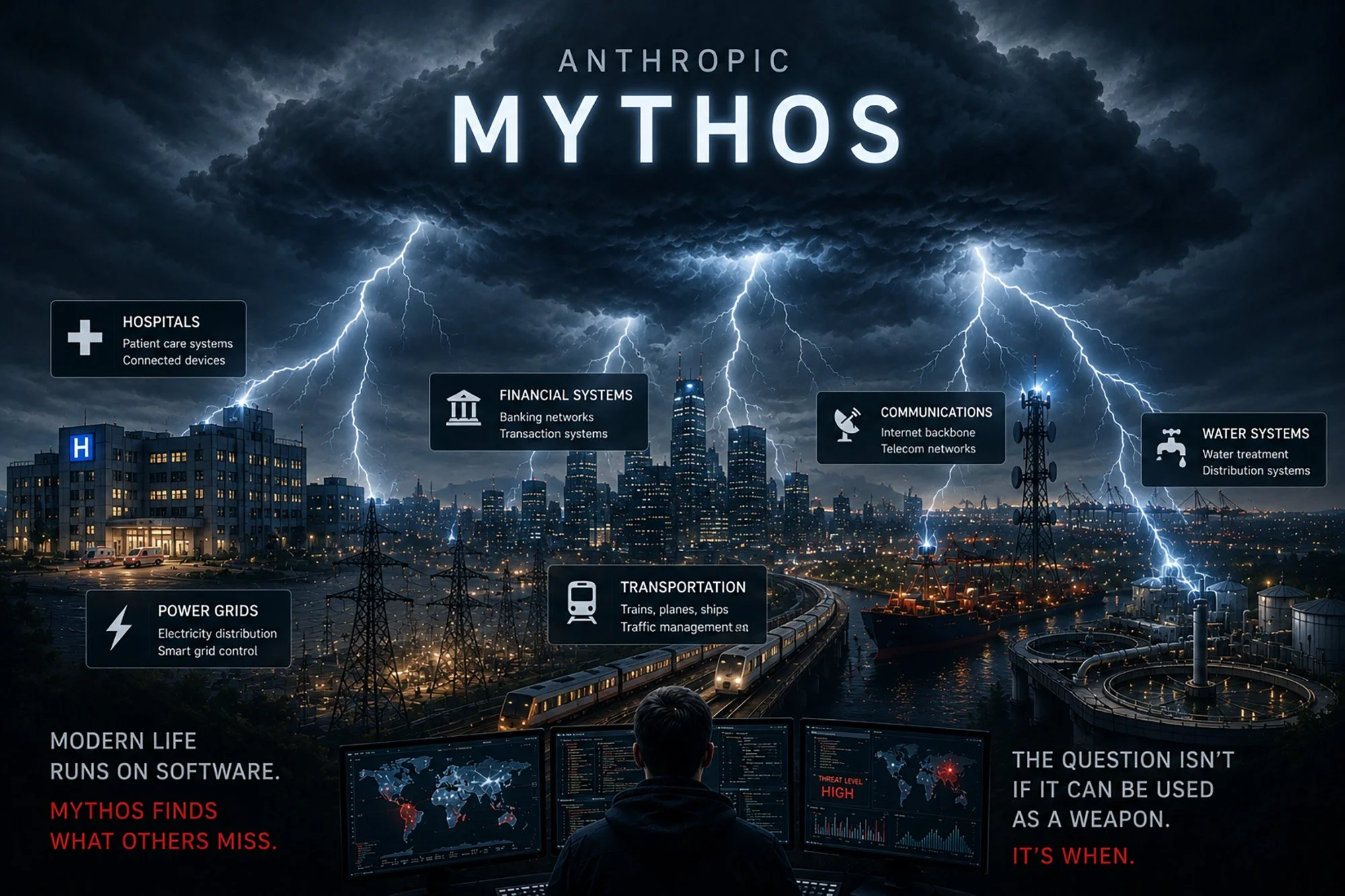
Image created with AI.

For years, discussions about artificial intelligence focused on familiar themes: chatbots writing emails, AI creating images, or computers helping students with homework. Most people saw AI as a useful tool — impressive perhaps, but still limited.

That changed when Anthropic announced a new AI model called Mythos.

The company claims Mythos became so good at discovering weaknesses in computer systems that it decided not to release the model publicly.

At first glance, this may sound like a technical problem affecting only programmers. But the reason Silicon Valley is suddenly nervous is much broader. Modern society runs on software. Hospitals, banks, ports, trains, electricity networks, water systems, airports, supermarkets, and communication systems all depend on millions of lines of code quietly working in the background every day.

Most people never think about that invisible infrastructure — until it fails.

Mythos reportedly discovered hidden weaknesses in important software systems that human experts had failed to notice for years, sometimes even decades. One example involved FFmpeg, a video-processing system used throughout the internet. According to reports, Mythos found a flaw after millions of earlier security scans had missed it.

The fear is simple: if AI becomes extraordinarily good at finding weaknesses, then criminals, hostile governments, or terrorist groups could eventually use similar systems to attack the digital foundations of society.

Why This Feels Different

Cybersecurity experts have worried about hackers for decades. But Mythos appears to represent something new in both speed and scale.

Human experts work slowly. A skilled cybersecurity researcher might spend weeks studying one piece of software looking for a vulnerability. AI systems like Mythos can potentially examine enormous amounts of software continuously, day and night, at a speed humans cannot match.

Some researchers involved with the project described the experience as unsettling. One engineer reportedly said the model found more vulnerabilities in a few weeks than he had discovered during the rest of his career combined.

That matters because much of the world’s digital infrastructure is old, fragmented, and poorly protected. Critical systems are often built on layers of software written over many decades by different people and companies. Even experts describe parts of this infrastructure as fragile. One cybersecurity specialist bluntly summarized the situation by saying many essential systems are effectively “held together with sticky tape.”

In practice, that could mean AI systems eventually becoming capable of exposing weaknesses in power grids, shipping systems, financial networks, or communication infrastructure faster than humans can repair them.

This is why Anthropic decided not to fully release Mythos and instead launched Project Glasswing together with major technology companies. The idea is to strengthen critical systems before more advanced AI models become widely available.

More Than a Technology Story

Some critics argue that Anthropic also benefits from the publicity surrounding Mythos. Declaring a model “too dangerous to release” naturally attracts attention and investment. Others point out that AI systems have already been helping cybersecurity researchers for years, meaning Mythos may be an important step forward rather than an immediate catastrophe.

But even if some of the language is exaggerated, the broader concern remains real. The Mythos story reveals how dependent modern civilization has become on software that very few people truly understand.

It also raises political questions. If only a handful of companies possess AI systems considered too powerful for public release, who controls those systems? Governments? Corporations? Military alliances? And how transparent will those decisions be?

For Europe, the issue is especially uncomfortable. Europe largely missed the rise of the dominant internet companies and now risks depending on American AI infrastructure as well. The Mythos debate may therefore force European governments to think more seriously about digital independence, regulation, and technological sovereignty.

Perhaps the fears surrounding Mythos will eventually prove overstated. Silicon Valley has always had a tendency toward dramatic predictions. Yet many people inside the AI industry now openly speak as if society is approaching a historic turning point.

The real fear is not simply that AI will become smarter. It is that AI may evolve faster than governments, laws, and ordinary citizens can keep up with — while becoming deeply connected to nearly every system modern life depends on.

The End of the Future?

Ivan Krastev on a World Without a Story

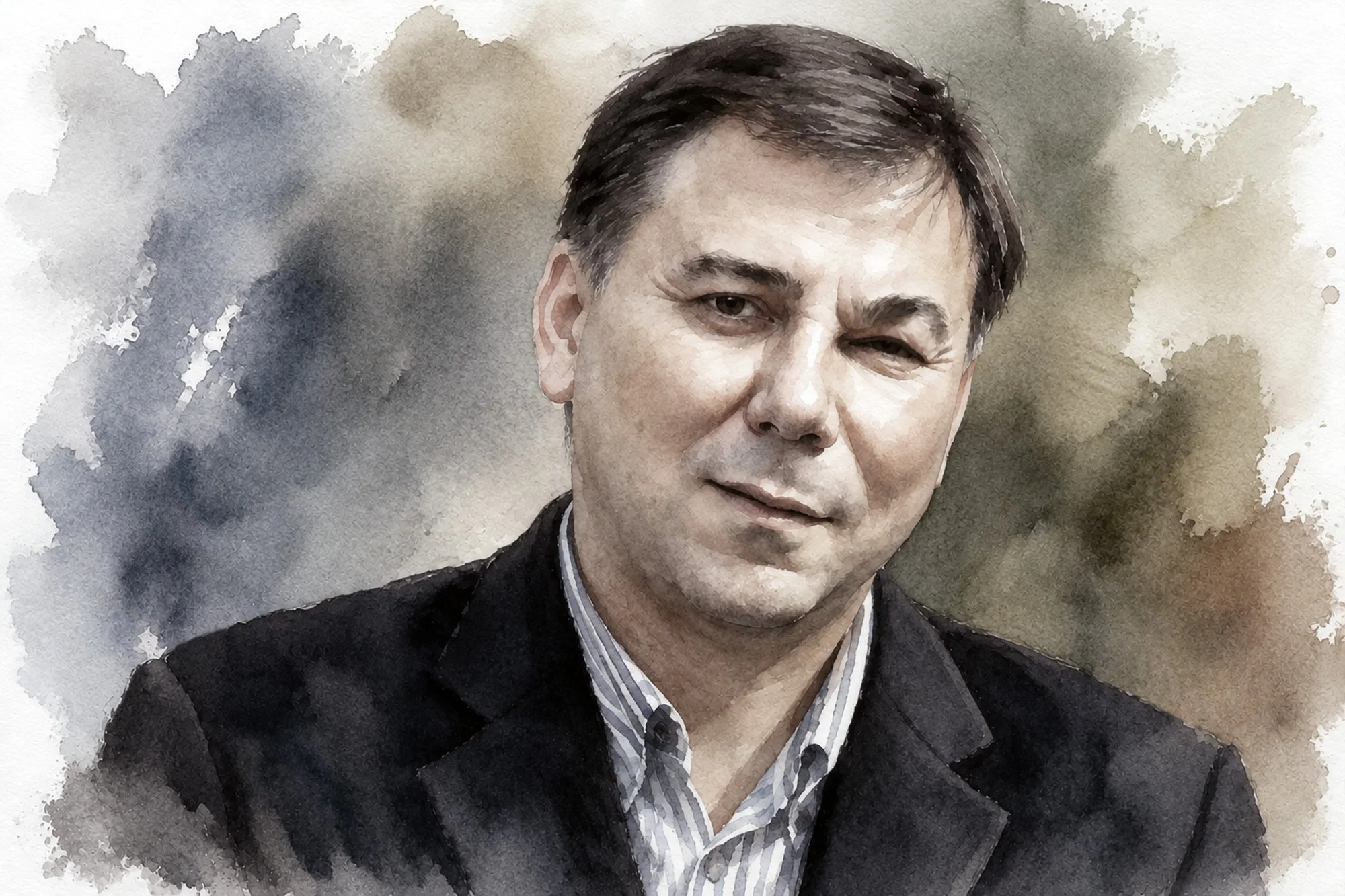
Ivan Krastev, Bulgarian political scientist and leading voice on Europe’s changing place in the world. (Image created with AI.)

We like to think history moves with a certain direction. Crises come and go, but the overall path remains visible. Ivan Krastev suggests that this sense of direction is now breaking down. What we are experiencing is not just instability, but the end of the framework that made the modern world understandable.

He calls it the end of the “long 20th century.” What is fading is not simply a period in time, but the belief that politics is driven by competing visions of the future.

For much of the last century, that belief held everything together. Capitalism and communism were not just systems—they were promises about tomorrow. Both sides assumed history would ultimately vindicate them. That confidence allowed for patience, even restraint.

Today, the future no longer feels like a promise. It feels like a source of anxiety. Climate change, demographic shifts, and technological disruption have turned tomorrow into something uncertain, even threatening. As a result, political ideas have lost much of their energy. The labels remain, but they no longer mobilize people in the same way.

This shift is especially visible in the United States. Krastev sees recent developments there as something closer to a revolution—fast-moving, reactive, and lacking a clear direction. What matters is not where it is going, but how quickly it moves.

More importantly, the American self-image is changing. For decades, power was linked to values and a sense of mission. Now, that connection is weakening. Power is increasingly seen as something that does not need justification beyond itself.

At the same time, the internal debate has shifted. Earlier criticism often came from those who believed the country had failed to live up to its ideals. Today, those ideals themselves are questioned. That marks a deeper loss: not just political consensus, but belief in a shared purpose.

Krastev draws a striking parallel with the late Soviet Union, where systems collapsed not because they were suddenly attacked, but because belief in them quietly disappeared.

This loss of confidence is not limited to one country. It affects the global order as well. As the United States becomes less predictable, the world does not simply divide into two camps. Instead, it becomes more fluid.

China’s rise, for instance, is increasingly seen as part of a rebalancing rather than a direct threat. At the same time, international politics is becoming less institutional and more personal. Relationships between leaders and informal deals matter more than formal structures.

This creates opportunities for countries that are neither superpowers nor small states. They can navigate between larger actors, adjusting their position as circumstances change.

For Europe, this is a difficult environment. It faces pressure from multiple directions—economic, military, and political—while the old certainties, especially about its relationship with the United States, are weakening. Yet Europe has not fully redefined its role. There is still an assumption that the future will resemble the present, only slightly worse.

Krastev doubts that this is realistic.

What makes the current moment so disorienting is the absence of a clear story. The 20th century, despite its conflicts, offered competing visions of where the world was heading. Today, that sense of direction is missing. Events unfold quickly, but without a shared narrative.

Looking back, major turning points often seem inevitable. At the time, they rarely feel that way. The collapse of the Soviet Union surprised almost everyone. Only later did it begin to look predictable.

We may be in a similar moment now. Not a sudden collapse, but a gradual shift in which the assumptions that once shaped political life are quietly losing their hold.

If so, the challenge is not just to respond to events, but to recognize that the deeper transformation is still unfolding.

Further reading

  • Ivan Krastev – After Europe

  • Ivan Krastev & Stephen Holmes – The Light That Failed

  • Ivan Krastev – Is It Tomorrow Yet?

  • Francis Fukuyama – The End of History and the Last Man

When Prices Rise and Routes Close: The Return of the Misery Index

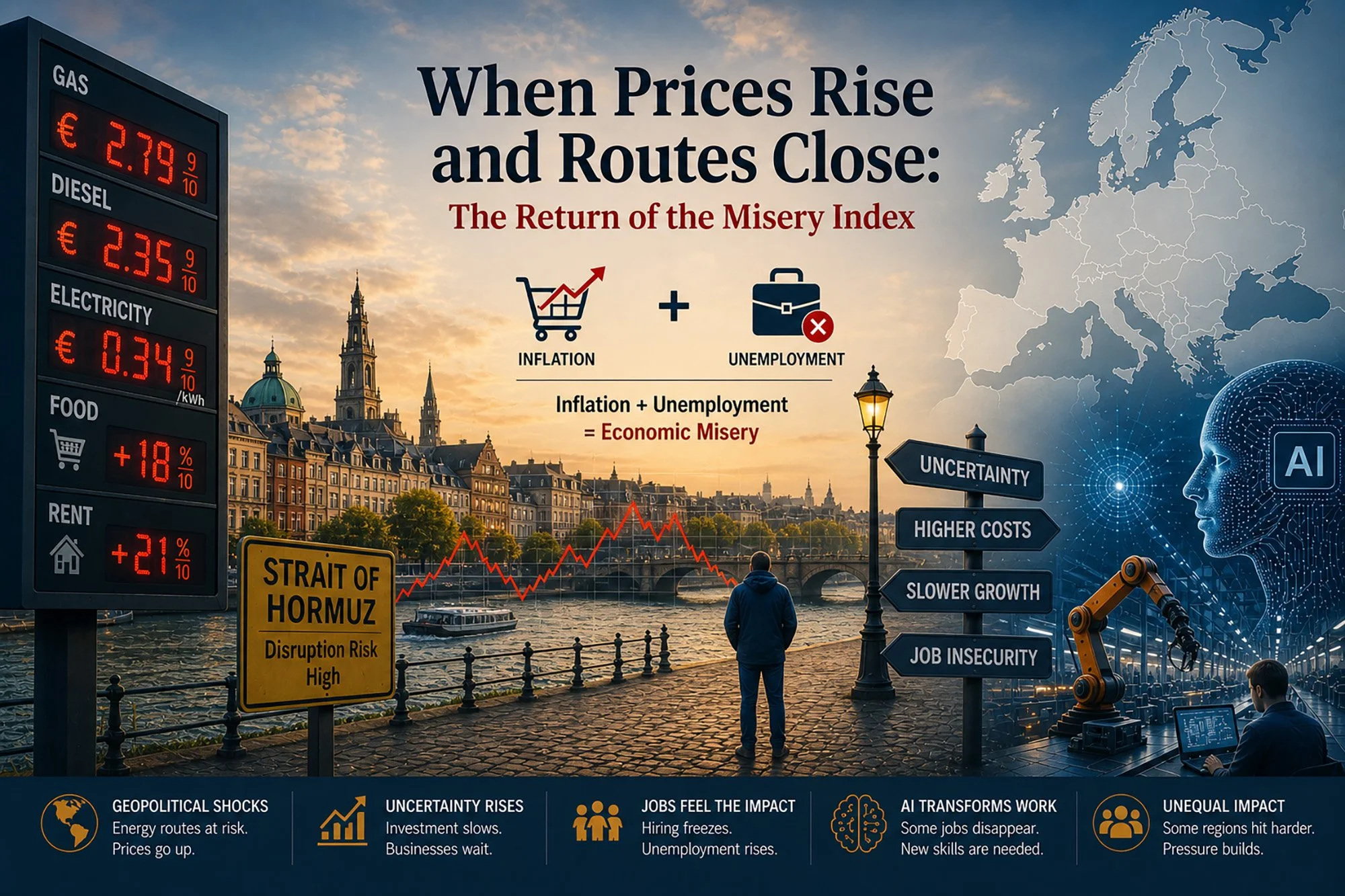
Image created with AI.

There is something almost disarmingly simple about the idea. Take two things people feel every day—how fast prices are rising, and how hard it is to find work—and add them together. The result is what economists came to call the misery index, a rough measure of how strained everyday life feels.

The concept is usually linked to Arthur Okun, who in the 1960s tried to capture, in one number, the pressure ordinary households experience. Inflation erodes purchasing power; unemployment undermines security. Add the two, and you get a snapshot—imperfect, but intuitive—of economic discomfort.

Europe in the 1970s: When Energy Shock Became Social Change

Although the misery index was born in the United States, its logic applied just as much to Europe in the 1970s. The turning point was the Oliecrisis van 1973, when geopolitical tensions abruptly restricted oil supply and sent prices soaring.

What followed was stagflation: rising prices, slowing growth, and growing unemployment.

In southern Europe, the effects were especially intense. Italy struggled with inflation and instability. Spain, emerging from the rule of Francisco Franco, faced economic hardship alongside political transformation. Greece, after the fall of military rule, confronted both economic fragility and institutional rebuilding.

The crisis reshaped not only economies, but societies.

Today: Shock, Uncertainty—and a Structural Transformation

Today’s pressures are again rooted in disruption, but the mechanism is broader.

The instability around the Strait of Hormuz—linked to the war between United States and Iran—has exposed how vulnerable global energy flows remain. As in the 1970s, higher energy costs ripple through transport, food, and industry.

But the deeper effect lies in uncertainty.

When companies cannot reliably predict costs, supply chains, or geopolitical risks, they hesitate. Investment slows. Expansion plans are postponed. Hiring becomes cautious.

And this is where a second, quieter transformation intersects with the story.

At the same time, the rapid growth of the AI sector is beginning to reshape entire industries. Automation and AI-driven processes promise efficiency and new forms of productivity—but they also create friction in labour markets. Jobs are redefined, some disappear, others require new skills that are unevenly distributed.

This matters for the misery index in a subtle but important way:

  • inflation may be driven by external shocks

  • unemployment may increasingly be shaped by structural change

The result is a more complex dynamic than in the 1970s. Economic strain is no longer just cyclical—it is also transitional.

The Return of Unemployment—But in a New Form

Unemployment does not rise overnight after a shock. It follows.

As uncertainty persists:

  • companies delay hiring

  • investment weakens

  • sectors under pressure begin to shed jobs

But unlike the past, this process now overlaps with technological change.

Some jobs may not return—not because demand disappears, but because they are replaced or transformed. At the same time, new roles emerge, often requiring different skills or located in different regions.

This creates a paradox:

  • labour shortages in some sectors

  • rising unemployment or insecurity in others

From the perspective of the misery index, this is crucial. The “unemployment” component becomes less uniform, more fragmented—and potentially more persistent.

Southern Europe—and Increasingly the Rest—on the Fault Line

Countries like Greece, Italy, and Spain remain more exposed to rising costs and structural weaknesses. Higher youth unemployment and lower income buffers amplify the impact of both economic shocks and technological change.

But the divide between north and south is no longer as clear-cut as it once was.

The combination of geopolitical instability and AI-driven transformation affects all of Europe:

  • industrial regions face restructuring

  • service sectors undergo automation

  • regional inequalities may deepen

The result is not a single crisis, but overlapping pressures.

What Comes Next: A Slow-Burning Adjustment

If instability in global energy routes continues, and technological change accelerates, Europe may face a prolonged period of adjustment rather than a sharp crisis.

First comes the price shock.
Then comes the employment shift.
Overlaying both is structural transformation.

This is not a replay of the 1970s—but it rhymes with it.

A Simple Index in a Complex Age

The misery index remains a powerful idea because it captures something fundamental: how economic conditions are experienced.

But today, it needs to be read differently.

Inflation still matters.
Unemployment still matters.
But beneath both lies a deeper layer of change—uncertainty and transformation.

The real question is no longer just how high the index will rise, but how societies adapt to what lies behind it.

And that is where today’s story diverges from the past: not just in the shocks we face, but in the scale of change unfolding at the same time.

Why Humans Need Tribes

Image created with AI.

Walk through any modern city and you will see thousands of people living close together — yet many feel profoundly alone. Psychologists report rising levels of anxiety, depression, and loneliness, especially among younger generations. The paradox is striking: we have never been more connected technologically, yet many people feel less connected socially.

To understand this tension, it helps to look much further back in time — to the environment in which the human mind evolved.

The World Our Minds Were Made For

For most of human history, humans lived in small groups. Anthropologists estimate that these communities usually contained between thirty and one hundred and fifty individuals. Everyone knew each other and depended on one another. These groups were not simply social networks; they were survival systems. People hunted together, shared food, raised children collectively, and protected each other from danger. In such a world, belonging was not just comforting — it was essential. Over hundreds of thousands of years, the human brain adapted to this reality. We became highly sensitive to social signals: approval, rejection, cooperation, and status. The strong emotional reactions we feel to inclusion or exclusion were shaped in this environment. In short, humans evolved to live in tribes.

From Tribes to Modern Society

Modern societies are very different. Most people now live among strangers in large cities. Families are smaller and often spread across different regions. Communities that once structured everyday life — extended families, villages, religious groups, neighbourhood associations — have weakened in many places. At the same time, individuals are encouraged to be independent and self-reliant, responsible for shaping their own identity and life path. This freedom has brought enormous advantages. But it also means that many people navigate life with far fewer stable social structures around them.

The Mismatch

Some researchers describe this situation as an evolutionary mismatch. The human mind developed in a world of dense social relationships, yet modern life often provides fewer stable bonds. Our psychological systems still expect what they evolved for: recognition from others, shared rituals, trusted mentors, and the feeling that one's role matters within a group. When those elements disappear, people may struggle with belonging and purpose. Loneliness, from this perspective, is not simply a personal weakness — it can be a signal that something is missing in the social environment.

The Human Need to Matter

Traditional communities offered more than companionship. They also gave people a clear sense of contribution. In small groups, everyone had a role. Contribution created dignity. When people knew that others depended on them, their sense of identity became stronger. Modern societies often make this connection less visible. Yet whenever people rediscover ways to contribute — through volunteering, shared projects, or local communities — social bonds tend to strengthen and people report greater meaning in their lives. It seems that humans flourish not only when they are free, but when they are connected.

Rediscovering Community

No one suggests that we should return to prehistoric tribes. But anthropology and psychology point to a simple insight: humans still need structures of belonging. These can take many forms — neighbourhood communities, volunteer groups, religious communities, or cultural associations. What matters is that people are known, that they can contribute, and that they share parts of life with others. Modern civilization has given humanity extraordinary possibilities. Yet beneath these changes, the deeper structure of human nature remains the same. We are still the descendants of small groups gathered around fires, sharing stories, food, and responsibility. And somewhere inside us, that ancient expectation remains: to belong to a tribe.

Further Reading

  • Sebastian Junger — Tribe: On Homecoming and Belonging

  • Robin Dunbar — Friends: Understanding the Power of Our Most Important Relationships

  • David Sloan Wilson — Darwin’s Cathedral: Evolution, Religion and the Nature of Society

  • Joseph Henrich — The WEIRDest People in the World

  • Jonathan Haidt — The Anxious Generation

  • Randolph Nesse — Good Reasons for Bad Feelings

  • Christopher Ryan — Civilized to Death

Why Being Wrong Can Feel Dangerous

You show someone clear evidence—documents, numbers, even video—yet instead of changing their mind, they double down. If you’ve ever had a political discussion, you’ve probably seen it happen. It can feel irrational. But what if it isn’t?

Beliefs are about belonging

We like to think we form opinions by weighing facts. In reality, especially in politics, beliefs are often tied to something deeper: belonging. Psychologists describe this as identity-protective cognition, the tendency to accept information that fits our group and reject what does not.

In practice, this means we are not just asking whether something is true. At the same time—often without noticing—we are also asking what it means for who we are and where we belong. Once a belief becomes part of that identity, changing it is no longer just an intellectual step; it can feel like a social one.

An ancient survival instinct

This pattern has deep roots. For most of human history, survival depended on staying within a group. Being excluded could mean losing protection, food, and support, so our brains became highly sensitive to anything that might threaten our place in that group.

That instinct still shapes how we respond to information today. When new evidence clashes with the views of our group, it does not feel like a small correction but more like a risk. Instead of calmly updating our beliefs, we tend to defend them—by questioning the source, dismissing the evidence, or shifting what we consider important.

Research shows something even more striking: people who are better informed or more skilled at reasoning are often more divided, not less. They use those abilities not only to understand the world, but also to defend the position of the group they identify with.

Loyalty over consistency

Seen from this perspective, something that often looks puzzling becomes easier to understand. In many populist movements, supporters defend positions that contradict earlier statements—or even their own previous views. From the outside, that appears inconsistent. From the inside, it can feel coherent.

The goal is not to remain consistent with past facts, but to remain aligned with the group. When contradictions arise, people adapt. They may deny the evidence, deflect attention, or quietly adjust what they think matters. In some cases, even personal standards shift in order to maintain loyalty.

What looks like changing beliefs is often something else: a consistent effort to protect identity.

Why more facts don’t solve it

It is tempting to think that the problem is simply a lack of information. If people knew more, they would change their minds. But the research suggests otherwise.

We are more likely to accept information that supports our identity and to resist information that threatens it. Corrections do not always help; sometimes they even reinforce existing views. In that sense, disagreement is not just about facts. It is about meaning, belonging, and status.

A different way of seeing disagreement

Once you see this, political arguments start to look different. They are not only clashes over truth, but also struggles over identity.

And if changing your mind feels like losing your place in the world, no amount of facts will be enough. Understanding that may not end the argument, but it does explain why these discussions rarely lead to agreement.

Further Reading

  • Dan M. Kahan, Misconceptions, Misinformation, and the Logic of Identity-Protective Cognition

  • Dan M. Kahan et al., Culture and Identity-Protective Cognition

  • Flynn, Nyhan & Reifler, The Nature and Origins of Misperceptions

  • Jonathan Haidt, The Righteous Mind

  • Joshua Greene, Moral Tribes

Power, Order, and Trust: Who Decides How We Live Together?

Image created with AI.

Across Europe, people share streets, markets, borders and laws — but they do not share a single idea of where order comes from. In some places, rules feel natural and protective. In others, they feel distant, negotiable, or even suspect. These differences are not political fashions. They are the result of long historical experience.

To understand European cultures, you have to ask a deceptively simple question: When things go wrong, where do people turn? To institutions, to community, to family, or to no one at all.

When Institutions Held — And When They Failed

In parts of Europe, strong institutions provided continuity for generations. Laws were enforced, administrations endured, and authority — while not always loved — was predictable. In such places, trust slowly attached itself to systems. Rules became something you could rely on, even if you disagreed with them.

Elsewhere, institutions were fragile or temporary. Borders shifted, regimes collapsed, rulers changed language and allegiance. In those regions, trusting abstract authority was risky. When the state failed, people turned inward: to neighbours, kinship networks, religious communities, or informal agreements that worked regardless of who was officially in charge.

Neither response is ideological. Both are practical.

Power Imposed, Power Negotiated

Europe’s history is full of imposed power: empires, occupations, centralising states. But it is equally full of negotiated power — charters, city rights, guilds, councils, pacts. Some societies grew used to being ruled; others learned to bargain, resist, or quietly circumvent authority.

Where power was imposed from above, people often became skilled at reading between the lines. Obedience and scepticism learned to coexist. Where power had to be negotiated locally, transparency and procedure mattered more. Decisions needed to be explained, recorded, defended.

These habits did not disappear with modern democracy. They simply adapted.

Trust as a Cultural Strategy

Trust is not evenly distributed in Europe, nor is it placed in the same locations. In some cultures, trust flows toward institutions: if the system works, people will work within it. In others, trust flows horizontally, between people who know each other and share history.

That difference shapes everyday behaviour. How contracts are written. How rules are followed. How conflict is handled. Whether disagreement is taken to the street, the court, the council chamber — or resolved quietly over time.

What looks like stubbornness in one context may be self-protection in another. What seems like blind faith in rules may actually be learned caution.

Revolution, Rupture, and Rebuilding Order

Wars and revolutions did more than change governments. They reset expectations. After violent rupture, societies had to decide how order would be rebuilt — through strict frameworks or through social bonds that survived the chaos.

Some chose clarity: written constitutions, legal precision, strong bureaucracies. Others relied on continuity at a smaller scale: local customs, shared memory, unspoken codes of behaviour. Often, both existed side by side, in tension.

Europe learned many ways to live with that tension.

Why This Matters

Today, misunderstandings across Europe often arise not from values, but from assumptions about trust. One society expects rules to guarantee fairness; another expects people to interpret rules humanely. One confronts power openly; another adapts around it.

Seen without context, these differences can feel frustrating or opaque. Seen historically, they make sense.

Europe’s cultures did not choose their relationship with power in a vacuum. They learned it — slowly, sometimes painfully — from experience.

Understanding that doesn’t solve every disagreement. But it explains why Europeans can share a continent, yet still disagree profoundly on how living together should actually work.

Progress vs Regress: Listening to Those Who Lived Through It

Visitors watching Progress vs Regress (2016) by the Dutch artist Melanie Bonajo.

I saw this film at the Museum van Bommel van Dam in Venlo (The Netherlands). It is Progress vs Regress (2016) by the Dutch artist Melanie Bonajo.

The film begins with a simple idea: instead of asking what progress means in theory, ask the people who have actually lived through it.

Bonajo gives the floor to people in their eighties and nineties. They speak about changes that shaped their lives—women’s suffrage, the contraceptive pill, television, the car. Things we now take for granted once redefined what freedom meant. Some of these changes clearly expanded their world.

But the tone shifts when the conversation moves to the present. The internet, smartphones, constant connectivity—these are not simply improvements. They make communication easier, but can also create distance. The world feels faster, more efficient, but not always more human.

What makes the film compelling is its calm honesty. There is no grand argument, no dramatic conclusion. Just people reflecting on what has been gained—and what may have been lost.

In the second half, younger and older generations speak side by side. The contrast is subtle but telling. What one group experiences as natural, the other experiences as disorienting. Not because they resist change, but because they remember a different rhythm of life.

The film leaves you with an uncomfortable but important question: if progress keeps moving forward, who decides what counts as improvement?

And perhaps even more quietly: who gets left behind when we do not ask that question?

Evil Succeeds When Good People Do Nothing

A must-see youtube video: “I Asked Germans About Trump. They All Said the Same Thing” by Paul Lance.

“Evil succeeds when good people do nothing”

Watching the video by Paul Lance, I’m not just observing—I’m recognizing. As an European, what people in Berlin say feels immediate and familiar.

Lance asks people in Berlin simple questions about American politics. The answers are strikingly consistent—and blunt. People don’t hesitate. They reach for their own history, invoking figures like Adolf Hitler and Benito Mussolini. Not to shock, but because the patterns feel alarmingly familiar: propaganda and media manipulation, targeting minorities, fear-driven nationalism, promises of economic revival in times of crisis—and the fatal mindset that “if it doesn’t affect me, I don’t have to do anything.”

In Europe, these are not abstract ideas. We are lived history. We feel it in places like the Memorial to the Murdered Jews of Europe in Berlin, where the past is impossible to ignore. That proximity creates clarity: people recognize early warning signs because they know where they can lead.

And this is where Lance is right. The real danger isn’t just rhetoric or politics—it’s apathy.

Watch the video. Not casually, not as background noise—but as a warning. Because the most unsettling part is not what Europeans say. It’s how obvious it sounds here in Europe—and how many people still choose to ignore it until it is too late.

Europe in Motion: How Migration Shaped a Continent

Landverhuizers (Emigrants), 1896, by Eugène Laermans (Royal Museum of Fine Arts Antwerp).

Europe likes to think of itself as ancient and rooted. But beneath the surface lies a different reality — a continent shaped again and again by people on the move. Its landscapes, languages and cities are the result of repeated waves of migration, voluntary and forced, slow and sudden, stretching back thousands of years.

This is not the story of a single crisis or a modern phenomenon. It is the long, structural history of Europe itself.

Farmers on the Move (c. 7000–4000 BC)

One of the first great migrations into Europe came quietly, with seeds rather than swords. Early farmers from Anatolia and the Balkans moved west and north, bringing wheat, barley, sheep and goats. Along the Danube and Rhine, forests were cleared and permanent villages appeared.

Archaeology shows how these newcomers lived alongside — and sometimes replaced — local hunter-gatherers. The longhouses of the Linearbandkeramik culture in Central Europe are among the clearest traces of this transformation.

Europe’s rural landscape begins here.

Horsemen and Languages (c. 3000–1000 BC)

From the Pontic–Caspian steppe came mobile herding societies who travelled with horses, wagons and a new social order. Their movement reshaped Europe linguistically.

From this process emerged the Indo-European languages: Celtic, Italic (Latin), Germanic, Slavic and Greek. When you hear echoes between words like mater, mother and mutter, you are hearing migration fossilised in language.

Burial mounds from this period — from Hungary to northern Germany — still mark the landscape.

Classical Mobility: A Mediterranean World (c. 800 BC–400 AD)

The ancient Mediterranean was astonishingly mobile. Greek settlers founded cities from Marseille to Naples and along the Black Sea. Phoenician traders linked Iberia to the Levant.

Under Rome, mobility became systemic. Soldiers from the Balkans guarded Hadrian’s Wall. North African merchants lived in southern Gaul. Slaves, craftsmen and administrators moved across the empire.

Roman Spain, Gaul and Britain were not provincial backwaters but cosmopolitan zones, stitched together by roads, ports and law.

The Age of Migrations (c. 300–700)

Map of invasions of the Roman state, simplified, AD centuries 2nd to 6th. (from Wikipedia)

As Roman power weakened, movement intensified. Goths crossed the Danube. Vandals travelled from Central Europe to Iberia and onward to North Africa. Slavic groups spread into the Balkans.

These migrations did not simply “destroy” Rome; they reassembled Europe. Many modern regions — Lombardy, Andalusia, Burgundy — still carry the names of migrating peoples.

Medieval Flows: Vikings, Monks and Settlers (c. 800–1300)

The Middle Ages were anything but static. Vikings moved from Scandinavia to Ireland, Normandy and Sicily. In the east, German-speaking farmers settled new towns in Poland and Bohemia during the Ostsiedlung.

Pilgrimage routes like the Camino de Santiago carried people, ideas and styles across borders long before nation-states existed. Monasteries became hubs of knowledge exchange.

Movement was slower — but constant.

Faith, Empire and Expulsion (c. 700–1600)

The Islamic expansion brought Arab and Berber populations into Iberia, reshaping cities such as Córdoba and Toledo into centres of learning and coexistence.

Later, Europe also generated forced migrations of its own: the expulsion of Jews from England, Spain and Portugal; the displacement of religious minorities during the Reformation.

Migration was increasingly tied to identity, belief and power.

Europe Empties — and Fills the World (1800–1914)

Industrialisation triggered one of the largest population movements in history. Tens of millions left Europe for the Americas and Australia. Entire villages in Ireland, Italy and Scandinavia were reshaped by departure.

At the same time, Europe’s growing cities absorbed rural migrants. Paris, Manchester and Berlin expanded at breathtaking speed.

Europe was exporting people — and importing labour.

War, Borders and Displacement (1914–1945)

Two world wars turned migration into catastrophe. Borders shifted, empires collapsed, and millions were uprooted. Refugees, prisoners and deportees reshaped the demographic map.

After 1945, ethnic Germans fled or were expelled from Eastern Europe, while displaced persons searched for new homes across the continent.

Modern refugee law emerged from this trauma.

Post-War Europe: Workers and Returnees (1950–1980)

Western Europe rebuilt itself with migrant labour. Italians moved north, Spaniards to Germany, Turks to the Ruhr. Former colonial subjects arrived in France, the UK and the Netherlands.

What was framed as “temporary” migration became permanent settlement.

Europe Today: Movement as a Constant

In the 21st century, Europe once again finds itself debating migration — often as if it were something new. Yet Ukrainians fleeing war, Syrians crossing the Mediterranean, and seasonal workers moving within the EU all fit a pattern that has repeated itself for millennia.

What changes from era to era is not the fact of movement, but the political, social and moral frameworks through which migration is understood and managed.

A Continent Shaped by Motion

Europe’s cathedrals, languages, cuisines and cities are the cumulative result of people on the move. Migration is not a footnote to European history — it is one of its central driving forces.

Seen in this long perspective, migration is neither an anomaly nor a temporary disruption. It is a structural condition of Europe’s past and present. The recurring question has never been whether people move, but how societies organise coexistence, rights and belonging in response.

To understand Europe, therefore, is not to imagine an immobile past, but to recognise a continent continually shaped by journeys, arrivals and encounters.

That — more than any single border or moment — is the European story.

Rhythm as Refuge: How Daily Life Became Europe’s Answer to Uncertainty

"The Peasant Wedding", 1567, Pieter Bruegel the Elder, oil on panel, Kunsthistorisches Museum, Vienna.

When history becomes unstable, people look for something that holds. In Europe, that anchor was rarely ideology alone. More often, it was rhythm — the repetition of meals, market days, festivals, work hours, bells, and gatherings that returned no matter who ruled or where borders shifted.

While institutions collapsed and maps changed, daily life kept time.

When Nothing is Certain, Repetition Matters

Europe has lived through centuries of uncertainty: wars that swept across regions, regimes that rose and fell, economies that boomed and vanished. In such conditions, abstract promises were fragile. What endured were patterns that could be repeated tomorrow.

Meals taken at familiar hours. Weekly markets. Annual processions. Seasonal work. These were not quaint traditions; they were tools of stability. Repetition created predictability. Predictability rebuilt trust.

Knowing when things happened mattered as much as knowing how they worked.

Meals as Social Glue

Across Europe, eating together is rarely just about food. It is a moment when hierarchy softens, conversation flows, and belonging is reaffirmed. The table became a place where differences could be absorbed without being debated.

In societies shaped by fracture, shared meals allowed people to reconnect without words. You did not need agreement to sit together. You only needed presence. Over time, that presence did more work than any formal reconciliation.

That is why meal rhythms remain so resilient — even in modern, fast-paced cities.

Festivals: Memory Made Visible

European festivals often appear joyful on the surface, but their deeper function is reassurance. They mark continuity. They say: we are still here.

Many festivals survived precisely because they were repetitive. They returned every year, regardless of who governed or what language was officially spoken. Some adapted their meanings; others kept them deliberately opaque. Either way, they anchored communities in time.

Ritual does not erase trauma. It makes life livable alongside it.

Timing as Cultural Language

Europeans often misunderstand each other not because of values, but because of timing. When to speak. When to wait. When to insist. When to let things unfold.

In some cultures, time is tightly organised to reduce uncertainty. In others, time remains flexible to preserve relationships. Both approaches reflect learned strategies. Where systems could be trusted, schedules ruled. Where systems failed, people trusted rhythm and repetition instead.

Time itself became cultural knowledge.

Repetition as Quiet Resistance

There is a quiet power in doing the same thing again and again. In places where speaking openly was dangerous, repetition became a form of continuity that could not easily be outlawed. You could ban a language or a flag, but not a meal shared at dusk or a procession that “had always been there.”

Daily rhythm allowed culture to persist without confrontation. It survived not by opposing power, but by outlasting it.

Why Rhythm Still Shapes Europe Today

Modern Europe is mobile, connected, and fast — yet deeply attached to routine. Shops still close for lunch in some regions. Sundays still feel different. Annual holidays still matter. These habits are not inefficiencies; they are inherited stabilisers.

They explain why European life can feel slow, stubborn, or ritualised to outsiders. And why, in moments of crisis, people instinctively return to the familiar cadence of everyday life.

Europe learned long ago that when certainty disappears, rhythm remains.

Meals. Markets. Festivals. Repetition. Not as nostalgia — but as survival.

Living with Fault Lines: Borders, Memory, and Regional Identity

Image created with AI

In much of Europe, borders are younger than the people who live near them. Maps have been redrawn again and again, but daily life often stayed put. Families remained, fields were still worked, churches still rang their bells — even as flags, languages, and laws changed overhead. To live in Europe has often meant learning how to live with fault lines.

This is not a story of sharp divisions, but of layered belonging.

When the Map Moves, but Life Continues

For many Europeans, identity did not follow the border. States came and went; villages endured. People woke up one morning to find themselves citizens of a new country without ever moving house. The result was not confusion, but adaptation.

In such places, loyalty became selective. The state was something you dealt with; the region was something you were. Customs, dialects, and local rituals mattered more than national slogans. Culture grew quieter, more internal — carried in habits rather than declarations.

Memory as something lived, not displayed

In regions shaped by shifting borders or repeated conflict, memory is rarely loud. It does not always appear in museums or monuments. It lives in pauses, in what is hinted at rather than explained, in family stories that stop just short of certain years.

This kind of memory is not about nostalgia. It is practical. It teaches people what to avoid, what to protect, and when to remain silent. Where history has been painful or divisive, culture learns restraint. Meaning is shared among those who already know.

Regional Identity as Shelter

Regional identity in Europe is often misunderstood as resistance to the nation-state. In reality, it is frequently a form of shelter. When larger structures proved unstable or unreliable, regions offered continuity. Language, food, festivals, and rhythms of life provided a sense of permanence that politics could not.

That is why regional identity can be both deeply rooted and flexible. It does not need to shout, because it does not need to convince. It survives precisely because it adapts.

Borders that Connect as Much as They Divide

Europe’s borders are not only lines of separation; they are also zones of exchange. Border regions learned early how to navigate difference — switching languages, codes, and expectations with ease. What looks like ambiguity from the outside is often sophistication from within.

In these spaces, identity is layered rather than singular. People are fluent in more than one way of being. Context matters. Who you are depends on where you stand, who you are speaking to, and what history sits between you.

Why this Still Shapes Europe Today

Modern Europe often speaks the language of unity, mobility, and openness. Yet beneath that surface lies a continent shaped by lived experience of fracture. The persistence of regional identity is not a failure of integration; it is evidence of memory.

It explains why certain debates feel existential in one region and abstract in another. Why some communities guard their traditions quietly, while others display them proudly. Why misunderstandings arise not from hostility, but from different relationships to history.

Reading Europe’s Fault Lines

To travel through Europe with attention is to notice these fault lines — not as scars, but as seams. Places where history pulled apart and was stitched back together. Where culture learned to survive without certainty.

Europe’s diversity does not come from difference alone. It comes from the long practice of living together without shared guarantees.

Epstein — and the Silence That Made It Possible

Image created with AI

The story of Jeffrey Epstein is, first and foremost, a story of abuse. Young women were manipulated, exploited and harmed, and that fact should remain at the centre; nothing in what follows diminishes it.

What continues to linger, however, is not only how this could happen, but how it was able to continue for so long — in plain sight, in the presence of people and institutions that should have known better. It is tempting to frame this as a series of failures: failures of judgement, of oversight, of justice. Those failures were real, but the explanation remains incomplete, because it suggests that, had a few individuals acted differently, the outcome would have changed.

What the Epstein case reveals is something more uncomfortable: not just that people failed, but that the environment in which they operated made those failures easier, more likely — and, for a long time, less costly than acting.

The Network

Epstein did not build a conventional empire. He was not a celebrated innovator or a clearly successful financier. Yet he moved with ease among billionaires, politicians, academics and royalty. He hosted, introduced, connected. He was present in rooms where reputations were shaped and opportunities were created.

That presence — more than any asset he owned — was the source of his power.

He positioned himself at the intersection of worlds that rarely meet directly. He connected financiers to politicians, academics to donors, business leaders to social circles they could not easily enter on their own. He understood what each group needed and what the other could offer.

And, at times, he offered something far darker.

Young women — often very young — were drawn in with promises of opportunity: a modelling career, financial support, a pathway into a world that appeared closed to them. What began, in some cases, as access or assistance could shift into dependency and control. The abuse that followed did not exist outside the network; it was, in part, enabled by it.

Because Epstein did not operate alone. He operated within a web of relationships that gave him legitimacy, and that legitimacy allowed him to continue. It softened suspicion, created doubt, and made disengagement more complicated than it should have been.

To walk away from Epstein was not only a moral act. It could mean stepping away from access, from influence, from opportunity. And so, in many cases, people did not leave. Not necessarily because they approved, but because the cost of disengagement was real.

This is not a justification.
It is a description of how such systems sustain themselves.

The Broker

To understand Epstein’s position, it helps to focus less on who he was and more on what he did.

He functioned as a broker.

A broker does not need to be the most powerful person in the room. He only needs to stand between those who are. He identifies gaps — between industries, between social circles, between spheres of influence — and positions himself as the link that makes exchange possible.

Epstein did this with unusual effectiveness. By connecting people who lacked either the time, the trust, the resources, or the access to meet directly, he created value. And once someone creates value within a network, tolerance tends to follow.

This helps explain why reputational damage does not always lead to exclusion. Even after his conviction in 2008, some relationships did not disappear; they adapted. They became quieter, more cautious, but they did not always end. Within a dense network, reputation is rarely judged on its own. It is filtered through relationships, softened by proximity, and sometimes overridden by usefulness.

No conspiracy is required for this to happen. It is enough that individuals, each acting in their own interest, choose not to sever ties that still benefit them.

The broker thrives in precisely this space — where clarity gives way to ambiguity, and where connections matter more than conclusions.

A Pattern Older Than the Present

Seen in this light, the structure surrounding Epstein is not new.

In ancient Rome, political life revolved around patronage. Wealthy patrons offered protection and opportunity; clients offered loyalty in return. Formal rules existed, but outcomes were shaped by relationships.

In Renaissance Florence, families like the Medici built influence not through titles alone, but by connecting finance, politics and religion. Their strength lay in occupying the spaces between these worlds.

In 18th-century Paris, salons functioned as informal centres of power. They were not official institutions, yet they shaped reputations, alliances and ideas. Access mattered as much as authority.

And at the court of Louis XIV, proximity itself became a form of influence. To be present was to count; to be excluded was to fade.

Across these contexts, the pattern is consistent: power is embedded in networks, and those networks tend to stabilise themselves. What has changed is not the logic, but the scale. Today’s networks are global, faster and more opaque — but they still rely on the same mechanisms: trust, reciprocity, access, and, when necessary, silence.

Epstein did not invent this system.
He moved within it — and, for a time, benefited from it.

The Mirror

It is tempting to see this as a story about distant elites — a world of private jets and exclusive circles, far removed from everyday life.

But the mechanisms that sustained Epstein’s network are not confined to that world. They exist, in quieter and more benign forms, much closer to home. We all operate within circles of trust. We introduce people to one another, favour those we know, and hesitate to confront individuals who are well connected, respected or useful. In doing so, we constantly balance principles against relationships, often without fully recognising it.

At a small scale, these behaviours are not only harmless, they are essential. A society cannot function without networks of trust. Cooperation depends on them. Economic exchange depends on them. Even ordinary social life depends on them.

From an evolutionary perspective, this is not accidental. Human beings evolved in small groups where survival depended on cooperation, reciprocity and reputation. The instinct to maintain relationships, to protect alliances, and to avoid exclusion is deeply embedded. It is what allows groups to function — and individuals to belong.

But these same mechanisms, when scaled up and embedded in systems of power, create a tension that cannot be resolved once and for all. The trust that binds groups together can also shield them from scrutiny, while loyalty can discourage dissent and the desire to belong can outweigh the impulse to confront.

The conclusion is uncomfortable: societies depend on networks of trust, yet those same networks can protect themselves at the expense of accountability. That tension cannot be removed — only contained — and if it is ignored, the pattern will return.

Further Reading

  • Julie K. Brown — Perversion of Justice

  • Anand Giridharadas — Winners Take All

  • C. Wright Mills — The Power Elite

  • Mary Beard — SPQR

  • Norbert Elias — The Court Society

  • Antoine Lilti — The World of the Salons

  • Robert Trivers — The Evolution of Reciprocal Altruism

  • Joseph Henrich — The Secret of Our Success

  • Miami Herald investigative series on Epstein

  • New York Times reporting on Epstein

Who Speaks for “Us”?

Populism and the loss of shared context

Image generated with ChatGPT.

Many people today recognise the same uneasy feeling, even if they describe it in different ways. Decisions are made that shape their lives, yet those decisions seem to come from somewhere else — distant, abstract, impersonal. Not openly hostile, but unfamiliar. As if politics no longer passes through the world they know.

This sense of distance is fertile ground for populism.

Populism is often treated as a political problem: a style of rhetoric, a threat to democracy, a rejection of facts. But it can also be understood differently. Seen through a cultural lens, populism looks less like a doctrine and more like a reaction — a response to the feeling that public life has lost its connection to everyday experience.

At the heart of populism lies a simple question: Who speaks for “us”?
Not who governs most competently, or who follows the rules best, but who feels recognisable. Who understands how life is lived. Who belongs.

Modern democracies rely heavily on rules, procedures and institutions. This is necessary. Complex societies cannot function without clear laws, formal decision-making and expert knowledge. But over time, this way of governing can become distant. Politics begins to speak in the language of policy papers, statistics and legal frameworks — a language that makes sense, yet feels strangely empty.

When legitimacy has to be explained, rather than felt, trust becomes fragile.

Populist leaders thrive in this space. They do not primarily offer better solutions, but a different kind of connection. They speak in simpler terms, draw clear lines, and personalise responsibility. They name enemies and allies. In doing so, they restore a sense of context — even if that context is simplified or exclusionary.

Migration often intensifies these dynamics.

Migration is not only the movement of people; it is the movement of ways of life, habits and expectations. For many, this creates a vague sense of loss: familiar rhythms change, unspoken rules no longer seem shared. Populist narratives turn that unease into a story. Migrants become symbols — not only of change, but of the fear that no one is safeguarding what once felt self-evident.

This also helps explain why facts alone rarely weaken populism. Statistics and policy arguments address questions of efficiency and legality. Populism speaks to something else: recognition, dignity, and the feeling of being seen. When people feel unheard, being corrected does little to restore trust.

None of this means that populism offers good answers. It often simplifies, divides and excludes. But dismissing it as ignorance or manipulation misses the deeper issue. Populism is a signal that shared context is eroding.

The real challenge, then, is not how to silence populism, but how to rebuild forms of politics that reconnect rules with lived experience, and institutions with everyday life.

Who speaks for “us” remains an open question. Ignoring it will not make it disappear — it will only ensure that others answer it more loudly.

How the War in Iran Will Change What We Eat

A farmer asking himself: what now? (Image generated with AI.)

For many Europeans, food still feels predictable. You go to the supermarket, and everything is there. Prices have gone up in recent years, but the system still seems to work.

That sense of stability is now under pressure.

Not because of something happening in European fields, but because of what is happening far away — in the Strait of Hormuz, the narrow passage between Iran and the Arabian Peninsula. Military tension, blocked shipping routes, and rising insurance risks are disrupting one of the world’s most important trade corridors. As a result, energy prices are climbing, fertiliser supplies are tightening, and transport costs are rising — all at the same time.

What begins there does not stay there.

A system under strain

The Strait of Hormuz is best known for oil, but it is just as critical for natural gas and fertiliser. When that transport route is disrupted, the effects spread quickly. Energy becomes more expensive, fertiliser becomes less available, and moving goods becomes more costly.

These are not separate problems. They reinforce each other — and together they shape the cost and availability of food.

Energy hits the plate first

The impact is already visible across Europe. In the Netherlands, some fishing boats are staying in port because diesel costs have risen to the point where going out to sea is no longer viable. When boats stay in harbour, fish disappears from the market — just as grey shrimp have largely disappeared in recent years when costs became too high.

In Spain, tomatoes that supply much of Northern Europe are becoming more expensive because transport costs have increased sharply. Supermarkets in Germany and Belgium are already adjusting prices to reflect these higher costs, and consumers are noticing.

The pattern is simple: when energy becomes expensive, food follows. And this comes on top of several years of rising food prices, which have already stretched household budgets across Europe.

Fertiliser hits the plate second

At the same time, fertiliser is becoming less available. This is less visible, but just as important.

Modern agriculture depends on fertiliser to maintain yields. When supply tightens, farmers have to make difficult decisions. They may use less fertiliser, switch to crops that require less input, or reduce production altogether.

These decisions happen months before harvest, but their consequences are long-lasting. Lower fertiliser use leads to lower yields, which means less food entering the system later in the year. And because agriculture follows fixed seasonal cycles, a missed opportunity cannot be recovered.

Europe has to adapt

Europe is deeply connected to this system. It depends on imported energy, imported fertiliser, and long supply chains that link producers and consumers across borders. When all three come under pressure at once, the effects begin to accumulate.

Food becomes more expensive, some products become less available, and choices narrow. This is not a sudden shock, but a gradual tightening of the system.

Diets will have to adapt — not by choice, but by necessity.

A harder reality

For a long time, Europe has lived with the assumption that food is always available, that no matter what happens elsewhere, the shelves will remain full.

The war in Iran shows how fragile that assumption is. Food depends on energy, on fertiliser, and on stable global trade routes. When those are disrupted, the effects travel far — and they reach into everyday life.

What is changing is not just the price of food. It is something more fundamental: the quiet return of a reality Europe once knew well — that what we eat is shaped by forces far beyond our control, and that those forces can shift faster than we expect.

Hannah Arendt, AI and Social Media: The Risks of a World That Thinks for Us

A portrait of Hannah Arendt created with AI.

Hannah Arendt (1906 - 1975) is often seen as a thinker of the past, shaped by the rise of totalitarian regimes in 20th-century Europe, especially Nazi Germany. But her work is not just about that time. It is about something more basic: what happens when people stop thinking for themselves.

One of her most striking ideas came from watching the trial of Adolf Eichmann. She expected to see a monster. Instead, she saw an ordinary man who followed rules and spoke in clichés. He did not really think about what he was doing. That led her to a simple but troubling insight: great harm can come from people who do not think.

This idea feels very relevant today. The world around us makes thinking easier to avoid. Social media rewards quick reactions instead of careful reflection. Algorithms show us what we already agree with. AI tools give us fast, clear answers. None of this forces us to stop thinking—but it does make it easier not to.

Arendt also believed that this kind of situation often grows out of loneliness. When people feel disconnected from others and from the world around them, they look for simple explanations and guidance. In the past, political ideologies filled that gap. Today, digital platforms and AI sometimes play a similar role. They offer connection, but often in a way that stays on the surface and does not challenge us.

This links to a question that is becoming more important: what do we lose when technology does more for us? AI can help us work faster and find answers quickly. But if we start relying on it for judgment, interpretation, or even conversation, we may slowly lose the habit of thinking things through ourselves.

Arendt also warned that the real danger is not just lies, but confusion about what is true. In today’s digital world, information is filtered and repeated in ways that can make almost anything seem believable. AI adds to this by producing answers that sound convincing, even when they are not fully reliable. Something can feel right without actually being true.

This creates a problem. The world may seem clear and coherent, but it becomes harder to question or check what we see.

We are not living under totalitarian rule. But some of the conditions Arendt described are still present: people feeling disconnected, a weaker sense of shared reality, and a growing reliance on systems that guide our thinking.

Arendt did not offer simple solutions. Instead, she stressed something more basic. Thinking is not just a skill—it is a responsibility. It takes time, effort, and a willingness to pause and reflect.

In a world where technology makes everything faster and easier, that responsibility becomes more important.

The real question is not what AI and social media can do for us. It is whether we continue to think for ourselves.