
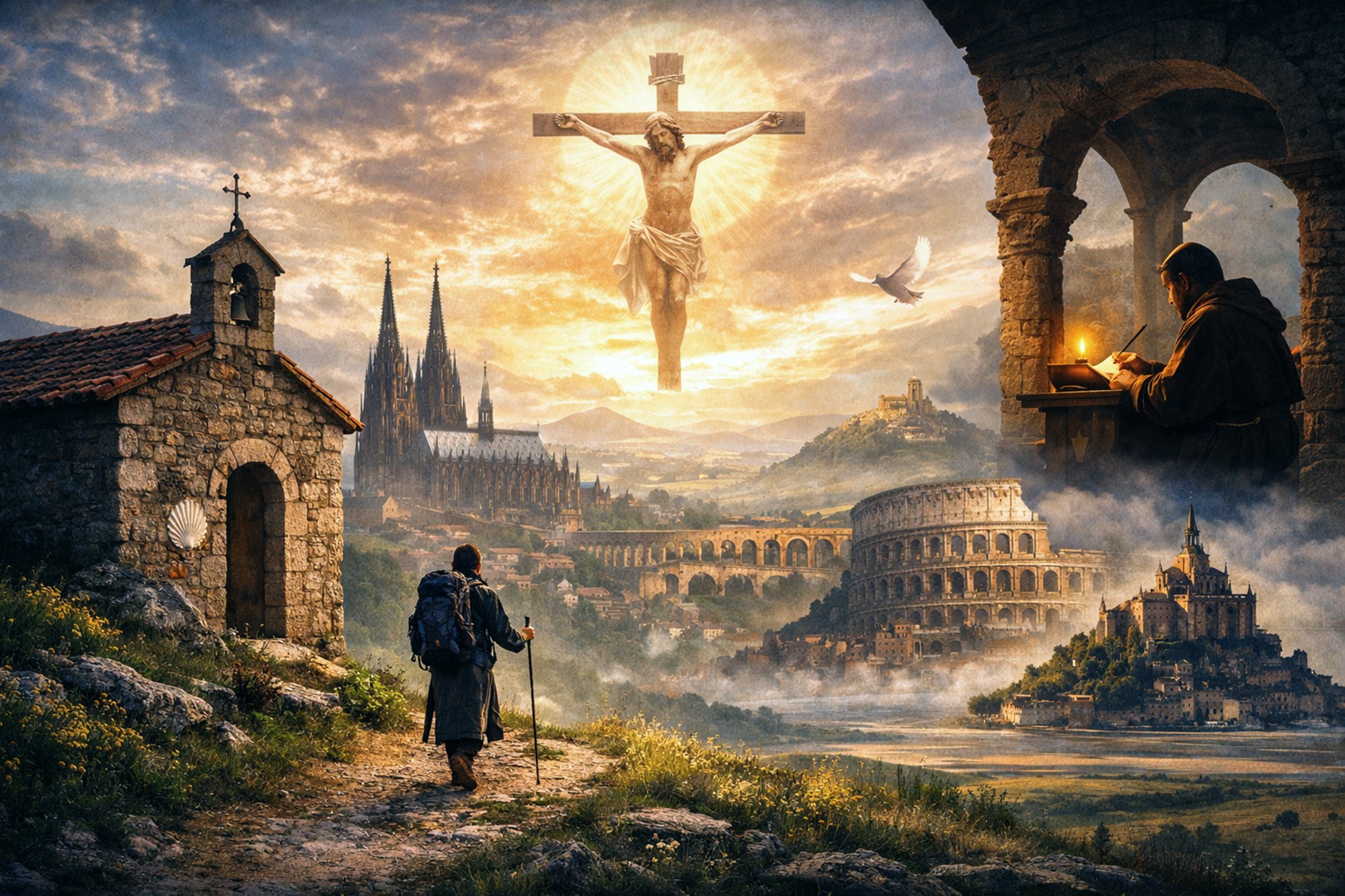
Image created with AI
When you travel through Europe, Christianity is everywhere. It is in the skyline of almost every town, in the rhythm of the calendar, in music, art, law, and even in the way communities organise care and solidarity. From the Camino routes to the monasteries of Cluny, from small village chapels to the great cathedrals of France, Germany, and Spain, Christianity shaped Europe for more than a thousand years.
To understand Europe, we need to understand how this religion developed. And that story is far more complex than many people assume.
One of the historians who has helped reshape this conversation is Elaine Pagels. Her work shows that early Christianity was not a single, unified movement. It was a landscape of competing ideas, interpretations, and spiritual paths. What we now call “Christianity” emerged only after centuries of debate, conflict, and adaptation.
In the first centuries, different groups tried to answer the same questions. Who was Jesus? What did his message mean? Some focused on faith, authority, and community. Others emphasised inner transformation and spiritual insight. Some believed the kingdom of God would soon arrive in dramatic historical events. Others saw it as a deeper awakening within the human person.
This diversity should not surprise us. Europe itself grew in the same way: through disagreement, exchange, and gradual consolidation. Cultural unity often came later, and rarely without conflict.
The early Christians also lived in a harsh and dangerous world. They were a small and vulnerable movement inside the Roman Empire. War, repression, and sudden political change shaped their experience. The destruction of Jerusalem in the first century forced followers of Jesus to rethink their identity and their future. In this environment, religious stories were not only spiritual. They were also tools for survival.
One of Pagels’ most striking insights concerns the development of ideas about good and evil. In earlier Jewish tradition, the figure of Satan played only a limited role. Over time, however, this figure became a powerful symbol of opposition. Religious language helped communities define boundaries: who belonged, and who did not.
Throughout European history, this pattern repeated itself. Christians divided among themselves. Catholics and Protestants fought devastating wars. Each side believed it defended truth against evil. These conflicts shaped the political and cultural map of Europe as much as kings and armies did.
Yet there was always another current. Alongside institutions and conflict, there were voices that focused on inner transformation. Some early Christian texts speak about discovering a deeper reality within oneself. This tradition echoes later in European mysticism, in monastic life, and in spiritual movements that emphasise experience rather than authority.
Eventually, a structured church emerged. It created stability, built institutions, founded universities and hospitals, and helped organise European societies. Without this framework, Europe would look very different today. At the same time, this process also narrowed the range of accepted beliefs. Many early voices disappeared from view.
When we travel through Europe now, we see the result of this long evolution. Every cathedral, pilgrimage route, and festival reflects centuries of debate, hope, fear, and imagination. Christianity did not simply shape Europe. It evolved together with Europe.
Understanding this makes travelling richer. The places we visit are not only monuments of faith. They are traces of the human search for meaning, community, and belonging.
Perhaps this is one of the deepest lessons Europe offers: culture is never fixed. It is always becoming.
Further reading
Elaine Pagels – The Gnostic Gospels
Elaine Pagels – The Origins of Satan
Elaine Pagels – Revelations: Visions, Prophecy, and Politics in the Book of Revelation
Diarmaid MacCulloch – Christianity: The First Three Thousand Years
Tom Holland – Dominion