
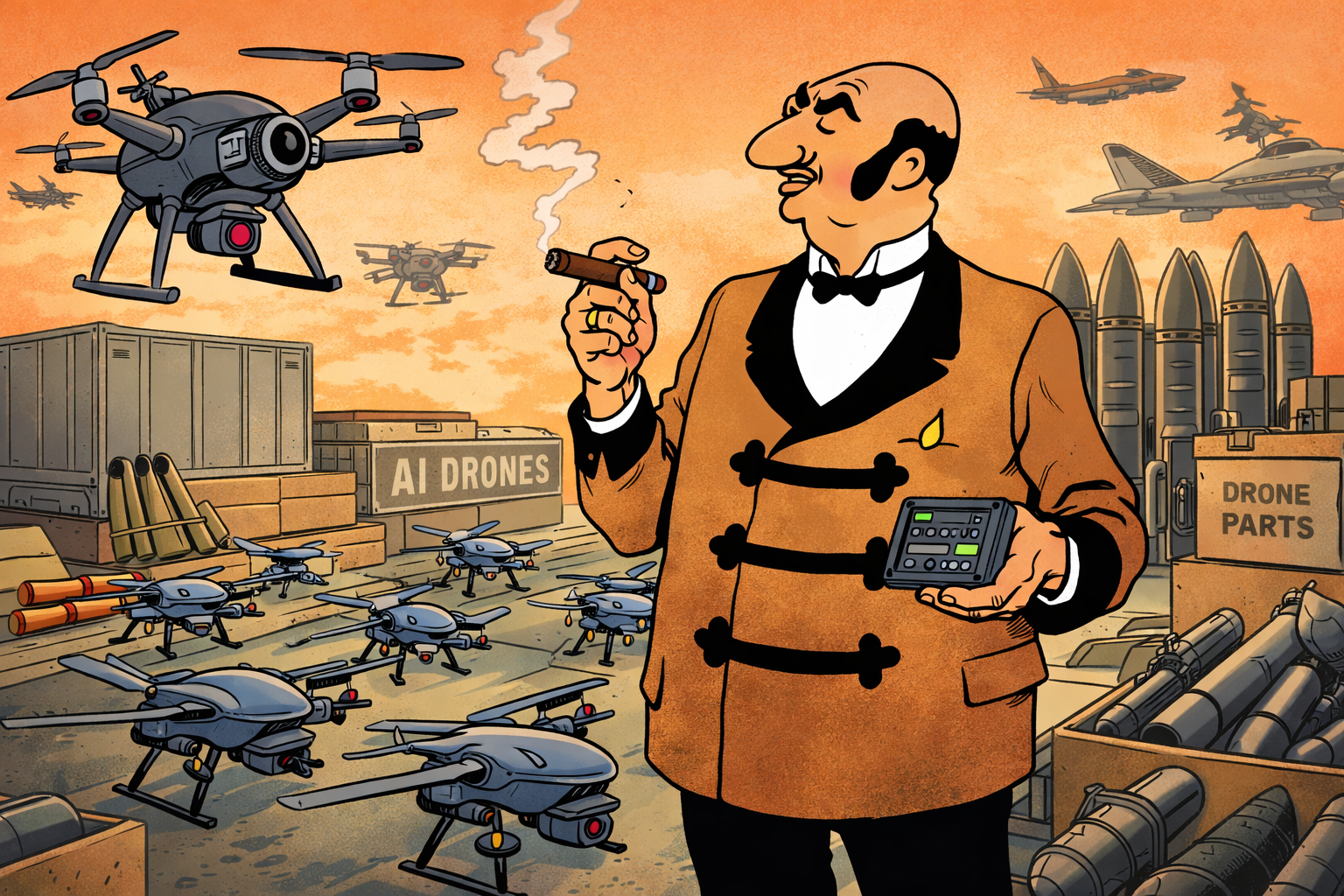
Image created with AI
In the adventures of Tintin (1929 - 1976), villains rarely appear as villains. They wear good suits, run international companies, and speak the language of progress and opportunity. At first glance, these stories may seem like a story from another time. Yet the patterns they reveal feel uncomfortably close to decisions being made in our own time.
No one embodies the dealmakers that we are talking about better than Roberto Rastapopoulos, the cigar-smoking tycoon who first appeared in Cigars of the Pharaoh (1934). Behind his elegant offices and film studios lay a network of smuggling, bribery, and intimidation that stretched across continents.
Rastapopoulos’ genius was not the crime itself, but his ability to make the system work for him.
If Hergé were writing the stories today, Rastapopoulos would probably not be dealing in opium or stolen jewels. His warehouse might instead contain rows of AI drones, missile components, and autonomous aircraft being prepared for “defense contracts.”
Everything would look perfectly legitimate.
Government officials would speak about security. Companies would talk about innovation. Investors would discuss growth markets.
But Tintin — and readers of Tintin — would look beyond the hardware.
A contract appears after a convenient political donation.
A procurement board is chaired by an old acquaintance.
A strategic position goes to a relative of someone powerful.
A competitor quietly withdraws after an unpleasant conversation.
Corruption opens doors. Nepotism keeps them open.
From the outside it all looks modern, technical, even respectable. Yet the structure behind it would be instantly familiar to anyone who has followed the adventures of Tintin.
Because in Rastapopoulos’ world, the real product was never opium, diamonds, or weapons. The real product was influence. And influence, once captured, can move markets, governments — and sometimes even wars.