
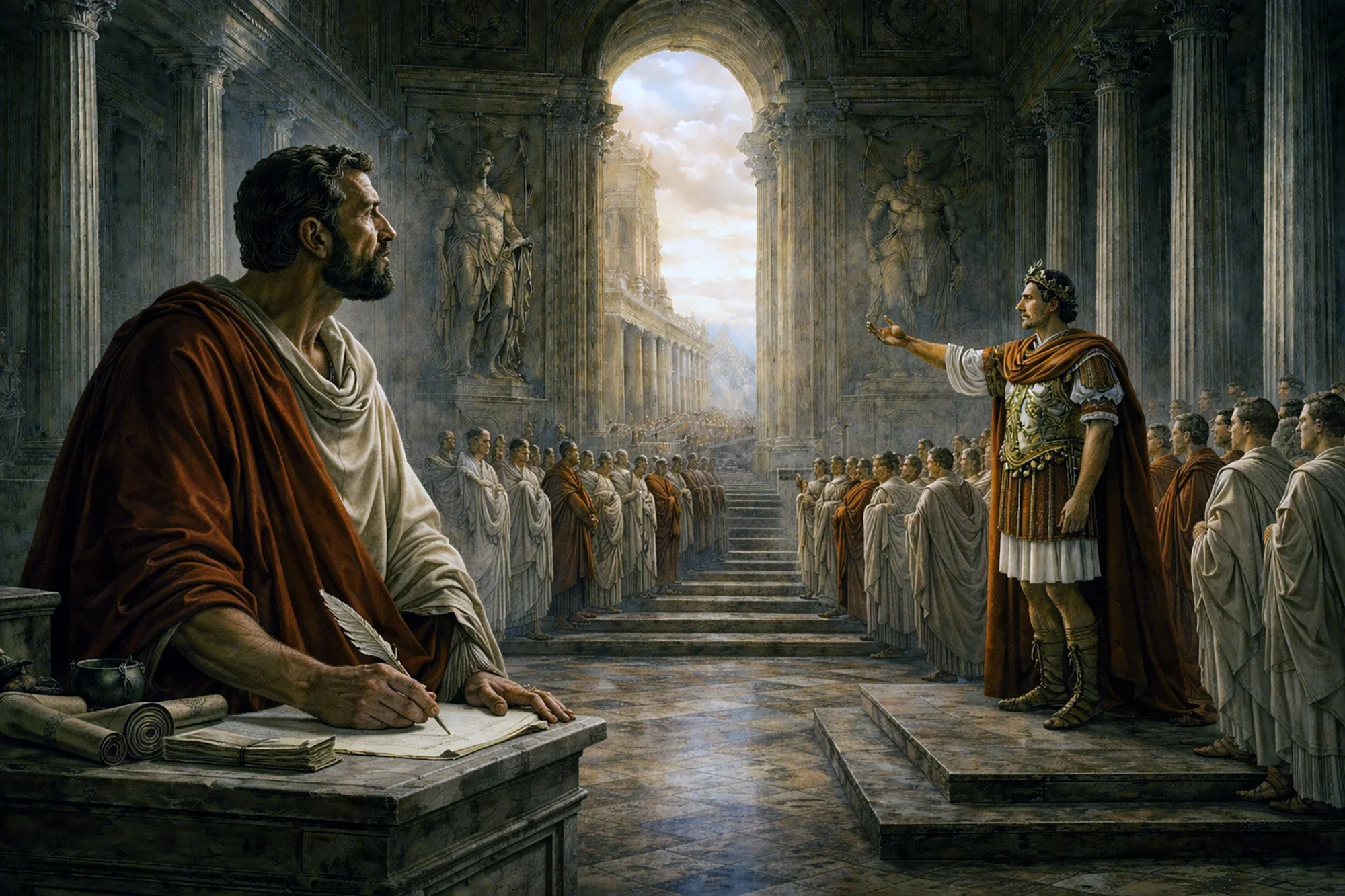
Image created with AI.
Around the year 100 AD, the Roman historian Tacitus looked back on the political world he had lived through and saw something unsettling. Rome still had its Senate. Laws were debated, magistrates held office, and the language of republican government survived. Yet everyone understood that real power now rested with the emperor—whether under Tiberius, Nero, or later Domitian.
Tacitus captured this transformation with quiet precision. Rome had not suddenly abandoned its republican institutions. Instead, those institutions had slowly adapted to a new reality in which authority was increasingly concentrated.
For modern readers, that observation feels strikingly familiar. Across the democratic world—particularly in the United States—political debates increasingly revolve around the strength of institutions, the limits of executive power, and the resilience of constitutional systems. Tacitus does not offer a blueprint for the present. But his histories reveal a recurring pattern in political life: freedom rarely disappears through dramatic collapse. It fades gradually, while institutions continue to function.
A Senator Writing After the Republic
Tacitus was not an outsider observing Rome from afar. He was a senator who had served under several emperors, including the authoritarian reign of Domitian. His career unfolded in a political system where public institutions still existed, but where criticism of imperial authority could be dangerous.
After Domitian’s death, Tacitus began writing his great historical works, including The Histories and The Annals. These books explore the early decades of the Roman Empire and the reigns of emperors such as Tiberius, Nero, and others who shaped the imperial system.
What makes Tacitus remarkable is not only what he records, but how he interprets it. His histories are less concerned with battlefield drama than with the mechanics of power: how rulers influence institutions, how elites behave in changing political environments, and how a political culture gradually adjusts to new realities.
Institutions That Remain, but Change
Rome did not lose its republican structures overnight. The Senate continued to meet and to vote. Courts functioned. Public ceremonies preserved the appearance of the old order.
Tacitus shows how these institutions slowly evolved under imperial authority. Emperors shaped the political climate in which decisions were made. Legal mechanisms could be used to silence rivals. Public debate became more cautious as people learned where the true boundaries of power lay.
What makes Tacitus’ account so compelling is his restraint. He rarely launches direct attacks on the system. Instead, he describes events carefully, allowing readers to see how authority shifts even while institutions outwardly survive.
The Quiet Adaptation of Elites
A central theme in Tacitus’ work is the behavior of Rome’s political elite.
The Senate once stood at the center of Roman public life. Under the empire, it continued to exist but operated within a system dominated by the emperor. Senators responded in different ways. Some openly praised imperial authority. Others remained silent. A few attempted resistance and paid a heavy price.
Tacitus portrays these figures with striking nuance. They are not simply villains or heroes. Many are pragmatic individuals navigating a system that has fundamentally changed.
This raises one of Tacitus’ most uncomfortable questions: when freedom erodes, is it only because rulers seize power—or also because elites adapt to the new order?
A Lens for the United States—and Beyond
Tacitus does not tell us that modern republics will follow the same path as Rome. History never repeats itself so neatly. But his work offers a powerful framework for thinking about political change.
In the United States, institutions remain strong and deeply rooted. Congress legislates, courts interpret the law, and elections regularly shift political power. Yet debates about executive authority, the role of the judiciary, and the stability of democratic norms have become increasingly central to American political life. Presidents rely more frequently on executive orders and emergency powers. Political battles over the courts have intensified. Trust between branches of government has grown more fragile. None of these developments mean that the American republic is destined to follow Rome’s path. But Tacitus reminds us that the health of institutions depends not only on laws and constitutions. It also depends on political habits, expectations, and the willingness of elites to respect the limits of power.
These tensions are not unique to the United States. Across Europe and other parts of the world, societies are also debating the balance between strong leadership, institutional independence, and democratic accountability.
Tacitus helps us see why these debates matter.
The Slow Drift of Political Systems
Tacitus never wrote a formal theory of politics. Yet his histories contain one of the most enduring observations about power.
Political systems rarely collapse overnight. The greater danger lies in gradual change: the expansion of authority in times of crisis, the normalization of exceptional powers, and the quiet adaptation of institutions to new political realities. By the time these shifts become obvious, the system itself has already evolved.
That insight, drawn from the experience of ancient Rome, continues to resonate today. Tacitus reminds us that republics are not only sustained by laws and institutions. They are sustained by the political culture that surrounds them.
When that culture changes, freedom can fade—even while the structures of government remain.
Further Reading
Tacitus – The Annals
Tacitus – The Histories
Tacitus – Agricola
Tacitus – Germania
Ronald Syme – Tacitus
Christopher Kelly – The Roman Empire: A Very Short Introduction
Miriam Griffin – Nero: The End of a Dynasty
Anthony Everitt – The Rise of Rome