
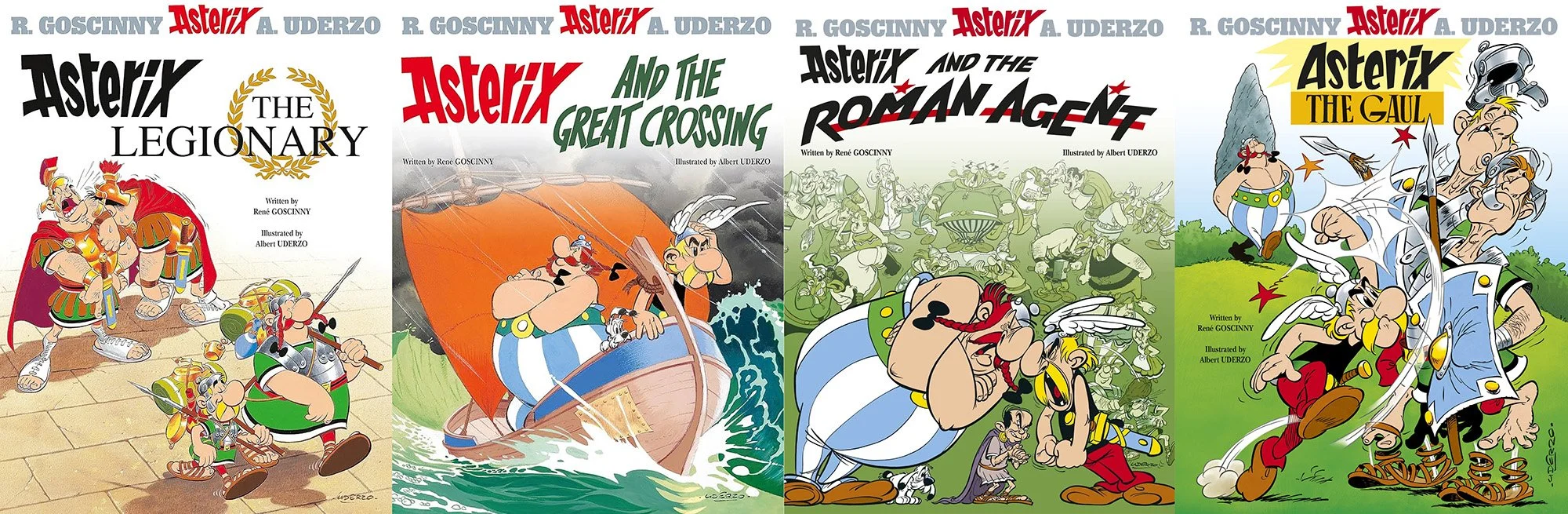
Some covers of English editions of the Asterix comic.
Every Asterix comic begins with the same idea: Gaul is entirely occupied by the Romans. Well, not entirely. One small community still holds out — the village of Asterix.
The story is humorous, but the theme is ancient and deeply European: the tension between large empires and small societies that refuse to submit.
In the comics, Rome represents overwhelming power. The empire has legions, roads, administration, and the confidence that its expansion is inevitable. Around the village stand Roman camps that symbolize imperial order.
The village of Asterix is the opposite: small, noisy, and stubbornly independent. Its inhabitants argue constantly, its chief is carried around on a shield, and its strength comes from the magic potion brewed by the druid Getafix.
Yet somehow, the village holds out.
The comparison is not perfect, but the image inevitably recalls Ukraine today. Faced with a far larger neighbor that claims historical and strategic rights over its territory, Ukraine has refused to accept that size alone determines the outcome.
In the Asterix stories, the villagers rely on magic potion. Ukraine relies on determination, technological ingenuity, and the support of a coalition that does not want the rules of Europe rewritten by force.
Europe’s history is full of similar moments. Time and again, small communities resisted larger empires — sometimes successfully, sometimes not.
That is why the story of the village of Asterix still resonates. It reflects a deeply rooted European belief: that freedom and identity are worth defending, even against overwhelming power.