ukraine

Ukraine and the Old European Story of the Small Village That Refused to Surrender

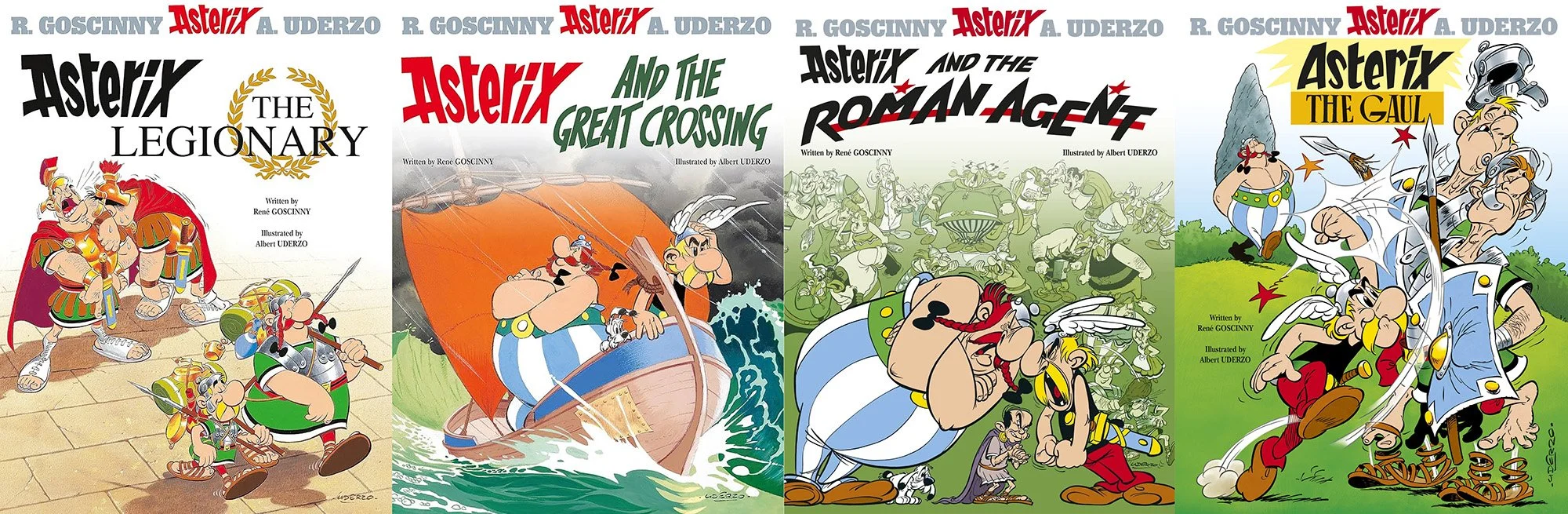
Some covers of English editions of the Asterix comic.

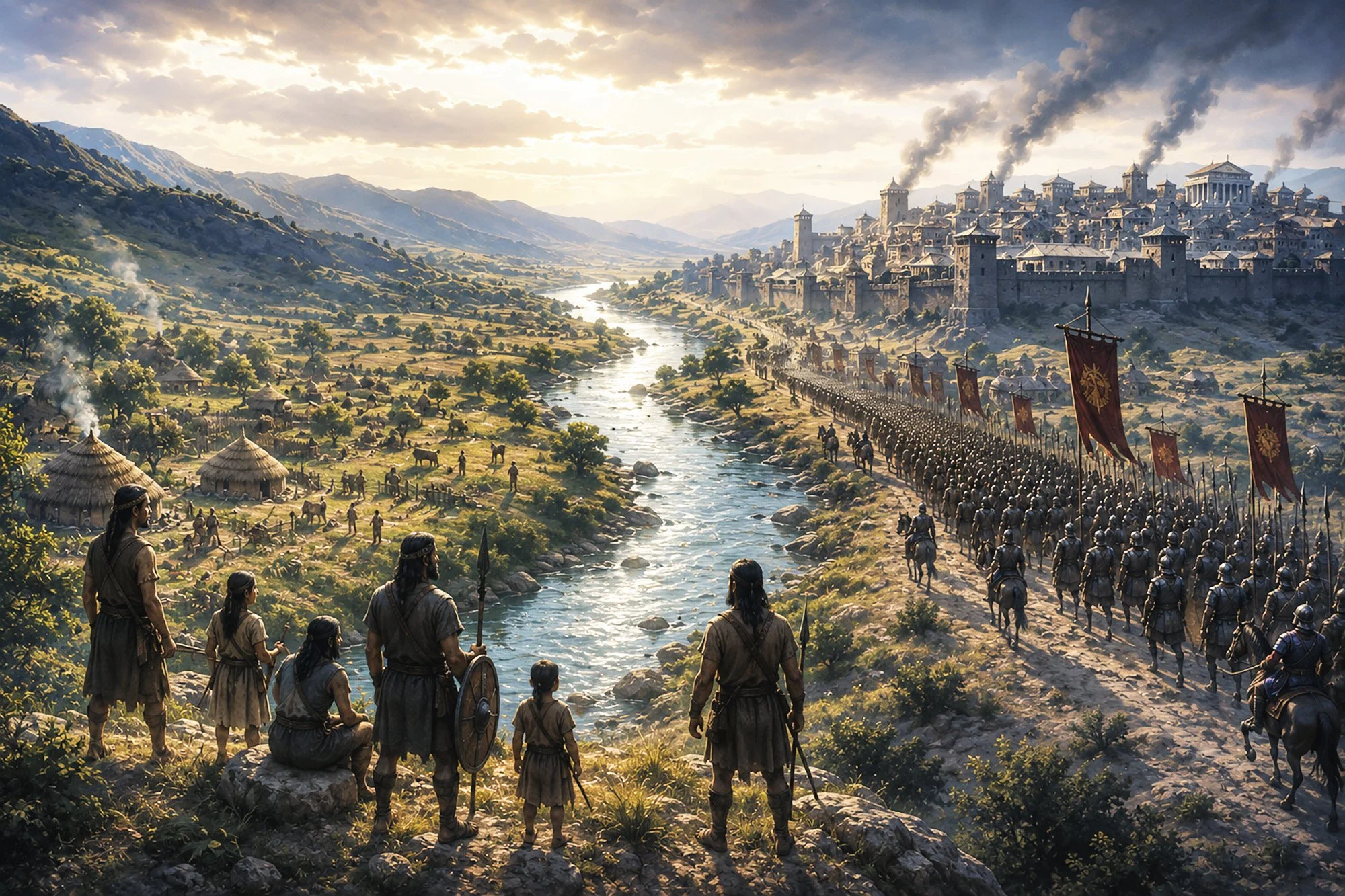
Every Asterix comic begins with the same idea: Gaul is entirely occupied by the Romans. Well, not entirely. One small community still holds out — the village of Asterix.

The story is humorous, but the theme is ancient and deeply European: the tension between large empires and small societies that refuse to submit.

In the comics, Rome represents overwhelming power. The empire has legions, roads, administration, and the confidence that its expansion is inevitable. Around the village stand Roman camps that symbolize imperial order.

The village of Asterix is the opposite: small, noisy, and stubbornly independent. Its inhabitants argue constantly, its chief is carried around on a shield, and its strength comes from the magic potion brewed by the druid Getafix.

Yet somehow, the village holds out.

The comparison is not perfect, but the image inevitably recalls Ukraine today. Faced with a far larger neighbor that claims historical and strategic rights over its territory, Ukraine has refused to accept that size alone determines the outcome.

In the Asterix stories, the villagers rely on magic potion. Ukraine relies on determination, technological ingenuity, and the support of a coalition that does not want the rules of Europe rewritten by force.

Europe’s history is full of similar moments. Time and again, small communities resisted larger empires — sometimes successfully, sometimes not.

That is why the story of the village of Asterix still resonates. It reflects a deeply rooted European belief: that freedom and identity are worth defending, even against overwhelming power.

The Front Is Closer Than We Think

Four Years of Russia’s War Against Ukraine

The Human Face of Europe’s Front.

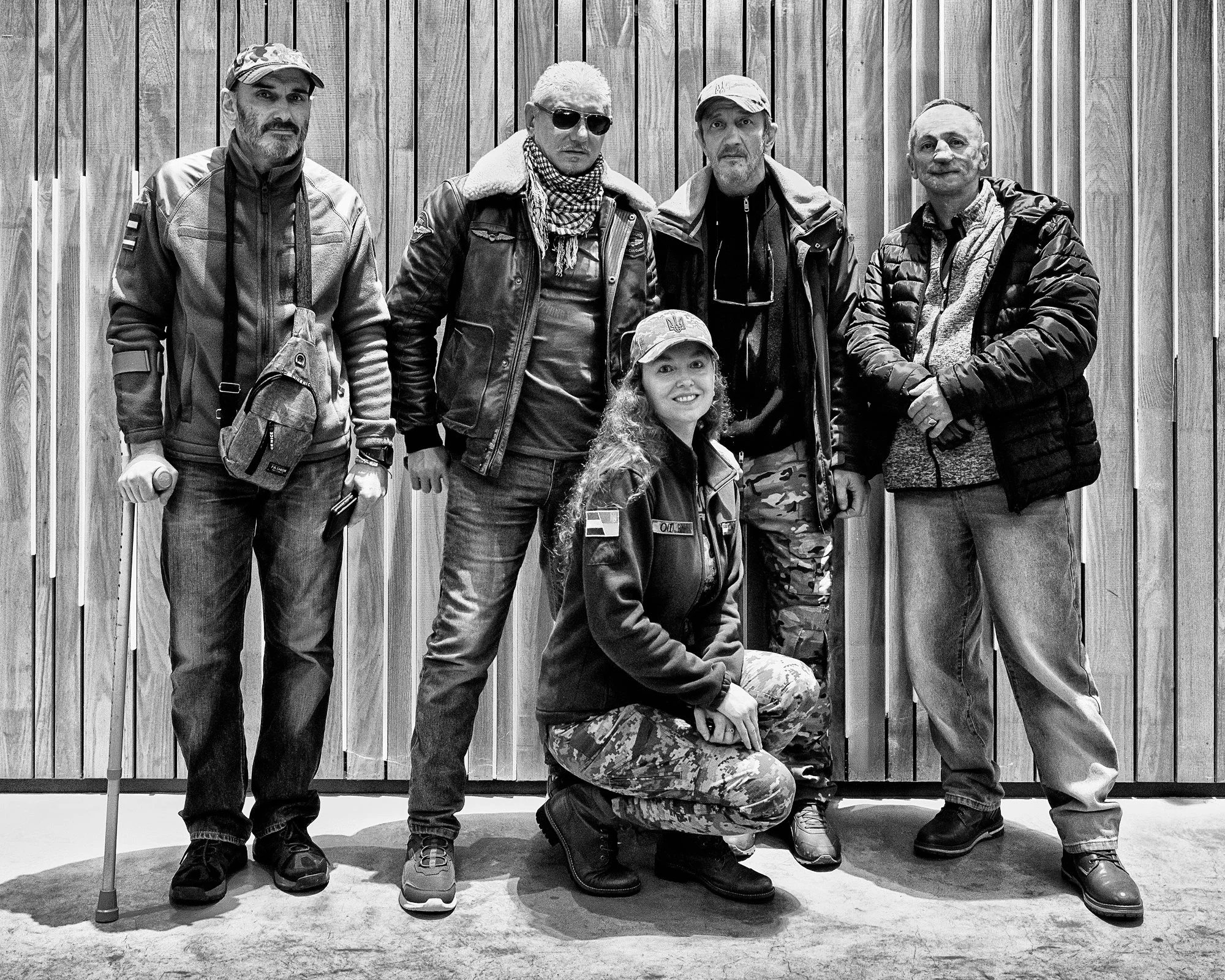
At the Remember Together event in Maastricht (February 24, 2026), held to mark four years since Russia’s full-scale invasion of Ukraine, I met five Ukrainian soldiers who have been fighting at the front. Speaking with them was not dramatic in the way one might expect. It was something else entirely: quiet, sober, and deeply humbling.

One of them, a young woman who spoke Dutch, shared her story. She was born in Ukraine but grew up in the Netherlands. She studied here, built a life here, and speaks with the calm clarity of someone shaped by both worlds. Yet when Russia invaded, she told me, something fundamental shifted. Her sense of justice was so deeply violated that she felt she had no choice. She started to work for the foundation ‘Eyes on Ukraine’ and supports the Ukranian soldiers.

She explained her decision without anger, without theatrical heroism. If you are attacked in your fundamental freedom, you do not really have a choice. You must defend yourself. It was not ideology. It was logic. Almost matter-of-fact.

What struck me most in my conversations with her and the others was their balance. These are people who have lived through trench warfare, who have lost friends, who have seen things most Europeans only know from history books. And yet they spoke with empathy, even about those in Europe who prefer not to see the danger. There was no bitterness. Only concern.

Again and again, they returned to one message: this is not only Ukraine’s front. It is Europe’s front. They worry that many Europeans still believe the war is distant, contained, someone else’s tragedy. They spoke about the fragility of support, about the limits of manpower, about the urgent need for weapons. But also about morale. Soldiers must feel they are not alone.

At the same time, they were clear about something else. You do not want this to happen to you. Their fight is not a call for others to suffer, but a warning. If aggression is not stopped, it spreads.

Standing there in Maastricht, far from the mud and noise of the trenches, I felt a deep sense of humility. These men and women have given so much, and still they speak rationally, with restraint, and with respect for the very societies that hesitate to fully grasp what is at stake. After everything they have endured, they have not lost their humanity.

Perhaps that is their most powerful message. Not only that freedom must be defended, but that even in the darkest circumstances, dignity and empathy can survive. And that, too, is something Europe should not take for granted.


Щиро дякуємо вам за вашу мужність, силу і людяність. Дякуємо, що ви захищаєте свободу всієї Європи. Ми з вами.

We sincerely thank you for your courage, strength and humanity. Thank you for defending the freedom of all Europe. We stand with you.


The Remember Together event was organised by Ukrainian House Maastricht, a local organisation supporting the Ukrainian community.

You can support the soldiers at the front via ‘Eyes on Ukraine’ by - Click Here

More on this blog on the topic of the Ukraine - Click Here

Foreign Policy for Sale: How Trump’s inner circle sees the Ukraine War as a Business Opportunity

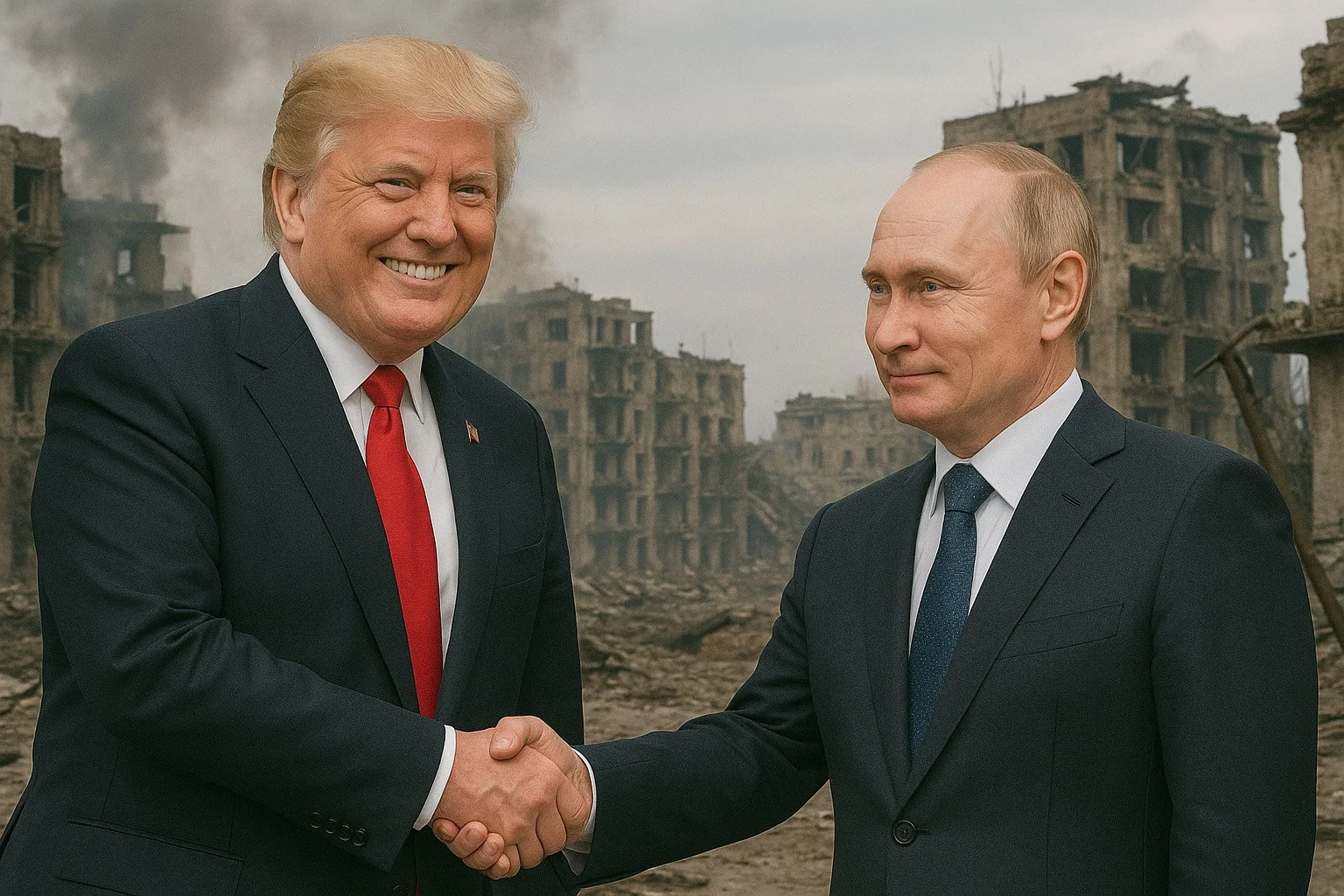
Trump and Putin (image created with AI).

Anne Applebaum’s analysis of the war in Ukraine exposes a troubling shift in how American foreign policy is currently being practiced. Her central argument is not that diplomacy has failed, but that its purpose has been distorted. Decisions that should be guided by public interest, democratic accountability, and long-term security increasingly appear to be shaped by private financial incentives.

At the heart of her critique is a series of informal and opaque “peace initiatives” related to Ukraine. These efforts are not being led by career diplomats, allied negotiators, or institutions accountable to voters and legislatures. Instead, they involve business figures and political confidants operating through private channels between the United States and Russia. While presented as attempts to end the war, the structure and content of the proposals suggest a different underlying logic.

According to reporting Applebaum cites, early versions of these peace plans paired Ukrainian territorial concessions with prospects for American–Russian commercial cooperation. These reportedly included access to natural resources, energy infrastructure, and even the use of frozen Russian assets. Within this framework, Ukraine’s sovereignty and Europe’s long-term security are not treated as fundamental principles, but as variables in a deal.

The substance of the proposed settlement makes this clear. Ukraine would be expected to formally recognize Russian control over occupied territories, renounce any future NATO membership, and accept an agreement without credible security guarantees. Applebaum stresses why this is not merely unfair, but dangerous. Russia has failed to win the war militarily. What it now seeks is a political victory—achieved by persuading or pressuring Ukraine, through American intermediaries, to surrender what Russian forces could not seize on the battlefield.

From Ukraine’s perspective, such a settlement would leave the country exposed. Without firm security guarantees, there can be no real reconstruction, no stable return of refugees, and no lasting investment. A “peace” built on these terms would not end the conflict; it would simply postpone the next phase of it.

Applebaum’s concern, however, extends well beyond Ukraine. What this episode reveals, she argues, is a deeper corrosion of decision-making within the United States itself. Foreign policy begins to resemble a commercial transaction, shaped by individuals whose primary expertise lies in deal-making rather than statecraft. The critical question shifts from “What serves national and allied security?” to “Who stands to gain financially?”

This model closely mirrors the systems Applebaum has long studied in authoritarian states. In such systems, political power and economic power are fused. Diplomacy, business, and state authority become indistinguishable, and public institutions serve the enrichment of a narrow elite. Her warning is stark: when anticorruption laws are ignored and access to power can be purchased, democratic systems begin to function in ways that closely resemble those they once opposed.

The contrast with Ukraine itself is striking. Despite being at war, Ukraine maintains active anticorruption institutions that investigate even figures close to political leadership. These efforts persist because Ukrainians understand something fundamental: corruption is not only immoral, it is strategically dangerous. It weakens the state and makes it vulnerable to external coercion. In this respect, Ukraine often appears more committed to democratic self-correction than the country negotiating its future.

Europe, meanwhile, is adjusting to the realization that American leadership can no longer be assumed. Countries closest to Russia have increased defense spending and military cooperation, while broader European support for Ukraine continues to grow. Germany’s shift in strategic thinking is particularly significant. The war is accelerating Europe’s move toward greater responsibility for its own security.

Applebaum does not argue that the United States has lost all influence. But she makes clear that influence erodes when foreign policy is treated as an opportunity for profit rather than a public trust. A settlement shaped by private interests would weaken Ukraine, destabilize Europe, and further undermine confidence in democratic governance.

The lesson of her argument is ultimately straightforward. When the Ukraine war is viewed as an opportunity—for access, leverage, or financial gain—foreign policy ceases to serve the public. The cost is paid not only on the battlefield, but in damaged alliances, fragile peace, and the gradual erosion of democratic credibility itself.


About Anne Applebaum: Anne Applebaum is a Pulitzer Prize–winning historian and journalist, best known for her work on authoritarianism, Eastern Europe, and the legacy of Soviet power. She is a staff writer at The Atlantic and a senior fellow at Johns Hopkins University. Her books include Gulag: A History, Red Famine: Stalin’s War on Ukraine, and Autocracy, Inc., in which she examines how modern authoritarian systems merge political power with private wealth. Applebaum lives in both the United States and Poland and has written extensively on Ukraine, Russia, and the evolving crisis of democracy in the West.

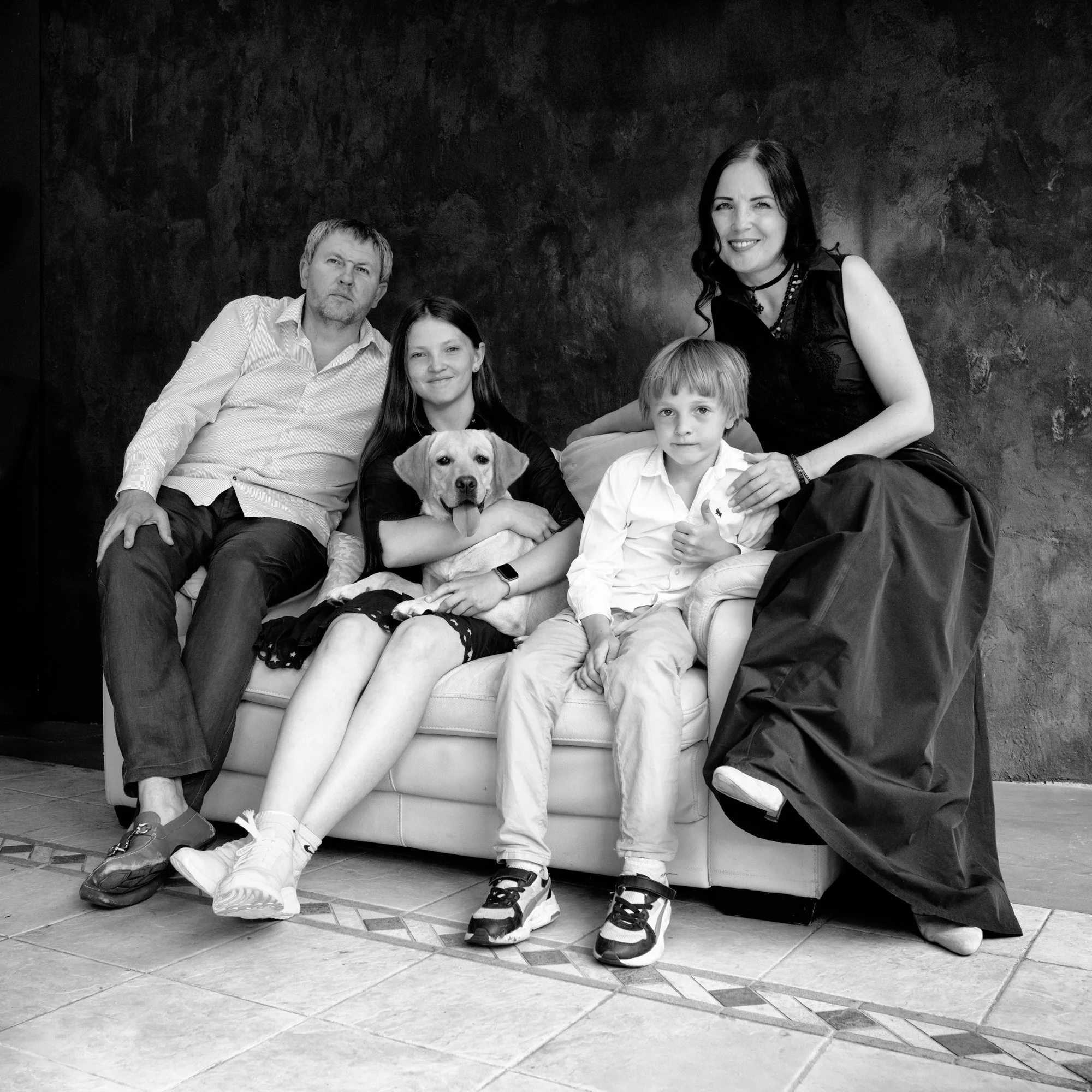
Ukrainians in search of safety: Hanna and family

Hanna and her family in The Netherlands.

My name is Hanna and I’m from Dnipro, a large industrial city in eastern Ukraine. Until early 2022, I lived a full and successful life. I ran my own marketing and advertising agency, worked with major international brands, and was involved in social projects and campaigns. At the same time, I taught marketing, communication, and public relations at the university – something I truly enjoyed. Together with my husband and our three children, we lived a comfortable life. We were entrepreneurial, creative, and engaged in our city.

The unrest began already in 2014, during the Maidan Revolution. It affected me deeply. Young people flooded the streets, dreaming of a European future for Ukraine. That dream was violently crushed. I still remember crying every evening while watching the news. The deaths of young protesters felt personal. That was the moment I understood: we are a people who must fight for freedom, for justice.

When Russia invaded Ukraine on February 24, 2022, everything changed. Our whole family — sixteen people in total — took shelter in a basement. We didn’t live far from the Zaporizhzhia nuclear power plant, and when it came under fire, the fear really hit us. There were rumors of a possible nuclear disaster. Doctors gave instructions on television about how to apply iodine to children’s skin to protect them from radiation. My children saw the panic in my eyes. On the ninth day of the war, I made the decision: we had to flee.

We left Dnipro in five cars. Normally, the drive west would take ten hours — it took us five days. The roads were packed with people like us — desperate, afraid, heading into the unknown. We taped signs reading “CHILDREN” to our car windows, hoping Russian pilots would see we were innocent civilians.

Eventually, we made it to Roermond in the Netherlands, where an old friend offered us shelter. My husband stayed behind at first, to take care of his parents and our business. He only joined us in Roermond nine months later.

Once I arrived, I couldn’t sit still. That’s not who I am. I volunteered at my children’s primary school, working as an interpreter and piano accompanist. Later, I became a coach for Ukrainian employees at La Place, taught at Stedelijk College, and began working as a project leader at the Ukrainian House in Maastricht.

Since October 2023, I’ve been working as a counselor for Ukrainian families in Limburg. I help people integrate, with paperwork, schools, doctors, and government agencies. The work is intense, but rewarding. I know where they come from. I know what it means to leave everything behind.

I feel happy here. In Ukraine, we lived well, but life was stressful and competitive. Here, we’ve found peace. My children are integrated at school, my husband works as a chef, and we are slowly building something new. Still, the future is uncertain. I don’t know if we’ll be allowed to stay. That’s hard, but we do our best, we work, we contribute. We are happy here.

What I’ve experienced is not unique. Hundreds of thousands of Ukrainians carry stories like this. But I hope mine shows just how deeply war affects a human life — and how much strength it takes to start over, in a foreign land, with a foreign alphabet, but with the same hope: a safe life for our children.

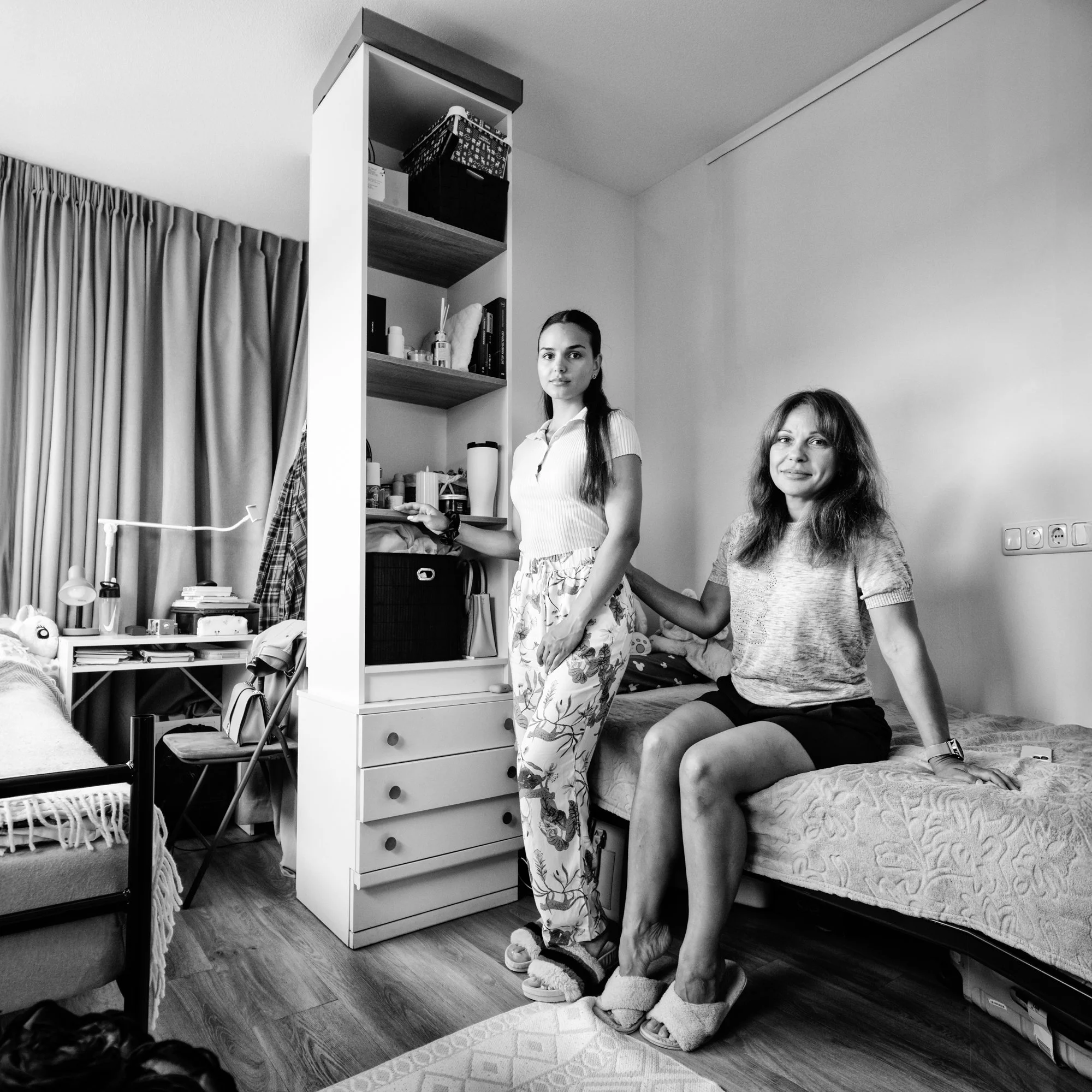
Ukranians in search of safety: Sofiia

Sofiia and her mother in The Netherlands.

I’m Sofiia, 18 years old, and I’m from Kharkiv, a city in eastern Ukraine, close to the Russian border. Until February 2022, my life was what you’d expect for a 15-year-old girl. I went to school, played sports, had friends, made plans. My world felt safe and simple — or so it seemed.

That all changed on February 24. My mother woke me up that morning and said: “Sofiia, the war has started. You’re not going to school today. We have to pack.” At first, I didn’t understand. As a kid, I even thought: no school, maybe I can stay in bed a bit longer. But then we spent days sleeping in the bathroom, between two thick walls. I heard bombs. I saw tanks passing by. We lived on a major road from Russia. Anything could happen at any moment.

My parents and I fled westward. What should have been a one-hour drive took eighteen hours. We slept in gyms, schools, and in places where strangers opened their doors to those in need. Eventually, we arrived in Chernivtsi, near the Carpathian Mountains. That’s where we made a decision that split my life in two: my mother and I would go to the Netherlands, while my father stayed behind. He couldn’t abandon his company or his employees. It broke our hearts, but there was no other option.

Through a friend of my mother’s, we ended up in Roermond. My mother didn’t speak any English, so I took on all the responsibility — documents, meetings, housing. I was fifteen, but suddenly I was no longer a child. In Ukraine, I had never been especially ambitious. But something shifted. I started school at Nt2 Mundium College in Roermond, a school for newcomers. The teachers saw me, supported me, and believed in me. They gave me confidence. I began learning Dutch, took extra courses, and became interested in marketing and international business. Things started to go well.

I now work part-time in an outlet store and volunteer at the Holland Ukrainian House in Maastricht, and a volunteer social media assistant at Meet Maastricht. I’m also doing an online university degree from Ukraine while preparing for a new chapter: I’ve been accepted to Maastricht University to study International Business. The admission process wasn’t easy — I didn’t meet all the requirements, had to submit extra documents, file an appeal, and prove my motivation. But I made it!

And still… everything I’m building here, I carry with mixed feelings. My father still lives in Kharkiv. His company is still running, our old apartment is still there — as if an angel is watching over it, because several bombs have fallen nearby. He lives under constant stress. When he visits us in Roermond, he even says he misses the adrenaline of danger. “You get used to it,” he says. But I also see what it’s done to him — how his thinking has changed, how heavy it all is for him.

My mother struggles. She’s trying to learn the language, but with no clarity about whether she can stay in the Netherlands, it’s hard for her to make decisions about her life. She doesn’t know whether her future lies here or back in Ukraine. Everything is uncertain. I try to support her — as I’ve done from the beginning. But I see how hard it is for her to live in this world of insecurity, without her home, her friends, her husband, her sense of certainty.

My older sister now lives in Spain with her husband and three children. They happened to be there on holiday when the war started, so they didn’t have to flee in a panic. They’re building a new life in Valencia. My cousins are scattered across Europe. Our family has been torn apart.

I don’t know what the future holds. I’d like to stay in the Netherlands — I feel at home here. I’m learning, growing, and I want to give something back. But for now, I only make small plans. After the war, you learn that everything can change in an instant. You become flexible — maybe too flexible. I always need a plan B.

War doesn’t just change your country. It changes your mind, your heart, your family. And still, I try to look forward. Because I’ve learned to. Because I have no other choice. Because I believe that building — even in small steps — is the only way not to break.

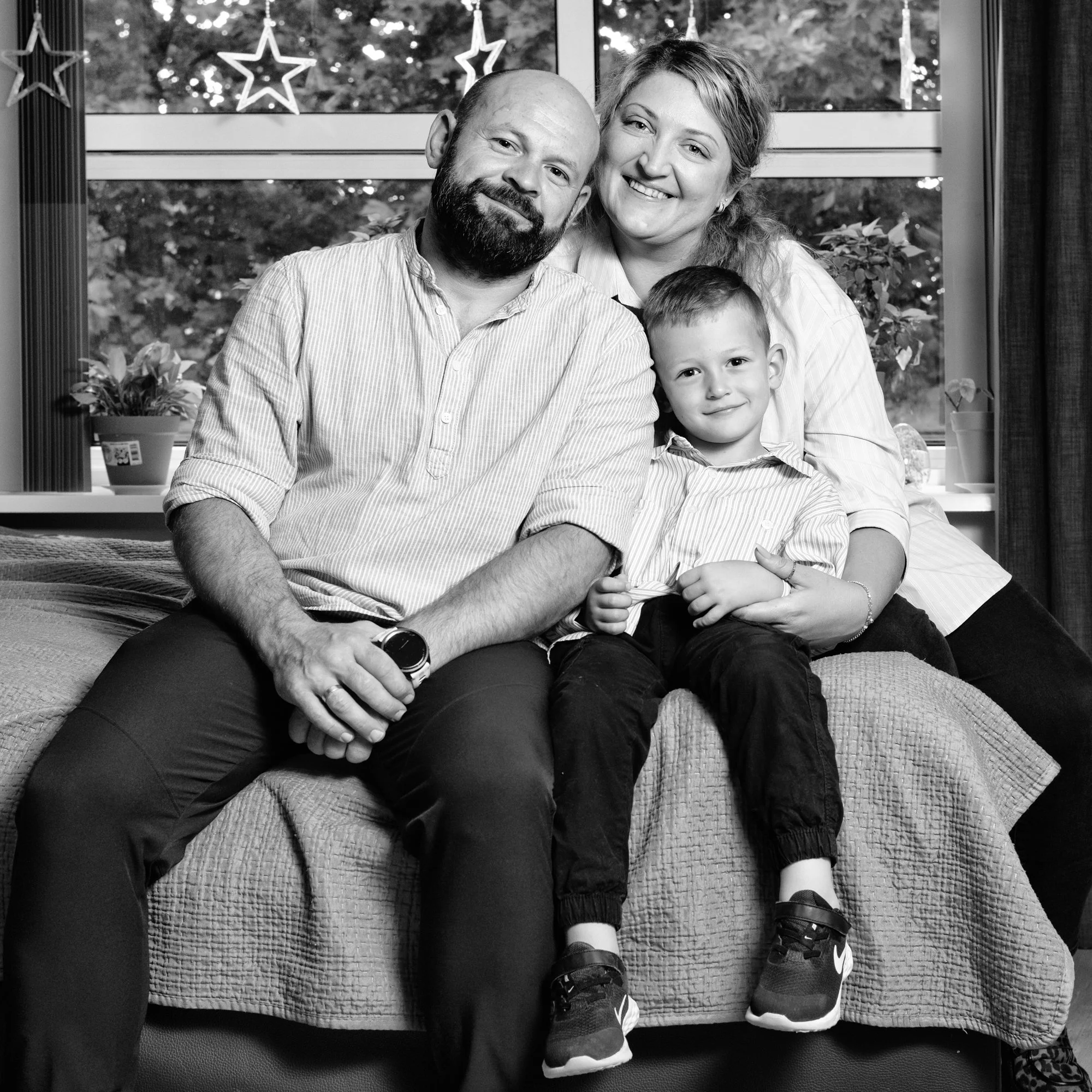
Ukrainians in search of safety: Svitlana and family

Svitlana with her husband and son in The Netherlands.

My name is Svitlana. I’m 40 years old, married, and the mother of a four-year-old son. Until February 2022, I lived a quiet and happy life in Chornobaivka, a village in the Kherson region in southern Ukraine. I owned my own nail studio, had worked as a manicure and pedicure specialist for seventeen years, and held a master’s degree in management. After my maternity leave, I dreamed of working in government. My husband and I were building our future: a beautiful, light-filled home for our family, full of plans and hope.

But everything changed on February 24, 2022.

That morning, the Russian invasion of Ukraine began. In the first few days, we didn’t understand how serious it was. My son was almost one year old – his birthday is on March 1. We decided to move in with my parents, as their house seemed safer than our fifth-floor apartment. But the violence reached us there too. We heard bombs, saw helicopters flying low overhead. Our house was hit by a rocket. The windows shattered. We had to flee to the basement, where we lived for three months.

That’s when the Russian occupation of our region began. It became a blockade. There was almost no food, no diapers, no baby formula. My parents and I ate only once a day, so my son would have enough. We slaughtered chickens, geese, and ducks. One neighbor found a small piece of turkey in her freezer – I cried with gratitude that I could give it to my child.

After three months, I knew we had to flee. I knew people who had tried and died, their cars hitting landmines. I was terrified. But staying might be even more dangerous. My husband was already in Europe and kept asking if I could come with our son. We tried to leave the occupied zone eleven times. Ten times we were stopped – there were no safe corridors, no green routes, no guarantees. On the eleventh try, we made it. When I saw the Ukrainian flag waving again after three months, I cried. The pain and fear of that time are still with me.

We stayed in the free part of Ukraine for another month. I arranged passports, saw doctors, took care of everything. Then we traveled via Moldova to Amsterdam, where my husband was waiting for us. Since July 2022, we’ve lived in Roermond. The municipality helped us – with food, diapers, a small bed. The kindness of the people here touched me deeply.

In the beginning, it was hard. I didn’t speak the language, didn’t know anyone. Everything was new, and I fell into a depression. But people helped us – with their hands, with pictures, with gestures. I started learning English, and now I’m waiting to start a Dutch language course. My husband has a permanent job at an outlet in Roermond, and our son goes to school. He’s doing well.

In the meantime, I do volunteer work at the Ukrainian school “Kryla” in Maastricht and sing in “Ptaha,” a choir of Ukrainian women. We sing, share our stories, and show that Ukrainian women are strong.

My parents still live in Ukraine. So does my brother. I miss them. I send gifts, try to help. Ukraine is and always will be my home. But here in the Netherlands, I feel safe. We want to stay here, build a life, rent a house in or near Roermond. My greatest dream is peace. No more war. No more sirens, bombs, or fear. I believe in a future with blue skies – for my son, for Ukraine, and for the whole world.

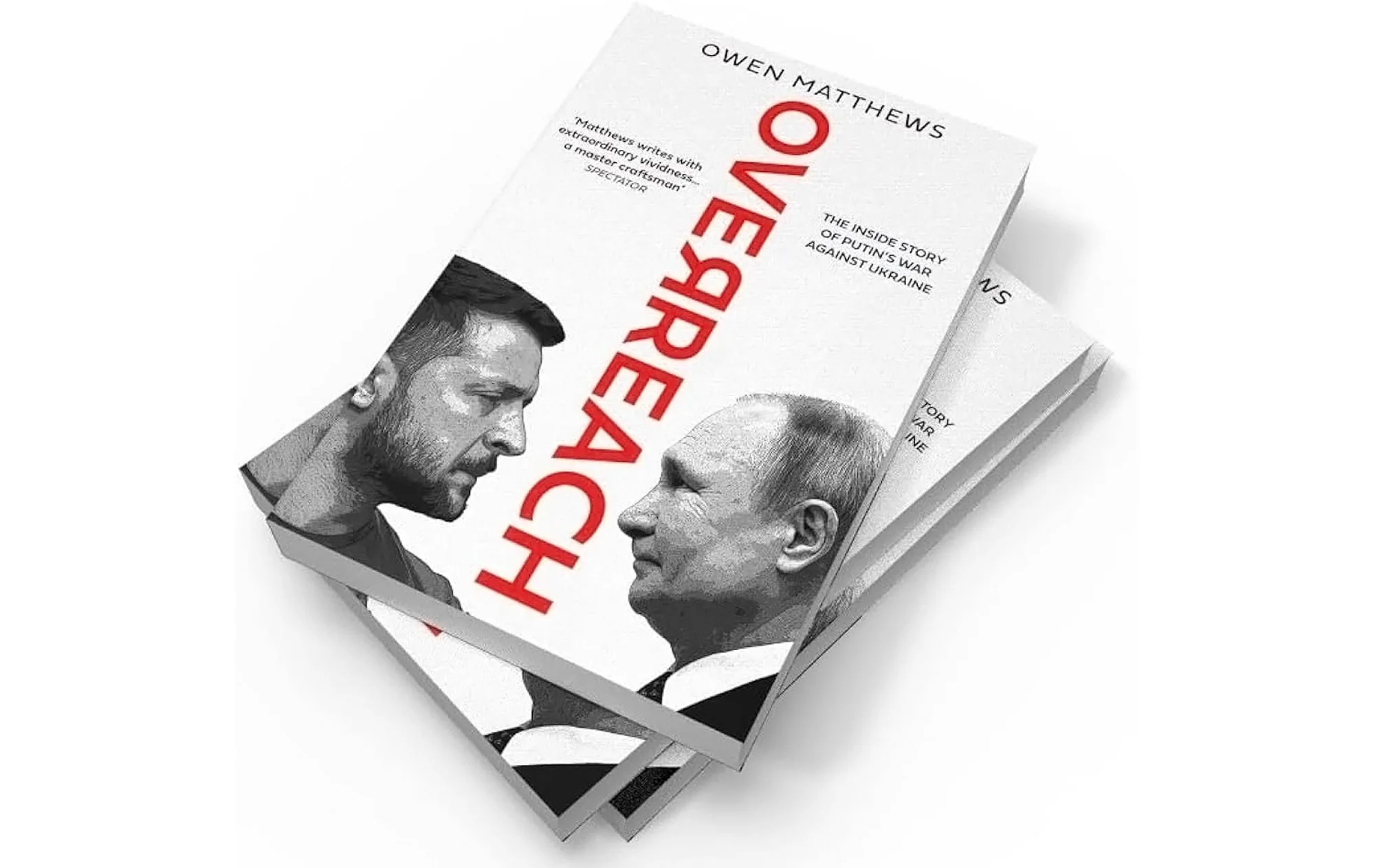
Overreach: Inside the Delusion: What “Overreach” Reveals About Putin’s War

Matthews, Owen. Overreach: The Inside Story of Putin’s War Against Ukraine (2023). - Image by amazon.com.

I recently came across Overreach: The Inside Story of Putin’s War Against Ukraine by Owen Matthews — a book that reads with the fluency of frontline reporting and the authority of someone who has seen Russia from the inside. Matthews, a veteran Moscow correspondent, writes with speed and confidence, stitching together intelligence leaks, diplomatic whispers, and battlefield accounts into a sharp, coherent narrative.

At its best, Overreach captures the extraordinary convergence of misjudgments that led to the invasion: a leader sealed off from reality, an army unready for the war it was told to win in three days, and a West too entangled in its own cynicism to believe the warnings. Matthews reconstructs the atmosphere inside the Kremlin with the precision of a journalist who has cultivated his sources well. His portrait of Putin is chilling — not the omnipotent schemer of Western caricature, but an aging ruler trapped in his own mythology, convinced that history is waiting for his final act.

But this clarity comes at a price. Matthews’ narrative occasionally slides into neatness — a story too elegantly told for a conflict that remains chaotic, contradictory, and unresolved. The reader rarely encounters the moral murk, the grey zones of complicity and fatigue that define real war. Ordinary Russians appear mostly as footnotes to elite decision-making, and Ukraine’s agency, while acknowledged, is often framed as reaction rather than initiative. The analysis sometimes echoes the Western policy consensus more than it interrogates it.

Still, Overreach succeeds on its own terms: it’s a readable, intelligent account of how hubris, fear, and historical delusion collided in 2022. Matthews’ talent lies in connecting personalities to consequences, and his prose hums with restrained anger — the tone of someone who knows too well that none of this had to happen.

If the book has a lesson, it’s this: wars are rarely born of strategy alone, but of misread intentions and unchecked pride. Overreach reminds us that power, once convinced of its own inevitability, is already in decline.

Matthews, Owen. Overreach: The Inside Story of Putin’s War Against Ukraine (2023).

Russia, The Eternal Return of Suppression: 2022 and Beyond - The Great Break

The events of February 24, 2022, marked the most dramatic rupture between Russia and the West since the Cold War. In the early hours of the morning, Russian forces launched a full-scale invasion of Ukraine from multiple directions — pushing south from Belarus toward Kyiv, east from Russia into the Donbas, and north from Crimea into the southern regions of Kherson and Zaporizhzhia. The Kremlin framed it as a “special military operation,” but its scale and ambition made clear it was a war to redraw borders and reshape Europe’s security architecture.

The Failed Blitzkrieg
Moscow’s plan for a lightning strike — seizing Kyiv within days, decapitating Ukraine’s leadership, and installing a pro-Russian government — collapsed in the face of fierce and determined resistance. Ukrainian forces, bolstered by volunteers and armed with Western-supplied anti-tank and anti-aircraft weapons, halted the advance. The battles for Kyiv, Kharkiv, and Mykolaiv became early symbols of defiance. By April, Russian troops withdrew from the north, leaving behind evidence of atrocities in towns like Bucha, and concentrated their efforts on the eastern front.

A War of Attrition
With the initial gamble failed, the conflict shifted into a grinding war of attrition. Artillery duels, long-range missile strikes, and the increasing use of drones became defining features of the battlefield. The siege and destruction of Mariupol shocked the world, as tens of thousands of civilians endured bombardment, shortages of food and water, and forced evacuations. Millions of Ukrainians fled abroad, creating the largest refugee crisis in Europe since the Second World War. Meanwhile, Western sanctions hit Russia hard, freezing assets, severing banking connections, and limiting access to critical technologies — though high global energy prices kept Moscow’s war machine funded.

The Expanding Battlefield
By 2023 and 2024, the war’s intensity did not diminish. Both sides adapted technologically: Ukraine integrated Western air defenses and precision-guided munitions, while Russia ramped up drone and missile production with the help of Iran and North Korea. The Black Sea became another contested arena, with Ukraine striking Russian naval assets and supply lines to Crimea. Fighting spread to previously quieter sectors, and both armies dug deeper into fortified positions reminiscent of the First World War.

Global Realignment
Russia’s isolation from the West drove it into a tighter embrace with China, India, Iran, and North Korea, forming a loose but significant network of states willing to trade, share technology, and counterbalance Western influence. NATO, far from fractured, expanded to include Finland, with Sweden on the way — a strategic setback for Moscow. The European Union accelerated its energy diversification, ending decades of dependence on Russian gas. The war shattered the assumptions that had underpinned Europe’s post–Cold War order, reviving large-scale military spending and long-term security planning.

Shifting Political Currents
Across Europe and beyond, the war reshaped politics. Governments faced pressure over rising energy prices and defense budgets. Populist movements sought to exploit divisions over aid to Ukraine, while others rallied around the need to defend democratic states from authoritarian aggression. In Russia, dissent was met with harsh repression, new laws criminalized criticism of the war, and thousands of political opponents, journalists, and activists fled abroad.

An Uncertain Future
By 2025, the frontlines had shifted only marginally. Neither side could deliver a decisive blow. Ukraine remained steadfast in its goal of restoring its 1991 borders, while Russia showed no sign of relinquishing occupied territories. The costs — measured in lives lost, economies strained, and trust shattered — promised to shape the region for decades to come. Whether the conflict ends in a negotiated settlement, a frozen front, or continued escalation remains one of the central geopolitical questions of the 21st century.

Further Reading:

  • Luke Harding – Invasion (2022)

  • Serhii Plokhy – The Gates of Europe (2015)

  • Mark Galeotti – Putin’s Wars (2022)

  • Lawrence Freedman – Command (2022)

Russia, The Eternal Return of Suppression: From Georgia to Ukraine

The 21st century saw Russia reassert itself on the world stage — often through military force.

War in Georgia
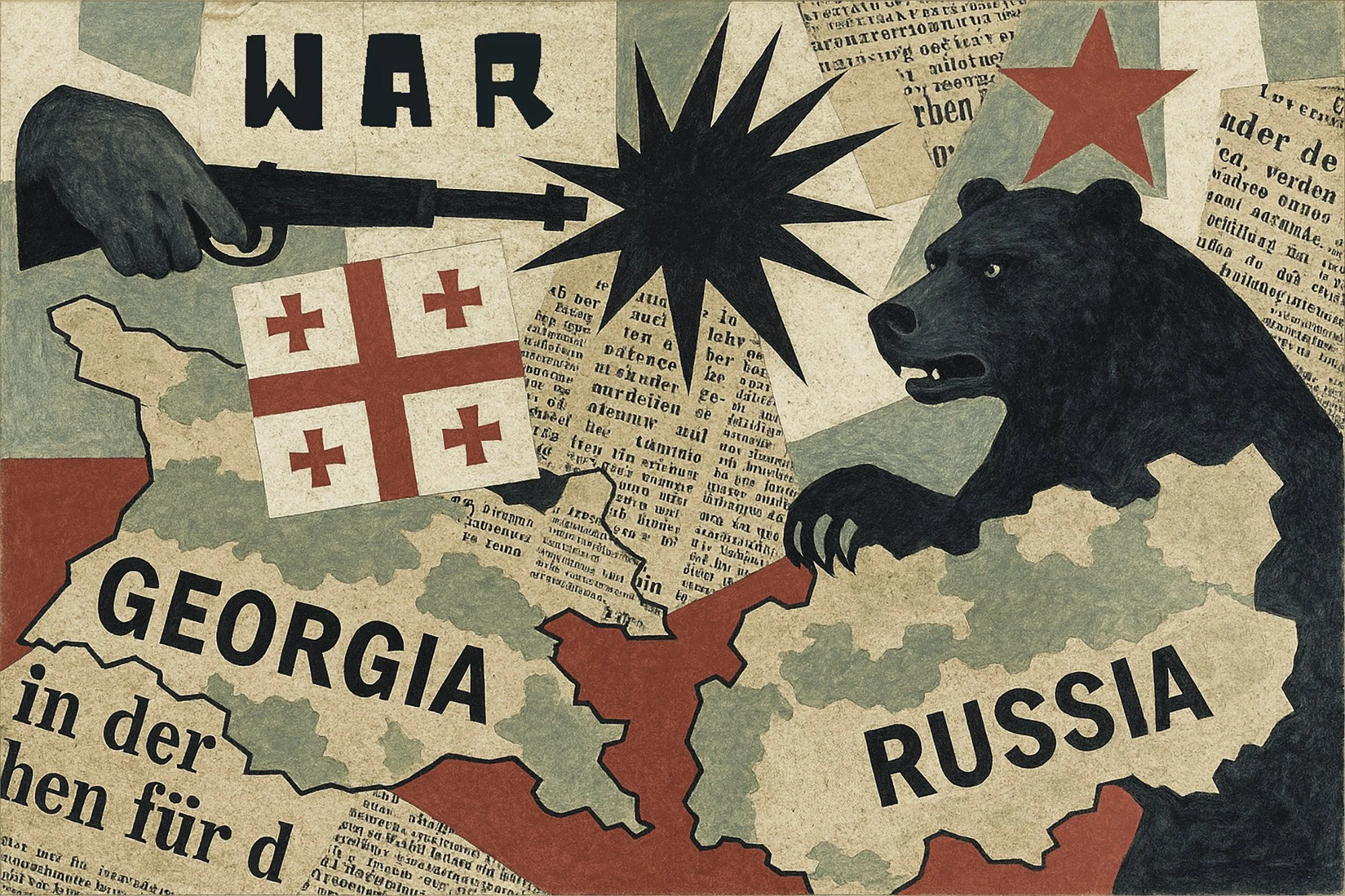
In 2008, tensions in the Caucasus erupted. Georgia sought to reclaim the breakaway regions of South Ossetia and Abkhazia, which were backed by Moscow. Russia responded with a swift military intervention, routing Georgian forces and recognizing the two regions as independent — a signal that Moscow would not tolerate NATO’s eastward reach.

Ukraine’s Turning Point
In late 2013, Ukraine’s president, Viktor Yanukovych, abandoned a planned agreement with the European Union in favor of closer ties to Russia. This sparked mass protests — the Euromaidan movement — in Kyiv. The demonstrations swelled into a revolution, and Yanukovych fled the country in February 2014.

Annexation of Crimea and War in Donbas
Within weeks, Russian troops seized Crimea, citing the need to protect Russian speakers. A hastily organized referendum — unrecognized by most of the world — formalized its annexation. In eastern Ukraine, pro-Russian separatists declared “people’s republics” in Donetsk and Luhansk. Supported by Russian fighters and weapons, they fought the Ukrainian army in a grinding conflict that left thousands dead.

The Frozen Conflict
The Minsk agreements of 2014 and 2015 sought to end the war but failed to resolve the core dispute. For eight years, low-intensity fighting continued, setting the stage for something far larger.

Further Reading:

  • Richard Sakwa – Frontline Ukraine (2015)

  • Anne Applebaum – Red Famine (2017)

  • Timothy Snyder – The Road to Unfreedom (2018)

  • Serhii Plokhy – Lost Kingdom (2017)

Russia, The Eternal Return of Suppression: From Chaos to Putin

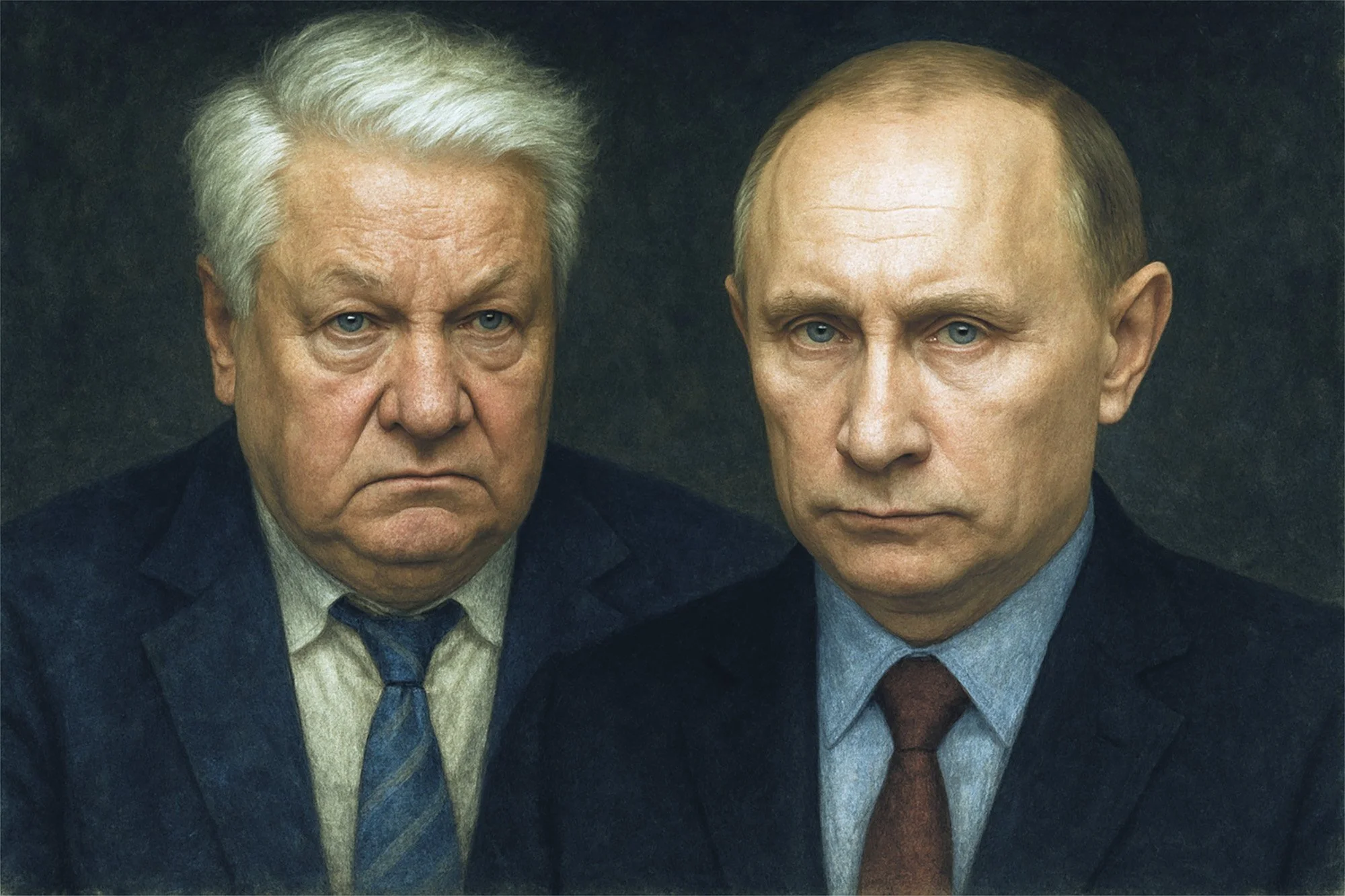
Boris Yeltsin and Vladimir Putin.

The 1990s in Russia were chaotic, hopeful, and brutal all at once. The Soviet collapse brought political freedom, but also economic ruin. Millions saw their savings vanish as inflation soared. State assets were sold off in rigged auctions, creating a new class of billionaires — the oligarchs — while ordinary Russians slid into poverty.

The Yeltsin Years
Boris Yeltsin presided over a turbulent democracy. Parliament clashed with the president; in 1993, tanks shelled the Russian White House during a political crisis. Chechnya declared independence, leading to a bloody war that humiliated the Russian army and deepened public discontent.

The Rise of Putin
In 1999, Yeltsin unexpectedly resigned, naming former KGB officer Vladimir Putin as acting president. Promising order after a decade of chaos, Putin won election in 2000. His early years coincided with a surge in oil prices, fueling economic growth and restoring a sense of stability.

Consolidation of Power
Putin moved quickly to centralize authority. Independent television networks were taken over by the state; regional governors lost their autonomy; political opponents were sidelined or prosecuted. The second war in Chechnya was waged with brutal efficiency, crushing separatism but leaving a legacy of repression.

Further Reading:

  • Anna Politkovskaya – Putin’s Russia (2004)

  • Masha Gessen – The Man Without a Face (2012)

  • Fiona Hill & Clifford Gaddy – Mr. Putin (2013)

  • David E. Hoffman – The Oligarchs (2002)

Russia, The Eternal Return of Suppression: The Fall of the Soviet Union

Mikhael Gorbachev, and his Glasnost and Perestroika.

By the early 1980s, the Soviet Union was a superpower in name but ailing in reality. Its economy was stagnant, its leadership geriatric, and its people weary of shortages and repression. Then came a man who promised change: Mikhail Gorbachev.

Glasnost and Perestroika
Gorbachev, taking power in 1985, sought to reform the system with perestroika (economic restructuring) and glasnost (openness). Censorship was eased; criticism of the government became possible. State enterprises gained more autonomy, and limited private business was allowed. But these reforms also exposed decades of corruption and inefficiency.

Nationalism Resurges
With glasnost came a flood of suppressed history: the Stalinist purges, the secret Molotov–Ribbentrop Pact, and the scale of wartime losses. In the Baltic states, Ukraine, Georgia, and elsewhere, nationalist movements gained momentum. The USSR’s empire in Eastern Europe collapsed almost overnight in 1989, as one communist regime after another fell — first in Poland, then Hungary, East Germany, and beyond.

The Coup and the Collapse
In August 1991, hardline communists staged a coup against Gorbachev. Crowds in Moscow, led by Russian President Boris Yeltsin, resisted, and the coup failed. But the attempt fatally weakened the central government. By December, the leaders of Russia, Ukraine, and Belarus declared the USSR dissolved. On December 25, 1991, the Soviet flag came down over the Kremlin for the last time.

The Legacy
The USSR’s collapse ended the Cold War but left behind 15 independent states, a shattered economy, and unresolved questions about identity and power — questions that still reverberate today.

Further Reading:

  • Serhii Plokhy – The Last Empire (2014)

  • Vladislav Zubok – Collapse (2021)

  • Archie Brown – The Gorbachev Factor (1996)

  • Stephen Kotkin – Armageddon Averted (2001)

Russia, The Eternal Return of Suppression: The Cold War - Confrontation and Control

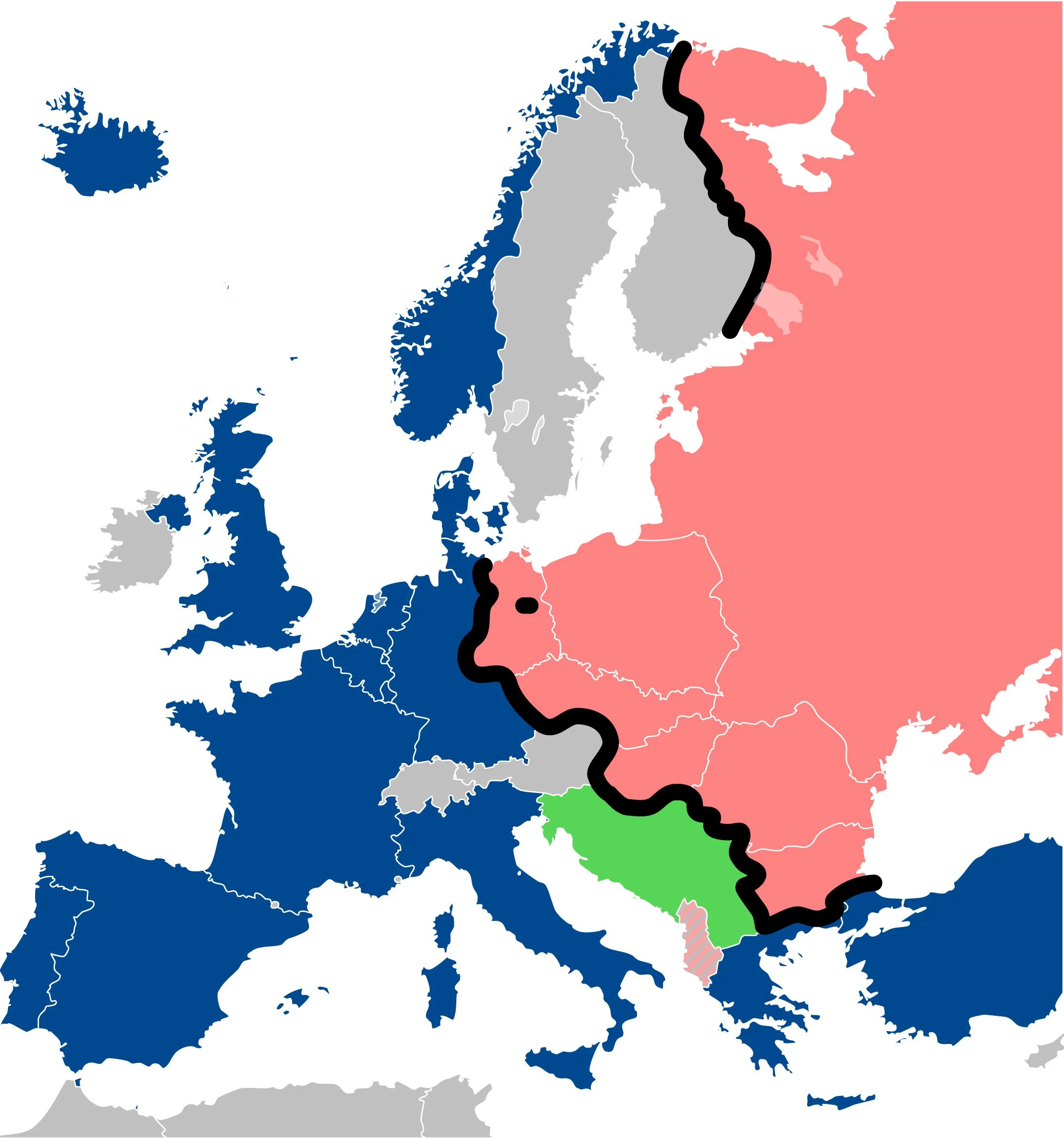
Map of post–World War II Europe illustrating the Iron Curtain dividing Eastern and Western blocs. License: © Sémhur / Wikimedia Commons. Licensed under CC BY‑SA 4.0 (Creative Commons Attribution‑ShareAlike 4.0 International).

The end of the Second World War left Europe divided — and the Soviet Union standing as one of two superpowers. The Red Army’s march west had not only defeated Nazi Germany but also planted the seeds of Soviet influence deep into Eastern Europe. What followed was a forty-year geopolitical standoff that shaped the modern world.

The Iron Curtain Descends
By 1947, Winston Churchill’s “Iron Curtain” speech captured the new reality: Eastern Europe, from the Baltic to the Balkans, was under communist governments loyal to Moscow. The USSR created a buffer zone of satellite states — Poland, East Germany, Czechoslovakia, Hungary, Romania, and Bulgaria — all bound together through political repression, secret police, and a common economic system, COMECON.

Containment and Confrontation
The United States responded with the policy of containment, pledging to halt the spread of communism. NATO was formed in 1949; the Warsaw Pact, its Eastern counterpart, followed in 1955. The Korean War (1950–1953) saw Soviet pilots secretly fighting for North Korea, while crises in Berlin repeatedly brought the superpowers to the brink.

Cracks in the Bloc
Even within the communist camp, unrest boiled. In 1956, a workers’ revolt in Hungary was crushed by Soviet tanks, killing thousands. In 1968, the Prague Spring in Czechoslovakia — a movement for “socialism with a human face” — was similarly put down by a Warsaw Pact invasion. The Brezhnev Doctrine justified such interventions as necessary to preserve the socialist system.

The Arms and Space Races
The Cold War was fought not only with ideology and armies but also with technology. The Soviets shocked the world in 1957 with the launch of Sputnik, the first artificial satellite, and in 1961 by sending Yuri Gagarin into space. But prestige in space masked economic stagnation at home. The nuclear arms race consumed vast resources, and the fear of mutually assured destruction hung over the globe.

Dissent Behind the Curtain
While dissidents like Aleksandr Solzhenitsyn exposed the horrors of the Gulag, and Andrei Sakharov spoke out for human rights, the KGB ensured dissent was contained. Yet underground movements, samizdat literature, and the whispers of reform kept the spirit of resistance alive.

Further Reading:

  • Anne Applebaum – Iron Curtain (2012)

  • John Lewis Gaddis – The Cold War (2005)

  • Vladislav Zubok – A Failed Empire (2007)

  • Tony Judt – Postwar (2005)

Russia, The Eternal Return of Suppression: The Second World War and a New World Order

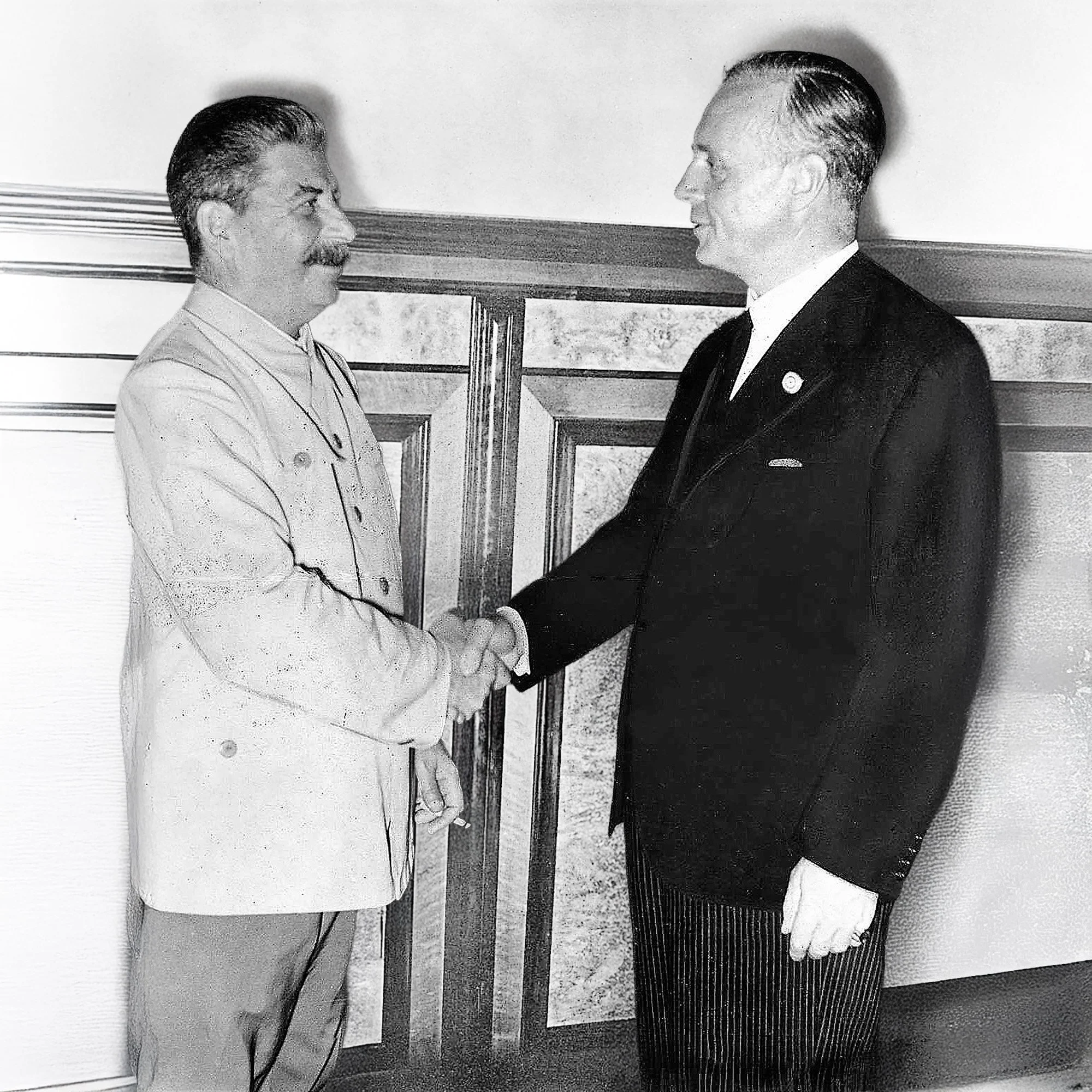
Pact with the Devil, Joseph Stalin shakes hands with German Foreign Minister Joachim von Ribbentrop at the Kremlin, Moscow, 1939. Based on photo: Bundesarchiv, Bild 183-H27337 / CC-BY-SA 3.0 DE.

The Second World War was both a catastrophe and a crucible for the Soviet Union. It transformed the USSR from an embattled revolutionary state into one of the two global superpowers — but at a staggering human cost.

The Pact with the Devil
In August 1939, the world was stunned by the Molotov–Ribbentrop Pact. The Soviet Union, sworn enemy of fascism, signed a non-aggression treaty with Nazi Germany. A secret protocol divided Eastern Europe into spheres of influence. When Germany invaded Poland from the west on September 1, the Red Army marched in from the east two weeks later, seizing territory promised in the pact. Within a year, the USSR had annexed the Baltic states and parts of Romania, and waged a bitter war against Finland in the Winter War of 1939–1940.

Operation Barbarossa: The Shock
At dawn on June 22, 1941, Germany launched Operation Barbarossa, the largest military invasion in history. Three million German soldiers, supported by allies, surged into Soviet territory. Stalin had ignored multiple warnings from Western intelligence and his own spies, convinced Hitler would not break the pact so soon. The result was chaos: Soviet forces were encircled, millions captured, and vast swathes of land overrun in the first months.

A War of Survival
Yet the Soviet Union did not collapse. Moscow did not fall. The Soviet leadership relocated industry east of the Urals, away from German bombers. Ordinary citizens endured unimaginable hardship — cities under siege, villages burned, families torn apart. The Siege of Leningrad lasted 872 days, killing over a million through starvation, shelling, and cold. The Battle of Stalingrad (1942–1943) became the turning point: a brutal, house-to-house struggle that ended with the surrender of an entire German army.

The Road to Berlin
From Stalingrad onward, the Red Army went on the offensive. In 1944, Operation Bagration annihilated Germany’s Army Group Centre, liberating Belarus and pushing west. Soviet troops advanced through Poland, Romania, Hungary, and into the heart of Germany. On May 2, 1945, Berlin fell to Soviet forces, and on May 9, the USSR celebrated Victory Day.

The Human Cost and Political Gain
The Soviet Union emerged victorious, but the toll was staggering: at least 20 million dead, countless wounded, and vast destruction of towns, farms, and infrastructure. Yet geopolitically, the USSR gained enormous influence. Communist governments, backed by Soviet military presence, took power across Eastern Europe. The wartime alliance with Britain and the United States soon gave way to suspicion and rivalry — the Cold War was already germinating.

Further Reading:

  • Richard Overy – Russia’s War (1997)

  • Antony Beevor – Stalingrad (1998)

  • Catherine Merridale – Ivan’s War (2006)

  • Evan Mawdsley – Thunder in the East (2005)

Europe at the Crossroads

Europe stands on a knife-edge. While China relentlessly builds and the United States races ahead in technology, the European Union risks drifting into slow decline—economically weaker, strategically dependent, and exposed to forces it cannot control. The Draghi report on EU competitiveness warns that without decisive action Europe will forfeit not only growth but its ability to defend its way of life.

The threats are multiple and reinforcing. Industrial capacity has thinned as factories moved abroad; vital know-how in energy technology, semiconductors and advanced manufacturing erodes further each year. Clean-tech ambitions clash with energy costs that remain far higher than in the U.S. or China. Fragmented capital markets and labyrinthine rules slow down every promising innovation until competitors elsewhere seize the lead. At the same time China dominates global supply chains for rare earths, batteries and pharmaceuticals, leaving Europe exposed to political leverage from Beijing.

To these economic headwinds comes the hard edge of security. Russia’s full-scale war on Ukraine is no longer a distant regional conflict but a strategic earthquake. A revanchist Kremlin openly threatens NATO’s eastern flank, tests Europe’s airspace and cyber-defences, and bets on Western fatigue. A continent that struggles to produce artillery shells fast enough, or to coordinate its own air-defence procurement, cannot assume that the U.S. nuclear umbrella will always suffice. Economic fragility and military vulnerability feed each other: a weaker industrial base makes rearmament harder, while insecurity discourages long-term investment.

What Europe needs is not another round of cautious communiqués but a surge of purposeful action. The Draghi report calls for hundreds of billions in annual investment to rebuild manufacturing and energy systems, but money alone will not be enough. Decision-making must be faster, regulation simpler, and the single market finally completed so that ideas, capital and skilled workers can move as freely as ambition demands. Industrial policy must target critical sectors—clean energy, digital infrastructure, advanced defence technologies—while integrating climate goals with competitiveness rather than setting them in tension.

Europe has shown before that it can reinvent itself when the stakes are existential. Today the choice is stark: either remain a mosaic of well-meaning but slow-moving states, or act as a true union capable of building, defending and innovating at scale. The alternative is a future where prosperity ebbs, dependence grows and security is left to others. In an age when power belongs to those who can out-build and out-last their rivals, Europe must decide whether it wants to shape the century—or be shaped by it.

Russia, The Eternal Return of Suppression: From Lenin to Stalin - Building the Soviet State

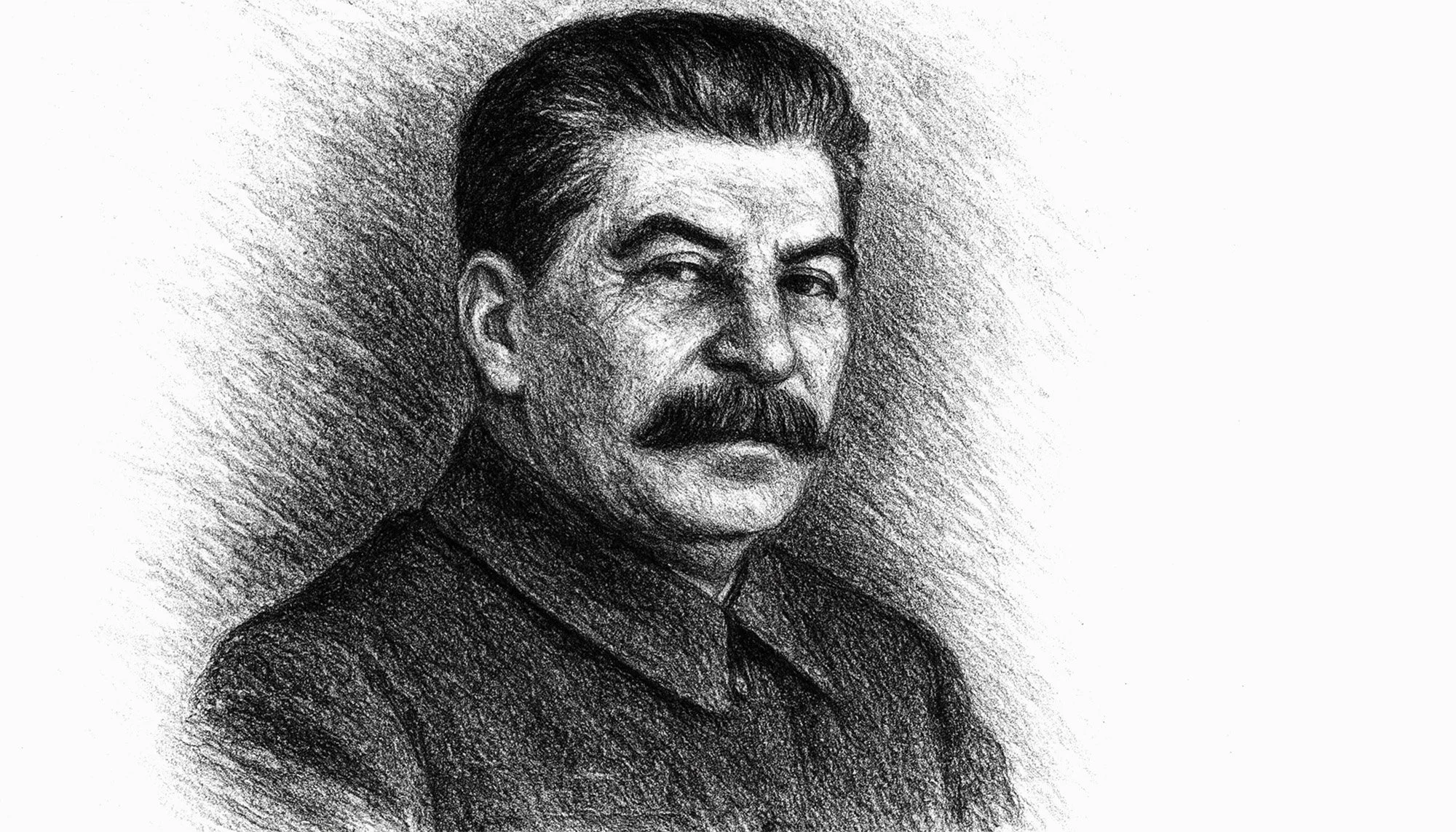
Joseph Stalin

The birth of the Soviet Union in 1922 was both the conclusion of the revolutionary struggle and the beginning of a new experiment in governance. The Bolsheviks had won the Civil War, but they inherited a country ravaged by years of conflict, famine, and economic collapse.

Lenin’s Pragmatic Retreat
To stabilize the economy, Lenin introduced the New Economic Policy (NEP) in 1921. It was a tactical retreat from full socialism: small businesses and private markets were allowed to operate, peasants could sell surplus grain, and foreign investment was cautiously welcomed. The policy brought modest recovery, but also ideological unease among hardline communists.

The Succession Struggle
When Lenin died in January 1924, he left no clear successor. The ensuing power struggle pitted Leon Trotsky — charismatic leader of the Red Army — against Joseph Stalin, the party’s General Secretary. Stalin used his position to quietly build alliances, control appointments, and marginalize rivals. By the late 1920s, Trotsky was exiled, and Stalin stood unchallenged.

The First Five-Year Plan
In 1928, Stalin launched the First Five-Year Plan, aiming to transform the USSR from an agrarian economy into an industrial superpower. Massive projects such as the Dnieper Hydroelectric Station and the Magnitogorsk steelworks became symbols of progress. Industrial output surged, but at tremendous human cost — workers endured harsh conditions, shortages, and strict discipline.

Collectivization and Famine
In the countryside, Stalin forced millions of peasants into collective farms. Those who resisted — labelled “kulaks” — were deported or executed. Grain was requisitioned to feed cities and finance industrialization, even during poor harvests. The result was famine on a massive scale. In Ukraine, the Holodomor of 1932–1933 killed millions, a trauma that still shapes Ukrainian–Russian relations.

The Great Terror
By the mid-1930s, Stalin’s paranoia turned inward. A wave of purges swept the Communist Party, the military, and the intelligentsia. Show trials extracted confessions through torture; executions and Gulag sentences followed. Entire generations of revolutionary leaders vanished. Yet even as fear spread, the Soviet state consolidated its grip, and Stalin’s image as the “Father of Nations” was cultivated through propaganda.

The Soviet Union on the Eve of War
By the end of the 1930s, the USSR was a formidable industrial power with a centralized command economy. The human toll had been immense, but Stalin believed the sacrifices had prepared the country for the challenges ahead — challenges that would arrive sooner than anyone expected.

Further Reading:

  • Stephen Kotkin – Stalin: Paradoxes of Power (2014)

  • Robert Service – Stalin: A Biography (2004)

  • Orlando Figes – Revolutionary Russia 1891–1991 (2014)

  • Sheila Fitzpatrick – Everyday Stalinism (1999)

Russia, The Eternal Return of Suppression: 1917 - Two Revolutions and a Civil War

The year 1917 was a whirlwind that shattered centuries of monarchy and reshaped the map of Eurasia. It began with bread queues and strikes, and ended with the birth of the world’s first socialist state.

February: The Fall of the Tsar
By February, Petrograd was gripped by strikes and food riots. Soldiers refused orders to fire on crowds and joined the demonstrators instead. Within days, the centuries-old Romanov dynasty collapsed. Nicholas II abdicated, and a Provisional Government took over, promising liberal reforms and elections.

Dual Power and Disillusionment
The Provisional Government shared power uneasily with the Petrograd Soviet, a council of workers’ and soldiers’ deputies. The government kept Russia in World War I, hoping to honor alliances with Britain and France. This decision proved disastrous, as the war continued to drain resources and lives. Radical parties gained support, especially the Bolsheviks, who called for “Peace, Land, Bread.”

October: The Bolshevik Takeover
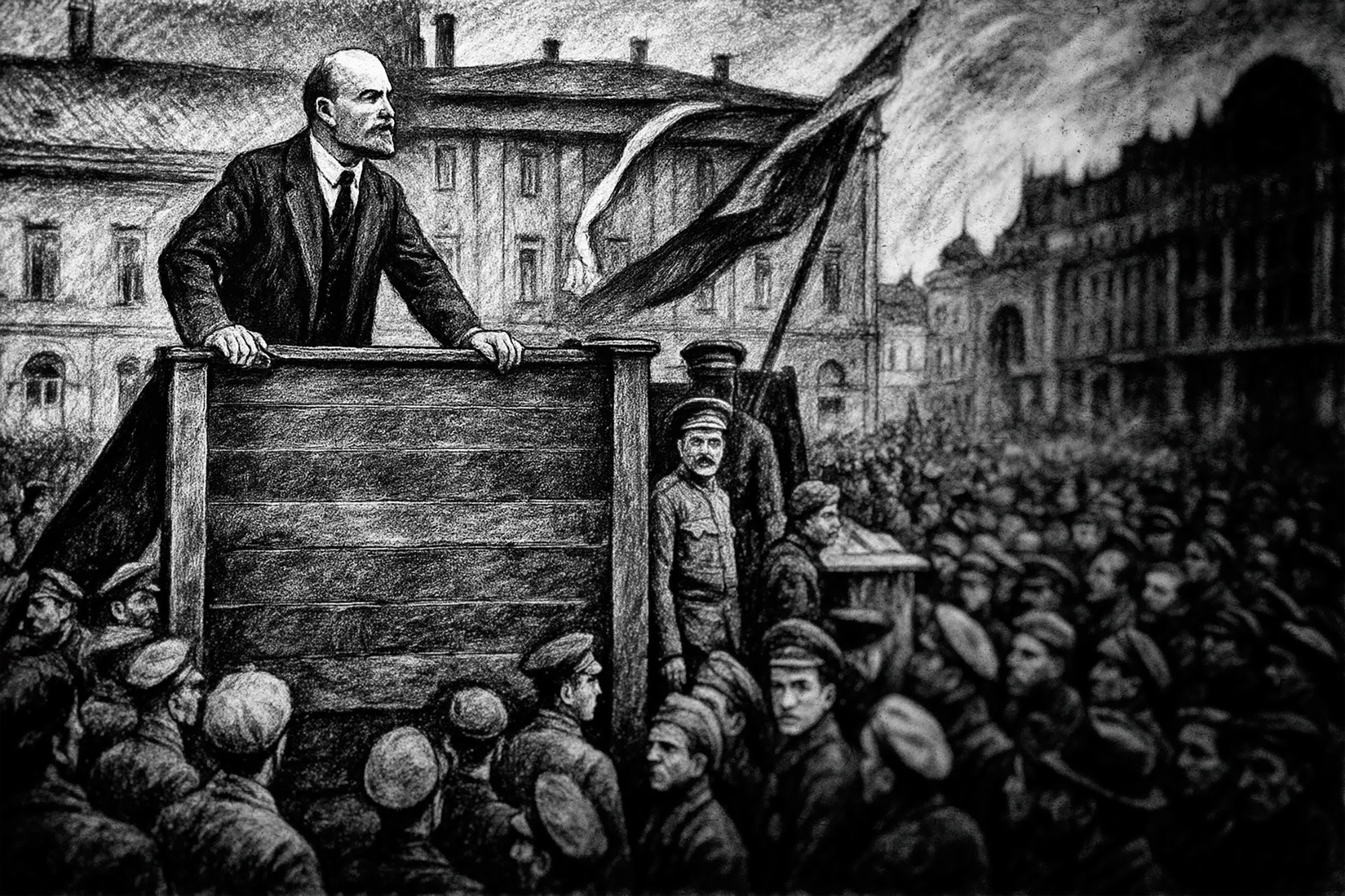
Led by Lenin, the Bolsheviks staged an armed uprising on October 25 (November 7 in the modern calendar). They seized key points in Petrograd and toppled the Provisional Government almost without bloodshed. The new Soviet regime withdrew from the war through the harsh Treaty of Brest-Litovsk, ceding large territories to Germany.

Civil War and Red Victory
From 1918 to 1922, Russia descended into civil war. The Bolshevik Red Army fought the White forces — a mix of monarchists, republicans, and foreign intervention troops — across a vast front. Nationalist movements sought independence in Ukraine, the Baltics, and the Caucasus. The Reds ultimately triumphed, consolidating control through the Cheka secret police and “War Communism,” which requisitioned grain and suppressed dissent. In 1922, the Union of Soviet Socialist Republics (USSR) was officially proclaimed.

Further Reading:

  • John Reed – Ten Days That Shook the World (1919)

  • Sheila Fitzpatrick – The Russian Revolution (1982)

  • Richard Pipes – The Russian Revolution (1990)

  • A. Beevor – Russia: Revolution and Civil War 1917-1921 (2022)

Ukrainians Strengthen Europe

Since the war forced millions of Ukrainians to leave their homes in 2022, their story in Europe has evolved far beyond one of refuge and survival. By 2025, they have become an undeniable force for economic growth, innovation, and cultural vitality across the continent.

In Poland alone, Ukrainians now make up around five percent of the workforce. In 2024 they contributed an impressive €3.6 billion in taxes and social security payments, according to a joint UNHCR–Deloitte report. Their labour and entrepreneurship boosted Poland’s GDP by 2.7%—and they did so without taking jobs away from Poles or depressing wages. Similar patterns are emerging in the Czech Republic, where studies show no negative impact on local employment, but instead a filling of critical labour shortages in logistics, healthcare, construction, and technical trades.

The entrepreneurial drive is equally remarkable. One in ten new businesses registered in Poland last year was Ukrainian-owned, from small tech firms to expanding restaurant brands like Lviv Croissants and Drunken Cherry, now opening outlets in Germany, France, Switzerland and even London. These ventures no longer cater only to Ukrainian communities; they target the wider European public with fresh ideas and a distinctive cultural flair.

This spirit of innovation is being noticed at the highest levels. In July 2025, the European Innovation Council committed €20 million to Ukrainian deep-tech start-ups in AI, robotics, biotechnology, and cybersecurity. Dozens of companies will receive up to €500,000 each to fast-track their products to market and forge international collaborations.

And beyond the economic data lies a powerful human story. The Sunflower Project, launched by the Tent Partnership for Refugees, is one of the largest employment initiatives for displaced Ukrainians in Europe. It aims to generate €2 billion in annual income for refugees, with a strong focus on Ukrainian women—many of whom arrived alone with their children. The project works with over 50 major European employers, including IKEA, H&M, Accenture, and Carrefour, to provide tailored job opportunities, language training, and childcare support. For example, in Germany, a major logistics company has hired over 300 Ukrainian women in supply chain roles, offering flexible schedules so they can balance work and family. In France, a retail chain partnered with the programme to create fast-track training for store managers, enabling qualified Ukrainian women to move into leadership positions within months. In the Netherlands, IT companies in the Sunflower network are tapping into the skills of Ukrainian software developers, connecting them with international clients and long-term career pathways.

Through work, entrepreneurship, and community involvement, Ukrainians are not just integrating—they are actively shaping Europe’s future. Their contributions are a reminder that migration, when met with opportunity, can spark mutual growth. The numbers tell one side of the story, but the energy, resilience, and creativity Ukrainians bring to their new homes may be their most lasting gift to Europe.

Further reading

Russia, The Eternal Return of Suppression: The Fuse to the Powder Keg - Russia Before 1917

Tsar Nicholas II

In the early 20th century, the Russian Empire was vast, diverse, and unstable — a giant straddling Europe and Asia, rich in resources yet poor in governance. Tsar Nicholas II sat atop an autocratic system that resisted meaningful reform, even as the world around it modernized. The gap between the ruling elite and the majority of the population was staggering.

A Land of Peasants and Aristocrats
Over 80% of Russians were peasants, living in rural villages bound by centuries-old traditions. Many still carried the memory of serfdom, abolished only in 1861, and freedom had brought little improvement. Small plots, heavy taxes, and outdated farming methods left millions in chronic poverty. Meanwhile, a tiny aristocracy — less than 2% of the population — owned vast estates and enjoyed lives of comfort and privilege.

Industrialization Without Inclusion
By the late 1800s, Russia was industrializing, but unevenly. St. Petersburg and Moscow had textile mills, metal works, and railways. Harsh factory conditions, long hours, and low pay bred resentment among workers. The new urban proletariat had no political voice; trade unions were illegal, strikes often met with armed force. Russia’s economic modernization created the very class that would later become the backbone of revolutionary movements.

The Empire of Many Nations
Russia was not a homogeneous state. It ruled over Poles, Ukrainians, Balts, Finns, Armenians, Georgians, and Central Asian peoples — many of whom resented Russian dominance. Nationalist movements grew in strength, often clashing with the imperial government, which sought to “Russify” minorities by imposing the Russian language and Orthodox religion.

1905: The First Shockwave
The Russo-Japanese War (1904–1905) was meant to project imperial power but ended in humiliation. The defeat sparked unrest at home, culminating in the events of January 9, 1905 — “Bloody Sunday” — when troops fired on peaceful demonstrators in St. Petersburg. Nationwide strikes, mutinies, and uprisings followed. The tsar reluctantly granted a parliament, the Duma, but its powers were limited, and opposition parties were repressed. The monarchy had dodged collapse, but its legitimacy was badly weakened.

World War I: The Breaking Point
When war broke out in 1914, patriotism ran high, but Russia’s military was poorly equipped and badly led. Casualties mounted into the millions. The home front suffered from food shortages, inflation, and collapsing transport networks. By 1916, the tsar’s decision to take personal command of the army tied him directly to its failures. Meanwhile, political intrigue in the capital, symbolized by the influence of the mystic Rasputin, discredited the monarchy further. The empire was a powder keg — and the spark was coming.

Further Reading:

  • Orlando Figes – A People’s Tragedy (1996)

  • Hugh Seton-Watson – The Russian Empire 1801–1917 (1967)

  • S. A. Smith – Russia in Revolution (2017)

Russia, The Eternal Return of Suppression: Placing the War in Ukraine in Historical Context

When Russia launched its full-scale invasion of Ukraine on February 24, 2022, it was more than a war between two countries. It was the most direct challenge to Europe’s post–Cold War order, the most violent conflict on the continent since the Second World War, and a shockwave with global repercussions.

For many, the war seemed to erupt suddenly — a bolt from the blue. But the roots of this confrontation run deep, woven through a century of revolutions, wars, ideological struggles, and shifting borders. To understand the decisions being made today in Moscow, Kyiv, Brussels, and Washington, we must first understand how we got here.

This series of blogs is meant to provide that context. It will trace the modern history of Russia, Ukraine, and the wider post-Soviet space from the last years of the tsars to the present day. It is not just a story of leaders and battles, but of societies in transformation — and of how history shapes political choices, national identities, and international relations.

Why Ukraine Matters to the World
Ukraine’s struggle is not only about its own survival. It is also about:

  • Whether borders in Europe can be changed by force.

  • Whether smaller nations have the right to choose their alliances without pressure from larger neighbors.

  • How the outcome of this war will influence the future of European security, global trade, and the balance of power between democracies and autocracies.

What This Series Covers
The historical arc will be told in a number of blog items, beginning with the social and political forces that led to the Russian Revolution of 1917, and moving through the rise of the Soviet Union, the Cold War, the collapse of the USSR, the chaotic 1990s, and Russia’s resurgence under Vladimir Putin — culminating in the events of 2014, the invasion of 2022 and the mess we are in today.

Anne Applebaum on Why Putin Refuses Peace

Anne Applebaum.

Anne Applebaum has argued that one of the biggest mistakes in understanding the war in Ukraine is to see it as a struggle over territory. Russia already stretches across eleven time zones, with vast regions it can barely populate. It does not “need” Donetsk, Crimea, or any other piece of land. For Putin, the war is not about geography but about power—the power to dominate Ukraine and pull it back into Russia’s orbit.

This is why talk of “land for peace” has always missed the point. Even when Western leaders hinted at deals that would have given Moscow large concessions, Putin was uninterested. He still believes he can win outright. That belief rests on a simple calculation: Americans are unreliable, Europeans are weak, and Ukrainians will eventually be bombed, starved, or demoralized into submission. If victory is still within reach, why settle?

Applebaum likens the war to France’s colonial fight in Algeria. Imperial powers often cling to the illusion that colonies can be held against their will. But just as Algeria was not French, Ukraine is not Russian. Both wars reveal the same truth: occupation cannot manufacture belonging. The question is not whether Moscow will one day accept this, but when.

Until that reckoning comes, Applebaum warns, hopes for quick ceasefires or neat compromises are illusions. Russia will only stop when defeat becomes undeniable, and the West’s task is to hasten that realization.

Further Reading

  • Anne Applebaum, Twilight of Democracy: The Seductive Lure of Authoritarianism (2020)

  • Anne Applebaum, Red Famine: Stalin’s War on Ukraine (2017)

  • Timothy Snyder, The Road to Unfreedom: Russia, Europe, America (2018)

  • Serhii Plokhy, The Gates of Europe: A History of Ukraine (2015)

  • Mark Galeotti, Putin’s Wars: From Chechnya to Ukraine (2022)

  • Michael Kimmage, Collision: The War in Ukraine and the Origins of the New Global Instability (2023)