
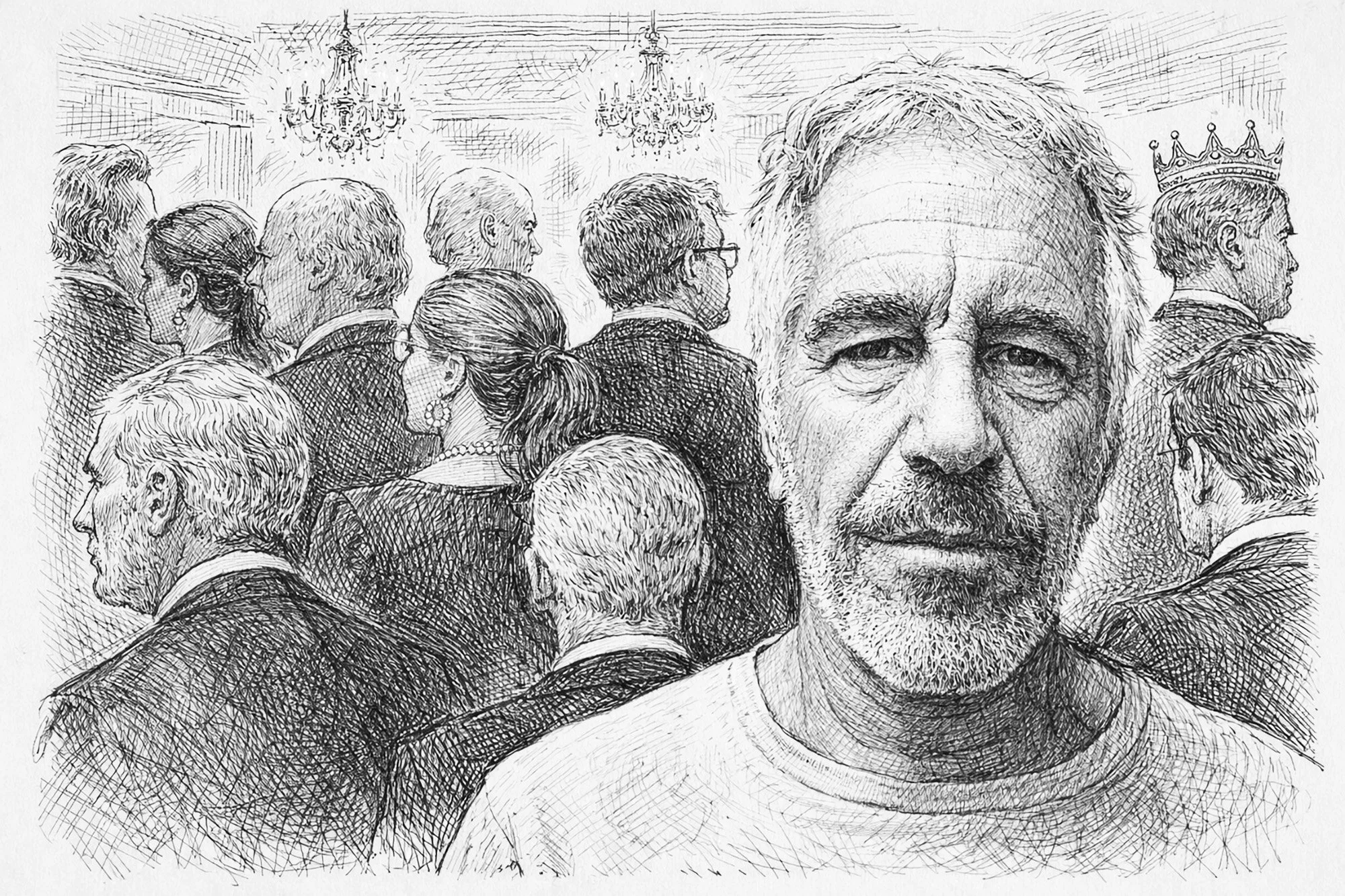
Image created with AI
The story of Jeffrey Epstein is, first and foremost, a story of abuse. Young women were manipulated, exploited and harmed, and that fact should remain at the centre; nothing in what follows diminishes it.
What continues to linger, however, is not only how this could happen, but how it was able to continue for so long — in plain sight, in the presence of people and institutions that should have known better. It is tempting to frame this as a series of failures: failures of judgement, of oversight, of justice. Those failures were real, but the explanation remains incomplete, because it suggests that, had a few individuals acted differently, the outcome would have changed.
What the Epstein case reveals is something more uncomfortable: not just that people failed, but that the environment in which they operated made those failures easier, more likely — and, for a long time, less costly than acting.
The Network
Epstein did not build a conventional empire. He was not a celebrated innovator or a clearly successful financier. Yet he moved with ease among billionaires, politicians, academics and royalty. He hosted, introduced, connected. He was present in rooms where reputations were shaped and opportunities were created.
That presence — more than any asset he owned — was the source of his power.
He positioned himself at the intersection of worlds that rarely meet directly. He connected financiers to politicians, academics to donors, business leaders to social circles they could not easily enter on their own. He understood what each group needed and what the other could offer.
And, at times, he offered something far darker.
Young women — often very young — were drawn in with promises of opportunity: a modelling career, financial support, a pathway into a world that appeared closed to them. What began, in some cases, as access or assistance could shift into dependency and control. The abuse that followed did not exist outside the network; it was, in part, enabled by it.
Because Epstein did not operate alone. He operated within a web of relationships that gave him legitimacy, and that legitimacy allowed him to continue. It softened suspicion, created doubt, and made disengagement more complicated than it should have been.
To walk away from Epstein was not only a moral act. It could mean stepping away from access, from influence, from opportunity. And so, in many cases, people did not leave. Not necessarily because they approved, but because the cost of disengagement was real.
This is not a justification.
It is a description of how such systems sustain themselves.
The Broker
To understand Epstein’s position, it helps to focus less on who he was and more on what he did.
He functioned as a broker.
A broker does not need to be the most powerful person in the room. He only needs to stand between those who are. He identifies gaps — between industries, between social circles, between spheres of influence — and positions himself as the link that makes exchange possible.
Epstein did this with unusual effectiveness. By connecting people who lacked either the time, the trust, the resources, or the access to meet directly, he created value. And once someone creates value within a network, tolerance tends to follow.
This helps explain why reputational damage does not always lead to exclusion. Even after his conviction in 2008, some relationships did not disappear; they adapted. They became quieter, more cautious, but they did not always end. Within a dense network, reputation is rarely judged on its own. It is filtered through relationships, softened by proximity, and sometimes overridden by usefulness.
No conspiracy is required for this to happen. It is enough that individuals, each acting in their own interest, choose not to sever ties that still benefit them.
The broker thrives in precisely this space — where clarity gives way to ambiguity, and where connections matter more than conclusions.
A Pattern Older Than the Present
Seen in this light, the structure surrounding Epstein is not new.
In ancient Rome, political life revolved around patronage. Wealthy patrons offered protection and opportunity; clients offered loyalty in return. Formal rules existed, but outcomes were shaped by relationships.
In Renaissance Florence, families like the Medici built influence not through titles alone, but by connecting finance, politics and religion. Their strength lay in occupying the spaces between these worlds.
In 18th-century Paris, salons functioned as informal centres of power. They were not official institutions, yet they shaped reputations, alliances and ideas. Access mattered as much as authority.
And at the court of Louis XIV, proximity itself became a form of influence. To be present was to count; to be excluded was to fade.
Across these contexts, the pattern is consistent: power is embedded in networks, and those networks tend to stabilise themselves. What has changed is not the logic, but the scale. Today’s networks are global, faster and more opaque — but they still rely on the same mechanisms: trust, reciprocity, access, and, when necessary, silence.
Epstein did not invent this system.
He moved within it — and, for a time, benefited from it.
The Mirror
It is tempting to see this as a story about distant elites — a world of private jets and exclusive circles, far removed from everyday life.
But the mechanisms that sustained Epstein’s network are not confined to that world. They exist, in quieter and more benign forms, much closer to home. We all operate within circles of trust. We introduce people to one another, favour those we know, and hesitate to confront individuals who are well connected, respected or useful. In doing so, we constantly balance principles against relationships, often without fully recognising it.
At a small scale, these behaviours are not only harmless, they are essential. A society cannot function without networks of trust. Cooperation depends on them. Economic exchange depends on them. Even ordinary social life depends on them.
From an evolutionary perspective, this is not accidental. Human beings evolved in small groups where survival depended on cooperation, reciprocity and reputation. The instinct to maintain relationships, to protect alliances, and to avoid exclusion is deeply embedded. It is what allows groups to function — and individuals to belong.
But these same mechanisms, when scaled up and embedded in systems of power, create a tension that cannot be resolved once and for all. The trust that binds groups together can also shield them from scrutiny, while loyalty can discourage dissent and the desire to belong can outweigh the impulse to confront.
The conclusion is uncomfortable: societies depend on networks of trust, yet those same networks can protect themselves at the expense of accountability. That tension cannot be removed — only contained — and if it is ignored, the pattern will return.
Further Reading
Julie K. Brown — Perversion of Justice
Anand Giridharadas — Winners Take All
C. Wright Mills — The Power Elite
Mary Beard — SPQR
Norbert Elias — The Court Society
Antoine Lilti — The World of the Salons
Robert Trivers — The Evolution of Reciprocal Altruism
Joseph Henrich — The Secret of Our Success
Miami Herald investigative series on Epstein
New York Times reporting on Epstein