
The Turning Points That Changed Everything
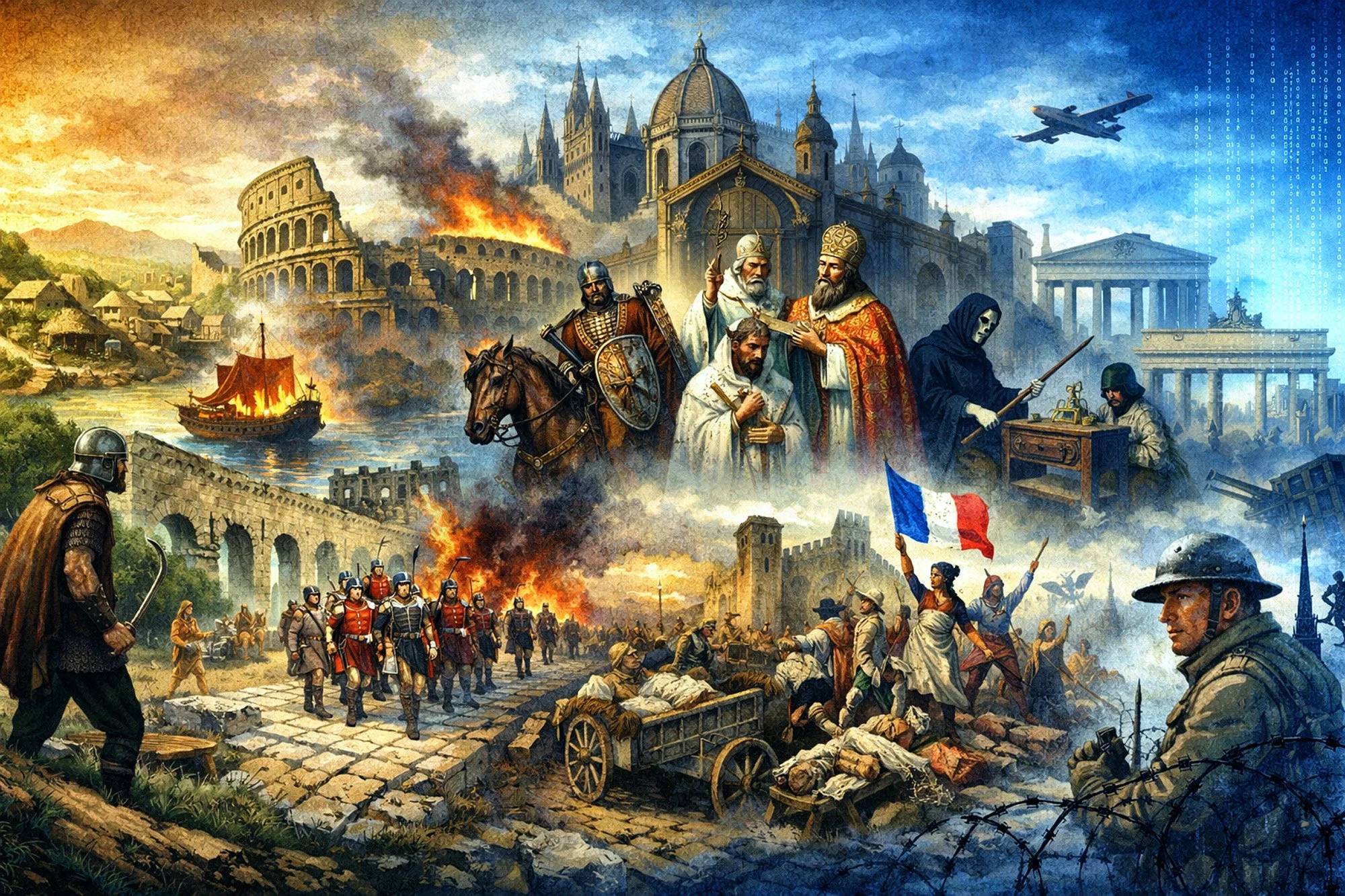
Image created with AI.
When we travel across Europe today, history often feels calm and continuous. Roman roads become medieval streets. Castles turn into hotels. Old kingdoms slowly transform into modern nations. Yet this impression is deceptive. Europe did not grow in a straight line. Again and again, long periods of tension built quietly beneath the surface. Then a relatively small event pushed societies over the edge.
If we want to understand Europe, we must look at these turning points.
The Iron Age and the Birth of European Diversity (around 800 BC)
Around 800 BC, Europe was not a unified civilisation but a mosaic of peoples and cultures. Celts, Iberians, Greeks, Etruscans and many others lived in networks of trade and rivalry. Iron technology spread, making tools and weapons more accessible. Trade routes connected the Mediterranean to the Atlantic and deep into the European interior. Wealth accumulated in new hands. Power became more concentrated.
This slow transformation was itself a tipping point. Europe moved from small, local communities to larger and more complex societies. Warfare became more organised. Long-distance exchange intensified. Cultural interaction increased. By the first millennium BC, Europe was already a connected world, restless and dynamic. The stage was set for a power capable of linking these regions into a single system.
Rome: Crisis as the Trigger for Empire
Rome was not destined to dominate Europe. For centuries it was simply one city among many in central Italy. Its rise was not inevitable. What changed was a series of existential crises that forced Rome to innovate. Surrounded by rivals, it developed flexible political institutions and a remarkable capacity to form alliances.
The decisive trigger came with the wars against Carthage in the third and second centuries BC. These conflicts pushed Rome beyond its limits. To survive, it mobilised unprecedented resources, built large fleets, and organised armies on a scale never seen before in the western Mediterranean. Victory over Carthage removed its greatest rival and gave Rome control over key trade routes and territories.
From that moment, the balance of power shifted. Expansion followed. Roads, colonies, and law spread across Europe. What had begun as a defensive struggle became an imperial system. For the first time, large parts of Europe shared infrastructure, administration and political frameworks. Cooperation and conquest became two sides of the same process.
The Fall of Rome and the Return of Fragmentation
The collapse of the Western Roman Empire in the fifth century is often imagined as a dramatic moment. In reality, decline had been gradual. Economic strain, migration, political instability and internal conflict slowly weakened the system. When a Germanic leader deposed the last Western emperor in 476, the event itself was almost symbolic. The real transformation had already taken place.
Yet the consequences were enormous. Europe fragmented into regional kingdoms. Local identities re-emerged. The central question became how to create order without empire. This challenge shaped the next thousand years.
Clovis and the Fusion of Cultures
Around the year 500, the Frankish king Clovis chose to adopt Catholic Christianity. Many other Germanic rulers followed different forms of the faith. His decision helped bridge the gap between Roman populations and new rulers. It strengthened cooperation between political power and the Church.
This was a small choice with large consequences. It laid foundations for medieval Europe and helped create a shared cultural framework that would endure for centuries.
Charlemagne and the Idea of Europe
In the year 800, Charlemagne was crowned emperor. His empire did not survive long, but the idea did. Europe began to see itself as a civilisation rooted in shared learning, religion and governance. Administration, education and communication were revived. The political geography of modern Europe began to take shape.
This moment shows how ideas can outlive institutions.
The Black Death: Catastrophe and Renewal
In the fourteenth century, plague devastated Europe. Yet it struck a society already under pressure. Population growth had strained resources. Feudal structures were rigid. The sudden loss of labour changed everything. Wages rose. Social mobility increased. Old hierarchies weakened.
Crisis became a catalyst for transformation. Europe emerged more dynamic and more flexible.
The Reformation and the Power of Networks
When Martin Luther challenged the Church in 1517, he did not intend a continental revolution. But printing, urban communication and political rivalry spread his ideas rapidly. Europe divided into competing systems. States gained strength. Individual belief became central.
Once again, long-term tensions combined with a triggering event.
Revolution and modern politics
The French Revolution transformed Europe. It introduced citizenship, rights and nationalism. Yet it grew from structural pressures: debt, inequality and social frustration. A political crisis ignited forces that reshaped the continent.
Modern Europe was born in this period of turmoil.
War and the Search for Cooperation
The twentieth century brought destruction on an unprecedented scale. Two world wars devastated Europe. Yet the response was not endless conflict. Instead, European leaders chose cooperation. Institutions replaced rivalry. Law replaced revenge. Integration became a strategy for survival.
This was perhaps Europe’s most surprising turning point.
1989 and the Reopening of the Continent
The fall of the Berlin Wall symbolised the end of division. Communist regimes had weakened for years, but small events accelerated change. Courage, communication and timing reshaped the political landscape. Europe reunited in ways few had predicted.
The Digital Age: a New Tipping Point
Today Europe faces another transformation. Globalisation, migration, climate change and digital technology are reshaping society. Social media amplifies emotions. Trust in institutions fluctuates. New communities emerge beyond borders.
The outcome remains uncertain. But history suggests that change will not be smooth. It will come through moments of crisis and renewal.
What Europe Teaches Us
Europe’s story is not only about conflict. It is about adaptation. Again and again, societies have faced collapse and uncertainty. Again and again, they have developed new forms of cooperation. Stability has never been permanent. Community has always had to be rebuilt.
For travellers, this perspective adds depth to every journey. Roads, villages and cities are not just heritage sites. They are the result of countless turning points. Europe is not a finished civilisation. It is an ongoing experiment.
And we are part of its next chapter.
Further Reading
Brian Klass, Fluke: Chance, Chaos and Why Everything We Do Matters
Christopher Dawson, The Making of Europe
Peter Heather, Empires and Barbarians
Ian Morris, Why the West Rules – For Now
Peter Turchin, Ages of Discord
Niall Ferguson, Civilization