wry reflections

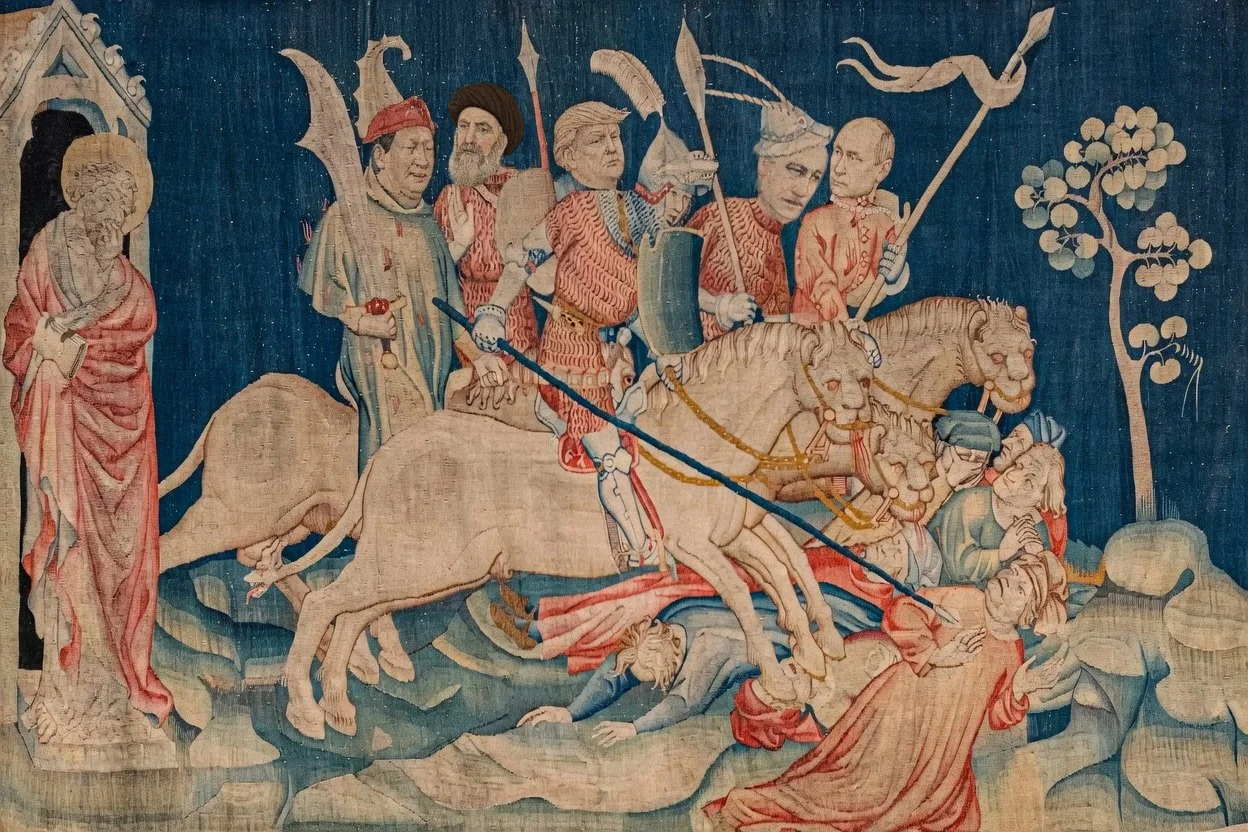
A Contemporary Version of The Myriad Horsemen of the Apocalypse

The Myriad Horsemen, this time with Xi Jinping, Ali Khamenei, Donald Trump, Benjamin Netanyahu, and Vladimir Putin.

A contemporary version of The Myriad Horsemen of the Apocalypse, this time with Xi Jinping, Ali Khamenei, Donald Trump, Benjamin Netanyahu, and Vladimir Putin.

At first glance, the image above looks like a fragment of a medieval tapestry: armored riders charging forward, people crushed beneath their horses. But look again. The riders are not medieval knights. Their faces resemble figures from today’s headlines — Xi Jinping, Ali Khamenei, Donald Trump, Benjamin Netanyahu, and Vladimir Putin.

This modern image reimagines one of the most striking scenes from the Apocalypse Tapestry in Angers, the panel often called The Myriad Horsemen. The original 14th-century tapestry illustrates the terrifying armies described in the Book of Revelation. (For the story behind the tapestry itself, see: The Apocalypse Tapestry, Château d’Angers, Angers (France).)

But medieval viewers probably saw more than a biblical vision. Europe was reeling from the Black Death and the destruction of the Hundred Years’ War. The riders even wear the armor of contemporary soldiers. To many people in 14th-century France, the apocalypse did not feel symbolic — it felt like the news of the day.

This modern reinterpretation simply continues that tradition.

Each age replaces the riders with the figures that embody its own anxieties. In the Middle Ages, they could evoke the armies ravaging France. Today, they may evoke a world unsettled by wars, rival powers, and a fragile international order.

The faces change. The uneasy sense of living in dangerous times does not.
The Night We Lost the Match and Won Everything (Sauviat-sur-Vige, France)

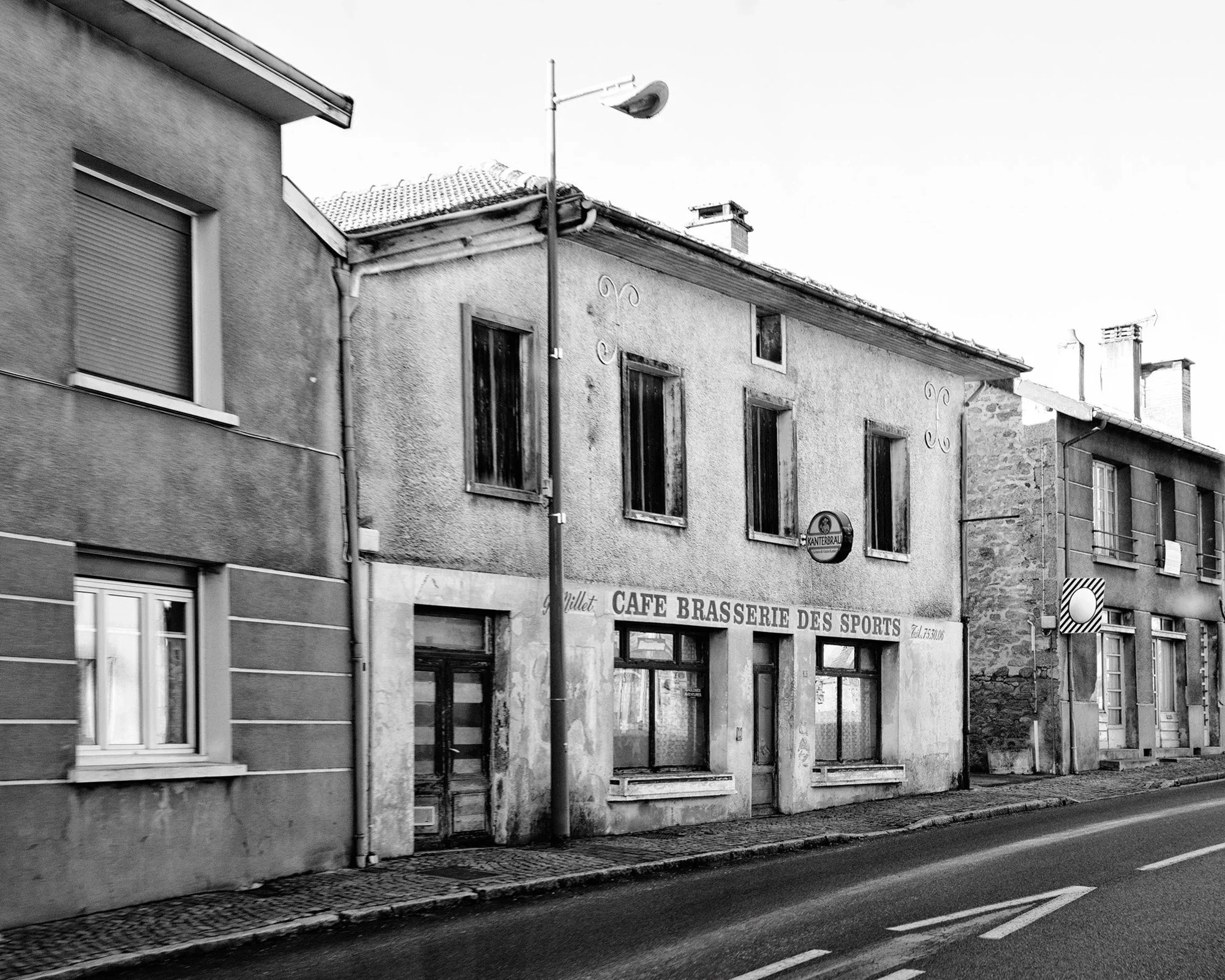
Café Brasserie des Sports in 2022 in Sauviat-sur-Vige (France).

The Café Brasserie des Sports stood silent now, its paint peeled by forty winters, the windows clouded with dust. But in André and Marcel’s minds, the lights were still on, the smoke still thick, and the air still trembling with the roar of a crowd that never quite went home.

“France versus West Germany,” André said, staring through the dusty window. “The whole village packed in here, remember? Millet yelling for quiet, the floor sticky with beer, and that tiny black-and-white TV balanced on the counter.”

Marcel laughed, that same deep laugh he’d had back then. “You mean the night you spilled your beer all over Yvette when Platini missed the penalty?”

“She said I looked honest when I suffered,” André smiled. “Then she married me. Must’ve liked lost causes.”

Marcel’s grin softened into something gentler. “That’s where I met Jeanne too. She stood at the bar pretending she didn’t notice me. But she laughed—oh, that laugh—when my ridiculous hat fell into the ashtray.”

Outside, a shutter rattled in the wind. The church bell struck six, hollow and patient.

For a moment, they both fell quiet. The street smelled of rain and wood smoke, and if you listened closely, you could almost hear it again—the clink of glasses, the hum of the crowd, the echo of a cheer that shook the walls when the final whistle blew.

André exhaled. “We lost that match, didn’t we?”

Marcel nodded slowly. “Aye. But we won everything that mattered.”

The wind carried a faint echo down the empty street, and for a heartbeat, Sauviat-sur-Vige was alive again—with laughter, with love, and the sound of a goal shouted to the rafters of the Café des Sports.

Saint-Mystère Remains Silent: The Tourists 01

The Czechs.

For a brief moment in the 1990s, Saint-Mystère was a destination.

No one quite remembers how it started—an article in a forgotten travel magazine, perhaps, or a whispered recommendation passed along border checkpoints and backpacker cafés. What is certain is that, for a few years, strangers arrived. Not many. Never in groups. Just a slow trickle of curious visitors drawn to the village where no one spoke and every window seemed to be watching.

The ones in this photo came from the Czech Republic, not long after the fall of the Iron Curtain. They stayed a week, maybe two. Camped just beyond the orchard. Kept mostly to themselves. In the mornings, they wandered the lanes. In the evenings, they sat near the war memorial and sketched the rooftops.

Then they were gone. Like the others.

No one comes anymore.
And in Saint-Mystère, no one talks about that time.