france

The Oppidum Saint-Vincent in Gaujac (France)

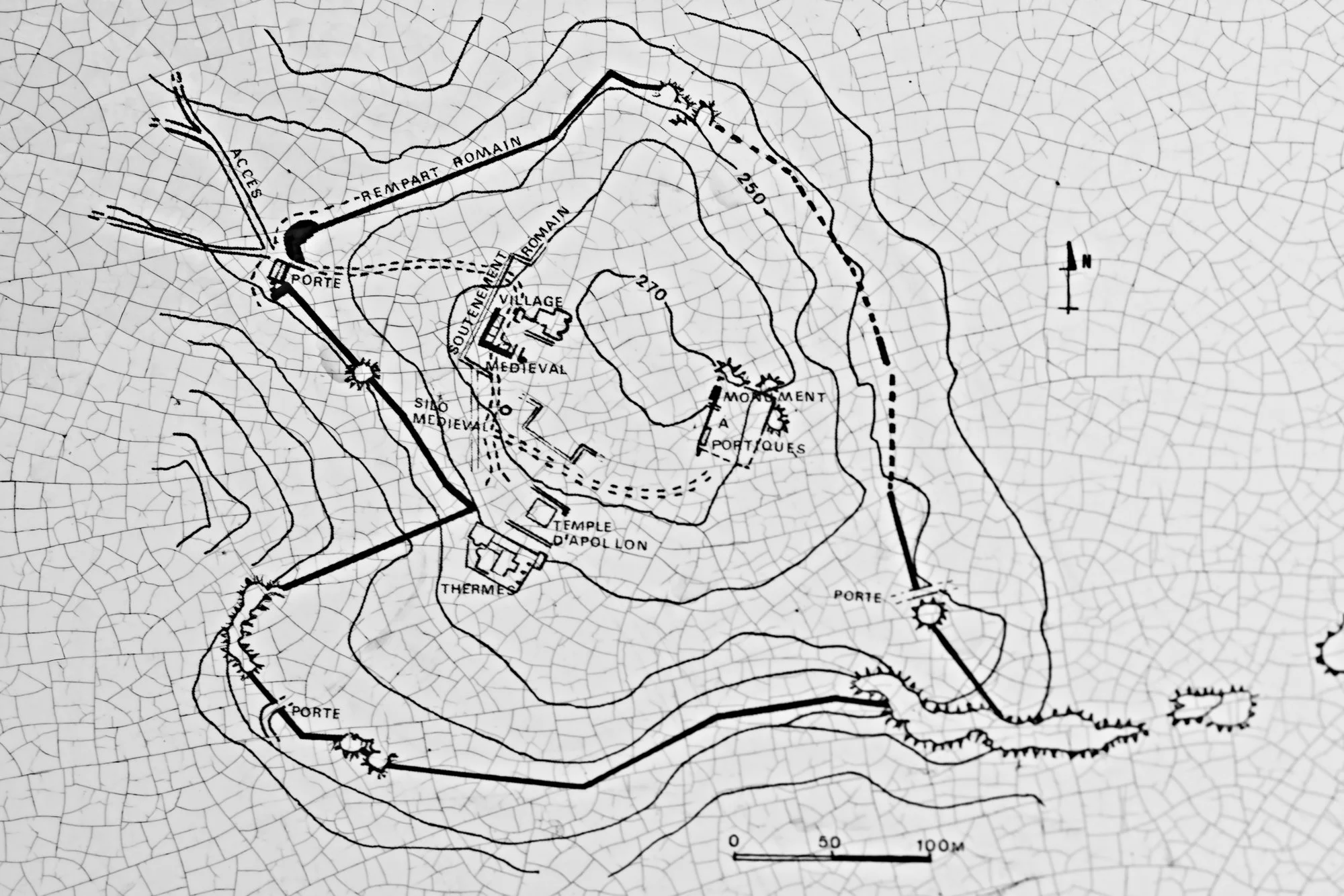
Plan of Oppidum Saint-Vincent at Gaujac, showing Iron Age ramparts, Roman monuments, and later medieval occupation layers. After J. Charmasson, published plan.

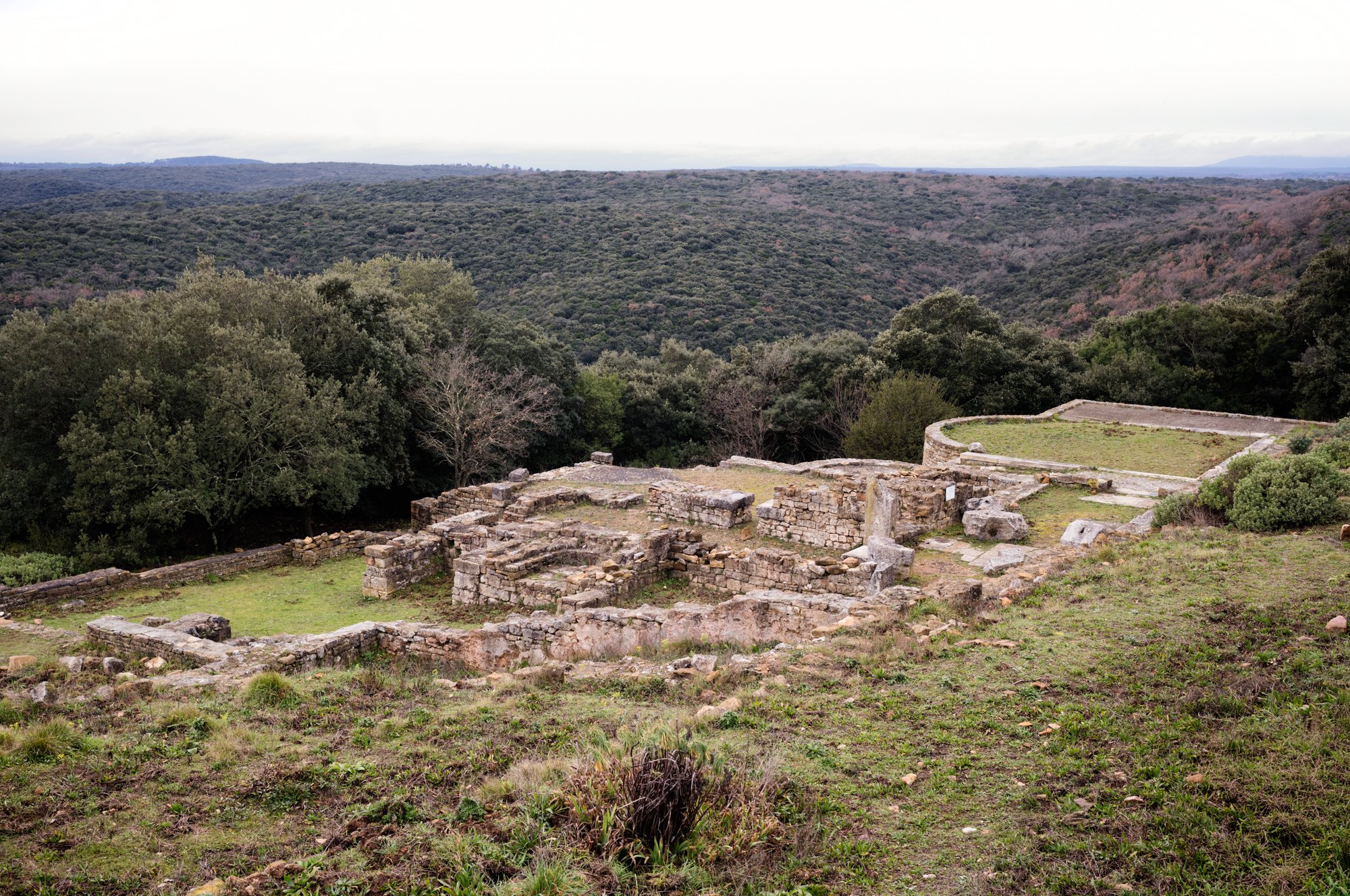
The ruins of the Roman baths at Oppidum Saint-Vincent, their low stone walls still tracing heated rooms and pools, set against the wooded hills that once framed daily life on the oppidum.

From down in the valley near Gaujac, the forested crest of Oppidum Saint-Vincent gives little hint of its past. Only when you climb it does the hill begin to speak. Saint-Vincent is not a single archaeological site, but a hillside shaped and reshaped by human lives for more than a thousand years.

The story begins around 425 BCE, when Gallic communities took possession of the summit and enclosed some twelve hectares with a defensive wall. This was an oppidum: a fortified hilltop settlement typical of Celtic Gaul. Oppida were not refuges in panic, but centres of authority, combining defense, habitation, ritual and trade. From Saint-Vincent, the Rhône corridor could be watched and controlled, and contacts reached as far as the Greek port of Massalia, modern Marseille. Archaeology reveals houses, storage areas and a striking ritual feature known as the “altar of ashes,” hinting at ceremonies that bound community, land and belief together.

By the early fourth century BCE the site was largely abandoned, its walls left to weather. But the hill was not forgotten. Around 120 BCE, as Roman power advanced into southern Gaul, Saint-Vincent was deliberately reoccupied. Its defenses were reinforced, transforming the old oppidum into a stronghold once more, now facing a new political horizon.

That horizon became Roman around 40 BCE, when Lepidus granted Saint-Vincent the status of oppidum latinum. The hilltop was reshaped into a Romanised town structured by terraces. Public life concentrated around a forum with porticoes, baths were built, and a monumental sanctuary—traditionally called the “Temple of Apollo”—dominated the sacred space. At this moment, Saint-Vincent was not merely inhabited; it was important. Its religious role drew pilgrims from across Narbonensis during major festivals, reinforcing both its political and spiritual status in the region.

The prosperity did not last. In the later third century CE, a series of earthquakes struck the region. The urban fabric of the hilltop suffered badly, and the Roman town gradually emptied. Yet even abandonment did not end the site’s usefulness.

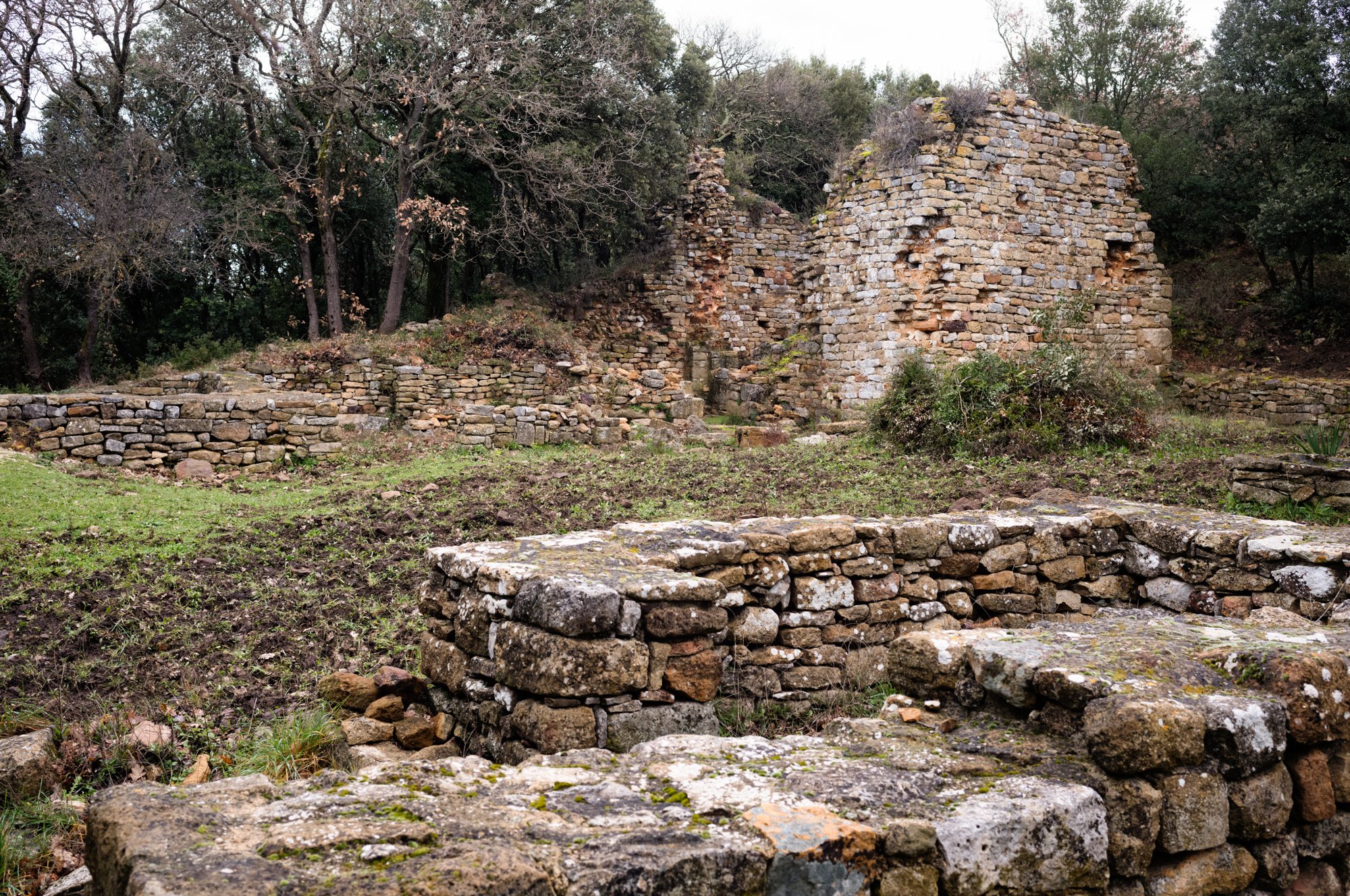
Remains of the medieval village at Oppidum Saint-Vincent: dry-stone houses and enclosure walls built by quarrymen and stonecutters between the 10th and 12th centuries, reusing the fabric of the ancient city.

During Late Antiquity, in the fifth and sixth centuries, Saint-Vincent entered a quieter but crucial phase. Parts of the old ramparts were repaired or rebuilt using simpler masonry and reused Roman stone. These walls are often referred to as “Visigothic,” and while the term survives, it deserves nuance. Saint-Vincent did not become a Visigothic city. Instead, it functioned as a hilltop refuge, a place of temporary safety for populations from the surrounding plain in an unstable world. The walls of this period speak not of empire, but of pragmatism: repair what already exists, defend what can still be defended.

In the Middle Ages, the hill found yet another role. Around a small church dedicated to Saint Vincent, families of stonecutters and quarrymen settled on the summit. The abandoned monuments of Roman antiquity became quarries; blocks once shaped for temples and baths were repurposed for houses, walls and paths. Stone moved again, but with new meanings and new hands.

What makes Saint-Vincent compelling today is precisely this continuity through change. It was never erased and rebuilt from scratch. Instead, each generation worked with what was already there—walls reused, terraces adapted, ruins transformed into resources.

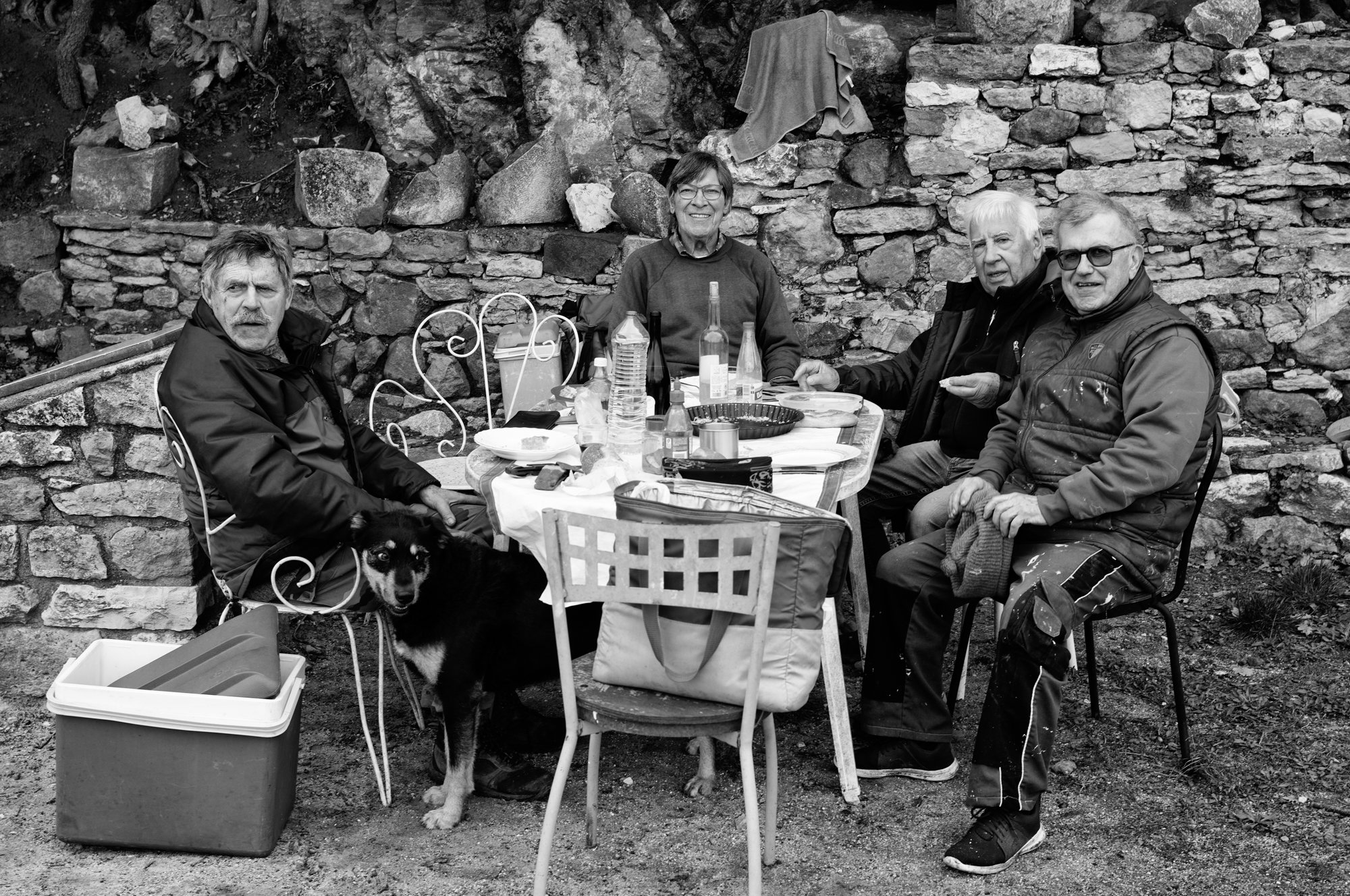
Some members of SECABR (Société d’Étude des Civilisations Antiques Bas-Rhodaniennes) enjoying lunch at the site of the Oppidum Saint-Vincent.

That layered history is why the presence of SECABR (Société d’Étude des Civilisations Antiques Bas-Rhodaniennes) matters so much. Their quiet stewardship—walking the site, monitoring erosion, sharing knowledge—continues a tradition that is as old as the oppidum itself: caring for a place because it matters. Where once councils met and pilgrims gathered, people still come together, not to defend or to rule, but to remember.

At Saint-Vincent, the walls no longer protect against enemies. They protect against forgetting.

More Information:

The Saint-Léonard Relic Mural in Honfleur

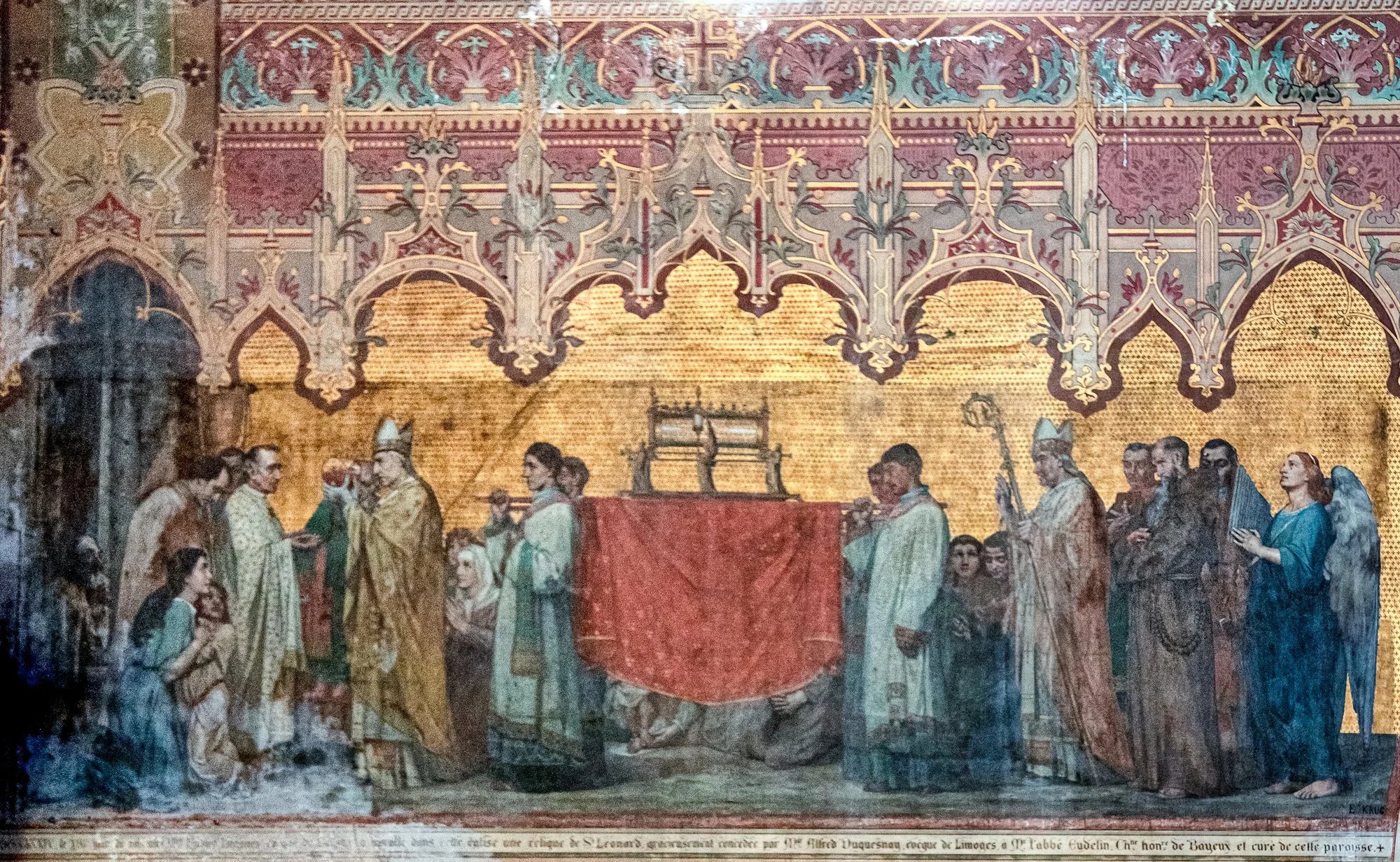
Krug’s 1899 marouflé mural in Église Saint-Léonard, Honfleur, commemorates the transfer of a relic of Saint Léonard—patron of prisoners and freedom—in radiant Renaissance-style gold.

Step inside the Église Saint-Léonard in Honfleur and a luminous wall painting commands attention. Created in 1899 by artist Krug on a toile marouflée (canvas bonded to wall), it records the transfer of a relic of Saint Léonard, patron of prisoners and liberation.

Saint of Chains and Freedom

Saint Léonard, a 6th-century noble turned hermit near Limoges, was famed for freeing captives who invoked his name. Pilgrims long sought pieces of his relics. For this bustling port—often battered by war—the relic’s arrival was a promise of protection and safe return.

Ceremony in Gold

The mural shows a solemn procession led by Bishop Hugonin of Bayeux: robed clergy, incense, and faithful figures glide across a gold ground reminiscent of Fra Angelico. It is at once a historical record and a devotional icon, celebrating the day Honfleur welcomed its saint.

Catholic Revival

Painted during the post-1870 Catholic resurgence, the work reflected a desire to strengthen faith through art and memory. More than a century on, the mural still speaks of hope and deliverance, its silent pageant glowing in the church’s soft light.

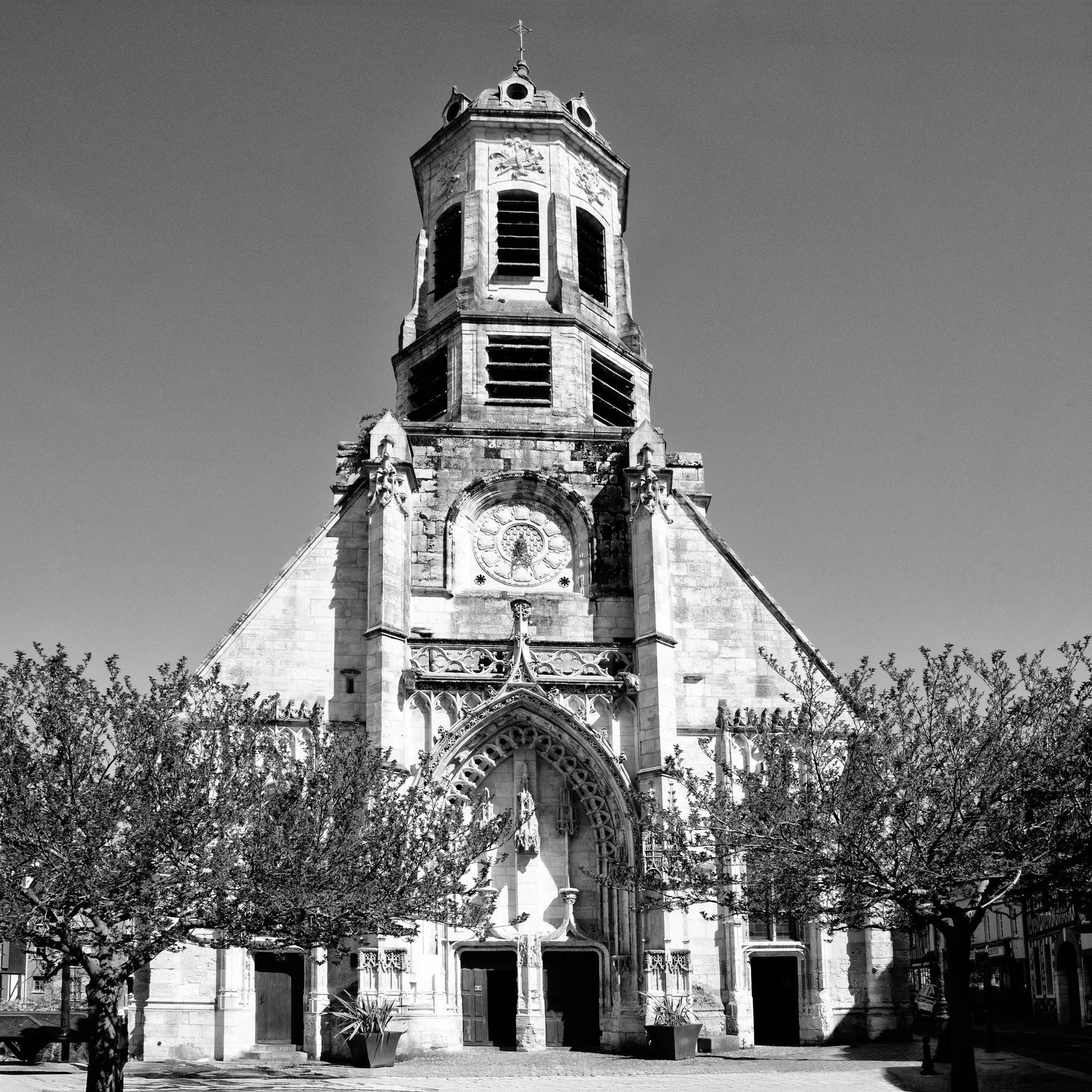
The flamboyant Gothic façade of Église Saint-Léonard in Honfleur, crowned by its 18th-century octagonal bell tower.

Saint Expédit: A Wall of Gratitude

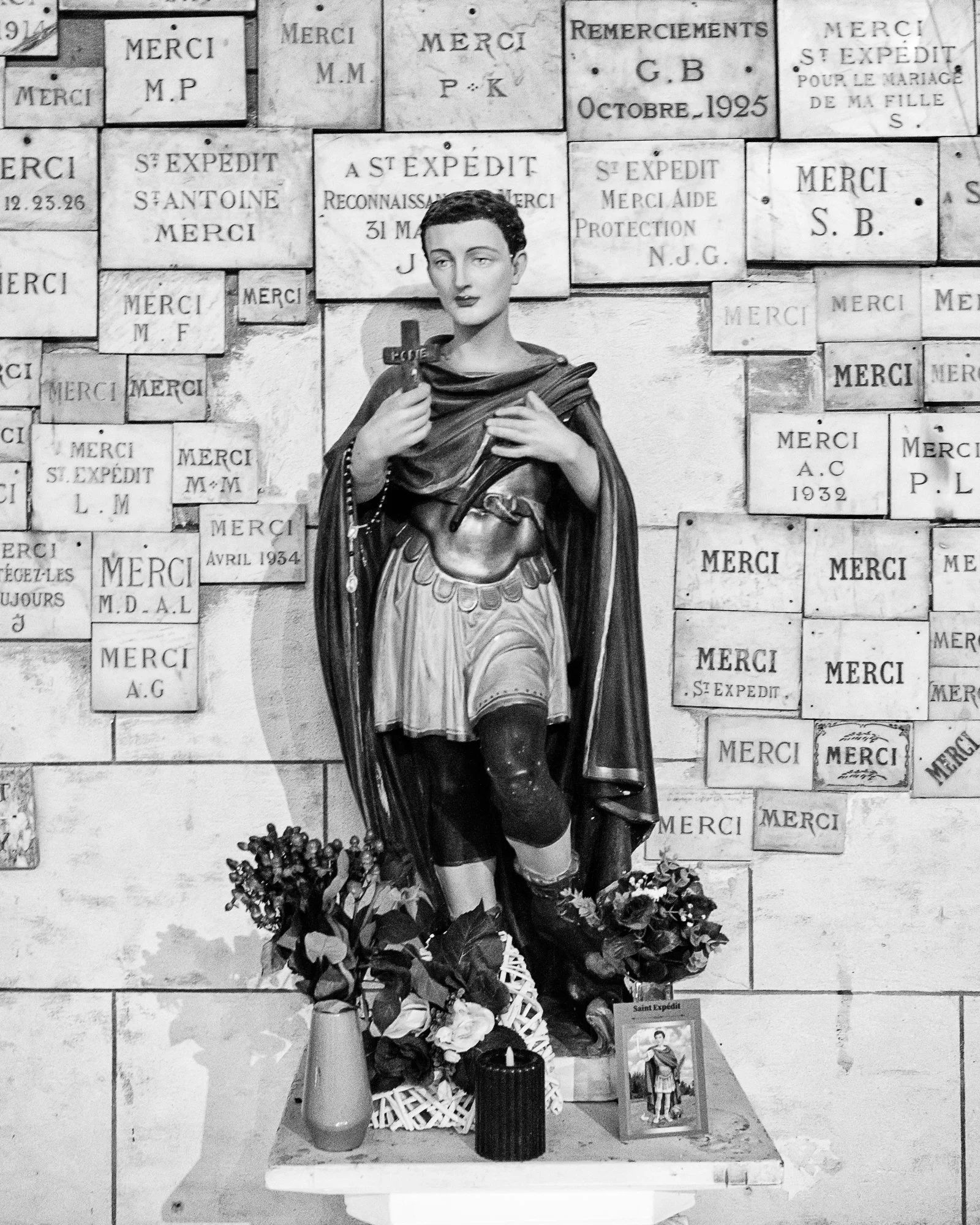
Saint Expédit, Église Saint-Pierre in Bordeaux (France).

We met him in a quiet chapel of the Église Saint-Pierre in Bordeaux (France)— a young Roman soldier standing almost casually, one knee bent, a cloak gathered in his hand. This is Saint Expédit, patron of people who cannot wait for tomorrow.

But what gives this shrine its power is not only the statue. It’s the wall behind him, tiled with small marble plaques, each carved with a simple word: MERCI.

A century of whispered relief, arranged like a mosaic.

Some plaques are formal, some abbreviated to initials, some marked with dates long before we were born. Others simply say “MERCI” — nothing more, yet somehow enough. Together they form a quiet ledger of fear, hope, and fulfilment.

According to the old legend, Expédit was a Roman soldier who, on the brink of converting to Christianity, faced a whisper of doubt urging him to delay. He refused. Faith, he decided, was for today, not some comfortable tomorrow. Ever since, people have come to him when hesitation is no longer possible.

In Bordeaux, this devotion feels very much alive. The flowers at his feet, the votive card leaning against the plinth, the steady growth of plaques over decades — all of it tells the same story: someone was in trouble, asked for help, found it, and returned with a piece of marble to say thank you.

A simple statue.
A wall full of human stories.
And a saint who still stands for the courage to act — not later, but now.

The Legionary, the Dog, and the Healing Mud of Dax (France)

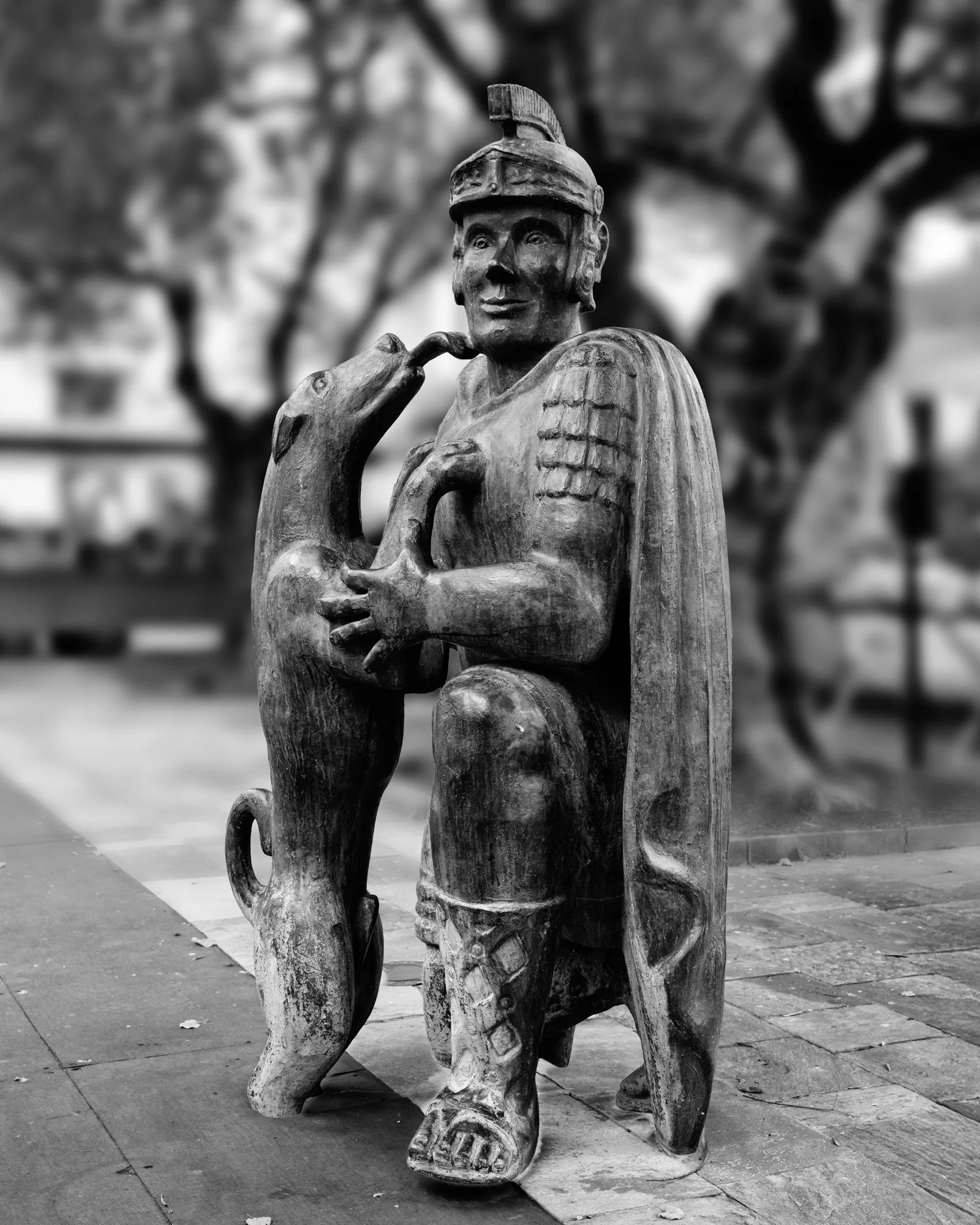
A Roman legionary and his loyal dog — a statue recalling the founding legend of Dax as a city of healing springs.

On the Place de la Cathédrale in Dax, in the shade of old olive trees, stands a quietly touching statue: a Roman legionary and his dog. At first glance it looks like just another piece of classical decoration. But behind it hides the founding legend of one of France’s oldest spa towns.

Long before Dax became a destination for bathrobes, wellness programmes and medical cure packages, it was already famous in Roman times as Aquae Tarbellicae — the waters of the Tarbelli tribe. Soldiers, officials and travellers came here to soak in warm mineral springs and coat their aching joints with therapeutic mud from the river Adour.

And according to local legend, it all began with a dog.

The story goes that a Roman legionary stationed in the area owned a loyal dog suffering badly from rheumatism. The animal could barely walk. Believing its suffering could not be eased, the soldier abandoned it on the banks of the Adour. When he later returned from campaign, he was astonished to find his dog alive, playful — and completely cured.

The animal had taken refuge in the warm, mineral-rich mud along the riverbanks. The same mud that is still used today in Dax’s famous thermal treatments.

The miracle dog had done what centuries of medicine would later confirm: Dax’s water and mud truly have healing properties.

Today Dax is France’s leading spa town for rheumatology. Tens of thousands of visitors come every year for three-week medical cures prescribed by doctors. Around the thermal baths grew an entire city economy: hotels, clinics, wellness centres, rehabilitation programmes, and an army of physiotherapists and hydrotherapists.

The statue of the legionary and his dog quietly tells the story of how Dax became a place of healing — where warm springs, river mud and time itself helped wounded bodies walk again.

Sometimes, history begins not with emperors or generals — but with a limping dog and a soldier who loved him.

The Quiet Wonder of the Église Saint-Marcel in the valley of the Creuse

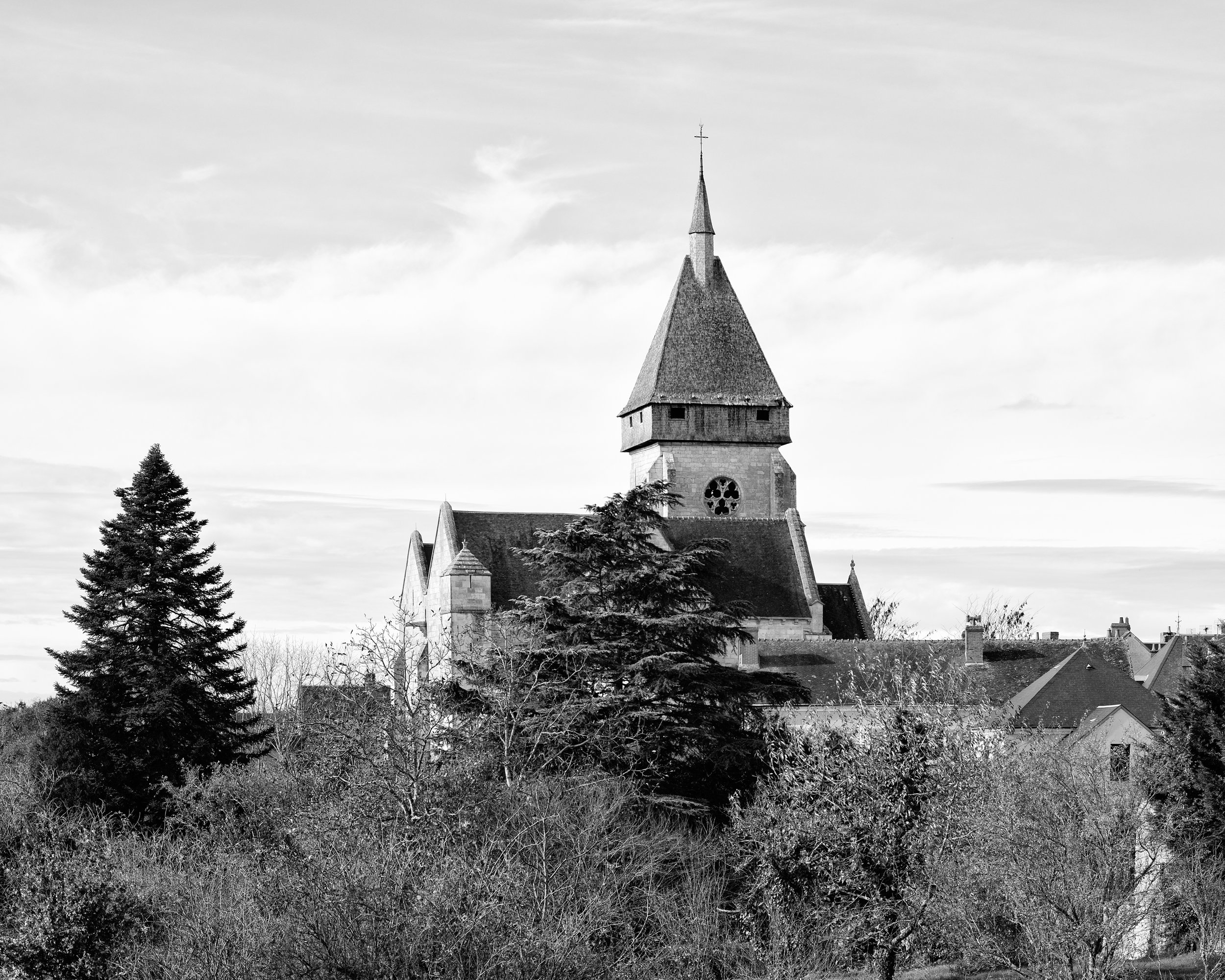
Église Saint-Marcel in Argenton-sur-Creuse (France).

A short walk from the Roman site of Argentomagus stands one of the most evocative rural churches in central France: the Église Saint-Marcel. Modest in size but rich in history, it brings together twelve centuries of architecture, devotion, and local craftsmanship — all in a peaceful village setting.

A Brief History

The church once belonged to a Benedictine priory linked to the Abbey of Saint-Gildas. Its oldest parts date from the 12th century, especially the Romanesque chevet with its thick stone walls and sturdy tower. Later additions — chapels, vaulting, and interior decoration — were carried out in the 16th century, giving the building its layered, time-worn character.

Highlights Inside

What makes Saint-Marcel stand out is the concentration of medieval and early-Renaissance artistry:

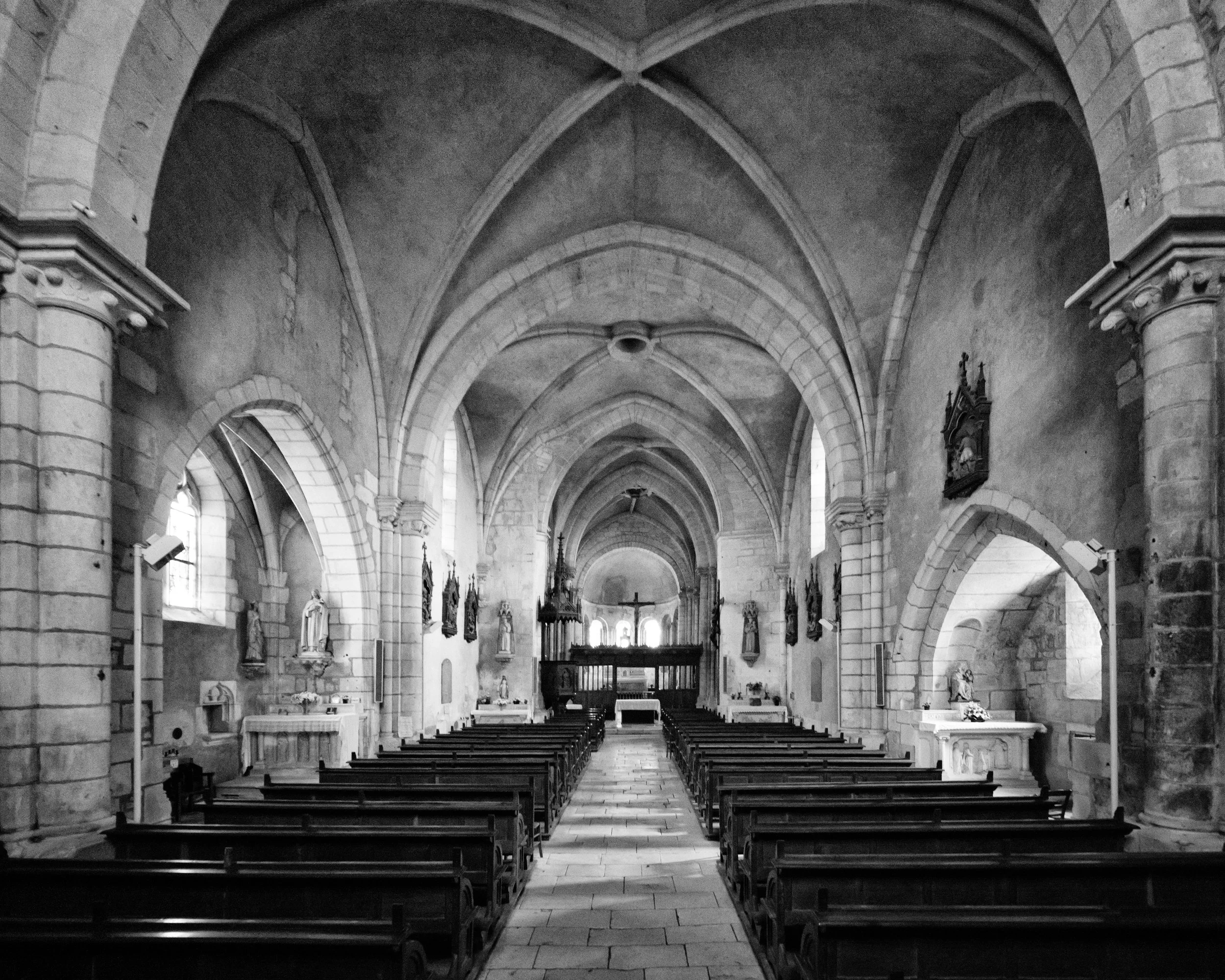
  • Romanesque architecture: A simple nave, a transept with three small apses, and a striking square tower that may once have had a defensive role.

  • The crypt: A rare survival beneath one of the chapels — atmospheric, intimate, and tied to early Christian worship in the region.

  • Carved choir stalls: Early-16th-century woodwork with delicate misericords showing the imagination of local artisans.

  • A 16th-century fresco of the Notre-Dame de Pitié above a side doorway, one of the few remaining wall paintings in the area.

  • Relics and liturgical treasures, including bust reliquaries associated with Saint Marcel and Saint Anastase, reminders of the church’s long devotional history.

Why It’s Worth a Visit

Saint-Marcel is the kind of place where different eras quietly overlap: Roman presence, medieval monastic life, and village spirituality. The church is never crowded, making it ideal for slow travel — a contemplative stop surrounded by old stone houses and the wooded slopes of the Creuse valley.

Just a few minutes away lies Argentomagus, one of France’s major Gallo-Roman archaeological sites. Visiting both in one day gives you a rare double insight: the world of antiquity and the world that replaced it.

The interior of Église Saint-Marcel in Argenton-sur-Creuse (France).

Saint Elophe: A Martyr on the Edge of Roman Gaul

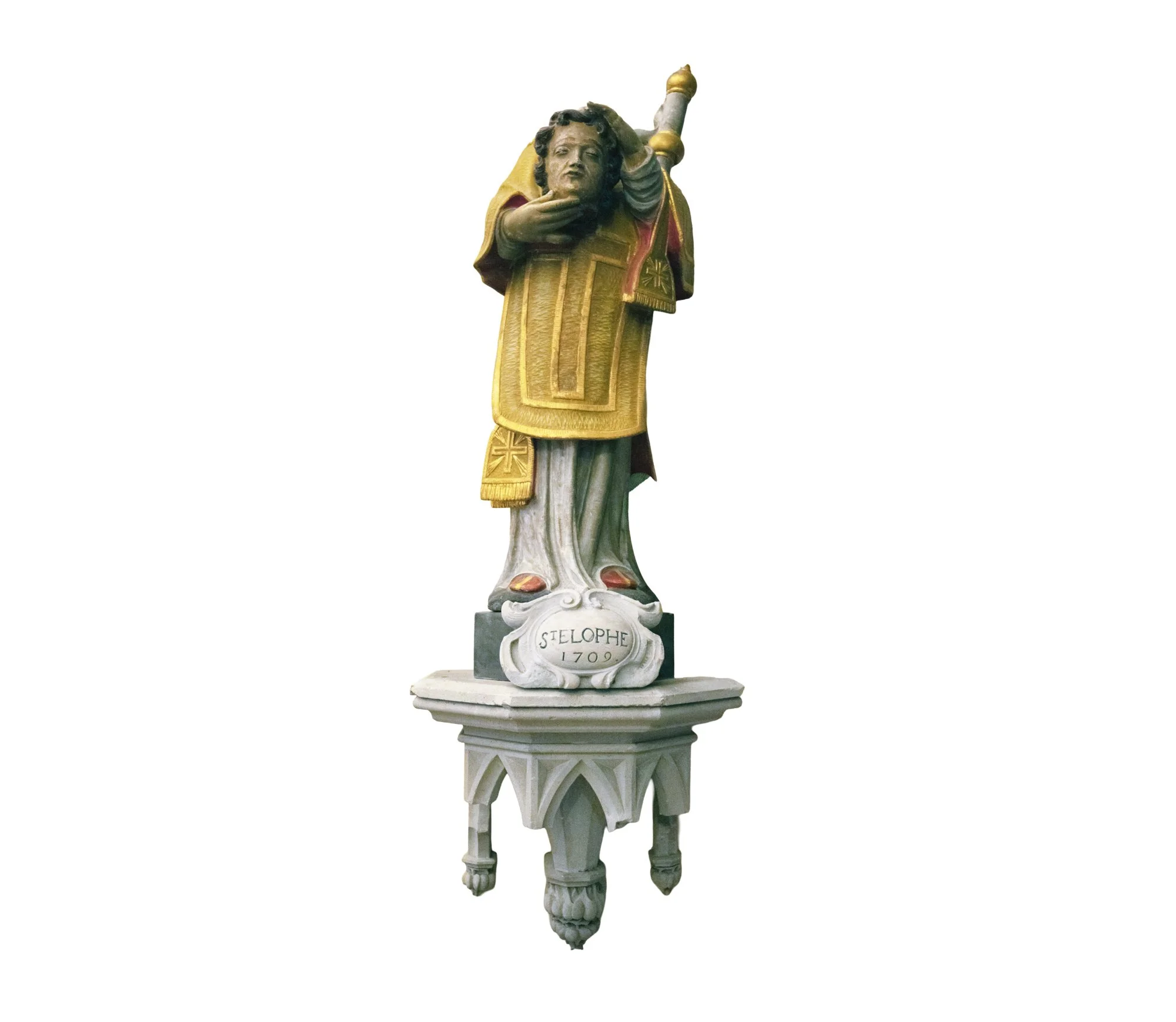
The statue of Saint Elophe in the Church of Saint-Remy (Église Saint-Rémy) in Domrémy-la-Pucelle.

If you’re looking at Saint Elophe’s statue in Domrémy-la-Pucelle’s Church of Saint-Remy, you’ll notice his unmistakable emblem: the saint bearing his own head—a “cephalophore.” The image condenses a local memory from the Toul–Vosges frontier, where Elophe (Eliphius) is remembered as a deacon and preacher who spread the new faith among Gallo-Romans in the mid-4th century.

Tradition places his death in 362, during the brief reign of Emperor Julian—nicknamed “the Apostate”—who tried to reverse the Christianising tide and restore favor to the old gods. Though Julian did not institute a formal empire-wide persecution, his policies stripped Christian privileges and emboldened local hostility. In that climate, Elophe was seized and beheaded near the Vair River. The legend says he then rose, took up his severed head, and walked uphill to the place he wished to rest—an image that fixed his cult in the Lorraine landscape.

It’s a striking turn after Emperor Constantine, decades earlier, had legalized Christianity with the Edict of Milan (313), ending the great imperial persecutions and allowing the Church to root itself in towns like Toul. Elophe’s story captures that hinge between eras: from tolerated and rising faith to a sudden, dangerous backlash—followed by a memory that would spread far beyond Lorraine, even to Cologne, where his relics were later honored.

And that statue before you at Domrémy keeps telling it—quietly, clearly, in stone.

A Taste of Lisbon in Bordeaux: L’Atelier des Pastéis

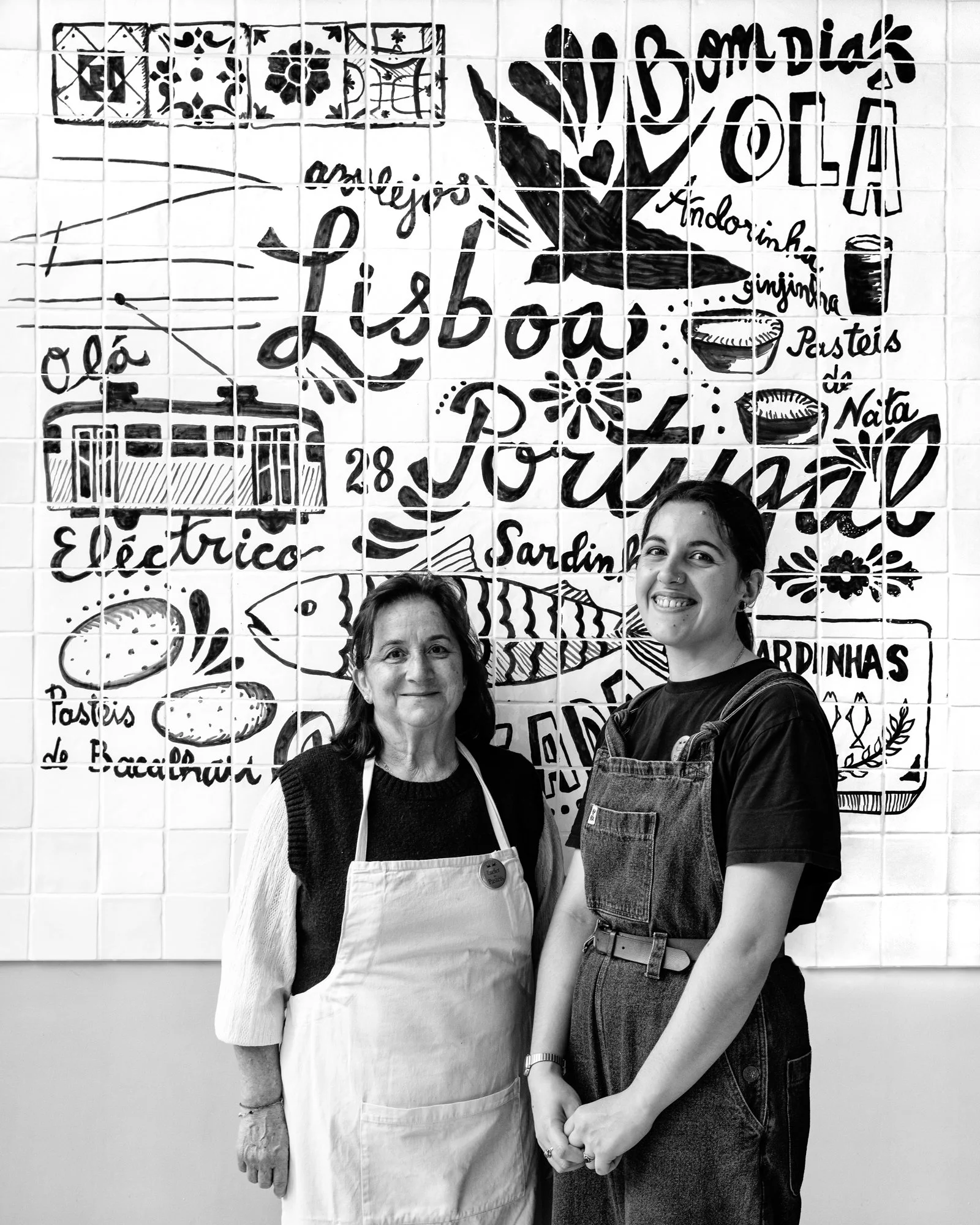
At L’Atelier des Pastéis in Bordeaux.

If you ever find yourself wandering through Bordeaux with a craving for something sweet, warm, and unmistakably Portuguese, step inside L’Atelier des Pastéis. This charming, family-run pastelaria has mastered one thing to near perfection: the iconic Pastel de Nata. And they bake them the way they should be baked — fresh, on site, all day long.

Why this little shop stands out

Freshly baked, all day
The pastéis are made and baked right in the shop, not frozen, not outsourced. The result? Flaky, buttery crusts that crack just right, and a velvety custard filling with that irresistible hint of caramelized sweetness.

A cosy slice of Portugal
The moment you walk in, you’re greeted by a warm, Lissabon-inspired interior. Soft colours, contemporary azulejo-style artwork, subtle Portuguese touches — it feels like a tiny café hidden somewhere in Belém.

Genuine hospitality
Reviewers consistently mention the kindness and warmth of the team. Whether you drop by for a takeaway treat or sit down with a coffee, you’re welcomed like a regular.

Affordable indulgence
A single pastel costs just a few euros, and multi-packs make it even more tempting to bring some home.

Our take — absolutely worth the stop

The pastéis we tasted were everything they should be: crisp on the outside, smooth and creamy inside, and still warm from the oven. It’s the sort of simple, perfect treat that brightens your day instantly.

If you’re visiting Bordeaux and want a quick edible escape to Lisbon, L’Atelier des Pastéis is a must-visit. Delicious, authentic, and full of heart — exactly what a pastelaria should be.

Radegonde: A Frankish Queen Who Chose the Cloister Over the Throne

Saint Radegonde. Life of Saint Radegonde, 11th century. Poitiers Municipal Library.

When Radegonde was born around 520 CE, Western Europe was still reeling from the collapse of the Roman Empire. Gaul was ruled by the Merovingians—Frankish warrior-kings who wielded power through conquest, family alliances, and an often-brutal politics of survival. Amid these shifting frontiers, a young Thuringian princess would chart an extraordinary course that defied the expectations of her age.

Radegonde’s childhood was torn apart when Frankish armies under Clotaire I invaded her native Thuringia. Taken as a war prize to the royal villa of Athies near Soissons, she received a classical Latin education that sharpened her intellect and nourished an early Christian piety. Eventually Clotaire made her his queen. Yet the splendor of the Merovingian court—lavish feasts, precious jewels, and the intrigue of power—never captured her heart. She was known to slip away from banquets to pray on the cold stone floors of her chapel, a silent protest against the violent world around her.

That world turned bloodier still when Clotaire ordered the murder of her younger brother, fearing he might challenge Frankish rule. For Radegonde this was the breaking point. She fled the royal household and sought protection from Bishop Médard of Noyon, who, despite the king’s fury, consecrated her as a nun. Legend tells of a miraculous escape: as Clotaire’s men pursued her near Saix, newly sown oat fields suddenly sprang to full height, hiding her and two companions from view. The episode became known as the “miracle of the oats.”

Radegonde’s choice was more than a personal act of faith. It symbolized a profound shift in early medieval society. Across Merovingian Gaul, Christian monasteries were becoming alternative centers of authority—repositories of learning, wealth, and moral power that could rival kings. From her new foundation at Poitiers, the abbey of Sainte-Croix, Radegonde embodied this spiritual counterweight. She secured from the Byzantine emperor a fragment of the True Cross, turning her monastery into a major pilgrimage site and inspiring the hymn Vexilla regis, still sung in Holy Week liturgies.

Her influence reached far beyond cloister walls. By caring for the sick, feeding the poor, and mediating between warring Frankish princes, Radegonde became a broker of peace in a violent age. Gregory of Tours, the great historian-bishop of the Merovingians, portrays her funeral in 587 as a moment of immense popular devotion, the culmination of a life that had turned royal power inside out.

Radegonde’s story reminds us that the early Middle Ages were not merely an age of swords and dynasties. They were also an age when women, through the Church and the new monastic networks, could carve out spaces of autonomy and moral authority. In a world where kings ruled by might, a captive queen transformed her captivity into freedom—and in doing so became a saint whose influence outlasted the empire that once claimed her.

The casket of Saint Radegonde in the Church of Sainte-Radegonde in Poitiers.

Further reading

  • Gregory of Tours, History of the Franks

  • Ian Wood, The Merovingian Kingdoms, 450–751

  • Jo Ann McNamara, Sainted Women of the Dark Ages

  • Pauline Stafford, Queens, Concubines and Dowagers: The King’s Wife in the Early Middle Ages

The Castle of Vitré

Rising above the Vilaine River in western France, Château de Vitré looks every inch the classic medieval fortress: high slate roofs, round towers with sharp conical caps, and massive granite walls that have witnessed nearly a thousand years of history. Its first stone castle was built around 1060, when the lords of Vitré needed a stronghold on the eastern frontier of the independent Duchy of Brittany.

During the 13th century, as conflicts between Brittany and the French crown intensified, the fortress was enlarged with the great gatehouse and round towers we see today. It became a keystone of the duchy’s defense. In the 14th century’s Breton War of Succession (1341–1364) the castle endured sieges and shifting alliances, holding fast as rival claimants and French armies struggled for control of Brittany.

By the 15th century, under the powerful Laval family, Vitré turned from a pure military post into a noble residence and a diplomatic stage. The Lavals—some of the richest nobles in Europe—hosted glittering feasts and negotiated marriages and alliances inside its walls. Local legend still speaks of a “Lady of Vitré” who wanders the ramparts on foggy nights, mourning battles and loves long past.

In later centuries the castle adapted to new realities. After Brittany was formally united with France in 1532, it served as an administrative center and, during the French Revolution (1789–1799), even as a prison. When romantic interest in the Middle Ages surged in the 19th century, Vitré’s fortress was carefully restored and opened to visitors.

Today its towers and halls house a museum that presents medieval arms, Renaissance furnishings, and the story of Brittany’s long struggle to keep its identity. Standing on the battlements, with the town’s tiled roofs below and the river curling beyond, you can feel how this granite sentinel once guarded a frontier—and how it now preserves the memories of nearly a millennium of French and Breton history.

Painting the Cross: Constantine’s Legacy on the Walls of Albi

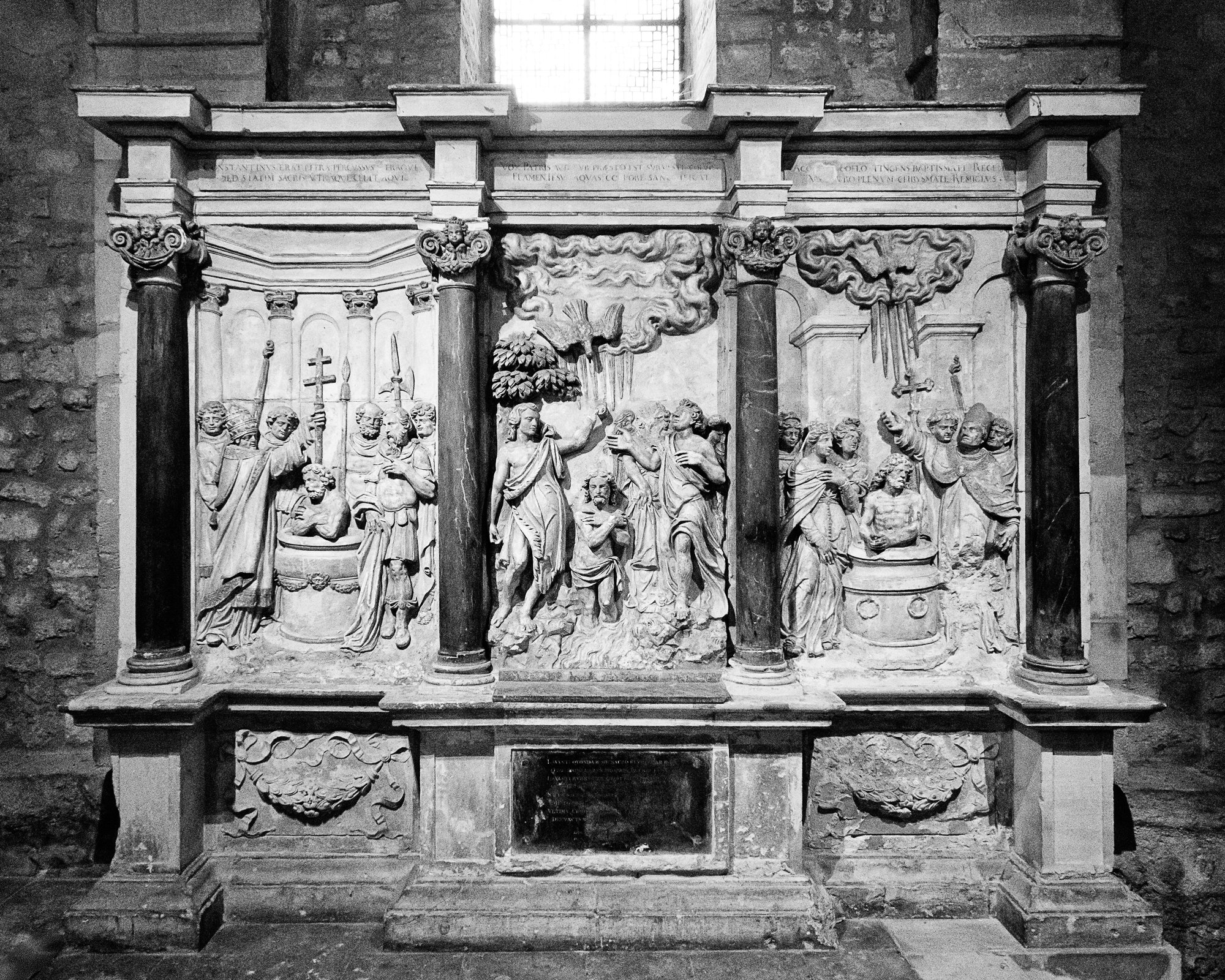
Fresco with Emperor Constantine and his mother Saint Helena in the Chapel of the Holy Cross, Cathedral of Sainte-Cécile, Albi, France (c. 1510–1512).

Emperor Constantine is depicted on this fresco The Cathedral of Albi on the eve of a decisive battle, gazing upward in astonishment as a brilliant red cross blazes in the sky. According to legend, an angel awakened Constantine and revealed this glowing cross accompanied by the words, “In hoc signo vinces,” meaning “In this sign, you will conquer.” In the fresco, angels hover around the radiant symbol, and Constantine’s soldiers pause in awe. This divine vision transforms the atmosphere: a moment before battle, the emperor and his army witness what they believe is a promise of victory from the Christian God. The red cross banner that appears becomes the centerpiece of hope – a vibrant emblem of faith in the midst of fear.

Under the Red Cross Banner

Inspired by the heavenly sign, Constantine commands his troops to carry a red cross banner as they charge into battle. Shields and standards are marked with the cross, turning the once-pagan army into an army under Christ’s protection. The fresco shows the young emperor leading the charge, his soldiers rallying behind the cross flag. True to the prophecy, Constantine wins a decisive victory over his rival under the banner of the cross. The red cross itself signifies the Crucifixion of Christ – red for the blood and sacrifice – and its presence signals that the Christian God favors Constantine.

The story continues after the battle: Constantine’s mother, Saint Helena, is shown receiving holy nails from the Crucifixion. She would later journey to find the True Cross of Christ, completing the tale of triumph.

Inspiring Faith in the 1500s

When these frescoes were painted in the early 1500s, their story had powerful meaning. The Cathedral of Albi had been built like a fortress of faith, symbolizing the Church’s resolve against heresy and enemies. The vivid scene of Constantine’s divinely aided victory would have inspired worshippers of that era, reminding them that unity under the cross could triumph over adversity.

The chapel housing this fresco once held a relic of the True Cross itself. Seeing Constantine’s vision and victory on the walls, and knowing a fragment of the actual Cross was nearby, people in the 1500s would feel a direct connection to this legend. The angels, emperors, and saints in the painting all served to reinforce the message that faith could guide leaders and nations to victory and salvation.

Mona Mania— Why the World Never Stops Lining Up for Her Smile

No comment.

There she sits — small, dark, behind bulletproof glass — and yet the crowd in the Louvre moves as if drawn by gravity itself. Cameras rise like a forest of hands. Whispers turn to gasps. For a few seconds, each visitor faces her — La Joconde, Leonardo’s Mona Lisa — and the miracle happens: proof. “I’ve seen it.”

But why this painting? Why not the radiant Venus de Milo just down the hall, or Delacroix’s Liberty Leading the People, blazing with drama and revolution? The Mona Lisa is quiet, almost modest — a woman sitting in stillness. Her mystery is not what she shows, but what she withholds. The half-smile that seems to change as you move. The eyes that appear to follow. Leonardo layered glazes of paint so thin they act like human skin; light breathes through her face, giving her an uncanny presence.

Her fame, however, was not born in the studio — it exploded in 1911, when she was stolen from the Louvre. For two years, she was the missing woman of Europe: her empty wall a national wound. When she returned, the world had made her a celebrity. From then on, her fame fed itself — through postcards, posters, parodies, and selfies.

Today, the Mona Lisa’s value isn’t just artistic; it’s symbolic. She is the universal passport to the art world — the one image everyone recognizes. Seeing her in person is like standing next to history itself, the moment when genius, myth, and human curiosity all meet in silence.

People crowd her room not just to look, but to witness. To say, I was there, she is real, and so am I.

Thérèse of Lisieux and Her Lasting Glow in Normandy

Sainte Thérèse de l’Enfant-Jésus with ex-voto plaques of gratitude, inside the Eglise Saint-Martin, Veules-les-Roses (France).

The Little Flower’s Short, Radiant Life

Thérèse Martin was born in 1873 in the quiet Norman town of Alençon, France, the youngest of nine children in a deeply devout family. Her mother died when Thérèse was four, and the family soon moved to Lisieux, where the Carmelite monastery would shape her destiny.

At just fifteen, Thérèse entered the Carmel of Lisieux, living a cloistered life of prayer and simplicity. Her “Little Way” of holiness—doing small things with great love—became the hallmark of her spirituality. She never left the convent walls and died of tuberculosis at only twenty-four (1897), yet her posthumously published autobiography Story of a Soul swept across the Catholic world.

From Hidden Nun to Canonized Saint

The power of her quiet witness was such that Pope Pius XI beatified her in 1923 and canonized her in 1925, an unusually rapid recognition. In 1997 Pope John Paul II proclaimed her Doctor of the Church, a rare honor for a woman, underlining the universal depth of her simple yet profound theology of trust and love.

Normandy’s Living Heart of Devotion

Though Thérèse is venerated worldwide, Normandy remains the heart of her devotion. Lisieux is home to the grand Basilica of Saint-Thérèse, a major pilgrimage destination drawing over a million visitors annually. Pilgrims come to walk the streets she knew, to pray in the Carmel where she lived and to touch the atmosphere of the family home “Les Buissonnets.”

The region’s attachment runs deep: Thérèse embodied the quiet perseverance and earthy faith long characteristic of rural Normandy. Her promise to “spend heaven doing good on earth” resonates in a landscape where faith is expressed less in spectacle than in steady, heartfelt fidelity.

Even along the Somme coast, in places like Veules-les-Roses, small churches keep her image close—testimony to how her “Little Way” crossed every parish boundary.

Why She Still Matters

Saint Thérèse invites modern seekers to discover the sacred in daily tasks and fleeting acts of kindness. In an age of noise and ambition, her life whispers that holiness is found not in grand gestures but in quiet love.

Further reading

  • Thérèse of Lisieux, Story of a Soul

  • Ralph Wright, Little Thérèse: Doctor of the Church

  • Guy Gaucher, The Story of a Life

Apremont-sur-Allier (France)

Apremont-sur-Allier (France)

On a graceful bend of the Allier River in central France lies Apremont-sur-Allier, a village that feels lifted from a storybook. Golden-stone houses draped in roses and cobbled lanes that lead to the river create a setting so perfect that it belongs to Les Plus Beaux Villages de France. Once a medieval quarry village supplying stone for great cathedrals, it was lovingly revived in the early 20th century by industrialist Eugène Schneider, who restored and rebuilt it in a harmonious neo-medieval style.

The heart of Apremont is its Parc Floral, five hectares of ponds, pavilions and rare trees that change colour and scent with the seasons. Though the château itself remains private, its towers and ramparts frame the gardens like a painting. The village cafés and the gentle rhythm of the river invite slow afternoons and quiet walks.

About 20 kilometres from Nevers, Apremont-sur-Allier is easy to reach by car yet blissfully far from crowds. Come in spring or summer, when flowers explode and the gardens are open, and you’ll discover one of France’s most enchanting hidden retreats—a place to wander, breathe and simply stay.

The Guardian Angels of Notre Dame de l'Assomption in Apremont-sur-Allier (France).

Along the Camino: Quiet Encounters in Late Autumn

Two of the pilgrims we met, one in Saint-Sever, and the other in Vezelay.

Travelling along the Camino de Santiago in November has its own rhythm. Winter is approaching, the days grow shorter, and the great summer crowds have long disappeared. The trail feels quiet now—almost contemplative—and the few pilgrims we do encounter stand out all the more.

We meet them here and there, often alone on the path or resting near a cathedral or a small chapel. Some walk only a section, others are still making their way toward Santiago. A handful travel with a dog, or with a horse carrying their pack. Most walk simply and lightly, moving at a pace shaped by the season.

Because there are so few of them, every conversation feels personal. These late-autumn pilgrims often have time—and stories. Some of them speak about why they walk, what the silence does to them, what they hope to understand or let go of. The simplicity of the Camino in November seems to deepen the lessons they learn: being present, appreciating small things, accepting the rhythm of each day.

For us, these encounters have been genuinely pleasant and full of insight. A short talk can open up entire perspectives on life, choices, and what matters.

To the pilgrims we’ve met along the way: Buen Camino. May the quiet season serve you well, and may the road ahead continue to teach, lighten, and inspire.

The Cathédrale Saint-Pierre of Poitiers

The Cathédrale Saint-Pierre of Poitiers.

In the historic heart of Poitiers, where Roman roads once crossed and medieval kings held court, rises one of France’s most striking Gothic churches: the Cathédrale Saint-Pierre. Begun around 1162 under the patronage of Eleanor of Aquitaine and Henry II of England, it reflects a turning point in architecture. Instead of the soaring spires of northern cathedrals, Poitiers offers a wide, hall-like interior—three nearly equal naves supported by massive clustered columns.

Step inside and you feel the difference immediately. The space is broad and luminous, more like an immense hall than a vertical climb toward heaven. Light spills through an exceptional set of 12th- and 13th-century stained-glass windows, among the oldest and best preserved in France. One masterpiece shows the Crucifixion flanked by detailed scenes from the lives of saints, its blues and ruby reds still glowing after eight centuries.

Music once filled this stone volume as richly as color does. The great organ, with pipes dating to the 18th century and a case adorned with delicate carvings, is among the finest in western France. Beneath it, carved choir stalls from the late Gothic period—intricate scenes of foliage, animals, and everyday life—give a surprisingly earthy counterpoint to the cathedral’s solemnity.

The building also tells of power and politics. Its foundation coincided with the Angevin empire of Henry II and Eleanor, whose marriage linked England and much of western France. Later centuries added chapels, sculptures, and restorations, but the core remains a proud witness to that rich medieval moment.

The interior of the Cathédrale Saint-Pierre

Young Bordeaux: Open, Curious, and Surprisingly Fluent in English

On an ordinary weekday in November, I found myself talking with a few students in Bordeaux. The weather was unusually warm for the season, giving the city a light, almost weightless atmosphere.

What struck me most was how effortlessly they shifted to English the moment I asked if they spoke English. They were open, curious, and happy to talk—and even happier to be photographed. Many carried actual books rather than screens, a small but refreshing reminder that reading in public is still very much alive.

They stood for portraits with an ease and confidence that surprised me. No posing culture, no hesitation—just simple human exchange. I walked away with images that feel honest, warm, and grounded in the everyday rhythm of the city. Sometimes the most ordinary moments offer the clearest glimpse of a place and its people.

The Death of Meleager – A Roman Theme Recast in Medieval Stone

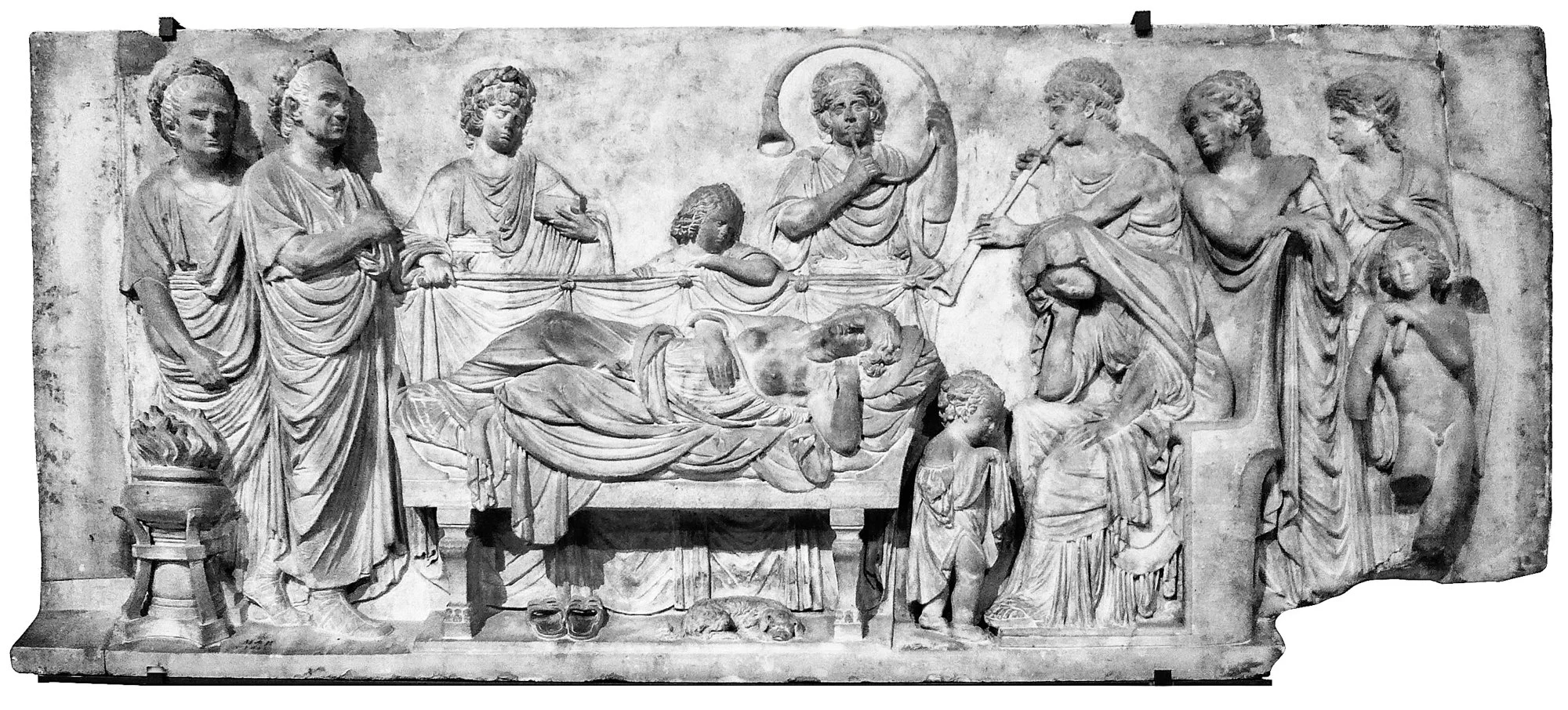
The Death of Meleager — marble relief carved in 11th-century Rome, reusing and reinterpreting ancient Roman motifs of the dying hero surrounded by mourners. Originally part of the Borghese Collection, later set into the façade of the Villa Borghese (1615), and now held in the Louvre Museum, Paris.

The Scene

Carved in marble in 11th-century Rome, this relief — known as The Death of Meleager — belongs to the Borghese Collection and now resides in the Louvre Museum, Paris. Though created long after antiquity, it reinterprets a classical myth that had already inspired countless Roman sarcophagi: the dying hero Meleager, surrounded by mourning women.

Meleager reclines on a couch, his body still strong but lifeless. Two women bend over him in grief — one supporting his shoulders, the other touching his face — while a third sits aside, her head veiled and her hand raised to her brow in a timeless gesture of sorrow. At the foot of the couch, a small dog waits faithfully beside a fallen helmet and shield, reminders of the hero’s warrior life. The figures are enclosed within deep niches, suggesting both an architectural setting and a tomb-like space.

The Meaning

In classical myth, Meleager’s death followed the Calydonian boar hunt and his fatal conflict with his own kin. Yet in this medieval version, the story has been transformed: no longer a mythic tragedy, but an image of human mortality. The sculptor, working in a Roman workshop of the 1000s, drew directly from ancient prototypes — perhaps even reusing a fragment of a Roman sarcophagus from the 2nd century CE — but gave it new devotional gravity.

Where ancient art emphasized heroic death, this version speaks in the visual language of compassion and lament. The gestures are quieter, the faces more introspective. The ancient Meleager becomes here a universal symbol of the dying man, surrounded by those who remain.

Reflection

Inserted into the façade of the Villa Borghese (Rome) in 1615 and later transferred to the Louvre, the relief bridges more than a millennium of art and faith. It shows how medieval artists continued to look back to Rome, not to revive its mythology, but to inherit its humanity. In this marble scene — the fallen hero, the grieving women, the silent dog — the boundaries between myth, memory, and prayer have dissolved.

Further Reading

  • J. Elsner, Art and the Roman Viewer: The Transformation of Art from the Pagan World to Christianity

  • C. Metzler, Sculpture in Rome, 1000–1150

  • M. Greenhalgh, The Survival of Roman Antiquities in the Middle Ages

What Makes the French…French?

Walk a French morning and the country explains itself. A queue at the bakery, neighbors greeting each other, a radio debate about schools and secularism, a tricolor over the prefecture, a poster for Saturday’s march—none of it exceptional, all of it telling. France isn’t one grand essence but a choreography of daily rituals.

Start with language. French is a public craft as much as a mother tongue: teachers weigh words, TV hosts fence with phrasing, and a simple tu or vous places people at a measured distance. Labels that protect names of cheeses and wines show how vocabulary guards landscapes too. Clarity and beauty aren’t luxuries; they’re civic habits.

Then the republic—felt more than proclaimed. National curricula, competitive exams, big public services: the state is not shy about being visible. Laïcité sets the tone of shared space: religion respected, institutions neutral. Most days the rule feels like background calm; sometimes it sparks an argument about the line between expression and equality.

You taste the country in its timing. Lunch is part of the day’s architecture; markets return like a heartbeat; “terroir” ties flavor to place and patience. Even so, France is modern to the bone: TGVs stitch distances, hypermarkets and click-and-collect keep families on schedule. Big principles—liberty, equality, fraternity—share a house with big conveniences, and they argue over dinner.

Public disagreement isn’t a crisis here; it’s a civic sport. People strike, march, write op-eds. Café talk can sound like a seminar, and essays remain a popular way to think in public. Form matters too: a letter begins “Madame, Monsieur,” a meeting ends “Bien à vous.” Style isn’t pretense; it’s a language of respect.

Beneath it all hum a few live tensions: universal citizenship vs. visible group identities; Paris’s pull vs. the pride of the periphery; secular neutrality vs. personal expression; terroir vs. global brands; a protective state vs. entrepreneurial zest. None is settled—and that’s the point. To “read” France, watch where routine meets principle: the school gate at 8:30, the roundabout lined with chain stores, the market at noon. In those ordinary theaters, the country becomes legible—practical, argumentative, elegant, and stubbornly itself.

Robert the Magnificent and His Vow to the Sea

Robert the Magnificent of Normandy portrayed on the Genealogical Chronicle of the English Kings.

In the early 11th century, Normandy was still a young duchy—rich, restless, and ruled by a man whose life reads like a Norse saga. Robert I of Normandy (c. 1000 – 1035), remembered as Robert the Magnificent, was the son of Duke Richard II and the father of William the Conqueror.

Though only in his late twenties when he took the ducal mantle in 1027, Robert quickly earned a reputation for daring and spectacle. He kept the feudal barons in line, encouraged trade along the Channel coast, and cultivated ties with the great abbeys that dotted Normandy. Yet his most enduring story began not in a council chamber but on the open sea.

A Storm, a Vow, and Three Chapels

Legend tells that Robert was caught in a violent storm while crossing the Channel. As waves threatened to swallow his ship, he prayed to the Virgin Mary, promising that if he survived he would build three chapels of gratitude along Normandy’s coast. He reached land safely, and the vow became action:

  1. La Délivrande, near Caen – Today a celebrated Marian shrine (Basilique Notre-Dame de la Délivrande), it grew from a humble chapel into one of Normandy’s oldest continuous pilgrimage sites.

  2. Notre-Dame de Grâce, Honfleur – Perched high above the Seine estuary, this chapel became a sailors’ sanctuary. Generations of fishermen and explorers—from cod fishermen bound for Newfoundland to long-distance captains of the Age of Discovery—left ex-votos (model ships, plaques, and prayers) in thanks for safe voyages.

  3. Notre-Dame de Salut, Fécamp – Built on a windswept cliff, this chapel doubled as a beacon for shipping. Even when religious wars ravaged it and its roof collapsed, the faithful of Fécamp rebuilt and returned. To this day departing vessels salute the site with three blasts of their horn, asking for “good wind and a safe return.”

Together these three sanctuaries stitched a spiritual safety net along Normandy’s maritime frontier—a chain of devotion and seamanship that long outlasted the duke who inspired them.

A Duke Larger than Life

Robert’s life ended as dramatically as it began. In 1035, during a pilgrimage to Jerusalem, he died suddenly—likely of illness—at Nicaea on the return journey. His young illegitimate son, William, would grow up to become William the Conqueror, reshaping European history.

Yet Robert’s own legacy is more than dynastic. His votive chapels stand as monuments to a ruler who linked faith and the sea, transforming a desperate prayer in a storm into three centuries-old beacons that still guide sailors and pilgrims alike.

Notre-Dame de Salut, Fécamp.

Further Reading

  • David Bates, Normandy Before 1066

  • Elisabeth van Houts, The Normans in Europe

The Expulsion of Paradise at the Abbey of Mont Saint-Michel (France)

Adam and Eve expelled from Paradise, mid-16th century, Abbey church of Mont-Saint-Michel, France.

Inside the abbey of Mont Saint-Michel, a mid-16th-century Caen-stone relief compresses the drama of Genesis 3 from the Bible into a single, charged scene. At the right side rises a tree full of apples. Coiled around its trunk clings a devilish figure, part human, part serpent, its horned head leaning toward Eve as one clawed hand offers the forbidden fruit. Adam stands close, torn between resistance and desire.

To the right, the consequence unfolds with striking force. A powerful angel strides forward, wings spread and sword raised, driving the pair out of the Garden of Eden. Adam and Eve shrink under the heavenly command: shoulders bent, arms crossed over their bare bodies, faces averted from the paradise they can no longer enter.

Carved during the French Renaissance, when sculptors combined late-Gothic sharpness with new attention to anatomy and movement, the relief captures in one sweep the temptation, judgment, and expulsion that mark the beginning of human history. More than five centuries on, the stone still brims with the urgency of that first exile.