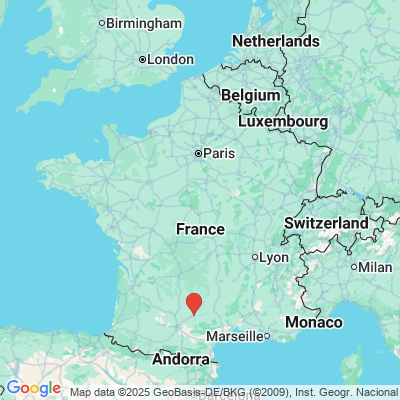
albi

Painting the Cross: Constantine’s Legacy on the Walls of Albi

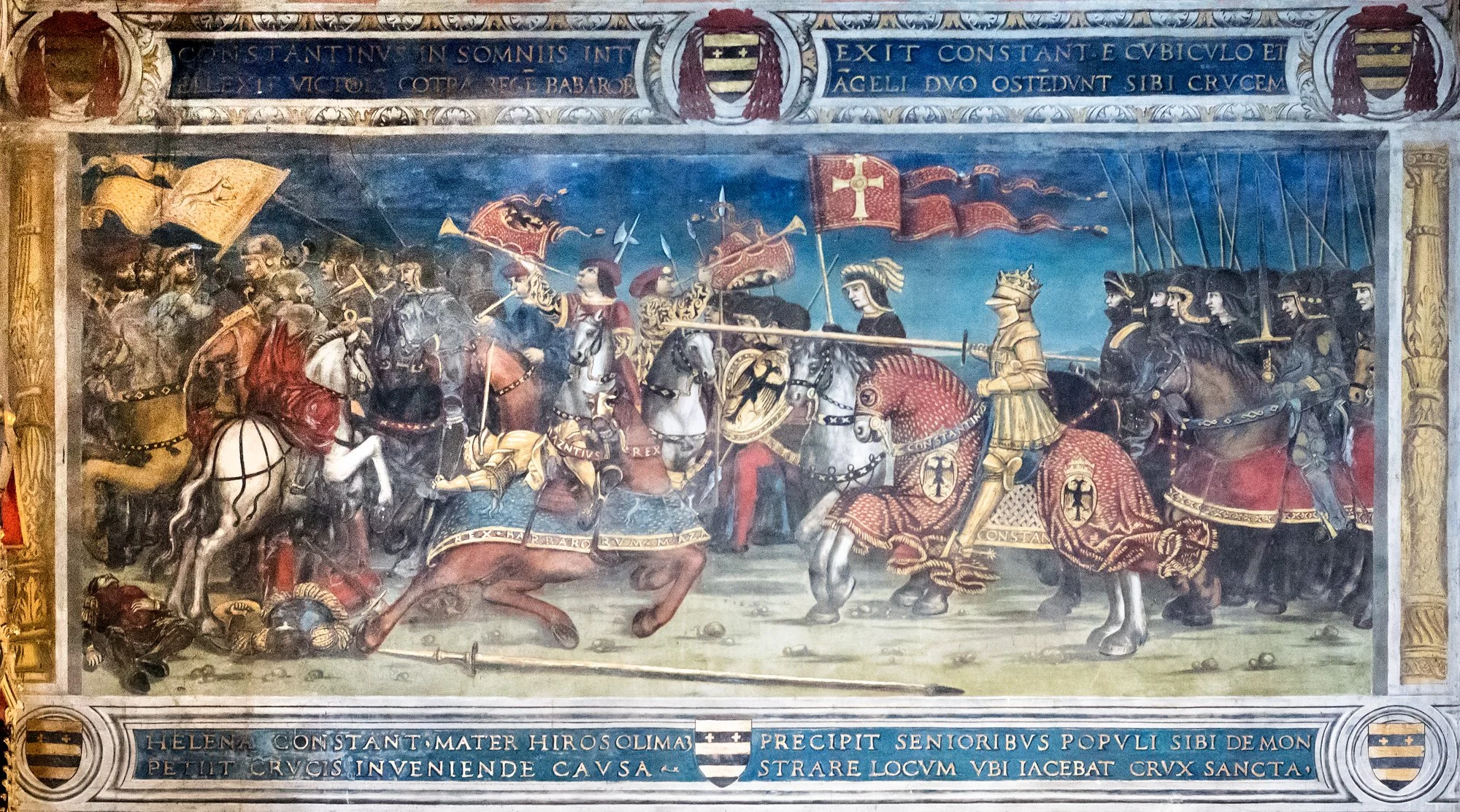
Fresco with Emperor Constantine and his mother Saint Helena in the Chapel of the Holy Cross, Cathedral of Sainte-Cécile, Albi, France (c. 1510–1512).

Emperor Constantine is depicted on this fresco The Cathedral of Albi on the eve of a decisive battle, gazing upward in astonishment as a brilliant red cross blazes in the sky. According to legend, an angel awakened Constantine and revealed this glowing cross accompanied by the words, “In hoc signo vinces,” meaning “In this sign, you will conquer.” In the fresco, angels hover around the radiant symbol, and Constantine’s soldiers pause in awe. This divine vision transforms the atmosphere: a moment before battle, the emperor and his army witness what they believe is a promise of victory from the Christian God. The red cross banner that appears becomes the centerpiece of hope – a vibrant emblem of faith in the midst of fear.

Under the Red Cross Banner

Inspired by the heavenly sign, Constantine commands his troops to carry a red cross banner as they charge into battle. Shields and standards are marked with the cross, turning the once-pagan army into an army under Christ’s protection. The fresco shows the young emperor leading the charge, his soldiers rallying behind the cross flag. True to the prophecy, Constantine wins a decisive victory over his rival under the banner of the cross. The red cross itself signifies the Crucifixion of Christ – red for the blood and sacrifice – and its presence signals that the Christian God favors Constantine.

The story continues after the battle: Constantine’s mother, Saint Helena, is shown receiving holy nails from the Crucifixion. She would later journey to find the True Cross of Christ, completing the tale of triumph.

Inspiring Faith in the 1500s

When these frescoes were painted in the early 1500s, their story had powerful meaning. The Cathedral of Albi had been built like a fortress of faith, symbolizing the Church’s resolve against heresy and enemies. The vivid scene of Constantine’s divinely aided victory would have inspired worshippers of that era, reminding them that unity under the cross could triumph over adversity.

The chapel housing this fresco once held a relic of the True Cross itself. Seeing Constantine’s vision and victory on the walls, and knowing a fragment of the actual Cross was nearby, people in the 1500s would feel a direct connection to this legend. The angels, emperors, and saints in the painting all served to reinforce the message that faith could guide leaders and nations to victory and salvation.
The Cathedral That Dominates Albi (France)

The Cathedral of Saint Cecilia of Albi (France).

Rising like a mighty fortress above the Tarn River, the Cathedral of Sainte-Cécile in Albi is one of the most unique and imposing churches in Europe. Built in the aftermath of the Cathar heresy, it was not only a place of worship but also a powerful statement of Catholic dominance. In the 13th century, the region of Albi was at the heart of the Cathar movement, a Christian sect deemed heretical by the Roman Catholic Church. After a brutal crusade and the systematic repression of the Cathars, the victorious Church sought to reaffirm its authority with an architectural symbol that was impossible to ignore. Thus, in 1282, construction began on what would become the largest brick cathedral in the world—a fortress of faith, designed to leave no doubt about who held power.

At first glance, Sainte-Cécile looks more like a military stronghold than a traditional cathedral. Its towering red-brick walls, narrow slit-like windows, and massive buttresses give it an imposing and defensive appearance, a clear reflection of the uncertain times in which it was built. But step inside, and the contrast is breathtaking. The stark exterior gives way to one of the most opulent church interiors in France, a riot of color, sculpture, and artistic mastery.

The "Last Judgement" mural of the Albi Cathedral.

One of the most striking features of the cathedral is the grand mural of the Last Judgment, painted in the late 15th century. Covering the entire western wall, this vast fresco depicts the fate of souls after death, with the righteous ascending to paradise and the damned suffering horrific punishments in hell. The lower section is divided into seven compartments, each representing one of the seven deadly sins. The scenes are vivid and haunting—proud souls broken on a wheel, the envious plunged into ice and fire, and the greedy tormented by demons. Remarkably, the fresco remains almost untouched by restoration, preserving its original intensity.

The nave of the Albi Cathedral.

The cathedral's vaulted ceiling, stretching over 18 meters high, is another masterpiece. Painted in deep blues and golds, it is adorned with intricate floral patterns and biblical scenes. The decoration is the work of Italian artists brought in during the early 16th century, adding a Renaissance touch to the otherwise Gothic structure. Below the ceiling, the ornate jubé (rood screen) is a true gem of Flamboyant Gothic sculpture, delicately carved and adorned with statues of biblical figures. It once separated the clergy from the congregation, emphasizing the hierarchy within the church.

With its dramatic history, fortress-like presence, and awe-inspiring decorations, the Cathedral of Sainte-Cécile is more than just a religious monument—it is a testament to a turbulent past and a masterpiece of medieval artistry. Whether viewed from afar or explored up close, it remains one of the most breathtaking and unforgettable cathedrals in Europe.

Monsieur, Madame et le Chien

"Monsieur, Madame et le Chien" by Henri de Toulouse-Lautrec (1893) - Musée Toulouse-Lautrec (Albi, France).

"Monsieur, Madame et le Chien" by Henri de Toulouse-Lautrec is a notable example of the artist's work, blending his characteristic wit and observational skill with a sense of playful ambiguity. Painted in 1893, this piece reflects Lautrec's fascination with the human condition and the social dynamics of the Parisian bourgeoisie.

The artwork depicts a well-dressed couple seated together, accompanied by their small dog. "Monsieur" is stiffly posed, his expression one of detached indifference, while "Madame" appears more relaxed, with a sly, knowing smile. The little dog, placed at the woman's feet, gazes directly at the viewer, as if to invite interpretation. The scene captures the tension between formality and intimacy, a recurring theme in Lautrec’s exploration of human relationships.

Lautrec's inspiration for the painting came from his time spent observing Parisian society. While much of his work focused on the bohemian nightlife of Montmartre, this piece offers a satirical take on the conventions of the upper middle class. The dog serves as a humorous focal point, symbolizing loyalty, status, and perhaps even the unspoken dynamics of the couple's relationship.

The title itself adds a layer of irony. By equating the dog with "Monsieur" and "Madame," Lautrec gently mocks the pretensions of his subjects, suggesting that their carefully curated appearances and manners are as much a performance as the animal’s obedience.

The late 19th century was a time of social transformation in France, with increasing tensions between traditional values and modernity. Lautrec, an aristocrat by birth but a bohemian by choice, was keenly aware of these shifts. His works often blurred the line between affection and critique, portraying his subjects with both empathy and a sharp eye for their flaws.

This painting, while less provocative than some of his depictions of dancers and courtesans, still carries his signature irreverence. It subtly critiques the stiff, ritualized interactions of bourgeois couples, using humor to reveal the emotional distance that could exist behind the veneer of propriety.

"Monsieur, Madame et le Chien" remains a celebrated piece for its lighthearted yet incisive commentary on society. It highlights Lautrec’s genius in capturing complex human emotions within seemingly simple compositions, cementing his reputation as one of the most insightful artists of his time.