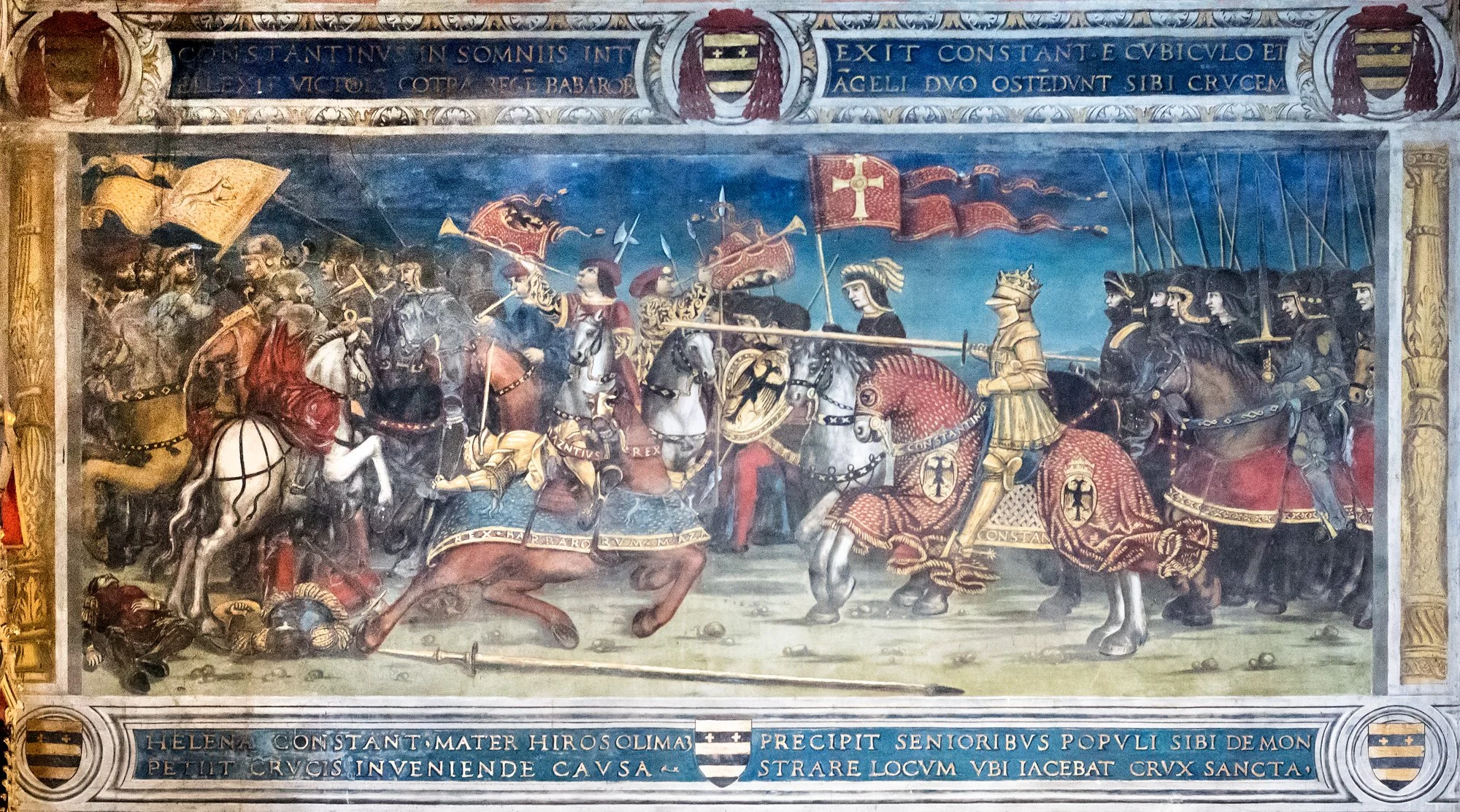
Fresco with Emperor Constantine and his mother Saint Helena in the Chapel of the Holy Cross, Cathedral of Sainte-Cécile, Albi, France (c. 1510–1512).
Emperor Constantine is depicted on this fresco The Cathedral of Albi on the eve of a decisive battle, gazing upward in astonishment as a brilliant red cross blazes in the sky. According to legend, an angel awakened Constantine and revealed this glowing cross accompanied by the words, “In hoc signo vinces,” meaning “In this sign, you will conquer.” In the fresco, angels hover around the radiant symbol, and Constantine’s soldiers pause in awe. This divine vision transforms the atmosphere: a moment before battle, the emperor and his army witness what they believe is a promise of victory from the Christian God. The red cross banner that appears becomes the centerpiece of hope – a vibrant emblem of faith in the midst of fear.
Under the Red Cross Banner
Inspired by the heavenly sign, Constantine commands his troops to carry a red cross banner as they charge into battle. Shields and standards are marked with the cross, turning the once-pagan army into an army under Christ’s protection. The fresco shows the young emperor leading the charge, his soldiers rallying behind the cross flag. True to the prophecy, Constantine wins a decisive victory over his rival under the banner of the cross. The red cross itself signifies the Crucifixion of Christ – red for the blood and sacrifice – and its presence signals that the Christian God favors Constantine.
The story continues after the battle: Constantine’s mother, Saint Helena, is shown receiving holy nails from the Crucifixion. She would later journey to find the True Cross of Christ, completing the tale of triumph.
Inspiring Faith in the 1500s
When these frescoes were painted in the early 1500s, their story had powerful meaning. The Cathedral of Albi had been built like a fortress of faith, symbolizing the Church’s resolve against heresy and enemies. The vivid scene of Constantine’s divinely aided victory would have inspired worshippers of that era, reminding them that unity under the cross could triumph over adversity.
The chapel housing this fresco once held a relic of the True Cross itself. Seeing Constantine’s vision and victory on the walls, and knowing a fragment of the actual Cross was nearby, people in the 1500s would feel a direct connection to this legend. The angels, emperors, and saints in the painting all served to reinforce the message that faith could guide leaders and nations to victory and salvation.