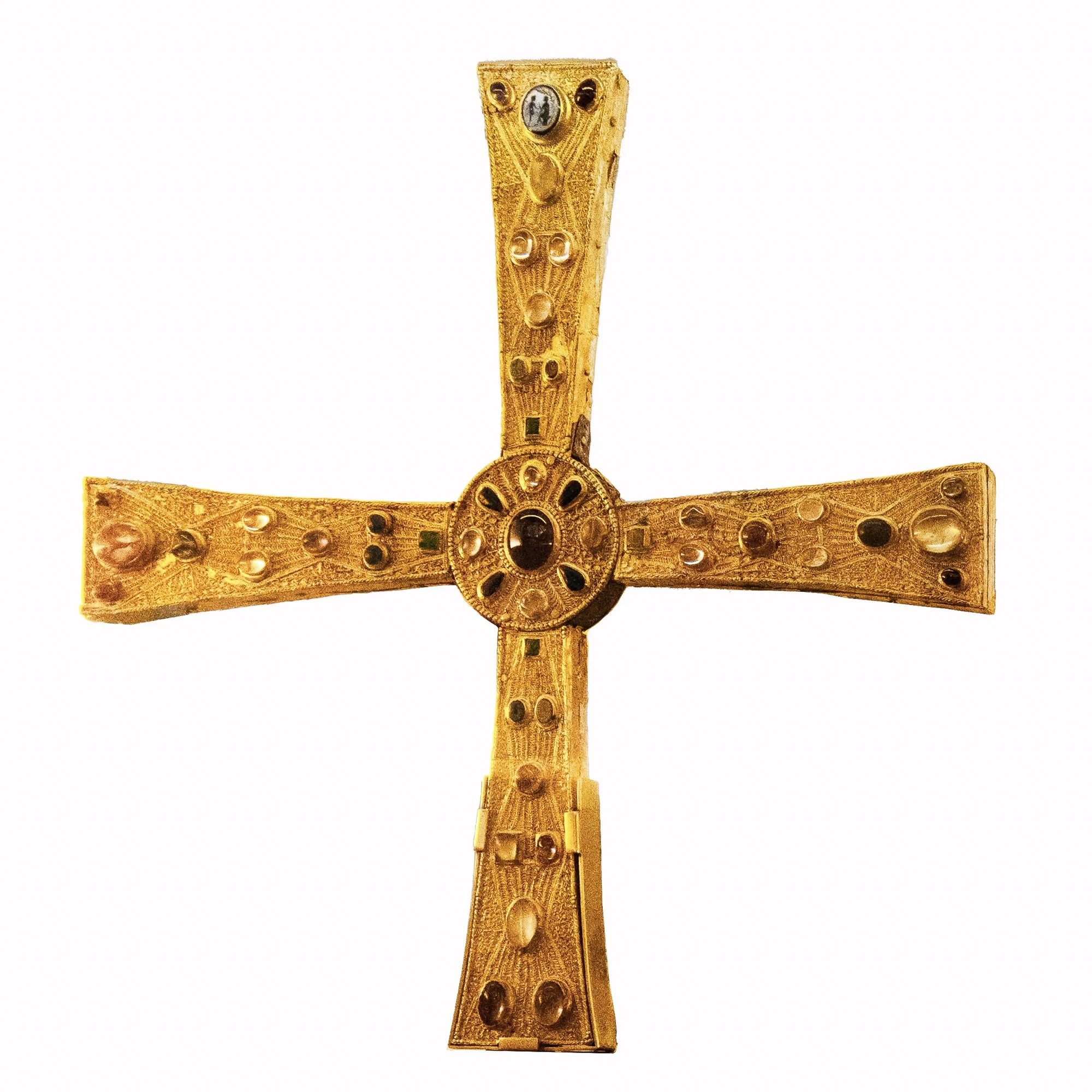
Oviedo’s Cruz de los Ángeles.
Step into the dim stone of the Cámara Santa and the light finds its target. Behind glass, a small golden cross glows like a held breath. This is the Cruz de los Ángeles—Oviedo’s emblem, the city’s oldest signature in metal and light.
The story begins in 808, when King Alfonso II “the Chaste” endowed the cathedral with a reliquary cross of gold, pearls, and colored stones. Legend adds a flourish: two mysterious craftsmen appeared, worked through the night, and vanished at dawn—angels, people said. Whether or not wings touched the workbench, the craftsmanship still feels unearthly: filigree like lace, geometry calm and exact, a willingness to shimmer without shouting.
Look at the cross and you see more than devotion. You see statecraft in an early-medieval key: a king gifting a radiant center to a capital he was shaping. In the decades that followed—by c. 813, when the shrine at Santiago gained royal recognition and the Camino Primitivo set out from Oviedo—the cross functioned as a compass of faith and cityhood. In time it moved from treasury to coat of arms, from shrine to street banners: the way Oviedo wrote its name.
The cross has known danger and repair. In the early hours of 12 October 1934, during the Asturian uprising, an explosion devastated the Cámara Santa and scarred its treasures. Then, on the night of 9–10 August 1977, thieves dismantled the cross to sell it in pieces. Most fragments were recovered, and a careful reconstruction returned the Cruz de los Ángeles to view between 1979 and 1986—scarred, like the city, yet standing.
How to look? Begin with the details: filigree borders like tiny braided rivers; stones cupped in their bezels; the hinge that reveals its truth as a reliquary. Step back, and the geometry resolves—four equal arms catching the room’s light like a compass. Then walk into the plaza, where the city’s heraldry echoes what you just saw. Gold and granite, myth and municipal seal, keep talking above your head.
In a world that loves spectacle, the Cruz de los Ángeles teaches a gentler amazement. It is small, portable, serious; it glitters not to dazzle but to endure. If you want to understand Oviedo, start here: a cross forged in 808, wounded in 1934 and 1977, restored by 1986—and still called by name.