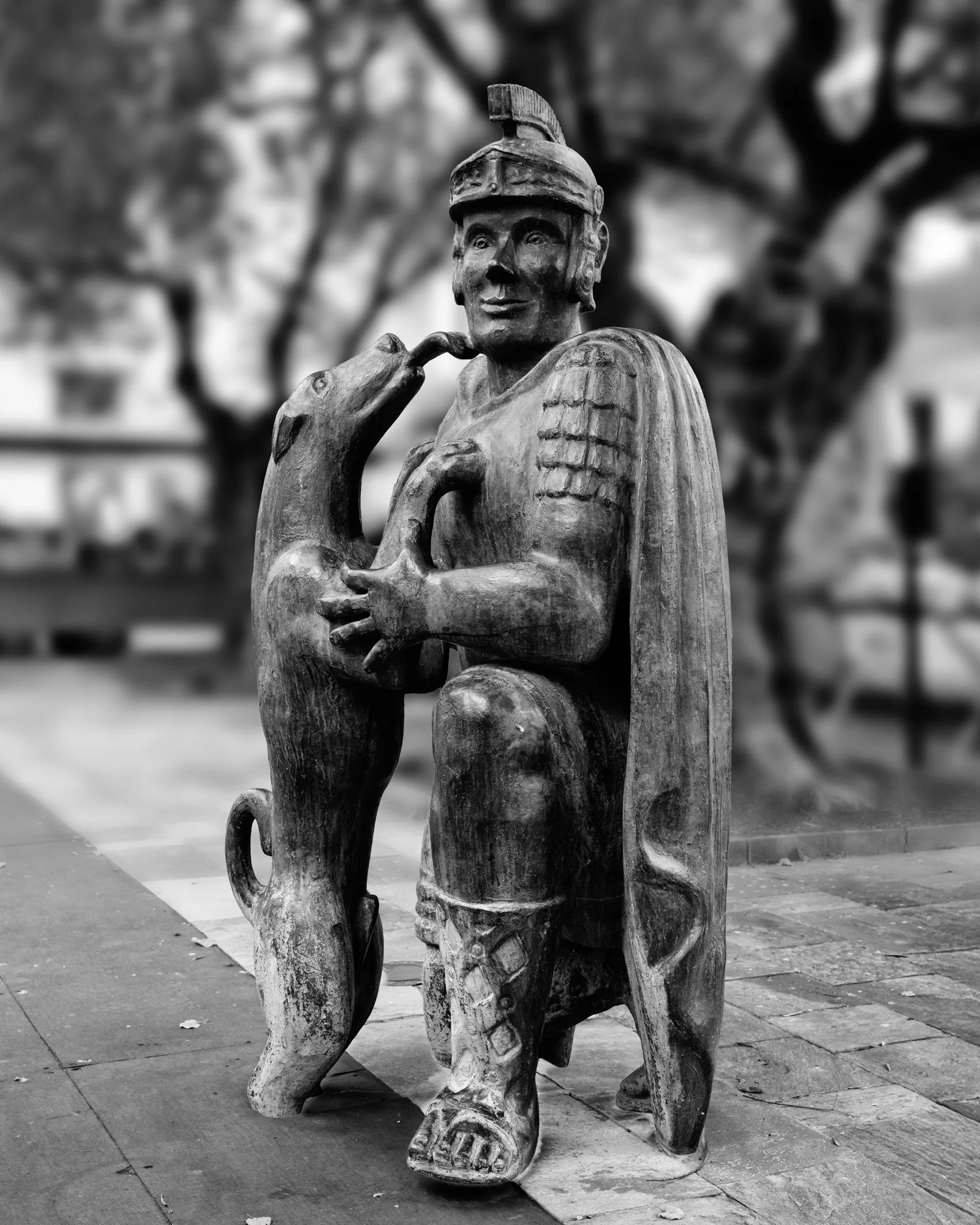
A Roman legionary and his loyal dog — a statue recalling the founding legend of Dax as a city of healing springs.
On the Place de la Cathédrale in Dax, in the shade of old olive trees, stands a quietly touching statue: a Roman legionary and his dog. At first glance it looks like just another piece of classical decoration. But behind it hides the founding legend of one of France’s oldest spa towns.
Long before Dax became a destination for bathrobes, wellness programmes and medical cure packages, it was already famous in Roman times as Aquae Tarbellicae — the waters of the Tarbelli tribe. Soldiers, officials and travellers came here to soak in warm mineral springs and coat their aching joints with therapeutic mud from the river Adour.
And according to local legend, it all began with a dog.
The story goes that a Roman legionary stationed in the area owned a loyal dog suffering badly from rheumatism. The animal could barely walk. Believing its suffering could not be eased, the soldier abandoned it on the banks of the Adour. When he later returned from campaign, he was astonished to find his dog alive, playful — and completely cured.
The animal had taken refuge in the warm, mineral-rich mud along the riverbanks. The same mud that is still used today in Dax’s famous thermal treatments.
The miracle dog had done what centuries of medicine would later confirm: Dax’s water and mud truly have healing properties.
Today Dax is France’s leading spa town for rheumatology. Tens of thousands of visitors come every year for three-week medical cures prescribed by doctors. Around the thermal baths grew an entire city economy: hotels, clinics, wellness centres, rehabilitation programmes, and an army of physiotherapists and hydrotherapists.
The statue of the legionary and his dog quietly tells the story of how Dax became a place of healing — where warm springs, river mud and time itself helped wounded bodies walk again.
Sometimes, history begins not with emperors or generals — but with a limping dog and a soldier who loved him.