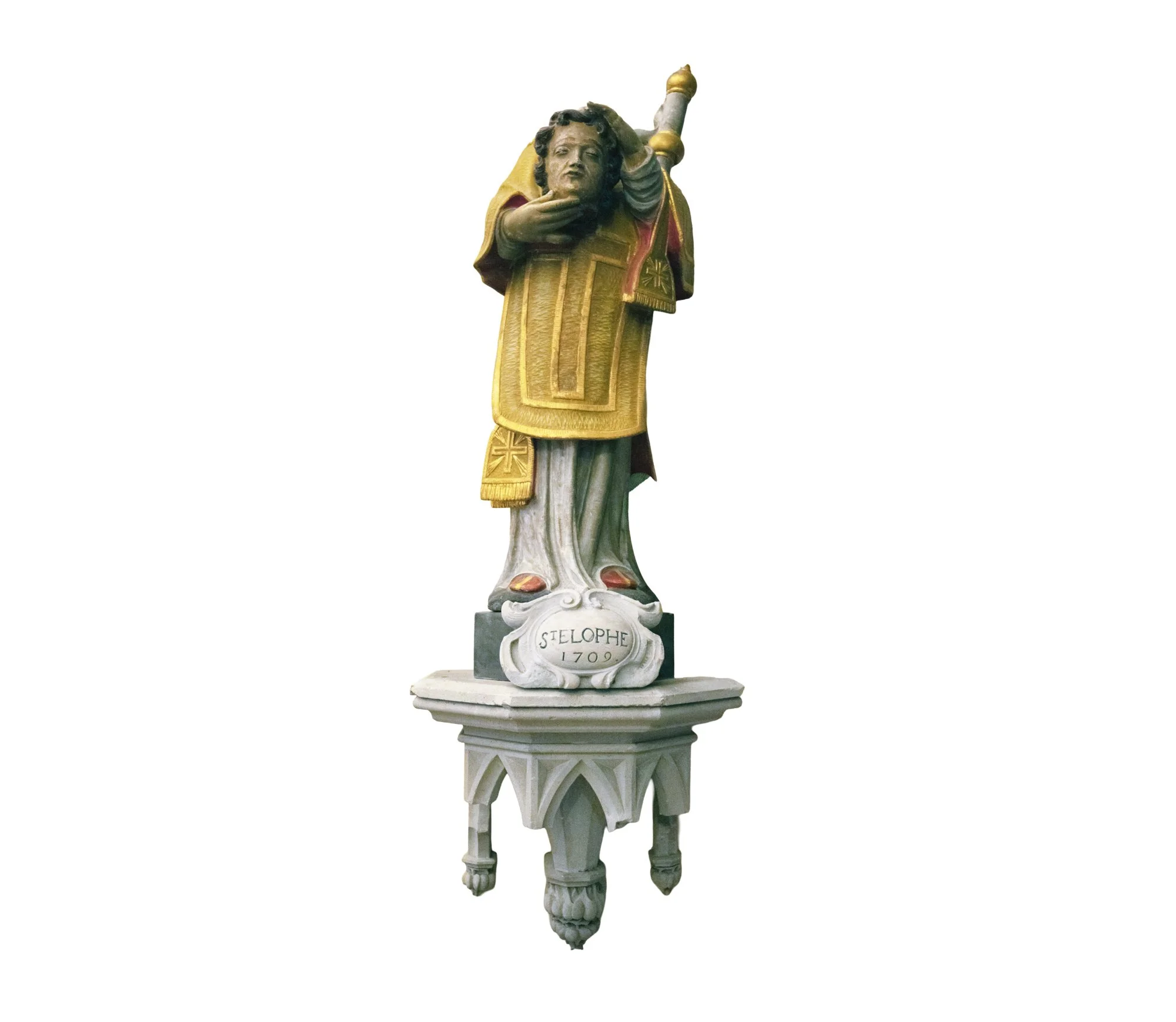
The statue of Saint Elophe in the Church of Saint-Remy (Église Saint-Rémy) in Domrémy-la-Pucelle.
If you’re looking at Saint Elophe’s statue in Domrémy-la-Pucelle’s Church of Saint-Remy, you’ll notice his unmistakable emblem: the saint bearing his own head—a “cephalophore.” The image condenses a local memory from the Toul–Vosges frontier, where Elophe (Eliphius) is remembered as a deacon and preacher who spread the new faith among Gallo-Romans in the mid-4th century.
Tradition places his death in 362, during the brief reign of Emperor Julian—nicknamed “the Apostate”—who tried to reverse the Christianising tide and restore favor to the old gods. Though Julian did not institute a formal empire-wide persecution, his policies stripped Christian privileges and emboldened local hostility. In that climate, Elophe was seized and beheaded near the Vair River. The legend says he then rose, took up his severed head, and walked uphill to the place he wished to rest—an image that fixed his cult in the Lorraine landscape.
It’s a striking turn after Emperor Constantine, decades earlier, had legalized Christianity with the Edict of Milan (313), ending the great imperial persecutions and allowing the Church to root itself in towns like Toul. Elophe’s story captures that hinge between eras: from tolerated and rising faith to a sudden, dangerous backlash—followed by a memory that would spread far beyond Lorraine, even to Cologne, where his relics were later honored.
And that statue before you at Domrémy keeps telling it—quietly, clearly, in stone.