Saint

Saint Expédit: A Wall of Gratitude

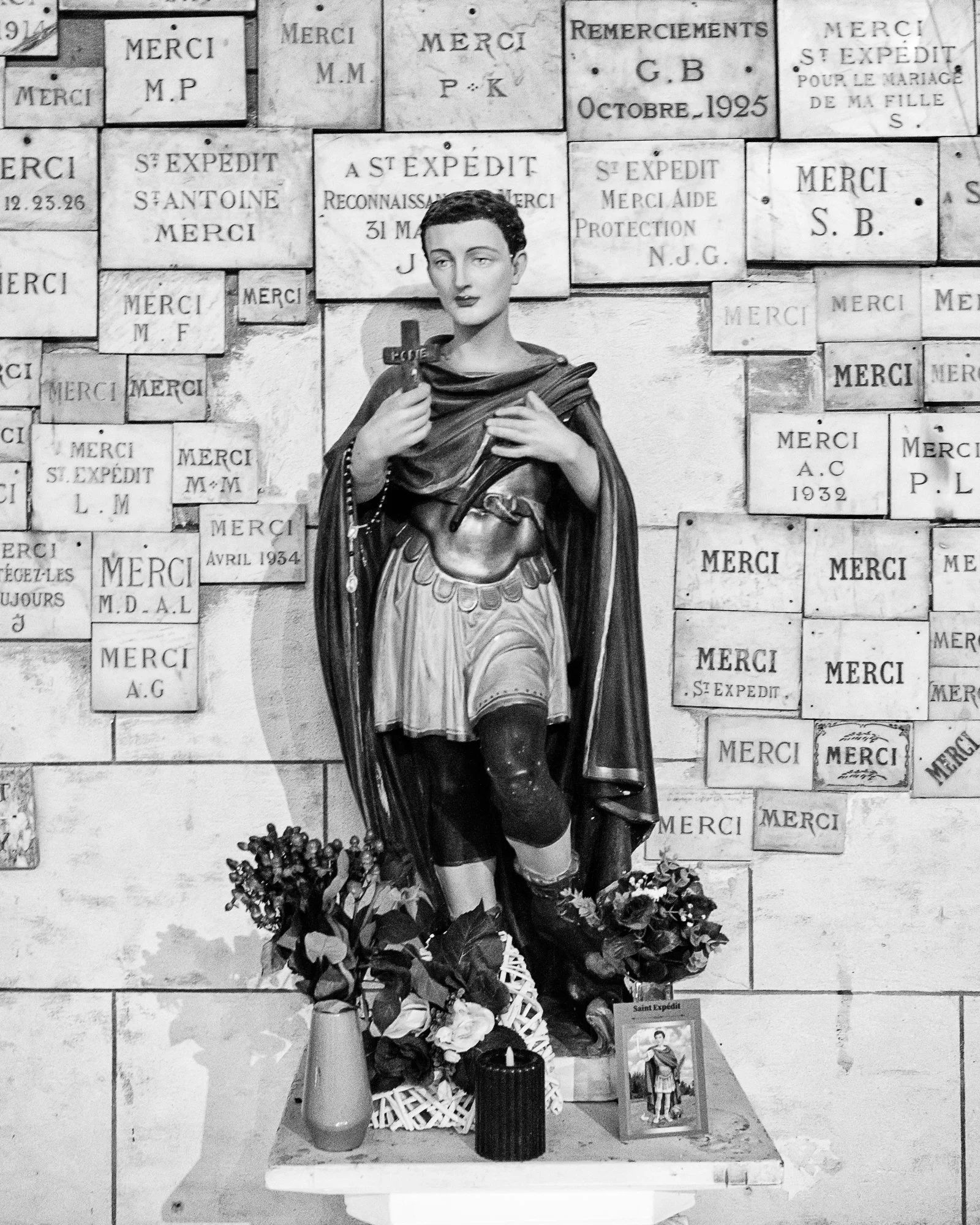
Saint Expédit, Église Saint-Pierre in Bordeaux (France).

We met him in a quiet chapel of the Église Saint-Pierre in Bordeaux (France)— a young Roman soldier standing almost casually, one knee bent, a cloak gathered in his hand. This is Saint Expédit, patron of people who cannot wait for tomorrow.

But what gives this shrine its power is not only the statue. It’s the wall behind him, tiled with small marble plaques, each carved with a simple word: MERCI.

A century of whispered relief, arranged like a mosaic.

Some plaques are formal, some abbreviated to initials, some marked with dates long before we were born. Others simply say “MERCI” — nothing more, yet somehow enough. Together they form a quiet ledger of fear, hope, and fulfilment.

According to the old legend, Expédit was a Roman soldier who, on the brink of converting to Christianity, faced a whisper of doubt urging him to delay. He refused. Faith, he decided, was for today, not some comfortable tomorrow. Ever since, people have come to him when hesitation is no longer possible.

In Bordeaux, this devotion feels very much alive. The flowers at his feet, the votive card leaning against the plinth, the steady growth of plaques over decades — all of it tells the same story: someone was in trouble, asked for help, found it, and returned with a piece of marble to say thank you.

A simple statue.
A wall full of human stories.
And a saint who still stands for the courage to act — not later, but now.
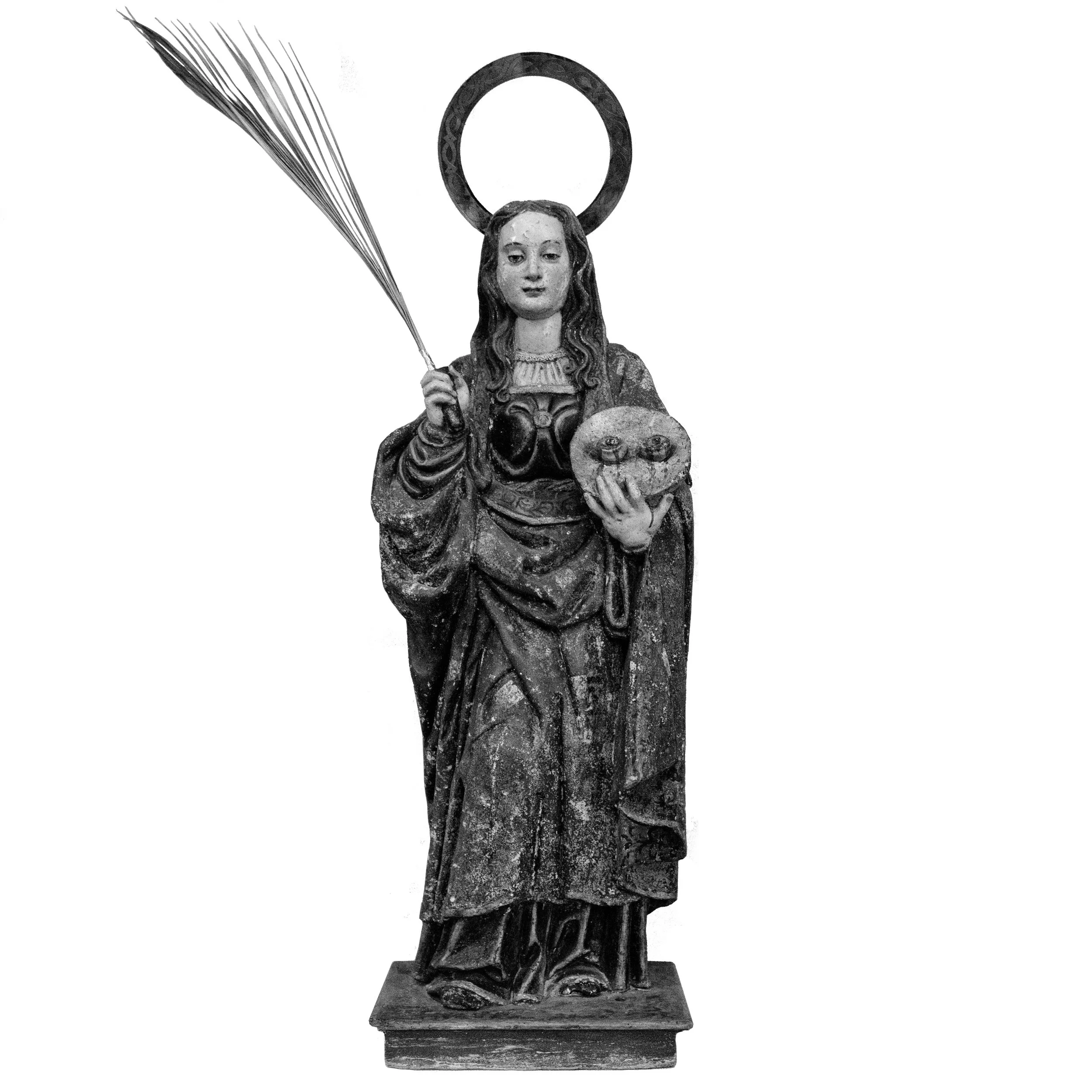
Saint Lucia of Syracuse

The statue of Saint Lucia of Syracuse, Catedral Vieja de Salamanca (Spain)

Saint Lucia, born in Syracuse, Sicily, during the 3rd century, led a life devoted to Christianity. Legend has it that she promised her life to God, vowing chastity and service. Despite persecution by Diocletian, she remained steadfast, even surviving attempts to martyr her. One tale recounts her clandestine visits to Christians in prison, bringing them food and light. She wore a wreath of candles to illuminate her path, symbolizing hope in dark times.

The plate with two eyes, a curious detail, is often attributed to her own actions. In one of the stories, Lucia plucked out her eyes to deter a persistent suitor who admired them. Miraculously, her sight was restored by divine intervention, leaving her with a plate depicting her eyes as a reminder of her unwavering faith and miraculous healing.

Today, Saint Lucia is celebrated on December 13th, embodying the virtues of courage, compassion, and the triumph of light over darkness.

Saints Cosmas and Damian

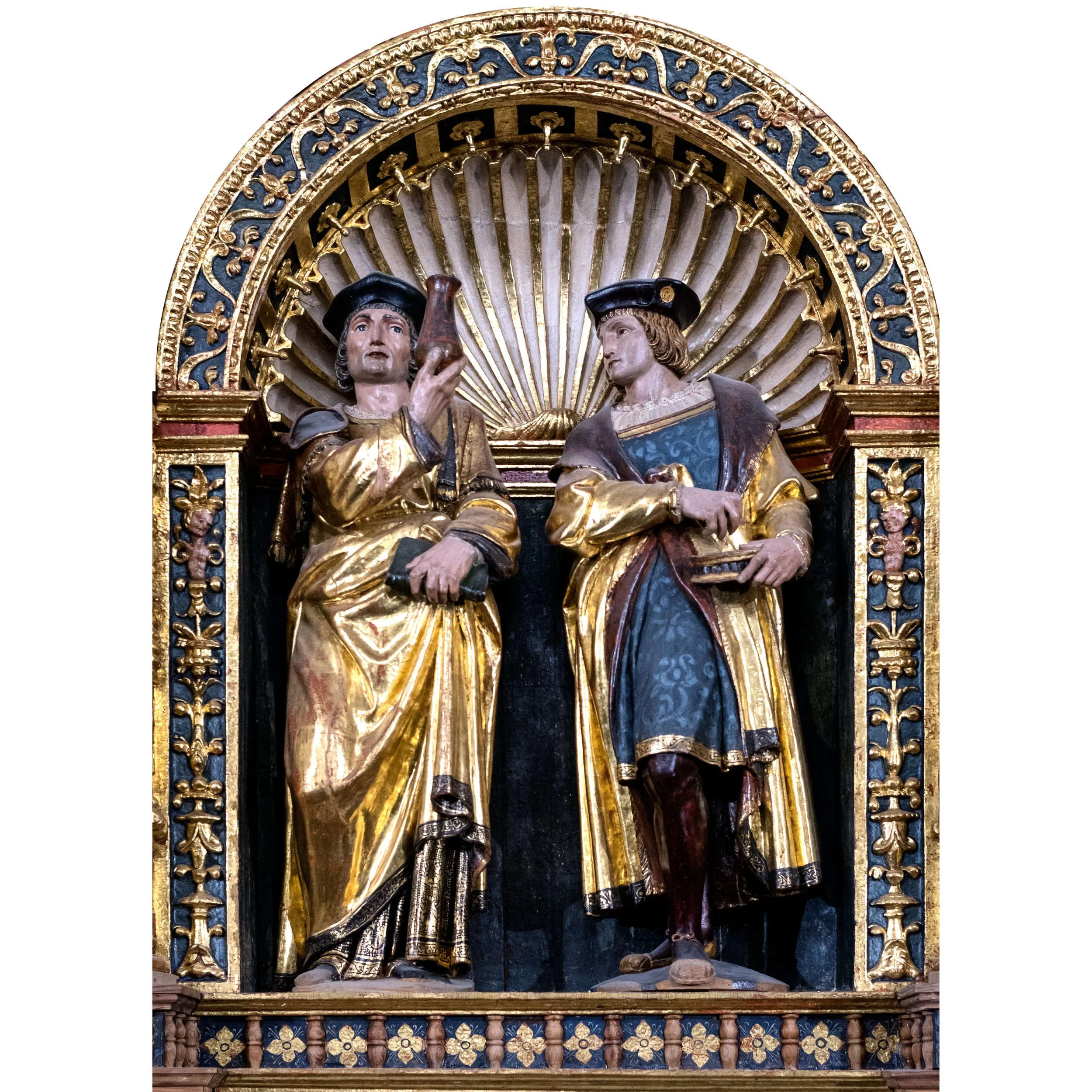
Saints Cosmas and Damian, Church of Saint Peter in Teruel (Spain).

Saints Cosmas and Damian were twin brothers who lived in the 3rd century AD and are revered as martyrs. Born in Cilicia, a region on the southeastern coast of Asia Minor, they worked as physicians in the port city of Aegea (now Ayas, Turkey). Known for providing free medical services, they were called Anargyroi (Greek for “the silverless”) due to their refusal to accept payment. Their charity is believed to have led to many conversions to Christianity. The brothers are credited with several miracles, including a legendary leg transplant in which they replaced a man’s lost leg with that of a deceased Moor.

Under Emperor Diocletian's persecution of Christians, they were arrested, tortured, and eventually beheaded for their faith. Veneration of Cosmas and Damian began soon after their deaths, with churches dedicated to them appearing in Jerusalem, Egypt, and Mesopotamia. In 527, Pope Felix III converted the Temple of Romulus in Rome into a basilica in their honor. Their skulls are kept in the Clarisses convent in Madrid, though other relics exist in cities like Munich, Vienna, and Venice.

Cosmas and Damian are patron saints of doctors, nurses, pharmacists, and the sick, as well as barbers and confectioners. Their feast day is celebrated on September 26. They are also invoked for protection against seasickness, inflammation, and plague. In Dutch history, two major floods, known as the Cosmas and Damian Floods, occurred on their feast day in 1477 and 1509, causing significant damage to Zeeland and Flanders.

Archangel St. Michael: Defender and Judge

Archangel St. Michael (~ 1425), Museum of the Cathedral of Santiago de Compostela (Spain).

Archangel St. Michael, one of the most venerated figures in Roman Catholic theology, is celebrated for his dual roles as a mighty warrior against evil and as a just arbiter on Judgment Day. In his iconic depiction, Michael is often shown in the midst of a fierce battle with a dragon, symbolizing his eternal struggle against the forces of darkness. Armed and majestic, he defeats the dragon, embodying the triumph of good over evil.

Equally significant is Michael's role in the divine judgment of souls. On Judgment Day, he is portrayed weighing the souls of the deceased, determining their fate with fairness and integrity. This powerful image underscores his importance not only as a protector but also as a guardian of divine justice, ensuring that righteousness prevails in the eternal balance. Through these vital roles, St. Michael stands as a beacon of hope and justice, revered by many across the world.