
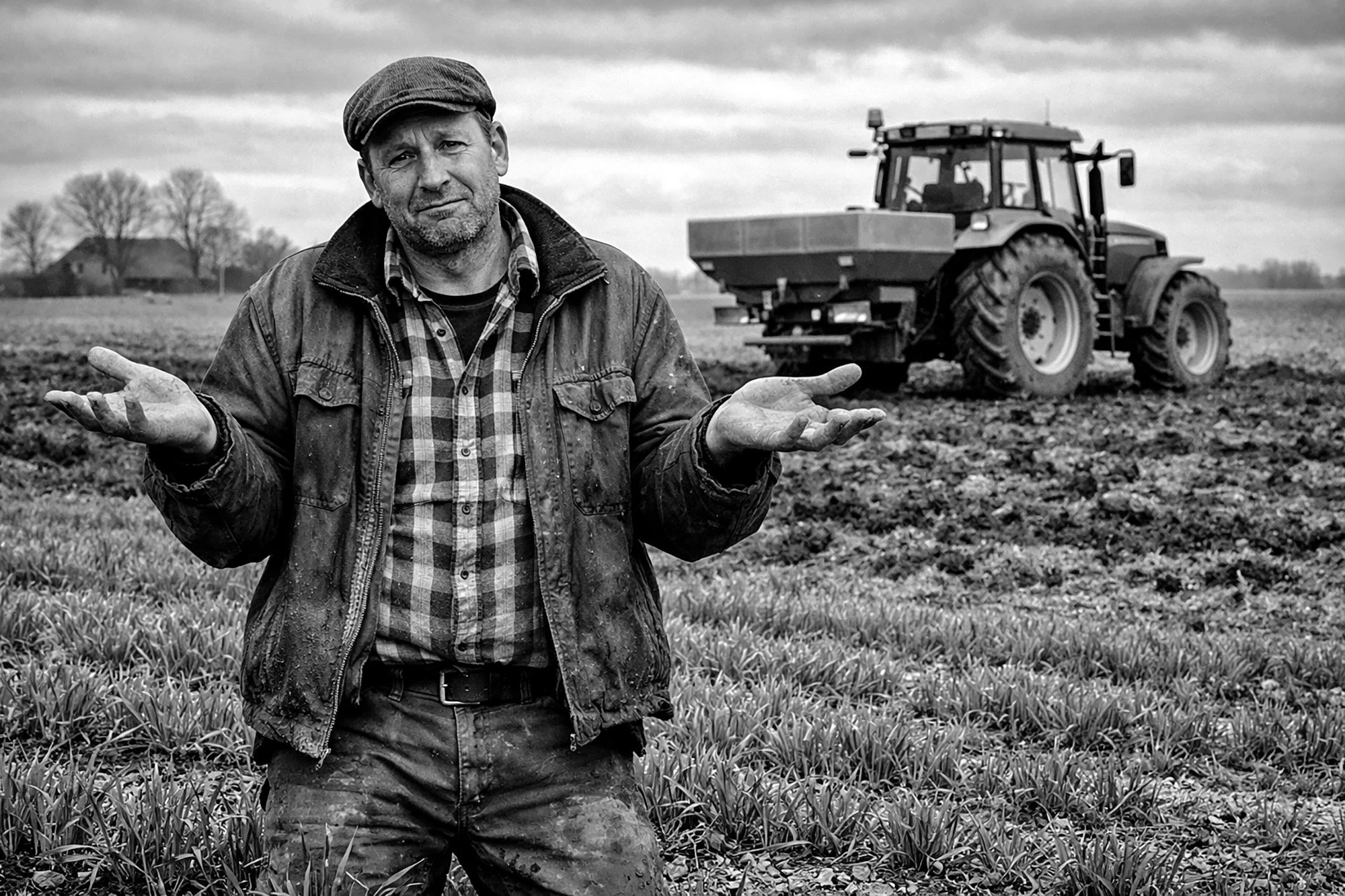
A farmer asking himself: what now? (Image generated with AI.)
For many Europeans, food still feels predictable. You go to the supermarket, and everything is there. Prices have gone up in recent years, but the system still seems to work.
That sense of stability is now under pressure.
Not because of something happening in European fields, but because of what is happening far away — in the Strait of Hormuz, the narrow passage between Iran and the Arabian Peninsula. Military tension, blocked shipping routes, and rising insurance risks are disrupting one of the world’s most important trade corridors. As a result, energy prices are climbing, fertiliser supplies are tightening, and transport costs are rising — all at the same time.
What begins there does not stay there.
A system under strain
The Strait of Hormuz is best known for oil, but it is just as critical for natural gas and fertiliser. When that transport route is disrupted, the effects spread quickly. Energy becomes more expensive, fertiliser becomes less available, and moving goods becomes more costly.
These are not separate problems. They reinforce each other — and together they shape the cost and availability of food.
Energy hits the plate first
The impact is already visible across Europe. In the Netherlands, some fishing boats are staying in port because diesel costs have risen to the point where going out to sea is no longer viable. When boats stay in harbour, fish disappears from the market — just as grey shrimp have largely disappeared in recent years when costs became too high.
In Spain, tomatoes that supply much of Northern Europe are becoming more expensive because transport costs have increased sharply. Supermarkets in Germany and Belgium are already adjusting prices to reflect these higher costs, and consumers are noticing.
The pattern is simple: when energy becomes expensive, food follows. And this comes on top of several years of rising food prices, which have already stretched household budgets across Europe.
Fertiliser hits the plate second
At the same time, fertiliser is becoming less available. This is less visible, but just as important.
Modern agriculture depends on fertiliser to maintain yields. When supply tightens, farmers have to make difficult decisions. They may use less fertiliser, switch to crops that require less input, or reduce production altogether.
These decisions happen months before harvest, but their consequences are long-lasting. Lower fertiliser use leads to lower yields, which means less food entering the system later in the year. And because agriculture follows fixed seasonal cycles, a missed opportunity cannot be recovered.
Europe has to adapt
Europe is deeply connected to this system. It depends on imported energy, imported fertiliser, and long supply chains that link producers and consumers across borders. When all three come under pressure at once, the effects begin to accumulate.
Food becomes more expensive, some products become less available, and choices narrow. This is not a sudden shock, but a gradual tightening of the system.
Diets will have to adapt — not by choice, but by necessity.
A harder reality
For a long time, Europe has lived with the assumption that food is always available, that no matter what happens elsewhere, the shelves will remain full.
The war in Iran shows how fragile that assumption is. Food depends on energy, on fertiliser, and on stable global trade routes. When those are disrupted, the effects travel far — and they reach into everyday life.
What is changing is not just the price of food. It is something more fundamental: the quiet return of a reality Europe once knew well — that what we eat is shaped by forces far beyond our control, and that those forces can shift faster than we expect.