
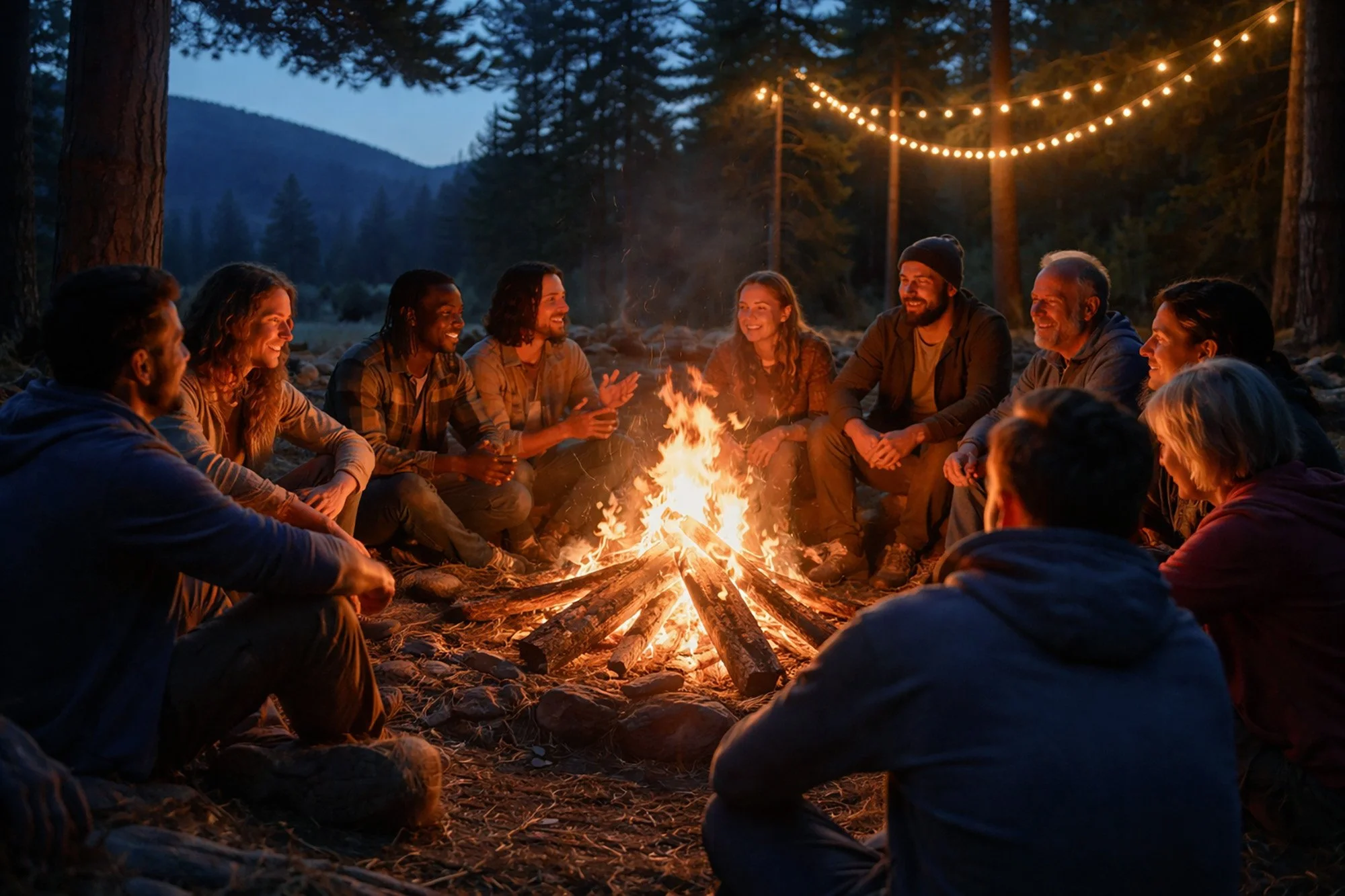
Image created with AI.
Walk through any modern city and you will see thousands of people living close together — yet many feel profoundly alone. Psychologists report rising levels of anxiety, depression, and loneliness, especially among younger generations. The paradox is striking: we have never been more connected technologically, yet many people feel less connected socially.
To understand this tension, it helps to look much further back in time — to the environment in which the human mind evolved.
The World Our Minds Were Made For
For most of human history, humans lived in small groups. Anthropologists estimate that these communities usually contained between thirty and one hundred and fifty individuals. Everyone knew each other and depended on one another. These groups were not simply social networks; they were survival systems. People hunted together, shared food, raised children collectively, and protected each other from danger. In such a world, belonging was not just comforting — it was essential. Over hundreds of thousands of years, the human brain adapted to this reality. We became highly sensitive to social signals: approval, rejection, cooperation, and status. The strong emotional reactions we feel to inclusion or exclusion were shaped in this environment. In short, humans evolved to live in tribes.
From Tribes to Modern Society
Modern societies are very different. Most people now live among strangers in large cities. Families are smaller and often spread across different regions. Communities that once structured everyday life — extended families, villages, religious groups, neighbourhood associations — have weakened in many places. At the same time, individuals are encouraged to be independent and self-reliant, responsible for shaping their own identity and life path. This freedom has brought enormous advantages. But it also means that many people navigate life with far fewer stable social structures around them.
The Mismatch
Some researchers describe this situation as an evolutionary mismatch. The human mind developed in a world of dense social relationships, yet modern life often provides fewer stable bonds. Our psychological systems still expect what they evolved for: recognition from others, shared rituals, trusted mentors, and the feeling that one's role matters within a group. When those elements disappear, people may struggle with belonging and purpose. Loneliness, from this perspective, is not simply a personal weakness — it can be a signal that something is missing in the social environment.
The Human Need to Matter
Traditional communities offered more than companionship. They also gave people a clear sense of contribution. In small groups, everyone had a role. Contribution created dignity. When people knew that others depended on them, their sense of identity became stronger. Modern societies often make this connection less visible. Yet whenever people rediscover ways to contribute — through volunteering, shared projects, or local communities — social bonds tend to strengthen and people report greater meaning in their lives. It seems that humans flourish not only when they are free, but when they are connected.
Rediscovering Community
No one suggests that we should return to prehistoric tribes. But anthropology and psychology point to a simple insight: humans still need structures of belonging. These can take many forms — neighbourhood communities, volunteer groups, religious communities, or cultural associations. What matters is that people are known, that they can contribute, and that they share parts of life with others. Modern civilization has given humanity extraordinary possibilities. Yet beneath these changes, the deeper structure of human nature remains the same. We are still the descendants of small groups gathered around fires, sharing stories, food, and responsibility. And somewhere inside us, that ancient expectation remains: to belong to a tribe.
Further Reading
Sebastian Junger — Tribe: On Homecoming and Belonging
Robin Dunbar — Friends: Understanding the Power of Our Most Important Relationships
David Sloan Wilson — Darwin’s Cathedral: Evolution, Religion and the Nature of Society
Joseph Henrich — The WEIRDest People in the World
Jonathan Haidt — The Anxious Generation
Randolph Nesse — Good Reasons for Bad Feelings
Christopher Ryan — Civilized to Death