
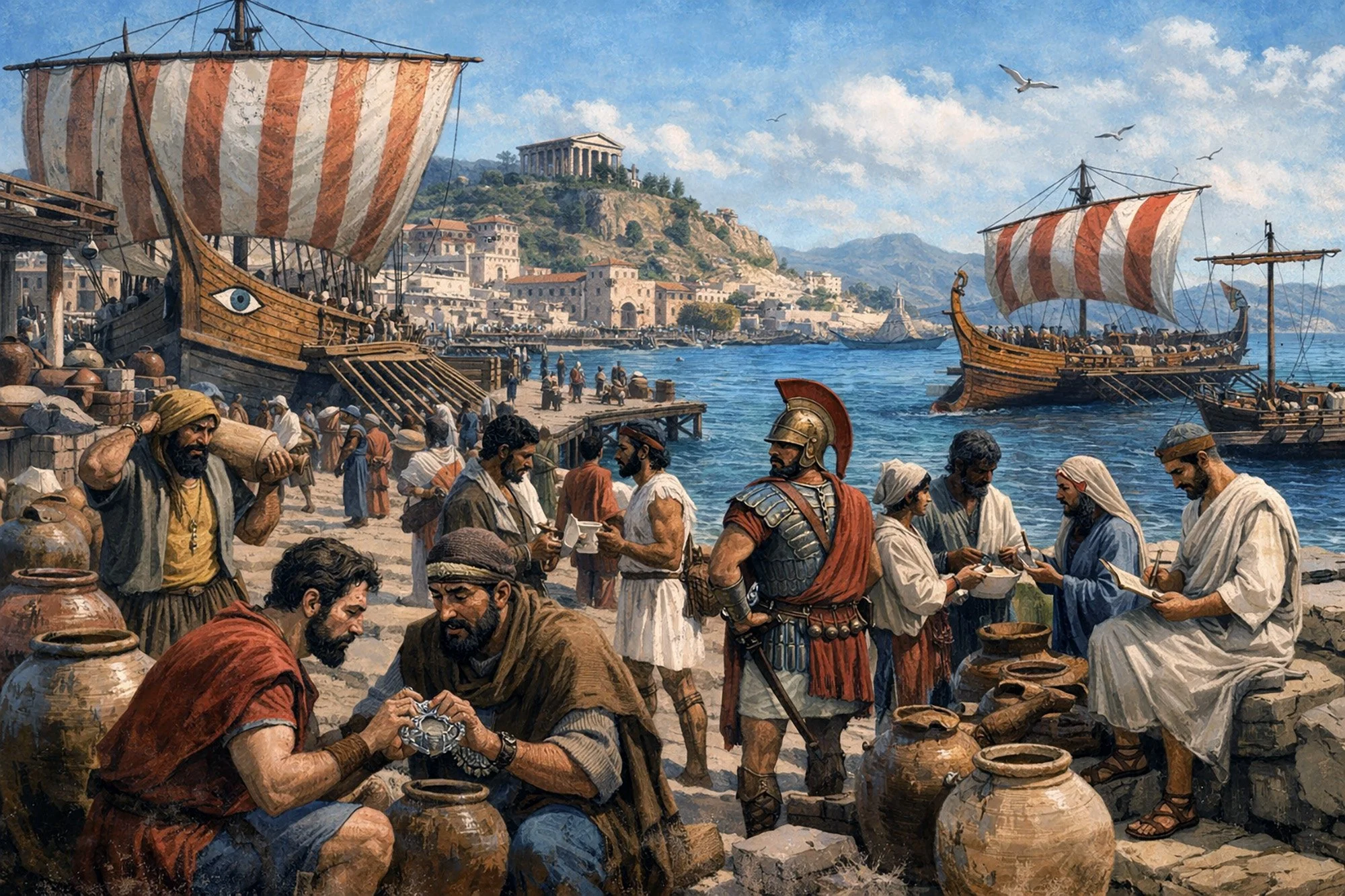
Image generated with AI
Around 500 BC, the Mediterranean was no longer just a sea surrounded by separate cultures. It had become something new: a vast, interconnected world. Merchants, sailors, migrants, and travelers moved constantly between its shores. Wine from Italy could be drunk in Gaul. Silver mined in Iberia might be turned into coins in the eastern Mediterranean. Pottery made in Corinth could appear in villages far away in southern France. Goods traveled widely—and so did ideas, religions, technologies, and languages.
In many ways, the Mediterranean around 500 BC functioned like an ancient version of globalization.
From Collapse to Opportunity
This interconnected world emerged slowly from the dramatic changes that followed the collapse of the Bronze Age around 1200 BC. Before that collapse, long-distance trade existed but was largely organized through powerful palace states such as Mycenaean Greece, the Hittite Empire, and Egypt. These political systems controlled the movement of luxury goods and essential metals such as copper and tin. When those palace networks disappeared, much of that system collapsed with them. For a time, the Mediterranean fragmented into smaller regional worlds. Yet the disappearance of centralized control also created new opportunities. Independent merchants and sailors began exploring new routes and markets. Over the following centuries a different type of economic system developed—less centralized, more entrepreneurial, and spread across far greater distances. By around 500 BC, these networks linked the entire Mediterranean, from the Levant in the east to the Atlantic shores of Iberia.
The Sea as a Highway
The geography of the Mediterranean made these connections possible. Although we often think of seas as barriers, in antiquity the Mediterranean functioned more like a highway. Travel by ship was frequently faster and easier than travel over land, where mountains, forests, and poor roads slowed movement dramatically. The Mediterranean coastline is also extremely diverse. Fertile plains, forested mountains, mineral-rich hills, and dry uplands lie close together. Each region produced different resources. Some areas had grain but lacked timber. Others had metals but needed food. Trade connected these micro-regions. Grain, metals, wine, olive oil, pottery, and textiles moved constantly between ports carried in large ceramic storage jars aboard merchant ships.
Sailors, Merchants, and Migrants
Two groups of seafarers were especially visible in this expanding world: the Phoenicians and the Greeks.
Phoenician merchants from small city-states along the Levantine coast—such as Tyre and Sidon—sailed westward for centuries. They founded trading settlements across the Mediterranean, including famous cities such as Carthage in North Africa.
Greek communities were also establishing new cities overseas, particularly in Sicily, southern Italy, Anatolia, and southern France. Over time many of these settlements became powerful cities in their own right rather than simple outposts of their homeland.
Yet the Mediterranean was never simply divided between Greeks and Phoenicians. Everywhere these travelers arrived they encountered other societies—Etruscans, Iberians, Libyans, Gauls, and many others. Trade, migration, and daily contact created new hybrid cultures that blended traditions from multiple worlds.
A Cosmopolitan Sea
The sailors who crossed the Mediterranean often lived in remarkably cosmopolitan environments. A single merchant ship might carry crew members from Tyre, Cyprus, Sicily, Egypt, and the Greek islands. Many spoke several languages and traded goods on their own account wherever they landed. Ports became meeting points of cultures. Markets brought together traders from distant regions. Foreign merchants settled permanently in cities. Religious cults, alphabets, and artistic styles spread along the same routes as trade goods.
By 500 BC, many cultural practices—such as drinking wine, using coinage, and writing with alphabetic scripts—had spread widely around the Mediterranean.
The Foundations of the Classical World
This interconnected system formed the foundation for the centuries that followed. The rise of Classical Greece, the growing power of Carthage, and the emergence of the Roman Republic all unfolded within this already connected Mediterranean world. Rome did not create a unified Mediterranean. It inherited one.
By around 500 BC the sea that separated continents had become the sea that connected them.
Further Reading
Tamar Hodos — The Archaeology of the Mediterranean Iron Age: A Globalizing World (1100–600 BCE)
Nicholas Purcell & Peregrine Horden — The Corrupting Sea
Cyprian Broodbank — The Making of the Middle Sea
Josephine Quinn — In Search of the Phoenicians
Patrick Wyman — Tides of History (podcast series on the Iron Age Mediterranean)