
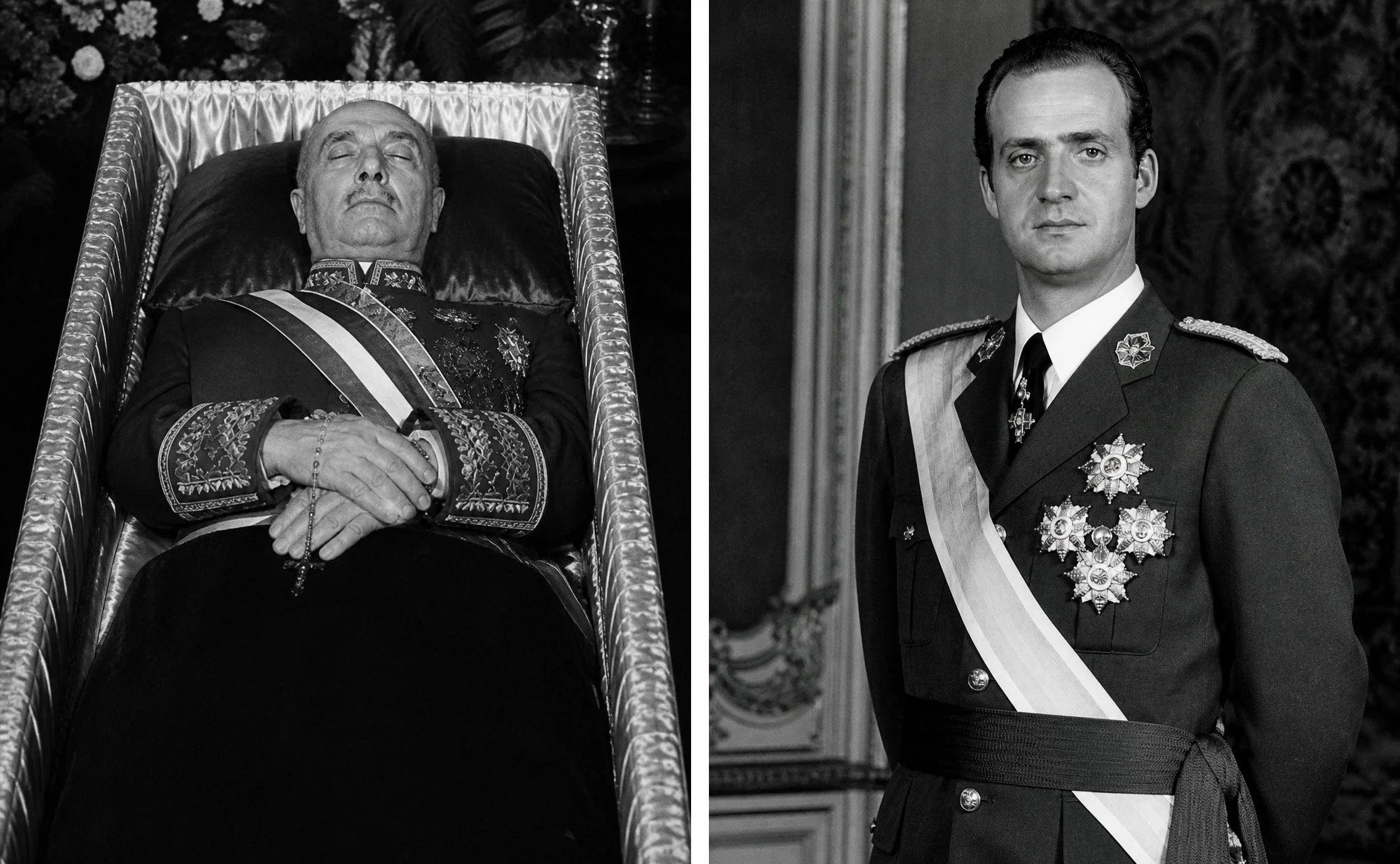
Left: Francisco Franco lying in state after his death in November 1975. Right: Juan Carlos I in formal portrait shortly after becoming king. (Image created with AI.)
Spain’s transition to democracy is often told as a moment of rupture: dictatorship ends, democracy begins. I get the impression it all happened more subtle—and ultimately more interesting.
The story begins before 1975.
By the final decade of Franco’s rule, Spain had already begun to change. Economic growth, tourism, and urbanization created a society that no longer fit comfortably within an authoritarian framework. While the regime remained rigid, everyday life became more fluid, more connected to Europe, and less ideologically controlled.
When Franco died, the system did not collapse. It adapted.
Power passed to Juan Carlos I, and from there to a group of reformers willing to dismantle the dictatorship from within. Under Adolfo Suárez, political parties were legalized, elections were held, and a new constitution was drafted—all within a remarkably short period.
What makes this process distinctive is not just what changed, but what did not. Institutions were reformed rather than replaced. Many figures from the old regime remained in place. This continuity was not accidental—it was the price of stability in a country still marked by the memory of civil war and the threat of military intervention.
The result was a transition built on compromise.
That compromise proved both effective and incomplete. Spain avoided large-scale violence and established a functioning democracy, but it did so by postponing deeper questions about accountability and historical memory. The so-called “pact of forgetting” allowed the country to move forward, while leaving parts of its past unresolved.
Seen through this lens, the Spanish transition is neither a simple success story nor a quiet continuation of dictatorship. It is a negotiated reinvention—one that worked, but not without cost.
Further reading
The Transition to Democracy in Spain — by José María Maravall
The Triumph of Democracy in Spain — by Paul Preston
Ghosts of Spain — by Giles Tremlett
Helen Graham — author of several key works on modern Spain, including The Spanish Civil War
Spain: Dictatorship to Democracy — by Raymond Carr and Juan Pablo Fusi