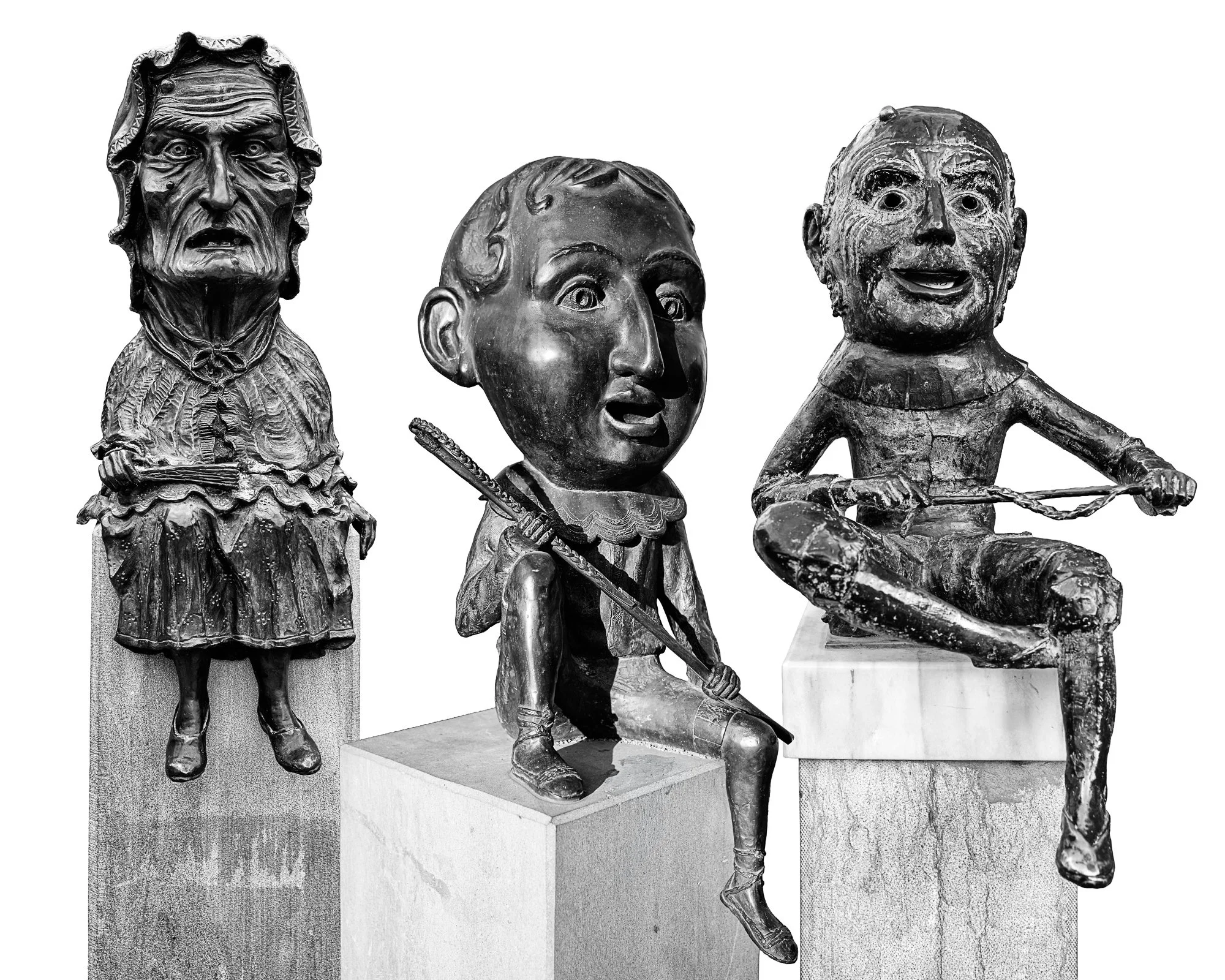
La Vella, El Nen, and La Merma from Vic (Spain).
In the Catalan town of Vic, history does not sit quietly in museums. It walks the streets. During the annual Festa Major and other civic celebrations, towering figures—gegants—move through the medieval squares, carried from within by a single person. Among them, three characters stand out for what they suggest about time, community, and identity: La Vella, El Nen, and La Merma.
They are part of a long Catalan tradition of processional giants that dates back at least to the late Middle Ages, when such figures appeared in Corpus Christi processions. In Vic, documented giants appear from the early modern period onward, with many current figures created or restored in the 19th and 20th centuries as part of a broader revival of Catalan cultural identity.
La Vella: A Face Shaped by Time
La Vella—“the Old Woman”—is instantly recognizable. Her lined face, slightly stooped posture, and deliberate movement set her apart from more regal or heroic giants.
She does not represent a specific historical figure. Instead, she embodies something more universal: the accumulated weight of memory. In Catalan festive culture, figures like La Vella often serve as reminders of continuity—of knowledge passed on, of traditions maintained not by institutions but by people.
When she turns slowly in the square, guided by the unseen carrier inside, the effect is almost theatrical. Yet nothing here is staged in the modern sense. The dance follows fixed rhythms, learned and repeated over generations. La Vella’s presence is not about spectacle alone—it is about recognition.
El Nen: Tradition Renewed
Where La Vella moves with gravity, El Nen—“the Boy”—brings lightness. His figure is smaller, more agile, and often positioned in ways that suggest movement and curiosity.
In practical terms, he reflects the evolution of the gegants tradition itself. Over time, many towns introduced smaller figures—gegantons—that could be carried by younger participants. El Nen fits into this development: he makes the tradition accessible, ensuring that it is not only preserved but actively continued.
Placed alongside La Vella, he creates a quiet but clear contrast. One looks back, the other forward. Together, they turn a procession into a story about time.
La Merma: The Uneasy Presence
Then there is La Merma, the most ambiguous of the three. Her exaggerated features and slightly unsettling expression place her outside the more familiar categories of noble, peasant, or child.
Figures like La Merma appear in several Catalan towns, often linked to older carnival traditions where distortion, satire, and inversion played a role. Rather than representing a clear social type, they introduce tension—an element that does not fully belong.
In Vic, La Merma’s exact origin is less clearly documented than that of other giants, but her role is evident in practice. She disrupts the visual harmony of the group. She draws attention not through beauty or grace, but through difference. If La Vella offers continuity and El Nen renewal, La Merma reminds us that every community also defines itself through what stands at its edges.
A Tradition Carried from Within
To understand these figures, it helps to look beyond their appearance. Each giant is carried by a person hidden inside a wooden frame, balancing weight and movement while following the music of gralles and drums. The dance is learned, physical, and precise. It is not improvised.
This matters. Because what you see in Vic is not a performance created for visitors, but a practice maintained by local groups—often for decades, sometimes within the same families. The giants are repaired, repainted, and occasionally replaced, but the roles remain.
That is what makes La Vella, El Nen, and La Merma more than decorative figures. They are part of a system of shared memory. They appear at specific moments in the year, move in known patterns, and carry meanings that are not formally explained but widely understood.
Walk through Vic during a festival, and you do not just see history. You move through it—alongside an old woman, a boy, and a figure that does not quite fit, yet clearly belongs.