
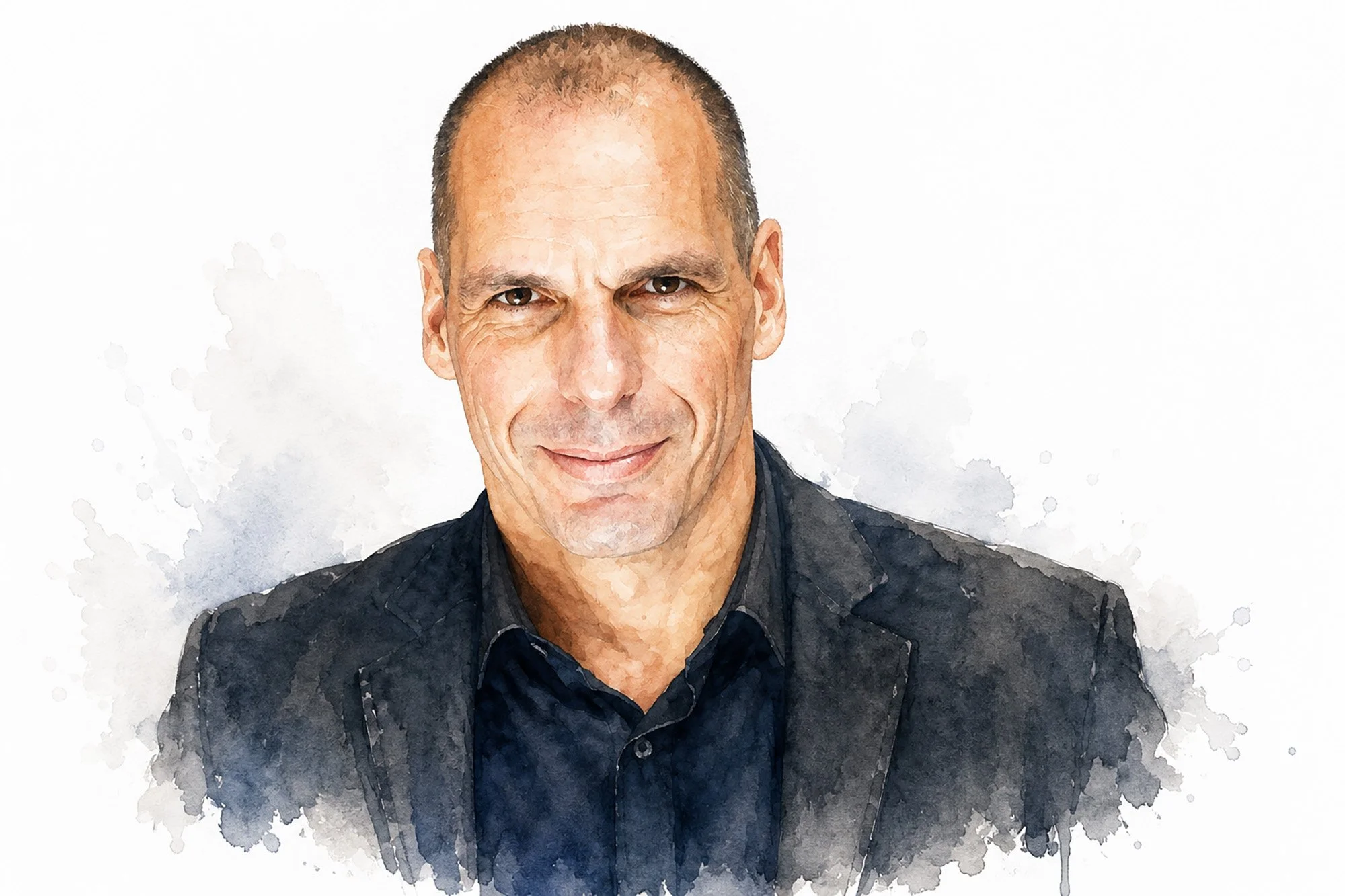
Yanis Varoufakis is a Greek economist, author, and former finance minister of Greece, known internationally for his outspoken criticism of austerity policies, global financial inequality, and the concentration of power within modern capitalism. Since the eurozone crisis, he has become one of Europe’s most recognizable public intellectuals on economics, democracy, and the future of the global order. (Image created with AI.)
In a recent interview, Greek economist and former finance minister Yanis Varoufakis argued that the world may be witnessing the gradual weakening of American global dominance.
His central claim is simple: by relying increasingly on sanctions, military pressure, and financial control through the dollar system, the United States is encouraging other countries to build alternatives.
The World Begins Looking Beyond the Dollar
Varoufakis points to a major turning point after the freezing of Russian state assets following the invasion of Ukraine. Many governments suddenly realized that access to their own reserves could become politically conditional.
According to him, countries across Asia, the Gulf, and Africa are now quietly diversifying away from the dollar. China’s digital payment systems and the emerging BRICS Pay network are, in his view, the first foundations of a parallel global financial system.
He does not believe the dollar will collapse soon. In fact, China itself still depends heavily on dollar stability. But he argues that the long-term shift has already started.
A Tale of Two Economies
One of Varoufakis’ most striking observations is the growing disconnect between financial markets and everyday life.
While ordinary people struggle with rising costs for food, housing, and energy, stock markets and AI companies continue booming. In his analysis, modern capitalism increasingly rewards financial speculation while much of the middle and working class loses purchasing power.
He describes Western democracies less as true democracies and more as oligarchic systems dominated by wealthy interests. Whether one agrees or not, the frustration he describes is increasingly visible across Europe and America.
Europe’s Uneasy Position
Varoufakis is especially critical of Europe.
He argues that after the 2008 financial crisis, European leaders combined austerity for citizens with large-scale support for banks and financial markets. The result, he says, was a weakened industrial base and growing dependence on the United States.
Recent years have exposed some uncomfortable truths. Europe remains vulnerable to energy shocks, dependent on American military protection, and economically squeezed between the United States and a rapidly rising China.
Meanwhile, China continues expanding its strength in electric vehicles, batteries, solar energy, and digital infrastructure.
The Return of a Multipolar World
For three decades after the Cold War, much of the world operated under the assumption that American economic and geopolitical leadership was permanent. Varoufakis believes that assumption is now fading.
Countries are increasingly trying to reduce their dependence on a single global center of power. Some are diversifying trade routes. Others are investing in alternative payment systems, energy partnerships, or regional alliances. The rise of BRICS reflects this wider search for balance and autonomy.
At the same time, the West faces growing internal strains: rising inequality, political polarization, industrial decline, and declining trust in institutions. For many citizens, the promises of globalization no longer feel convincing.
Varoufakis does not predict an immediate collapse of the United States. Rather, he describes the beginning of a long transition toward a more fragmented and competitive world order — one in which economic power, technological innovation, and political influence are distributed across several competing centers rather than concentrated in Washington alone.
History offers many examples of such transitions. Great powers rarely disappear overnight. More often, influence slowly erodes while new systems emerge alongside the old.
Varoufakis believes we may already be living through one of those moments.
Further Reading
Technofeudalism — Yanis Varoufakis (2023)
The Global Minotaur — Yanis Varoufakis (2011)
The World for Sale — Javier Blas & Jack Farchy (2021)