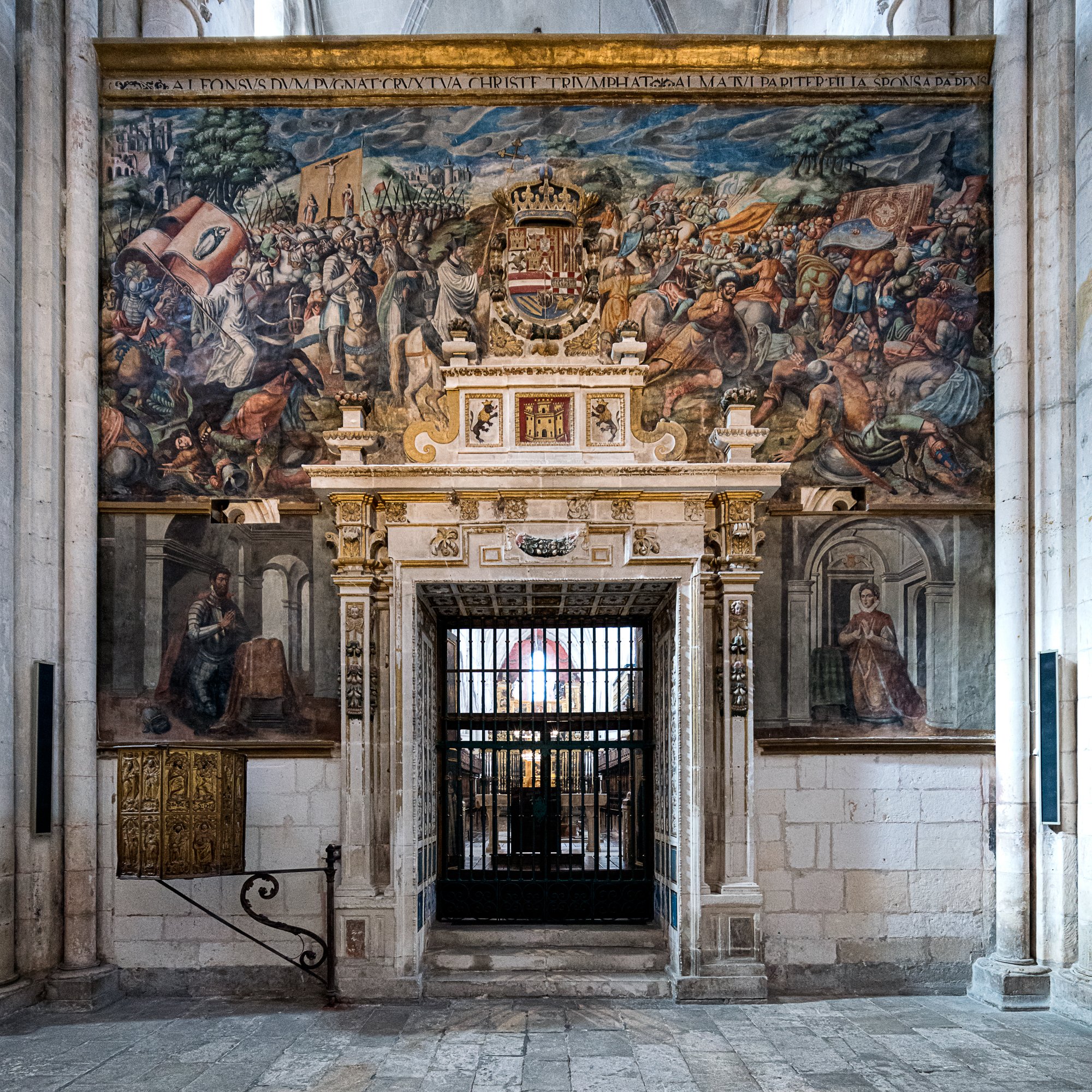
The Battle of Las Navas de Tolosa at the Monasterio de Santa María la Real de Las Huelgas in Burgos (Spain).
A quiet monastery, a distant battlefield
Inside the Monasterio de Santa María la Real de Las Huelgas, everything feels calm and contained—stone, light, silence. And yet, on one of its walls, you suddenly find yourself in the middle of a battle fought hundreds of kilometres away, more than eight centuries ago.
The fresco shows the Battle of Las Navas de Tolosa, fought in 1212 in southern Spain. At that time, much of the Iberian Peninsula was under the control of the Almohads, a powerful Islamic empire based in North Africa. For the Christian kingdoms in the north, this was not just distant politics but a constant pressure. Only a few years earlier, the king of Castile, Alfonso VIII of Castile, had suffered a painful defeat.
What followed was unusual. Rival kingdoms—Castile, Aragon, and Navarre—set aside their differences and formed a coalition. Even more striking, the campaign was supported by the pope, Pope Innocent III, who granted it the status of a crusade. That meant that fighting in Spain was, in the eyes of the Church, part of the same wider struggle as the crusades in the eastern Mediterranean. For those who took part, this was not only a war for territory, but also a war framed in religious terms.
When the armies finally met near the Sierra Morena, the battle was hard and chaotic, fought at close range. At a decisive moment, the Christian forces broke through the Almohad lines and reached the caliph’s camp. The victory did not end the conflict overnight, but it shifted the balance decisively and opened the way for further advances into the south.
Reading the fresco
The fresco in Las Huelgas does not try to recreate that chaos. Instead, it turns the battle into a clear and structured image. At the centre stands Alfonso VIII, larger and more composed than the figures around him, as if the confusion of the battlefield has been organised into a story with a single focus.
Once you start looking more closely, the painting reveals itself as less of a report and more of a statement. The different rulers appear aligned, the movement flows toward a moment of breakthrough, and the uncertainty that must have defined the real battle is replaced by clarity and purpose. What you are seeing is not simply what happened in 1212, but how people, centuries later, chose to remember it: as a moment of unity, of faith, and of decisive victory.
The people beneath the painting
What makes this fresco more than just historical decoration is where it is placed. This monastery was founded in 1187 by Alfonso VIII and his wife, Eleanor of England, and it was intended from the beginning as a royal space, closely tied to the identity of the kingdom.
They are buried here.
That fact quietly changes everything. The battle on the wall is not an abstract national memory; it is part of the personal story of the people lying beneath it. Alfonso VIII fought that battle. Eleanor supported the political and dynastic world in which it became possible. Together, they founded the monastery that would preserve their memory.
See also: Alfonso VIII and Leonor of England – A Royal Marriage Carved in Stone
A place where history is arranged
The Monasterio de Las Huelgas is not just a place where history happened; it is a place where history has been carefully arranged. Royal tombs, objects linked to the battle, and the fresco itself all work together to tell a coherent story.
What is striking is not only what is included, but how it is presented. A violent and uncertain battle becomes a clear turning point. A coalition of uneasy allies becomes a unified force. A complex past is shaped into something that can be understood at a glance.
Standing there, you are looking at more than a painting. You are looking at an interpretation that has been given a permanent place, above the graves of the people it commemorates. The silence of the monastery and the intensity of the battle do not contradict each other; they complete each other.
The result is a space where past and memory meet—where a distant battlefield is brought into a quiet room in Burgos, and where the story of a kingdom is told in a way that still feels present.