
Europe Woke Up in a Different World
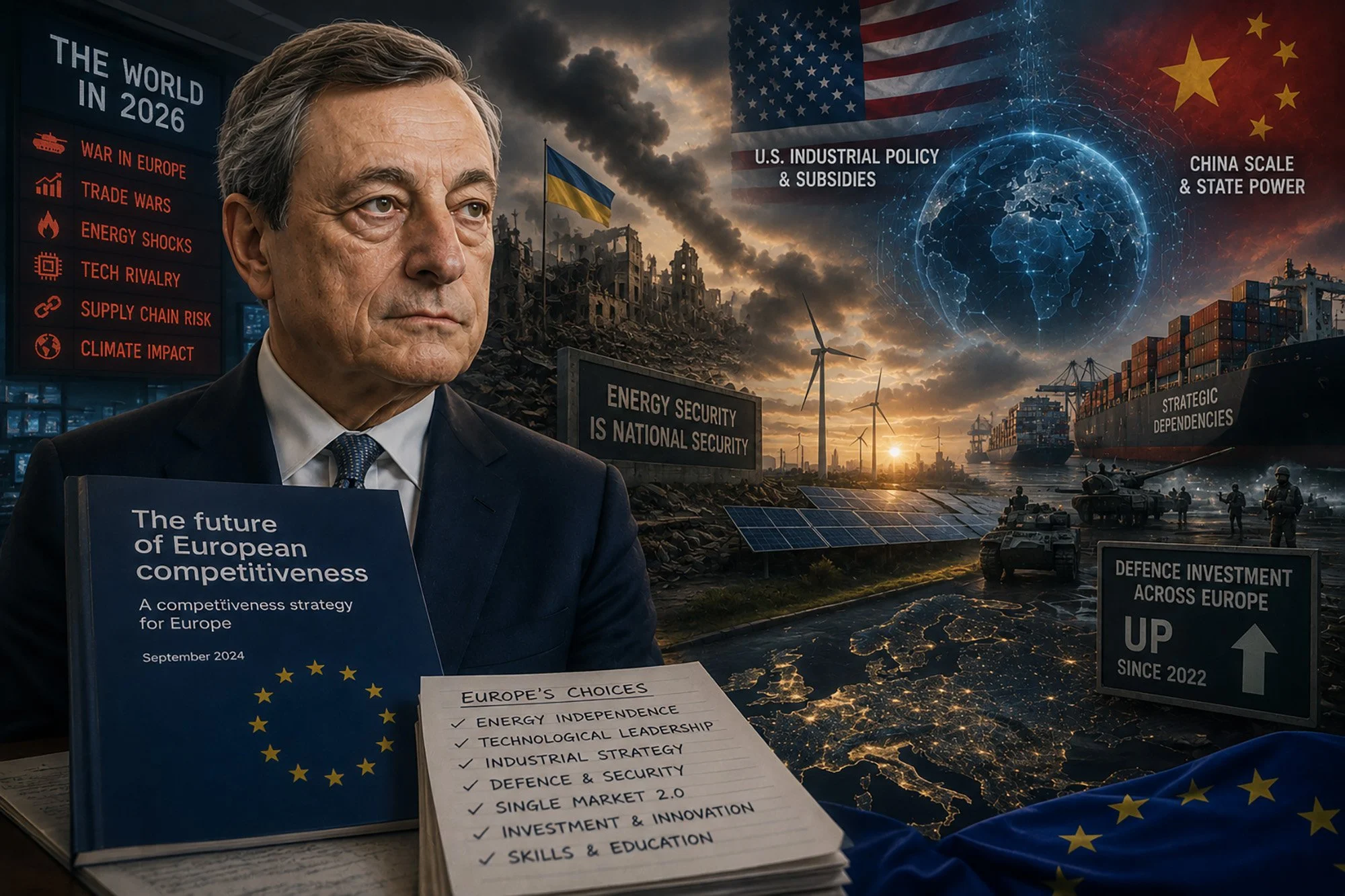
Image created with AI.
For decades, Europe lived in unusually favourable conditions.
Cheap Russian energy powered factories. Chinese manufacturing supplied affordable goods. American military protection guaranteed security. Global trade expanded steadily. European countries could focus on welfare, culture, healthcare and environmental goals while assuming the wider world would remain broadly stable.
By 2026, that world has already changed.
What once sounded like warnings in policy papers now shapes everyday political and economic reality. Energy shocks, wars, trade conflicts, sanctions, technological rivalry and military rearmament are no longer distant possibilities. They are becoming the defining structure of the new international order.
A major 2024 report on Europe’s future competitiveness, led by former Italian prime minister Mario Draghi, argued that Europe was entering a far more dangerous and competitive era. Only two years later, many of its concerns already look understated.
Russia’s invasion of Ukraine shattered Europe’s assumptions about security and economic interdependence. The conflict did not only disrupt energy supplies — it fundamentally changed how Europe thinks about dependence, infrastructure and strategic risk.
At the same time, tensions between the United States and China have intensified further. Trade restrictions, technological sanctions and industrial subsidies are reshaping global supply chains. Artificial intelligence has become a geopolitical race. Governments increasingly view semiconductors, cloud systems, rare earth materials, ports and energy grids as instruments of national power.
The consequences are now visible across Europe.
Factories face structurally higher energy prices than competitors in the US and parts of Asia. Industrial electricity prices remain far above American levels, while gas prices continue to weigh heavily on European manufacturing. German industry — long the engine of Europe’s economy — is under visible pressure. Chemical production, heavy industry and parts of manufacturing are shrinking or relocating investment abroad.
At the same time, defence spending is rapidly increasing across Europe. Governments that once prioritised efficiency and austerity are now investing in ammunition production, cybersecurity, critical infrastructure and military coordination. The continent is slowly rediscovering something many Europeans hoped belonged to the past: geopolitical hard power.
The Age of Cheap Globalisation Is Over
The deeper shift is psychological as much as economic.
For much of the post-Cold War era, Europe believed that economic integration would gradually make the world more peaceful and interdependent. Trade was seen as a stabilising force. Dependencies were considered efficient rather than dangerous.
That assumption has weakened dramatically.
Europe now finds itself squeezed between two superpowers pursuing increasingly strategic economic policies. The United States is using massive industrial subsidies to attract investment and strengthen domestic production. China combines industrial scale, state planning and technological ambition on a level Europe struggles to match.
The world is no longer organised primarily around low-cost efficiency. It is increasingly organised around resilience, control and strategic autonomy.
That creates difficult choices for Europe.
European countries still want open trade and international cooperation. Europe remains deeply dependent on global commerce. But recent crises have exposed how vulnerable excessive dependence can become — especially in energy, semiconductors, digital infrastructure, batteries and critical raw materials.
The Draghi report argues that Europe’s greatest weakness is not a lack of talent or wealth, but fragmentation. Europe often struggles to act quickly and collectively at the scale modern geopolitics requires.
And yet Europe is not collapsing or powerless.
The continent still possesses enormous strengths: world-class universities, advanced infrastructure, strong scientific research, major industrial capabilities and highly educated populations. Nordic countries remain highly innovative. France is pushing for greater strategic autonomy. Southern Europe is investing heavily in renewable energy. Eastern Europe has become increasingly important for security and manufacturing.
The challenge is not whether Europe still matters.
The challenge is whether Europe can adapt quickly enough to remain strategically independent in a world becoming harsher, faster and more competitive.
Europe’s Next Decade May Define Its Future
By 2026, Europe has already begun changing course.
The EU is investing more heavily in semiconductors, battery production, defence cooperation, renewable energy infrastructure and critical raw materials. Dependence on Russian gas has been sharply reduced. Industrial policy — once viewed almost suspiciously in Brussels — has returned.
But the pace of events may be moving faster than Europe’s political structures.
Permitting remains slow. Capital markets remain fragmented. Defence industries remain divided nationally. European startups still often struggle to scale compared to American or Chinese competitors. Major infrastructure projects frequently take years longer than geopolitical reality comfortably allows.
The danger for Europe is therefore not sudden collapse. It is gradual strategic weakening — becoming increasingly dependent on technologies, platforms, energy systems and geopolitical decisions controlled elsewhere.
That is why the Draghi report feels more urgent today than when it appeared.
Its real message is not panic, but adaptation.
Europe does not need to abandon openness, democracy or social protection. In fact, those remain among its greatest strengths. But preserving them now requires something Europeans have often been reluctant to embrace: long-term strategic thinking, large-scale investment and collective political action.
The coming decade may determine whether Europe remains one of the world’s shaping powers — or slowly becomes a prosperous but dependent peninsula on the edge of geopolitical blocs dominated by others.
The transition has already begun.
The only remaining question is whether Europe fully understands how profoundly the world around it has already changed.