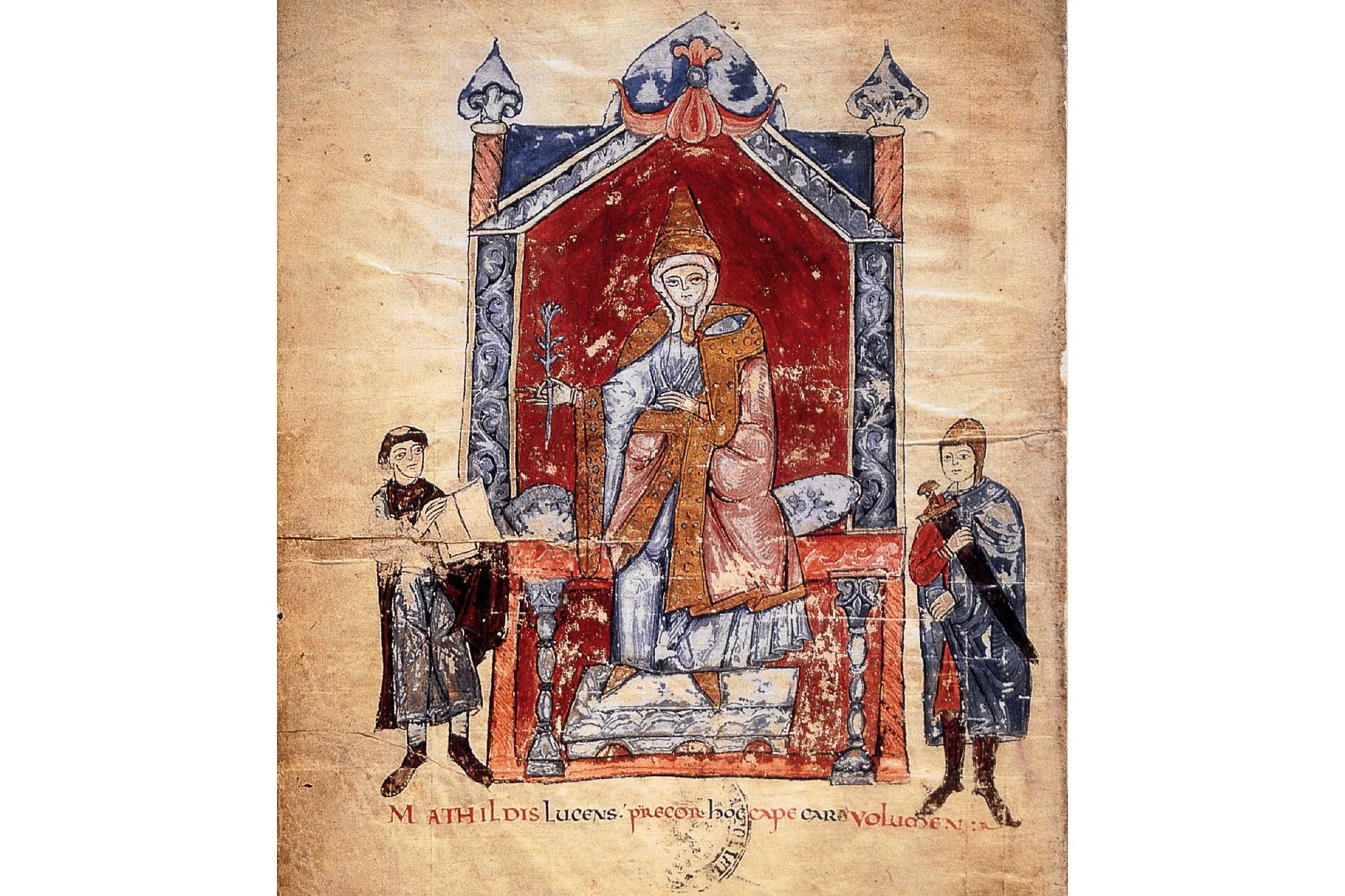
Matilda of Canossa in the Vita Mathildis of the monk Donizo, written around 1115. The image presents her as both ruler and protector at the height of her power (Vatican Library).
The Castle in the Mountains
In the winter of 1077, the most powerful ruler in Europe stood barefoot outside a mountain fortress in northern Italy, waiting in the snow for forgiveness.
The castle was Canossa. The ruler was the Holy Roman Emperor Henry IV. And at the centre of the drama stood a woman: Matilda of Canossa.
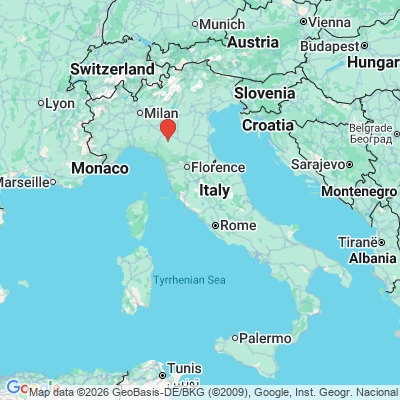
Today the ruined fortress still rises above the Apennines, surrounded by forests and deep valleys. In the Middle Ages, however, Canossa guarded some of the most important routes between Germany and Rome. Whoever controlled these mountain passes held enormous political power.
Matilda inherited that power. Born around 1046 into the powerful House of Canossa, she grew up in a dangerous world of assassinations, shifting alliances, and rival emperors and popes. Her father was murdered when she was still a child, and within a few years her brother and sister had also died.
Raised by her politically gifted mother, Beatrice of Lorraine, Matilda received an education unusual for a medieval noblewoman. She learned languages, administration, diplomacy, and military strategy. By the time she reached adulthood, she was already one of the most influential rulers in Italy.
Between Pope and Emperor
Matilda lived during one of the great political struggles of the Middle Ages. The pope and the emperor were fighting over who had the right to appoint bishops and control the Church. Behind the religious arguments stood a larger question: who truly ruled Christian Europe?
Matilda chose the side of Pope Gregory VII.
She became one of the strongest supporters of the reform movement within the Church, providing troops, castles, money, and political protection. Chroniclers describe her constantly travelling through her territories on horseback, directing armies and negotiating with nobles and bishops.
The conflict reached its most famous moment at Canossa. Excommunicated and threatened by rebellion, Henry IV crossed the Alps in winter to seek forgiveness from the pope, who was staying under Matilda’s protection. According to later tradition, the emperor waited outside the castle for three days as a penitent before being admitted.
The scene became legendary: an emperor humbled in the snow while a countess helped shape the fate of Europe.
The Legacy of the Great Countess
War did not end at Canossa. Henry later invaded Italy again, and Matilda spent years defending her territories against imperial forces. She lost castles, rebuilt alliances, and continued resisting powerful enemies long after many rulers would have surrendered.
But Matilda was more than a military leader. She was also one of the great patrons of Romanesque architecture in Italy. Churches, monasteries, cathedrals, and bridges across Tuscany and Emilia-Romagna still preserve traces of her influence. Her support helped strengthen cities such as Modena and Florence during the centuries that eventually gave rise to the Italian Renaissance.
When she died in 1115, Matilda left behind more than lands and castles. She had helped reshape the balance between church and empire, and she proved that political and military leadership in the Middle Ages was not reserved for men alone.
Nearly a thousand years later, Italy still remembers her as La Gran Contessa — the Great Countess.
Further Reading
Tuscan Countess: The Life and Extraordinary Times of Matilda of Canossa — Michele K. Spike (2004)
Matilda of Tuscany — Nora Duff (1909)
The Civilization of the Middle Ages — Norman F. Cantor (1993)
The Investiture Controversy: Church and Monarchy from the Ninth to the Twelfth Century — Uta-Renate Blumenthal (1988)