italy

The Iron Countess of Italy

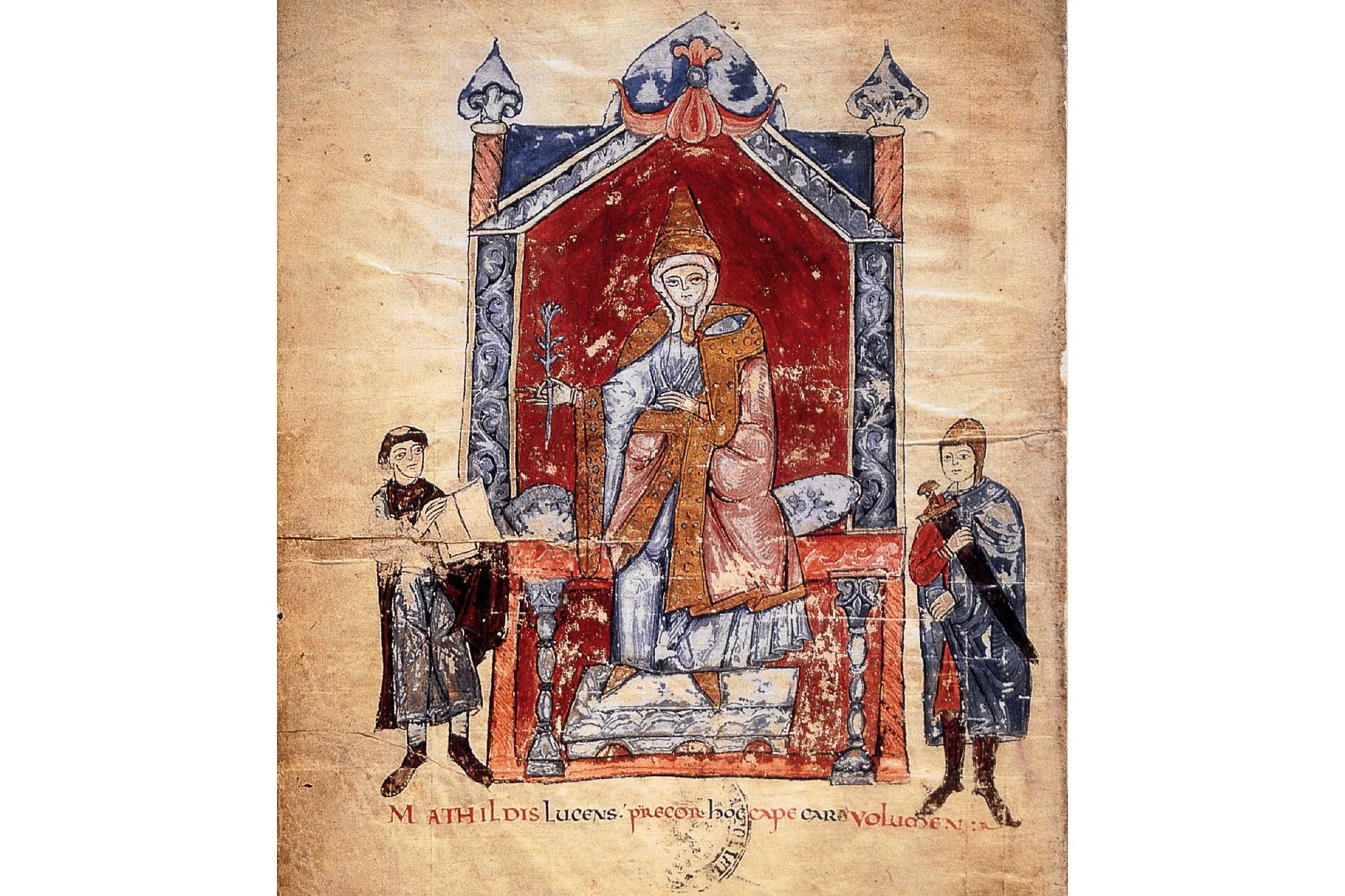
Matilda of Canossa in the Vita Mathildis of the monk Donizo, written around 1115. The image presents her as both ruler and protector at the height of her power (Vatican Library).

The Castle in the Mountains

In the winter of 1077, the most powerful ruler in Europe stood barefoot outside a mountain fortress in northern Italy, waiting in the snow for forgiveness.

The castle was Canossa. The ruler was the Holy Roman Emperor Henry IV. And at the centre of the drama stood a woman: Matilda of Canossa.

Today the ruined fortress still rises above the Apennines, surrounded by forests and deep valleys. In the Middle Ages, however, Canossa guarded some of the most important routes between Germany and Rome. Whoever controlled these mountain passes held enormous political power.

Matilda inherited that power. Born around 1046 into the powerful House of Canossa, she grew up in a dangerous world of assassinations, shifting alliances, and rival emperors and popes. Her father was murdered when she was still a child, and within a few years her brother and sister had also died.

Raised by her politically gifted mother, Beatrice of Lorraine, Matilda received an education unusual for a medieval noblewoman. She learned languages, administration, diplomacy, and military strategy. By the time she reached adulthood, she was already one of the most influential rulers in Italy.

Between Pope and Emperor

Matilda lived during one of the great political struggles of the Middle Ages. The pope and the emperor were fighting over who had the right to appoint bishops and control the Church. Behind the religious arguments stood a larger question: who truly ruled Christian Europe?

Matilda chose the side of Pope Gregory VII.

She became one of the strongest supporters of the reform movement within the Church, providing troops, castles, money, and political protection. Chroniclers describe her constantly travelling through her territories on horseback, directing armies and negotiating with nobles and bishops.

The conflict reached its most famous moment at Canossa. Excommunicated and threatened by rebellion, Henry IV crossed the Alps in winter to seek forgiveness from the pope, who was staying under Matilda’s protection. According to later tradition, the emperor waited outside the castle for three days as a penitent before being admitted.

The scene became legendary: an emperor humbled in the snow while a countess helped shape the fate of Europe.

The Legacy of the Great Countess

War did not end at Canossa. Henry later invaded Italy again, and Matilda spent years defending her territories against imperial forces. She lost castles, rebuilt alliances, and continued resisting powerful enemies long after many rulers would have surrendered.

But Matilda was more than a military leader. She was also one of the great patrons of Romanesque architecture in Italy. Churches, monasteries, cathedrals, and bridges across Tuscany and Emilia-Romagna still preserve traces of her influence. Her support helped strengthen cities such as Modena and Florence during the centuries that eventually gave rise to the Italian Renaissance.

When she died in 1115, Matilda left behind more than lands and castles. She had helped reshape the balance between church and empire, and she proved that political and military leadership in the Middle Ages was not reserved for men alone.

Nearly a thousand years later, Italy still remembers her as La Gran Contessa — the Great Countess.

Further Reading

  • Tuscan Countess: The Life and Extraordinary Times of Matilda of Canossa — Michele K. Spike (2004)

  • Matilda of Tuscany — Nora Duff (1909)

  • The Civilization of the Middle Ages — Norman F. Cantor (1993)

  • The Investiture Controversy: Church and Monarchy from the Ninth to the Twelfth Century — Uta-Renate Blumenthal (1988)
The Venice Art Biennale – Where the World Comes to Imagine

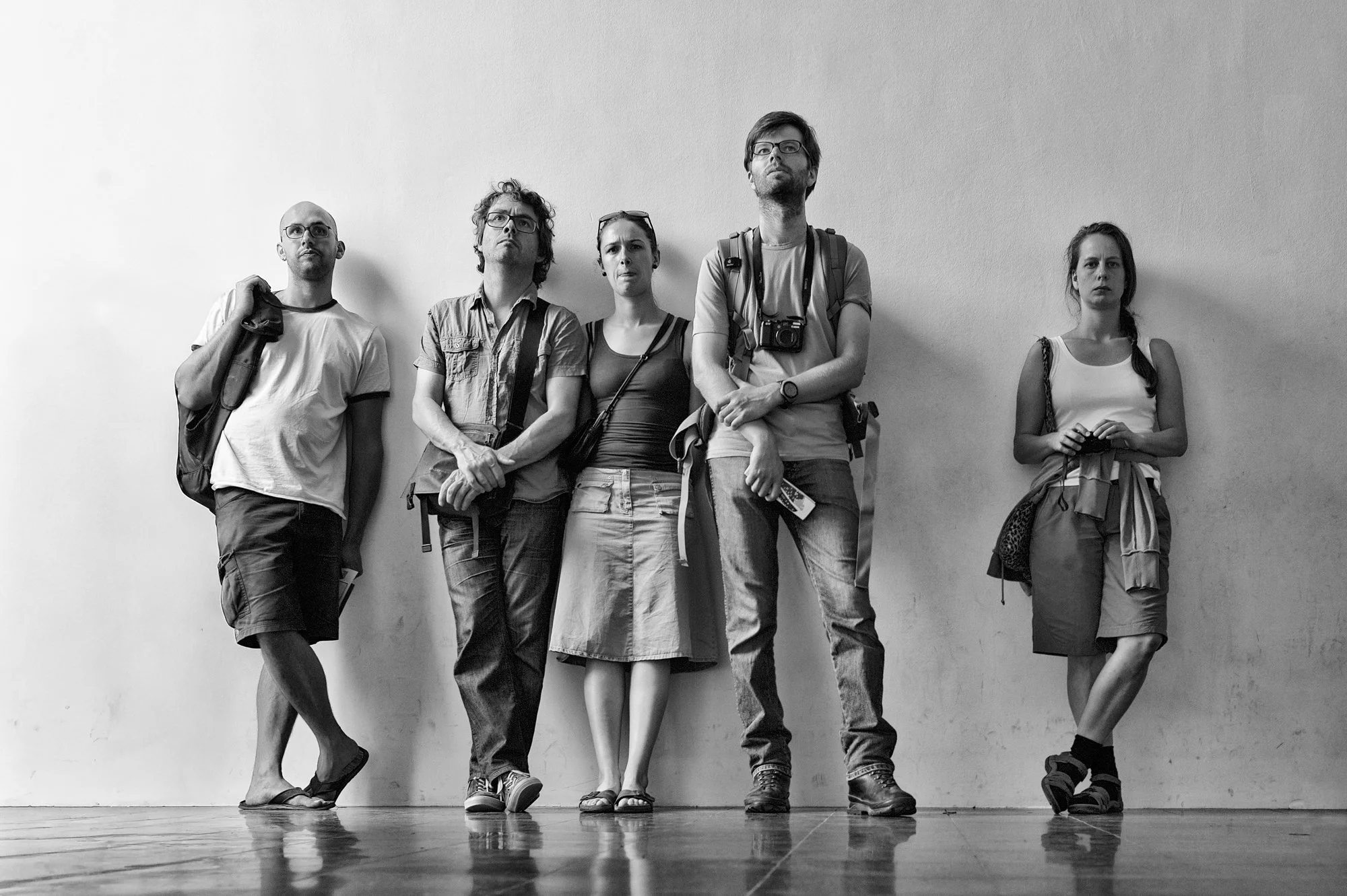
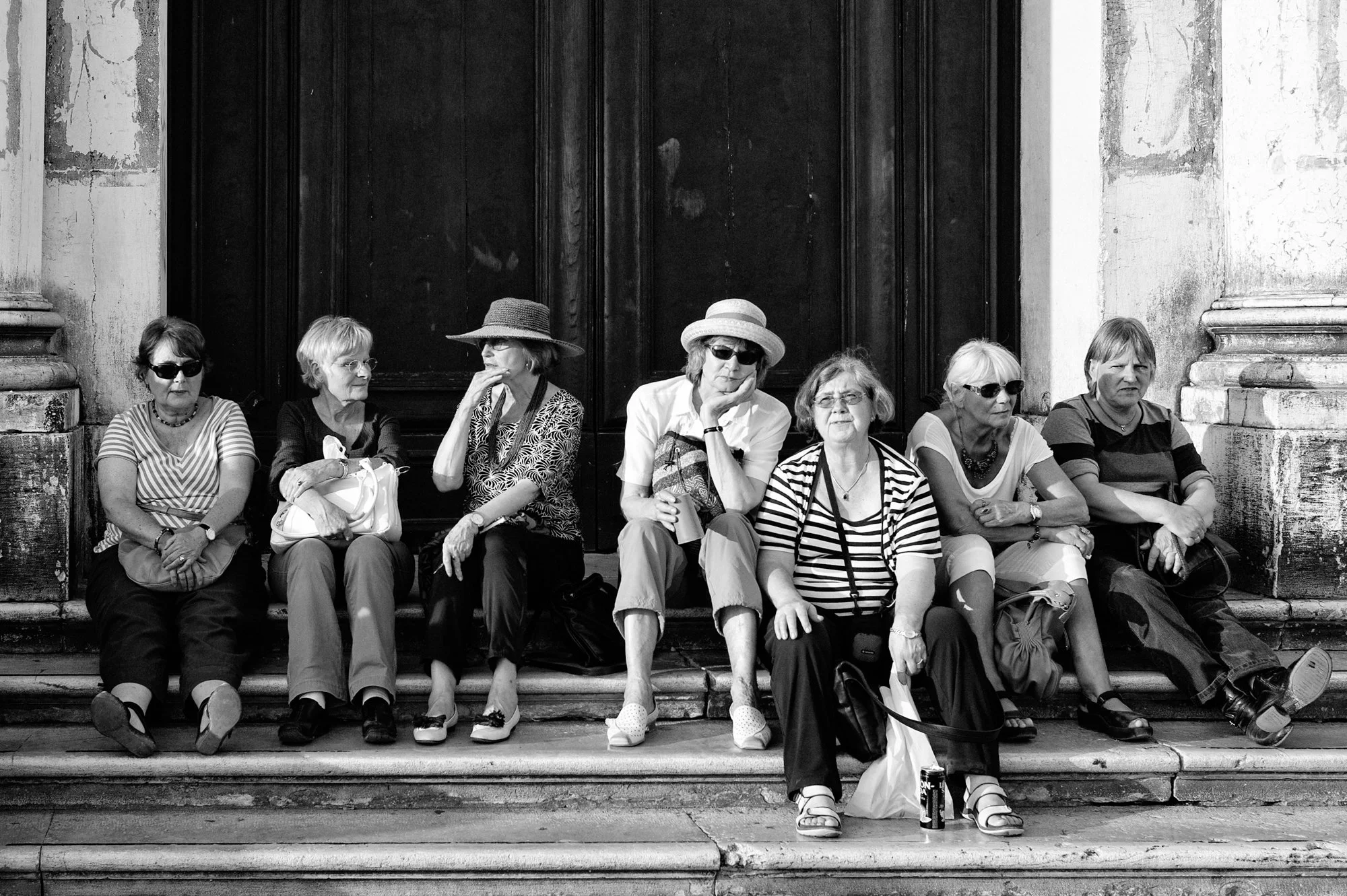
Visitors of the Venice Art Biennale of 2011.

Every other years, Venice transforms into a living map of contemporary art. The Biennale, founded in 1895, stretches across the city — from the historic pavilions of the Giardini to the vast halls of the Arsenale and countless palazzi scattered along its canals. It’s not a single exhibition but a city-wide conversation, where artists, curators, and visitors explore what art can still say about the world.

Each edition has its own theme, but the real magic lies in the contrasts: quiet installations beside theatrical spectacles, digital dreams across from centuries-old frescoes. National pavilions show pride, politics, and poetry side by side. Venice itself, half sinking and half eternal, adds its own commentary — a reminder that beauty and fragility often walk together.

The Biennale isn’t about answers. It’s about curiosity — about stepping into rooms that challenge, delight, or disturb, and leaving with more questions than before. In a city built on reflections, that seems perfectly fitting.

The Moment I Missed — and Didn’t

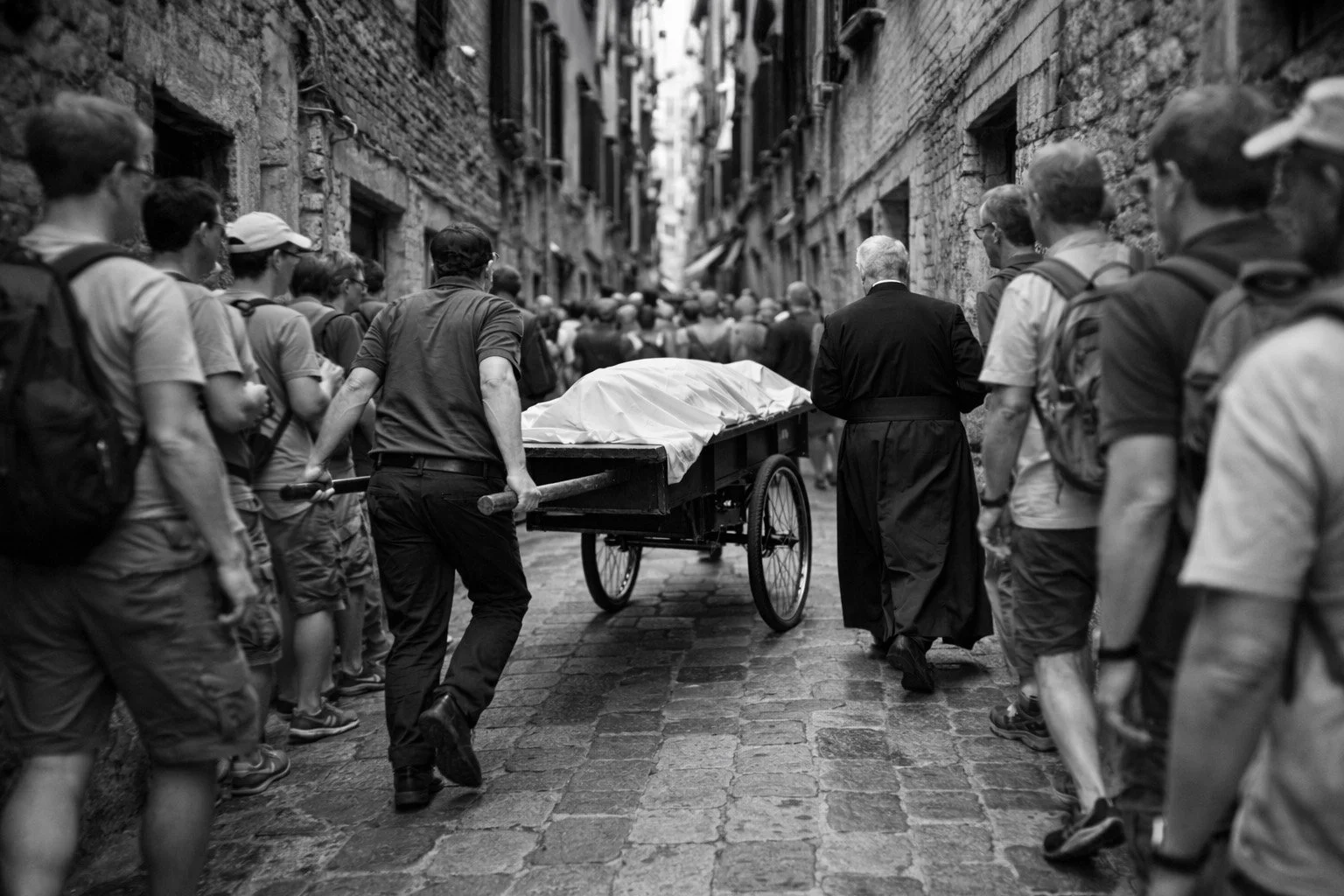
The bier in the streets of Venice (generated with AI).

Anyone who walks around with a camera knows this feeling.

You carry certain images in your head—scenes you saw clearly, moments that would have made an extraordinary photograph, if only you had been a second faster. But you weren’t. The camera was still in your bag, or your hands hesitated, or reality simply moved on. The moment vanished. The image, however, never does. It stays etched on your retina.

This time it happened in Venice.

Walking through the city as a tourist, drifting between alleys and canals, I was suddenly overtaken by something utterly unexpected: a bier mounted on bicycle wheels, pushed briskly forward. A body lay beneath a white shroud. A priest followed, visibly struggling to keep up with both the pace and his companion.

It passed in a flash.

I am convinced that more than half of the tourists around me didn’t even register what they had just seen. There were no sirens, no solemn procession—just a fleeting, almost surreal interruption of the Venetian rhythm. And then it was gone.

I never raised my camera in time. But the image lodged itself firmly in my mind.

Later, unable to let it go, I turned to AI to reconstruct the scene as faithfully as possible—not as a replacement for the photograph I failed to take, but as an attempt to give form to a moment that refused to disappear.

Some photographs are never taken. But that doesn’t mean they are lost.

The Lonely Station — Nogaredo, 2010

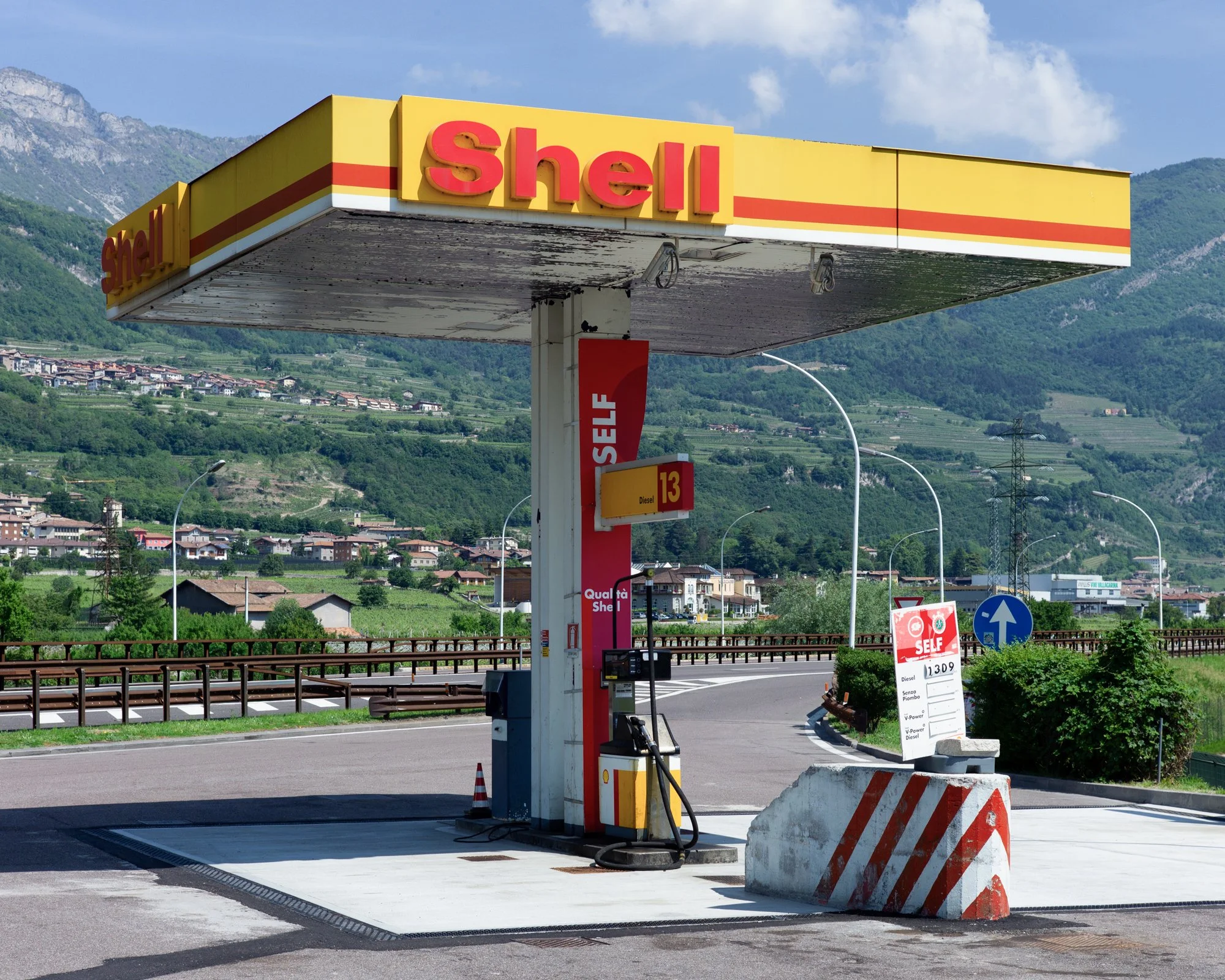
A Shell station near Nogaredo (2010).

On the roadside near Nogaredo in northern Italy, this small Shell station still glows in the mountain sun. It’s 2010 — the era when cars hum on diesel, when petrol prices make headlines, and when every highway bend seems to promise another stop for fuel and coffee.

Yet even then, the scene feels oddly quiet. A single pump, the yellow canopy already fading, no attendants in sight. The brand is there, but its energy seems to have drained away — like the end of a long drive.

Only a decade later, the world would begin to turn sharply toward electric mobility. Companies like Shell would find themselves in courtrooms rather than discussing expansion plans, accused of ignoring their responsibility for a warming planet. This lonely station, with its clean concrete and perfect Alpine backdrop, is now sold by Shell and does not advertise a brand anymore. The photograph seems to be a sign of change just before it begins.

It reminds us how fast certainty evaporates. The petrol age once seemed endless; now its architecture already belongs to the past — silent, sunlit, and waiting for whatever comes next.

Holy Sightseers

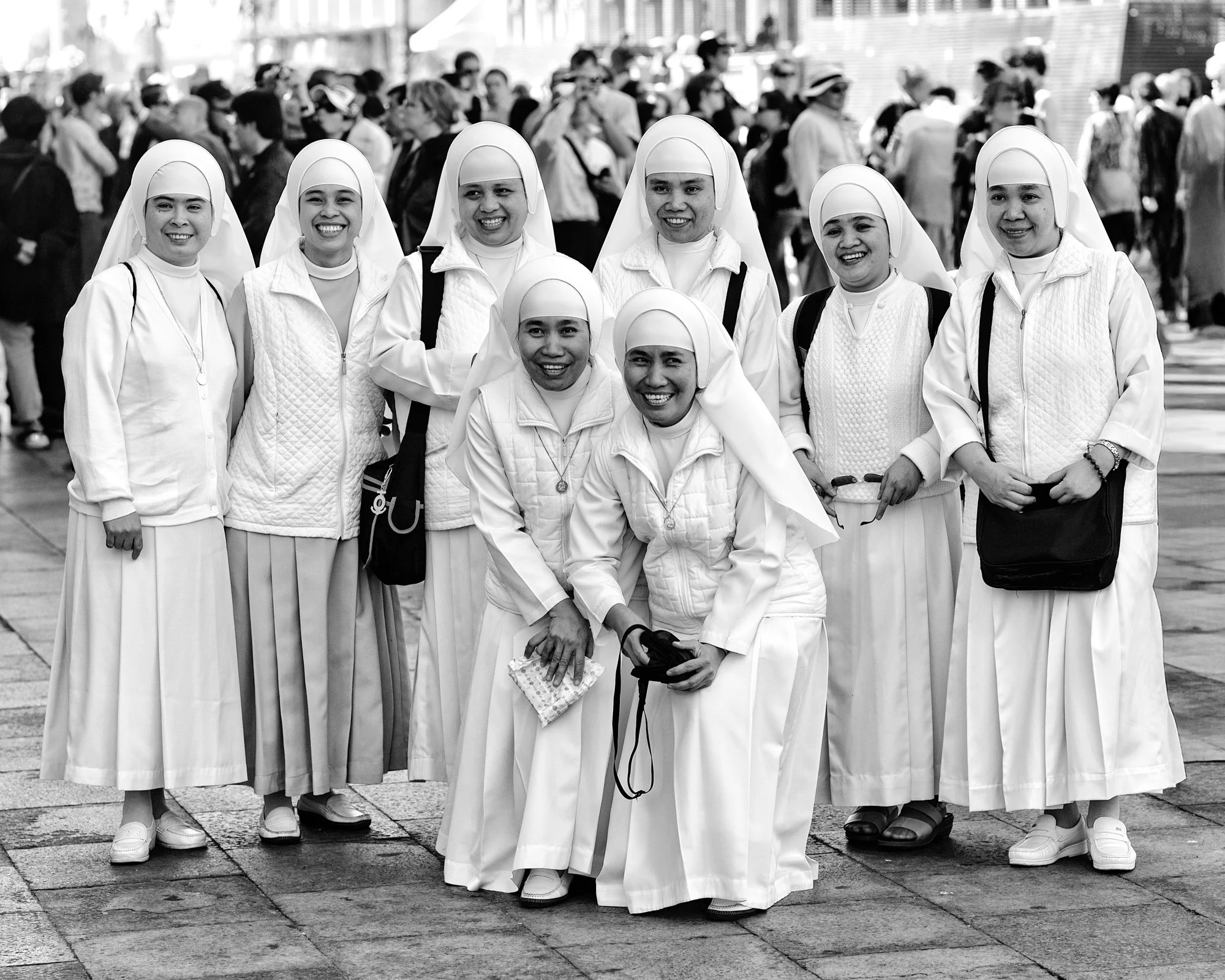
A group of Asian nuns on St. Mark’s Square, Venice (Italy).

Even nuns are tourists. Across Europe, they travel in small, smiling groups — cameras in hand, guidebooks tucked beneath their habits — tracing the footsteps of saints and centuries. On Piazza San Marco in Venice, amid selfie sticks and pigeons, their quiet laughter blends with the crowd’s hum. Faith meets curiosity; devotion meets delight.

Two Souls in Awe of Venice

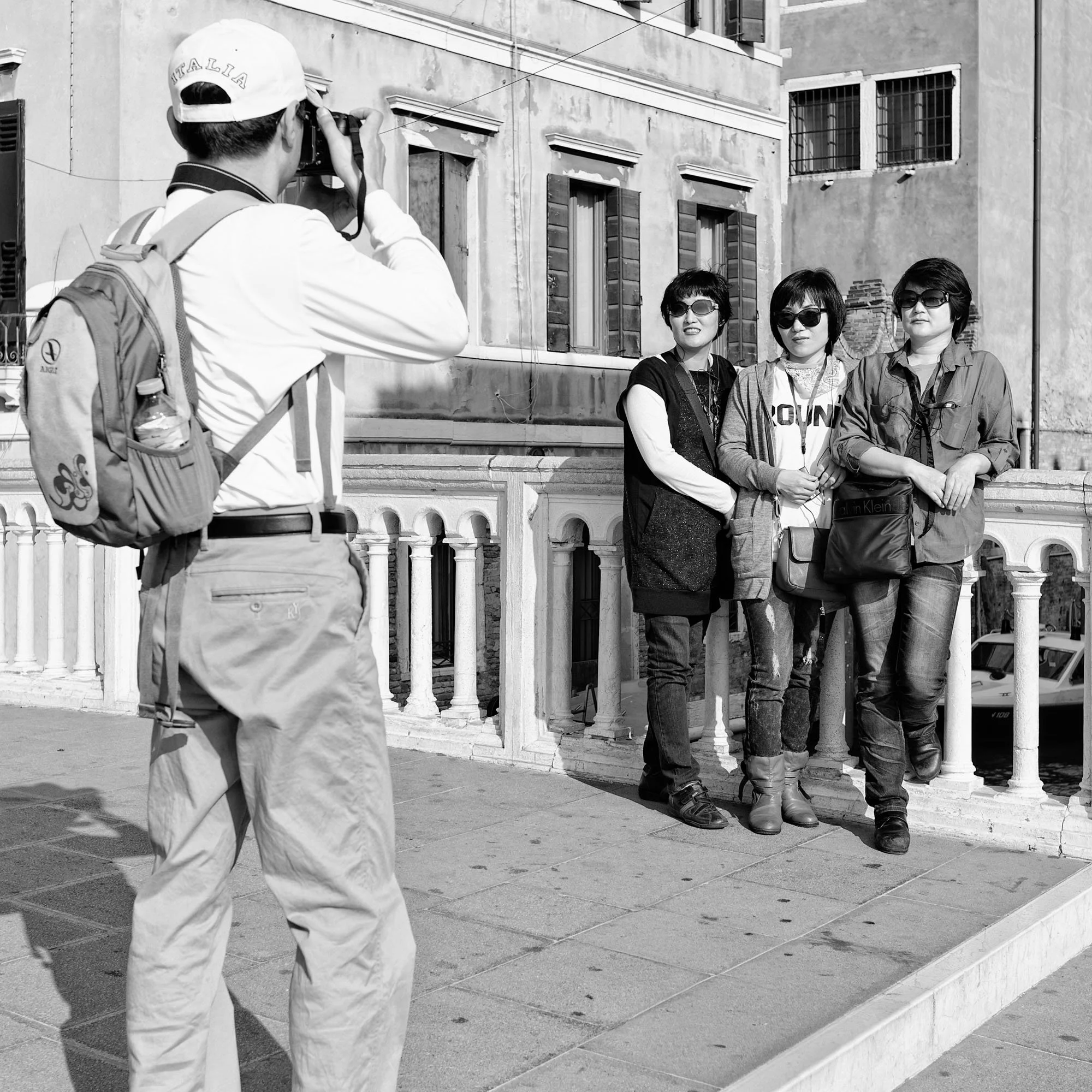
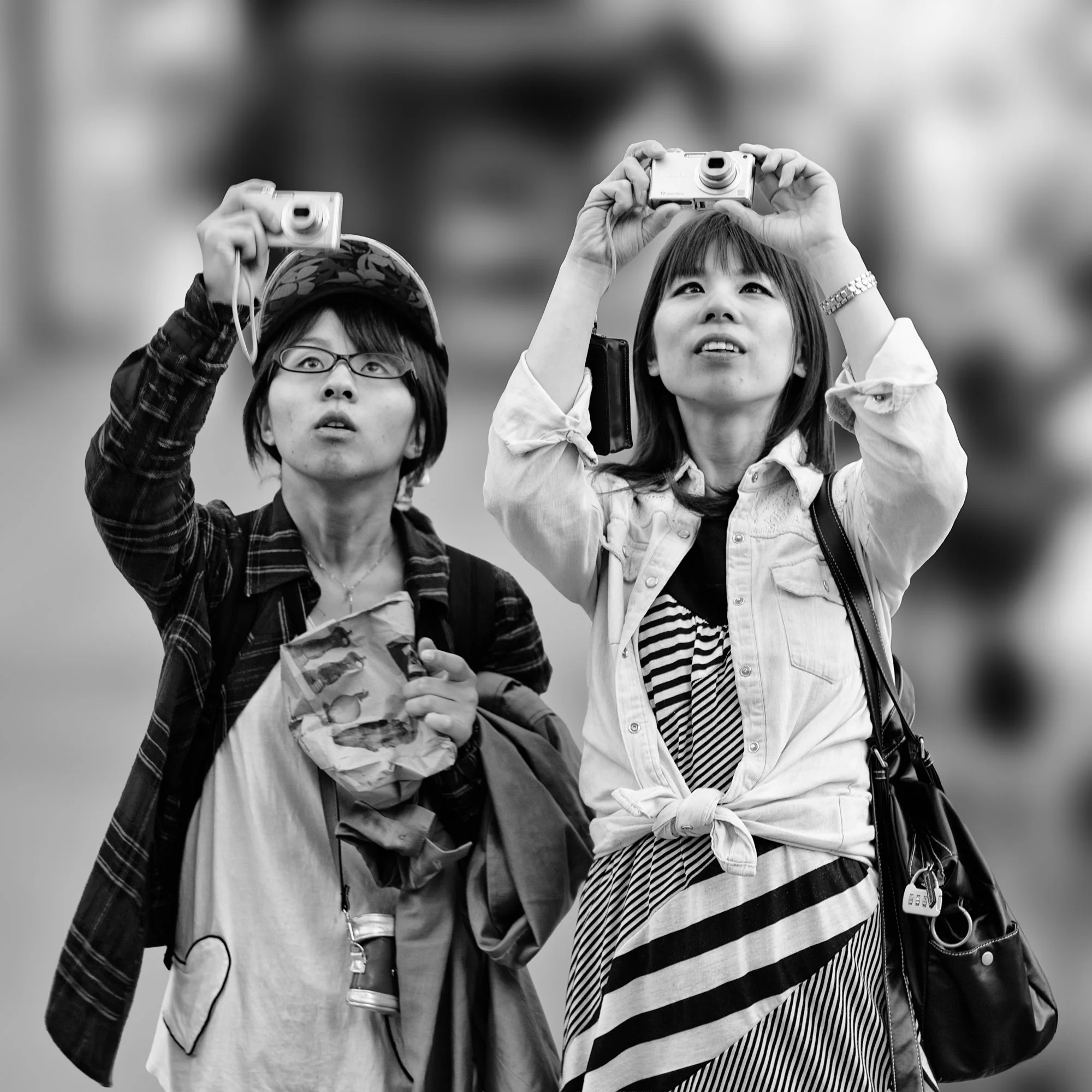
Two Asian girls in Venice.

We came from far across the sea,
 With phones and dreams and time for tea,
 Each bridge, each boat, each golden dome,
 Feels like a story far from home!

 Oh, life is full of wonders, see —
 From gondolas to gelat-i!
 We click, we pose, we laugh, we cheer,
 Europe feels like magic here!

 The pigeons dance, the waiters smile,
 We’ve walked in style for half a mile,
 We tilt our heads, the photo’s right —
 Two wandering souls, what a sight!

 Oh, life is full of wonders, see —
 From bridges old to the wide blue sea!
 With selfie-sticks and joy so clear,
 Europe feels like magic here!

 So if you see us grin and spin,
 Just smile — and let the cameras in!

The Mystery of the Bronze Figure Plate at the Museu Episcopal de Vic

MEV 7946 at the Museu Episcopal de Vic.

In one of the display cases in the Museu Episcopal de Vic (MEV) lies a small and enigmatic Iron Age object: a stylized bronze anthropomorphic plate with hanging pendants, catalogued as MEV Inv. 7946. Dated to the 7th–6th century BCE and attributed to the Picene culture of central Italy, this piece has puzzled researchers and raises intriguing questions about trans-Adriatic connections, ritual symbolism, and even its own provenance.

An Unusual Artifact

The bronze object in question takes the form of a schematic human figure: a flat, trapezoidal plate with raised arms, a loop-shaped head, and a series of perforations along the lower edge. These holes are used to attach a set of ritual pendants, including miniatures of hands, axes, spoons, and abstract shapes. Despite its simplicity, the plate radiates symbolic density: the outstretched arms may signify prayer or invocation; the pendants suggest ritual paraphernalia. It is not merely decorative—it is a visual language of power, status, and possibly female priesthood.

A Rare Type from Picenum

Objects of this type are exceedingly rare. Closely comparable pieces have only been securely documented in a few elite tombs from Picenum, a culturally rich region along the Adriatic coast of central Italy (modern-day Marche and Abruzzo). Graves at Montegiorgio, Montambone, and Ascoli Piceno have yielded similar anthropomorphic plaques, often found with women of high status. The distinctive combination of stylized form and symbolic pendants appears to be a Picene cultural signature.

This association is supported by the object's typology, metallurgy, and symbolic language, all of which firmly point to an Adriatic-Italic tradition. Furthermore, no parallels of this type have been found in the northeast of the Iberian Peninsula, including the region of Tarragona—where this object is allegedly said to have been found.

A Problematic Provenance

This brings us to the most confounding aspect of MEV 7946: its provenance. The object entered the museum's collection as part of a group of bronzes said to have been discovered near Tarragona. However, multiple clues cast doubt on this claim:

  • Typological mismatch: The object shares no stylistic, functional, or technological features with Iberian Iron Age bronzes from the region.

  • Cultural singularity: The anthropomorphic figure plate is entirely absent from Iberian archaeological records.

  • Contextual inconsistency: The collection includes a restored fibula (inv. 30) and other items of varied patina and corrosion, suggesting a modern aggregation of separate finds.

  • Trade and antiquarian channels: The early 20th century saw numerous Picene artifacts enter European collections via the antiquities market, often with unclear or falsified findspots.

Together, these factors strongly suggest that MEV 7946 may not have been found in Spain at all, but rather acquired through art dealers or collectors who misattributed—or intentionally obscured—its origin.

Ritual Meaning and Cross-Cultural Echoes

Despite its murky provenance, the object opens a window onto the ritual world of Iron Age elites. The raised arms and pendant symbols resonate with themes of supplication, protection, and magical function. Interestingly, similar symbolic arrangements appear in other Iron Age cultures, such as the Paeonians of the Vardar Valley (in present-day North Macedonia), whose elite women also wore composite ornaments with symbolic danglers. Though unrelated culturally, the convergence suggests widespread visual languages of status and sanctity across Iron Age Europe.

Conclusion

MEV 7946 is a unique artifact with a powerful presence—and an uncertain past. While its design and meaning root it firmly in Picene ritual tradition, its presence in a Spanish collection remains unexplained and increasingly doubtful. Rather than diminishing its significance, this mystery only deepens the object’s allure: a trans-Adriatic ambassador of Iron Age spirituality, displaced in time and space, but still eloquent in bronze.

Its silence speaks volumes.