
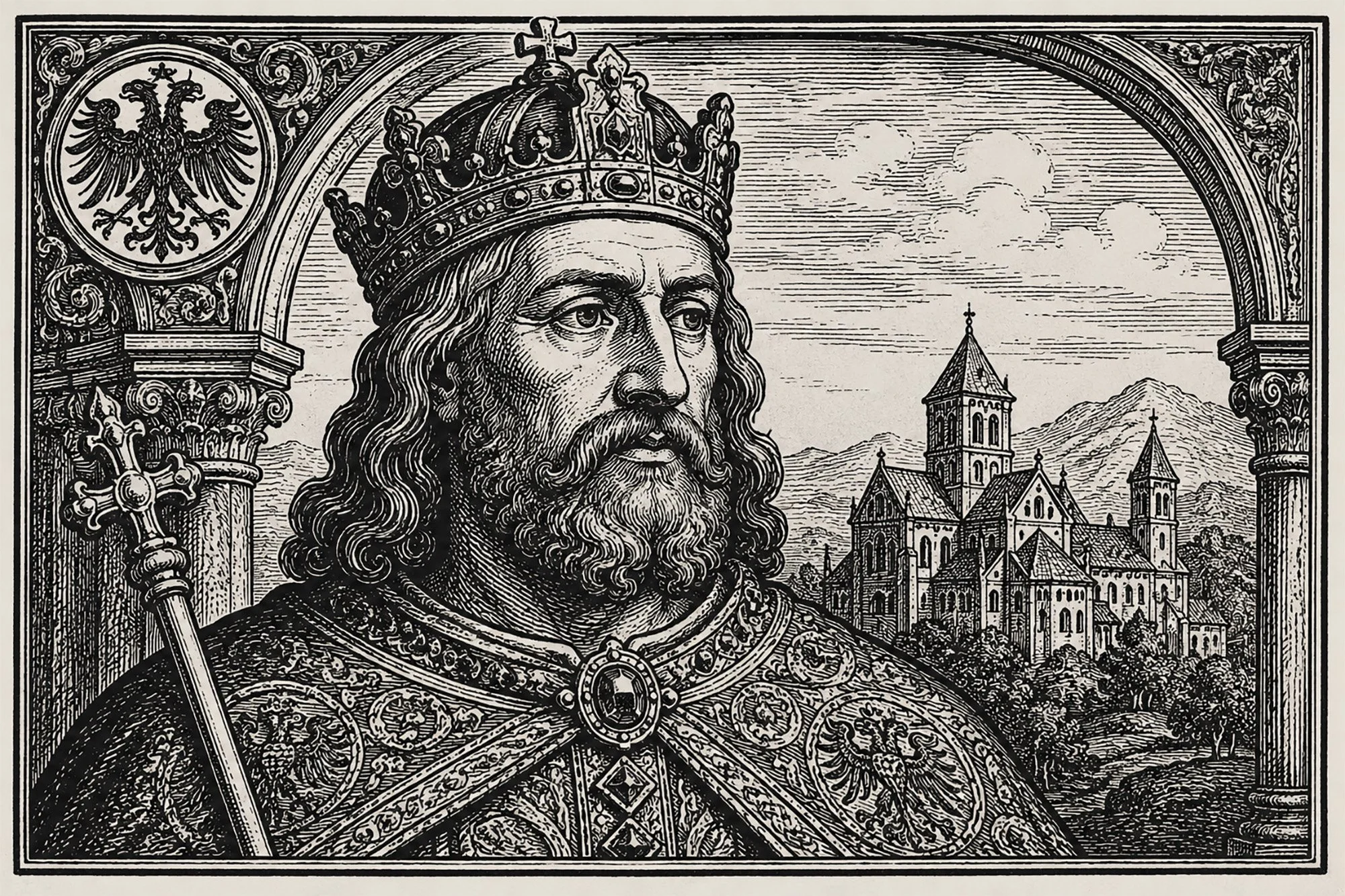
Charlemagne (image created with AI).
When people think of Charlemagne (742–814), they usually picture the ruler who united much of Western Europe through conquest and diplomacy. Yet one of the most fascinating portraits of the emperor tells a different story. It is not about battles or politics, but about justice.
This portrait comes from Notker the Stammerer (Notker Balbulus), a monk at the Abbey of Saint Gall in present-day Switzerland. Around 884—roughly seventy years after Charlemagne's death—Notker wrote the Gesta Karoli Magni ("The Deeds of Charlemagne"). Rather than producing a chronological biography, he collected memorable stories that illustrated the emperor's character. Modern historians recognise that some episodes are embellished or even legendary, but together they reveal how Charlemagne was remembered by later generations.
The following five stories, drawn from different chapters of the Gesta Karoli Magni, offer a glimpse into that memory. Whether every episode happened exactly as described is less important than the ideals they express. Together they portray a ruler who valued merit above birth, expected those in power to act responsibly, and believed that justice should apply equally to everyone.
Merit Before Noble Birth (Book I, Chapter 3)
Notker begins one of his best-known stories in Charlemagne's palace school. After returning from a military campaign, the emperor asked to inspect the work of the pupils. To the surprise of everyone present, the finest essays and poems had been written not by the sons of powerful nobles but by boys from ordinary families who had worked hard.
Charlemagne praised these students warmly and promised that their dedication would one day be rewarded. The noble boys, however, received a sharp rebuke. They had relied on their family status instead of applying themselves.
The story reflects one of Notker's central themes: talent and diligence deserve recognition, while privilege without effort deserves none. It is one of the earliest medieval stories to suggest that education should reward ability rather than social background.
Courage Earns Honour (Book II, Chapter 2)
Justice, in Notker's view, also meant recognising courage wherever it appeared.
During one of Charlemagne's campaigns, two ordinary soldiers distinguished themselves by attacking the walls of a heavily defended town. Their bravery caught the emperor's attention.
Instead of reserving promotion for men of noble birth, Charlemagne rewarded one of them with one of the highest military commands in the empire.
The lesson is straightforward. Honour should not depend on family connections but on proven courage and loyal service.
No One Is Above the Law (Book II, Chapter 3)
Another story demonstrates that justice must also apply to the powerful.
During a military expedition, the sons of two dukes were entrusted with guarding the royal camp. Instead of carrying out their duty, they became drunk and fell asleep while on watch.
The following morning Charlemagne gathered his leading nobles and asked what punishment such negligence deserved. They unanimously declared that anyone whose carelessness had endangered the king and the Frankish army deserved the harshest penalty.
Only then did Charlemagne reveal that the offenders were their own sons.
Although he ultimately chose mercy rather than execution, the point had already been made. Noble birth did not place anyone beyond judgement.
Protecting Those Without Power (Book I, Chapter 13)
Notker repeatedly returns to another characteristic of Charlemagne's rule: his willingness to protect ordinary people.
In several stories, the emperor refuses to let influential nobles misuse their authority. He listens carefully before reaching a decision and expects those in positions of power to exercise their authority fairly.
Whether these episodes are exact historical accounts is impossible to know. Together, however, they reveal the kind of ruler Notker believed people should admire: one who defended those who could not easily defend themselves.
Power Brings Responsibility (Book I, Chapter 18)
The final story reinforces a principle that runs throughout the Gesta.
Notker makes it clear that bishops, judges and royal officials were not exempt from the standards they imposed on others. Holding office brought greater responsibility, not greater privilege.
For Charlemagne, justice did not stop with ordinary people. Those entrusted with governing were expected to set the example. A ruler who tolerated corruption or unfair judgement among his own officials would fail in his most important duty.
The Charlemagne People Remembered
Modern historians rightly caution that Notker's stories should not always be read as literal history. They are moral narratives as much as historical memories. Yet that is precisely why they remain so valuable.
Notker was writing only a few generations after Charlemagne's death. His readers still lived in a world shaped by the emperor's legacy, and the stories he chose reveal which qualities were considered worthy of remembrance.
The Charlemagne who emerges from these pages is remembered not primarily as a conqueror, but as a ruler who rewarded learning, recognised courage wherever he found it, refused to excuse privilege, protected the vulnerable, and expected even the most powerful people to answer for their actions.
Whether every event happened exactly as Notker describes it is ultimately less important than the portrait these stories create. More than eleven centuries later, they continue to raise a timeless question: what makes a ruler truly great?
For Notker, the answer was clear. A great ruler is not defined by military victories alone, but by the determination to place justice above privilege.
Further Reading
Notker Balbulus. Gesta Karoli Magni Imperatoris (The Deeds of Charlemagne), written around AD 884.
Recommended scholarly edition:
Hans F. Haefele (ed.), Notkeri Balbuli Gesta Karoli Magni Imperatoris, Monumenta Germaniae Historica, Scriptores rerum Germanicarum, Nova Series 12. Berlin: Weidmann, 1959.