
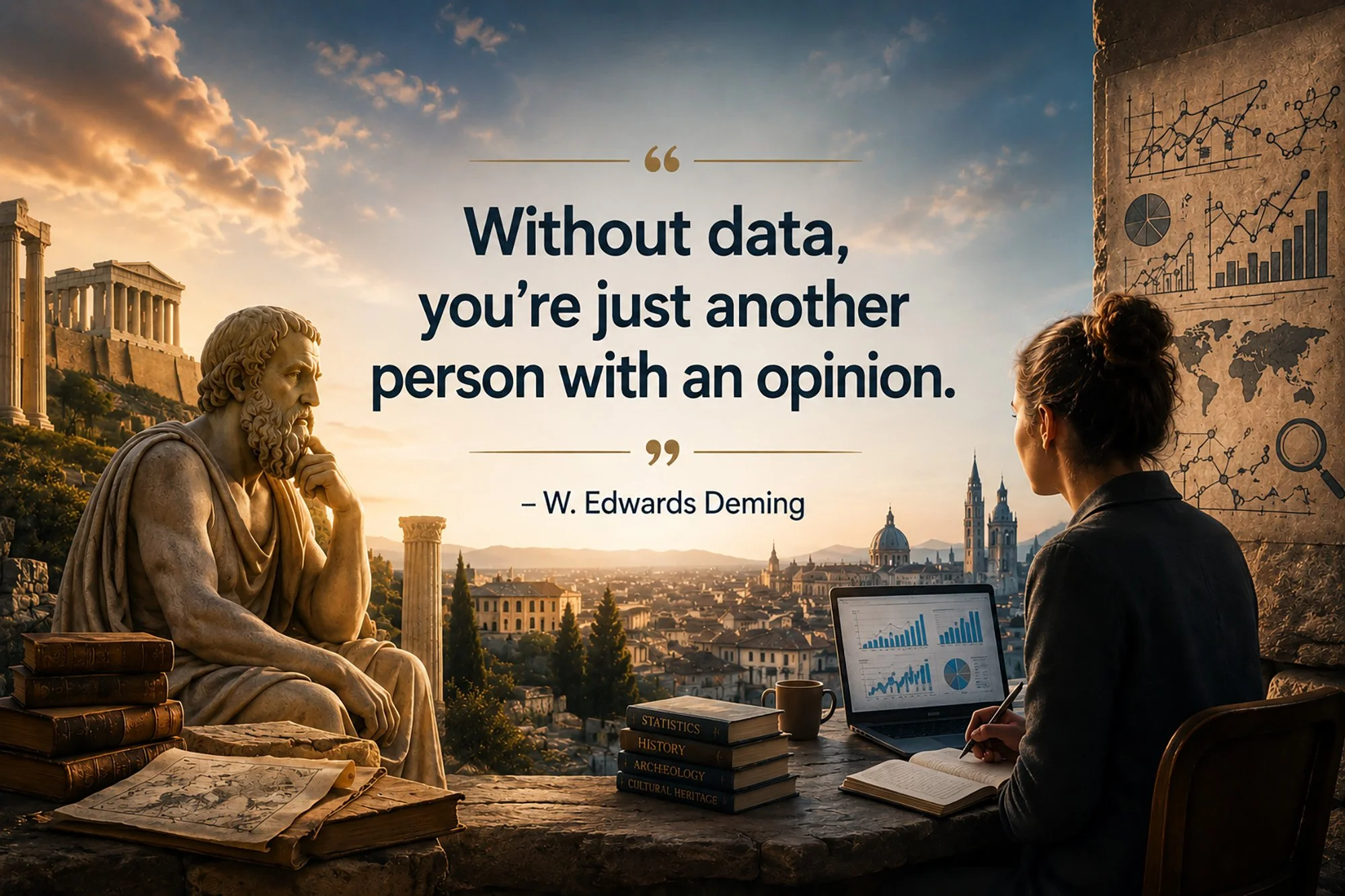
Image created with AI.
Most of us have experienced it.
Someone speaks with great confidence. The room becomes quiet. Heads begin to nod. The conclusion sounds convincing. Yet, after the meeting, you may wonder: What was the evidence?
The famous quote, often attributed to the American statistician and management thinker W. Edwards Deming, captures this perfectly:
"Without data, you're just another person with an opinion."
Although Deming said this in the context of business and quality management, the idea is much older. It reaches back to the philosophers of ancient Greece, who argued that claims should be supported by reason rather than authority. It also echoes the spirit of the scientific revolution, when observation gradually replaced tradition as the foundation of knowledge.
For most of history, however, people often accepted statements because they came from kings, priests, nobles, or respected elders. Their position gave weight to their words. The question "How do you know?" was not always welcomed.
The modern world has largely turned this upside down. Scientists, historians, archaeologists, and judges all work from the same basic principle: conclusions should follow from evidence. A strong opinion is not enough. Even widely accepted ideas must be open to challenge when new evidence appears.
This way of thinking is not limited to laboratories or universities. It shapes everyday life as well. Whether discussing history, restoring a medieval church, managing a local association, or planning a journey, better decisions usually begin with the same simple question:
"What do the facts tell us?"
That question does not guarantee agreement. People can interpret the same evidence differently. But it shifts the discussion away from personalities and towards understanding.
Perhaps that is why Deming's words have remained so memorable. They remind us that confidence is not the same as knowledge, and that good conversations begin not with certainty, but with curiosity.
In the end, culture is more than monuments and traditions. It is also the way societies learn, question, and search for truth. Every time we ask for evidence before accepting a conclusion, we continue a tradition that has shaped the best of European thought for more than two thousand years.