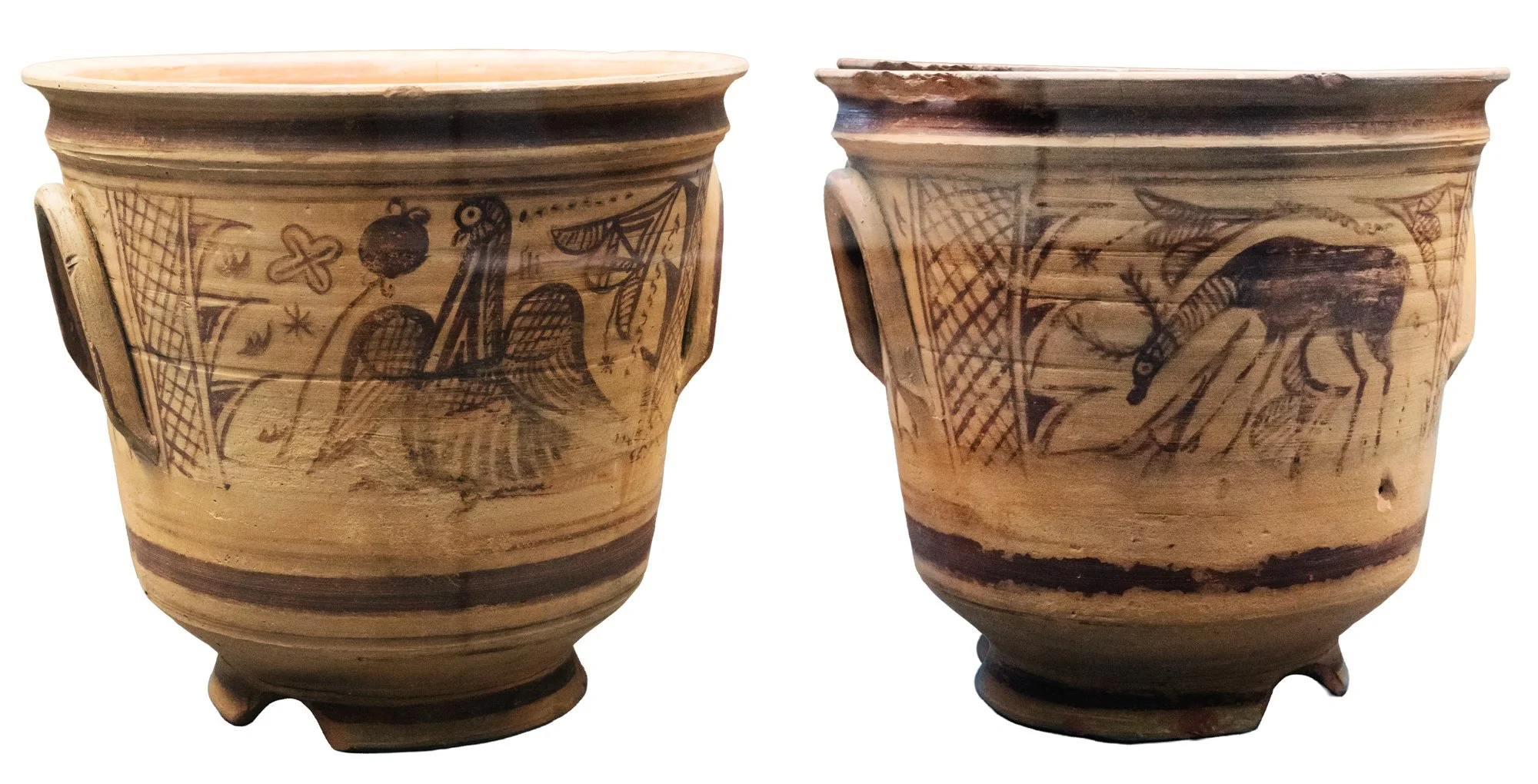
Painted Iberian crater, El Tolmo de Minateda, early 1st century BCE. Bird and deer appear on opposite sides of the vessel, forming a symbolic dialogue placed in a funerary context.
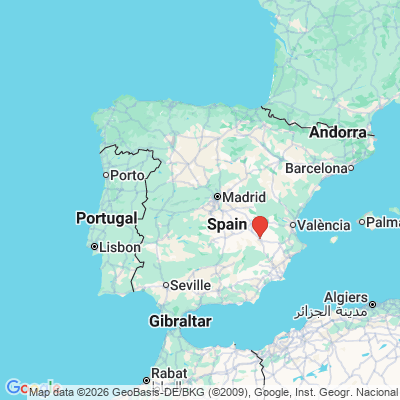
In the first half of the 1st century BCE, in what is now southeastern Spain, a large painted vessel was placed in a grave at El Tolmo de Minateda (Albacete). It was not an ordinary container. This crater — a Greek vessel form reinterpreted by Iberian potters — was chosen to accompany someone into death.
What makes it remarkable is that it speaks in two images, one on each side.
On one face, a bird with outstretched wings stands upright, surrounded by flowers and vegetal motifs. On the opposite face, a deer lowers its head, calm and contained, again framed by floral elements. Both images were painted deliberately, each occupying its own panel, as if inviting the viewer to walk around the vessel and read it in the round.
This crater comes from a funerary context, and that matters. In Iberian ceramics from El Tolmo, birds and deer are not random decorations. Archaeological research shows that deer appear almost exclusively in burial contexts, where they are often interpreted as psychopomps — animals associated with transition, guidance, and the passage between worlds. The bird, frequently depicted with spread wings, may echo similar ideas of movement between earth and sky.
Together, the two animals form a quiet visual dialogue: land and air, stillness and motion, body and soul. This is not storytelling in the modern sense, but symbolic language, meant to work within ritual rather than explanation.
By the time this vessel was made, Roman power was already present in Iberia. Yet the imagery is deeply local. The form may echo the Mediterranean world, but the meaning belongs to the community that buried its dead here, using symbols that had carried weight for generations.
This crater was never meant for display. It was made to stand beside ashes, to protect, to accompany, and perhaps to explain what words could not.
Two animals. One vessel.
And a final journey, told in clay.