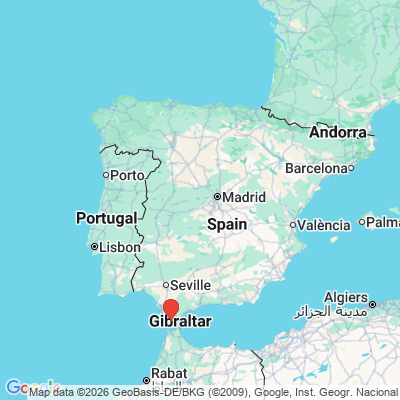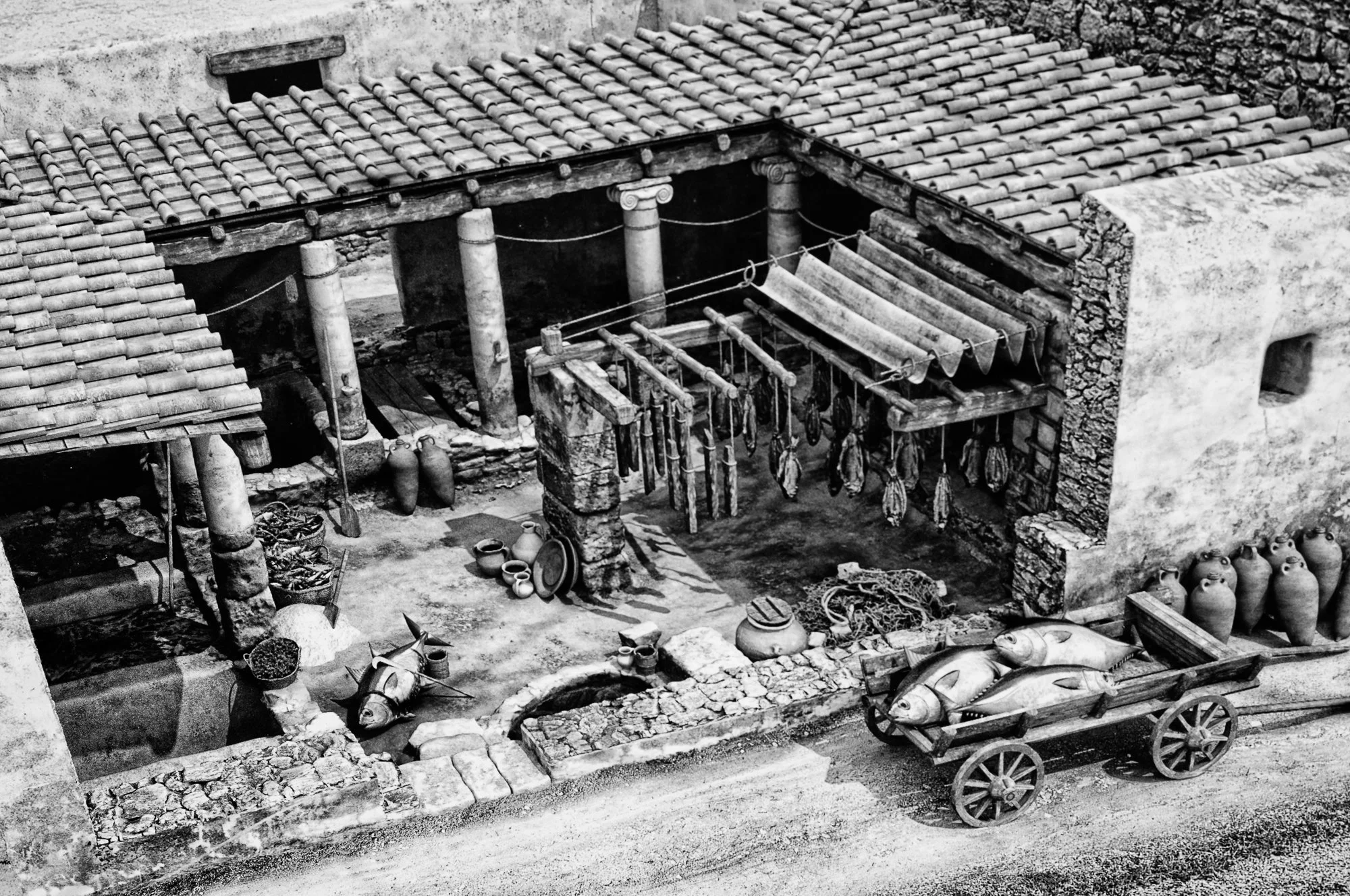
A reconstruction of a cetaria (fish-processing workshop) in Baelo Claudia reveals the industrial heart of this Roman coastal city. Built against the eastern city wall, the complex was designed for efficiency: fresh fish—sardines, anchovies, and tuna—arrived daily from nearby almadraba fisheries, were cleaned in small basins, then either salted in large vats or left to ferment in ceramic dolia to produce garum, the prized Roman fish sauce. Drying areas and shaded roofing helped control heat and preserve the catch. Far from being a quiet provincial town, Baelo Claudia emerges here as a carefully organized production hub, where maritime resources were transformed into goods traded across the Roman world.
Some ruins require imagination. Baelo Claudia does not. Walk through its streets, with the Atlantic wind coming in from the Strait of Gibraltar, and the structure of a Roman city is still clearly there — not as an abstract idea, but as something you can physically follow.
Set on the southern coast of Spain, Baelo Claudia was perfectly placed for trade between Europe and North Africa. Ships crossed these waters constantly, and the town grew into a small but well-connected hub. Its wealth came from an unlikely source: tuna. The seasonal catch fed a thriving industry of salted fish and garum, the fermented sauce that Romans exported across the empire.
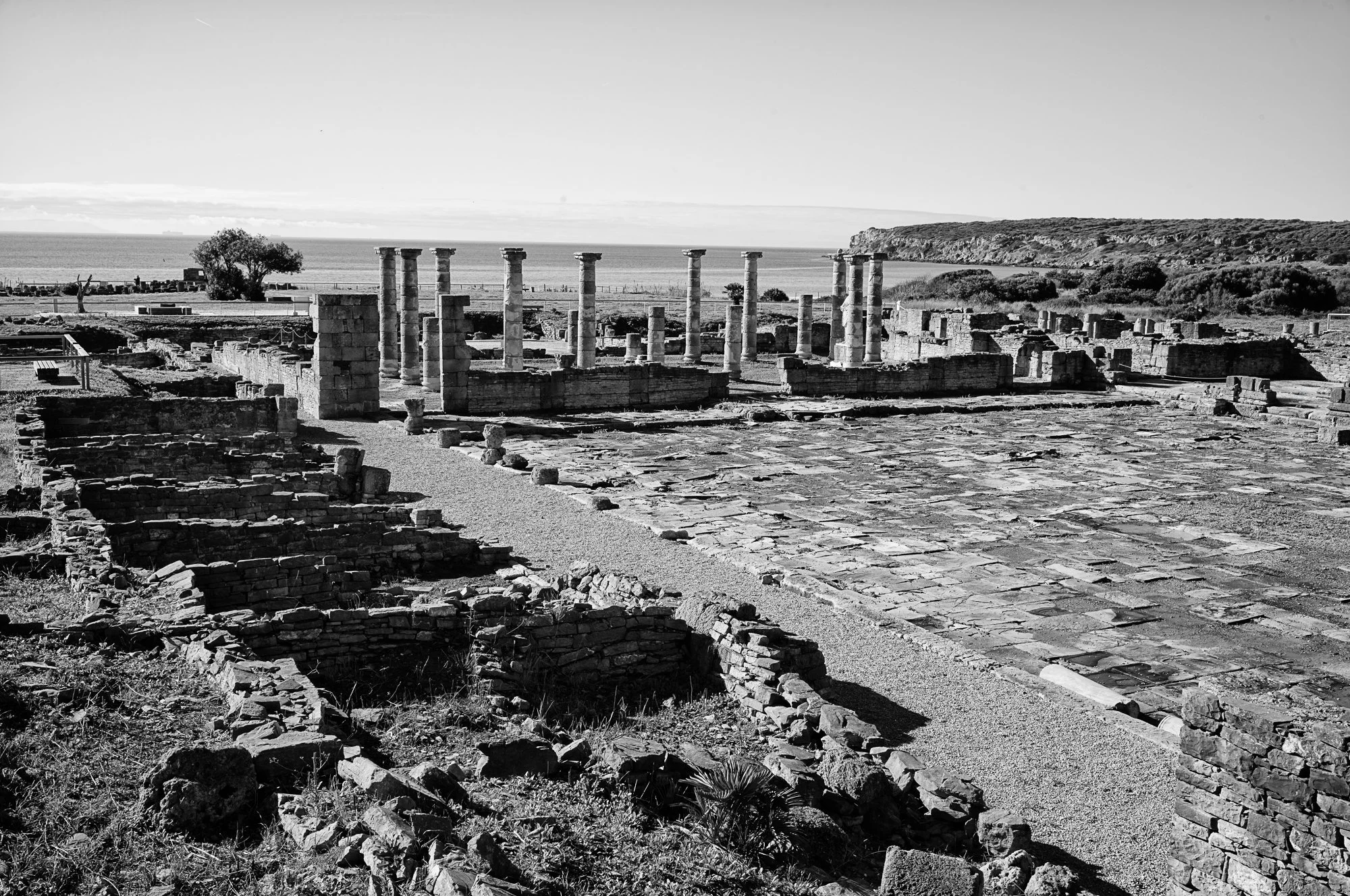
A view across the forum of Baelo Claudia, the civic heart of the Roman city. On the left, a row of tabernae—small stone shops—once opened directly onto the square, serving the town’s daily commercial life. Just beyond the forum stand the columns of the basilica, where legal and administrative affairs were conducted, with the Atlantic visible further in the distance. Together, they frame a space where trade, justice, and public life converged, illustrating the classic organization of a Roman forum.
By the 1st century AD, under Emperor Claudius, Baelo had become a municipium, fully integrated into the Roman system. The city took on a familiar layout — a forum surrounded by temples, a basilica for justice, a theatre, baths, and markets. Local elites stepped into public roles, governing the city in Rome’s name. Figures like Quintus Pupius Urbicus, known from a surviving inscription, belonged to this world: local leaders shaped by a global empire.
And yet Baelo Claudia was never just a copy of Rome. Its coastal position gave it a different rhythm, open to influences from across the strait. Even its religious life reflects this, with the presence of a temple to Isis alongside the traditional Roman gods.
The city’s success did not last. An earthquake in the 2nd century AD caused major damage, and over time trade declined. By the 6th century, Baelo Claudia was abandoned, left to the wind and sand.
What remains today is one of the most complete Roman townscapes in Spain — a place where trade, politics, and daily life still feel visible. Baelo Claudia is not just a ruin, but a reminder of how a small coastal settlement could briefly become part of something much larger: the economic and cultural network of the Roman world.