A Roman Millefiori Glass Bowl in Southern Spain
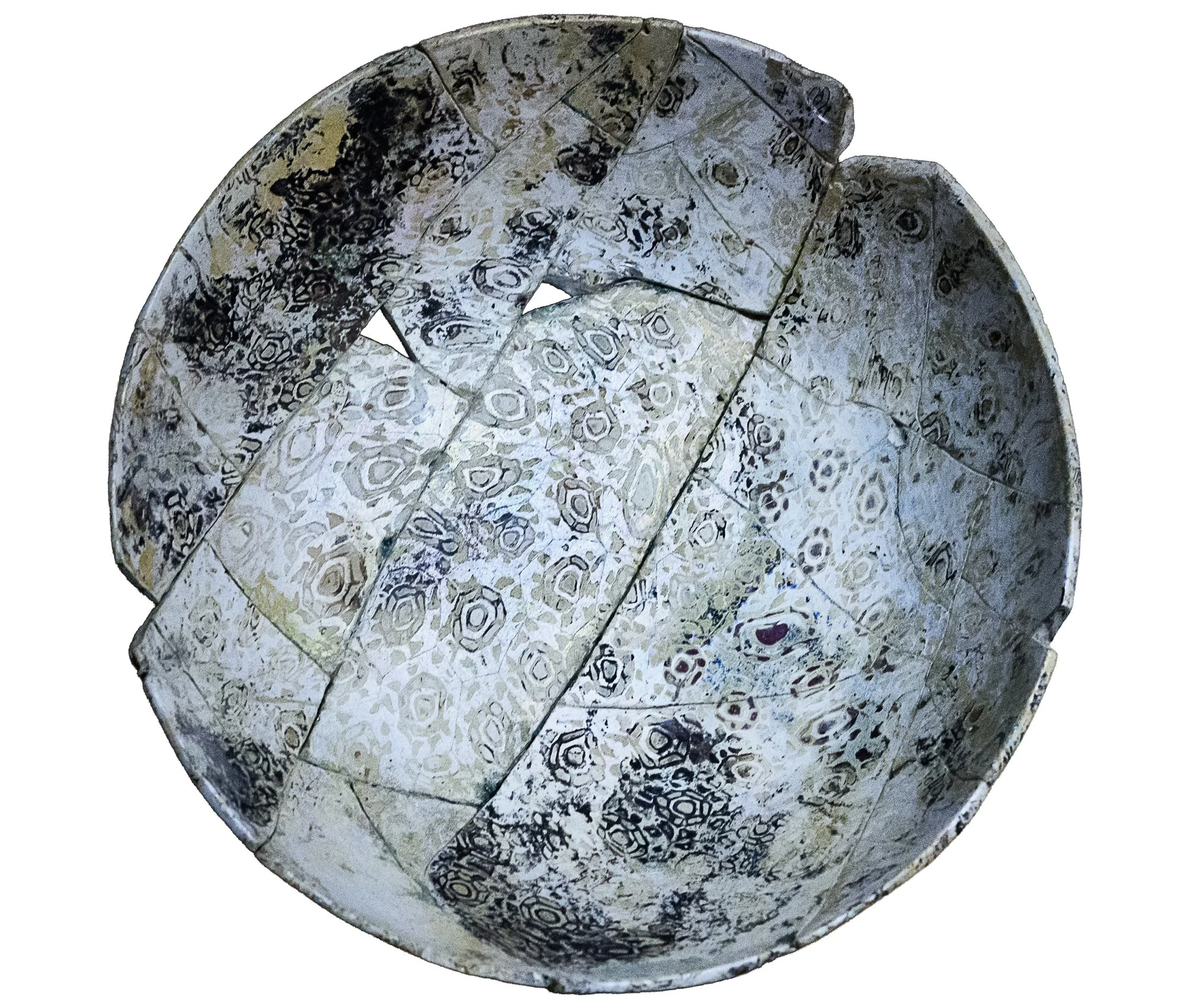
A Roman millefiori glass bowl (1st century AD), found in Medina Sidonia and now ond display in the Museo Arqueológico de Medina Sidonia (MAMS) in Medina Sidonia.
At first glance, it looks almost improvised — a shallow bowl, broken and reassembled, its surface covered in small circular patterns. It could easily be mistaken for something simple, even local. It is neither.
This is a Roman millefiori glass bowl, made in the 1st century AD, now in the Museo Arqueológico de Medina Sidonia. What appears fragmented and irregular is in fact the result of a remarkably sophisticated technique. The name millefiori, meaning “a thousand flowers,” refers to the way it was made: glassmakers created rods of coloured glass, built up in layers, then sliced them into thin sections. Each slice revealed a tiny pattern — often resembling a flower or an eye — and these were carefully arranged and fused together to form the surface of the bowl.
The effect looks almost accidental, but it is anything but. Every pattern was planned, every piece placed with intention. This was high-level craftsmanship, requiring both control and experience. It also belonged to a wider world. Bowls like this were not made everywhere, but in specialised workshops, most likely in the eastern Mediterranean, before travelling across the networks of the Roman Empire.
The fact that such an object ended up in southern Spain is not surprising, but it is revealing. It shows how connected that world had become. Fragile, decorative objects could move across long distances, carried along the same routes as metals, wine, oil and people.
What makes this bowl particularly compelling is the contrast between what it seems and what it is. It looks like a patchwork of fragments, but it is the result of precision. It feels local, but it is part of a much larger system. Like so many objects in museums, it only begins to make sense once you look beyond the surface.