salamanca

The Silent Lady of Salamanca: The Grave of Aldonza Díez Maldonada

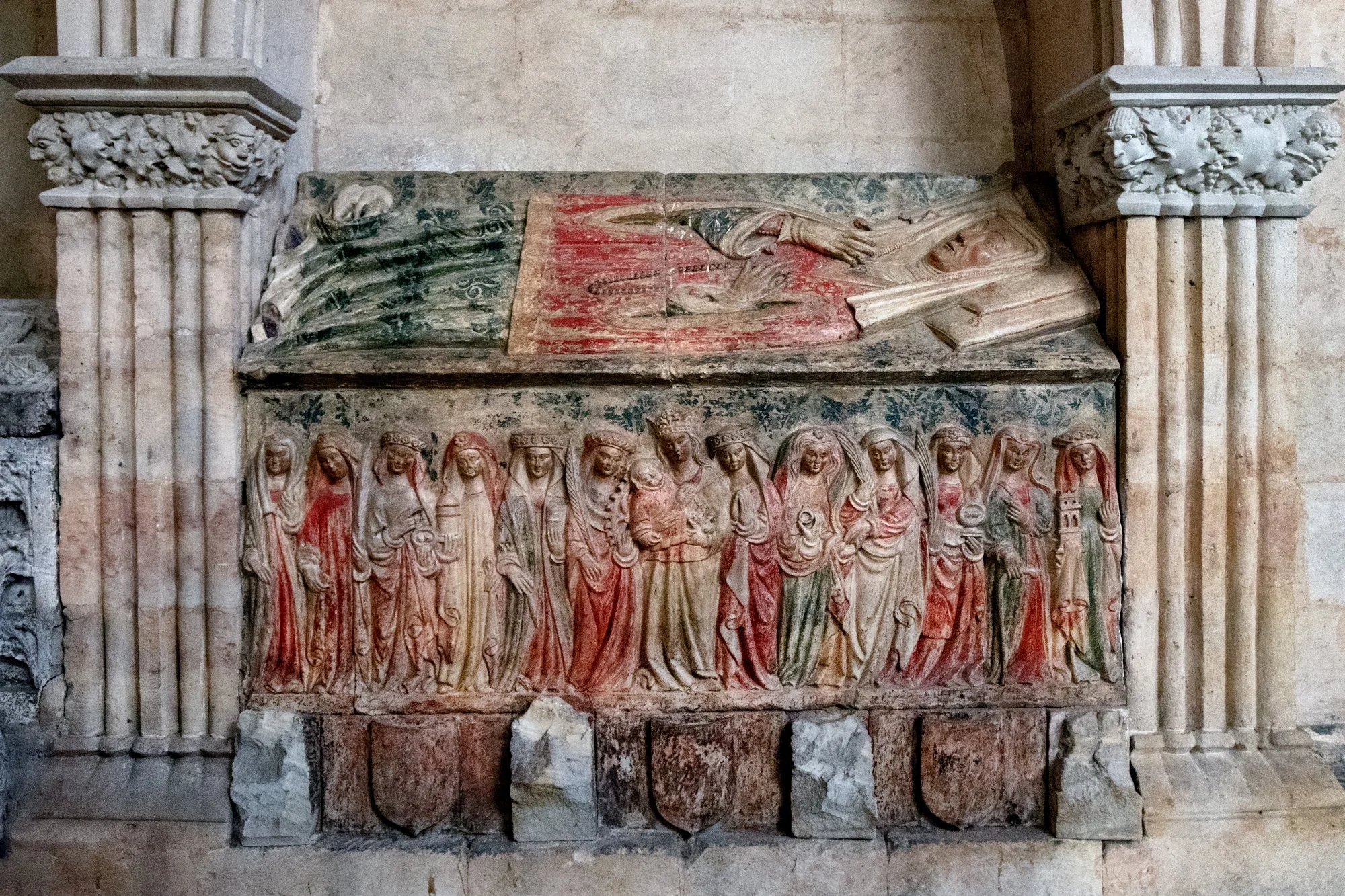
Sepulcher of Doña Aldonza Díez Maldonada in the Capilla de Anaya, Old Cathedral of Salamanca. Shown as a serene recumbent figure with a rosary in hand, her monument blends personal devotion with late Gothic artistry, linking her memory to the sacred life of the cathedral.

In the Old Cathedral of Salamanca, the Capilla de Anaya shelters a quiet yet striking tomb. It belongs to Doña Aldonza Díez Maldonada, remembered as the mother of Fernán Nieto, a nobleman active around 1500.

Her effigy shows her lying in repose, a rosary in her hand, framed by carvings of the Virgin and holy women. Unlike the grand monuments of bishops and dukes, Aldonza’s tomb reflects devotion and family memory rather than worldly power.

Art historians trace its style to fifteenth-century Toledo, where Hispano-Flemish influences brought grace and realism to stone. Though her exact story remains partly veiled, Aldonza’s monument still speaks of faith, dignity, and the place of women in Salamanca’s medieval nobility.

The Vision of Heaven in Salamanca’s Old Cathedral

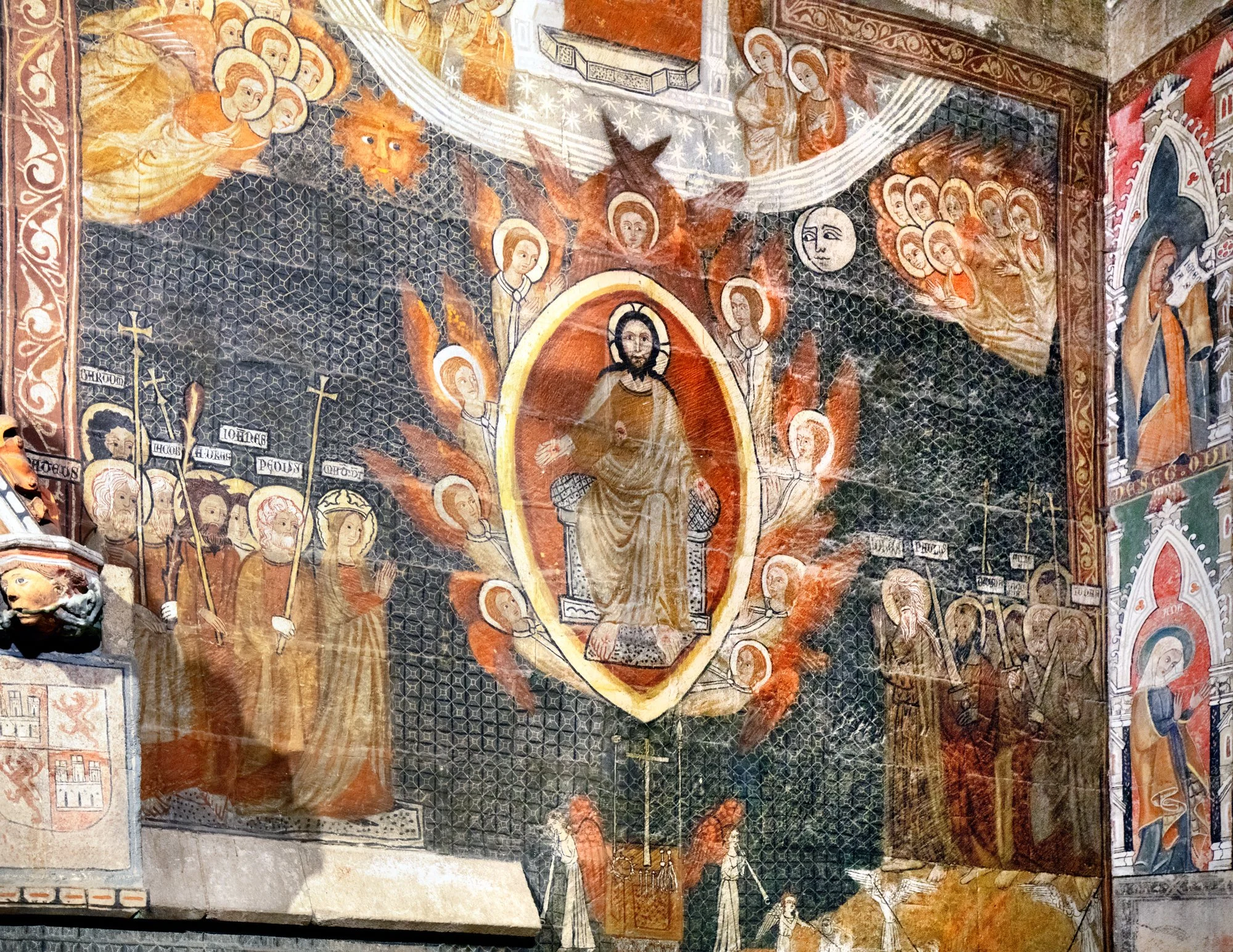
Christ in Majesty surrounded by angels and saints, with the sun and moon as witnesses. Fresco from the Chapel of St. Martin, Old Cathedral of Salamanca (c. 1300), painted by Antón Sánchez de Segovia.

Step into the Chapel of St. Martin in Salamanca’s Old Cathedral and you are immediately surrounded by one of the most breathtaking fresco cycles in medieval Spain. Painted around the year 1300, these walls are alive with fiery color, gold halos, and a vision of eternity that once spoke directly to the faithful of the city.

At the center of the great composition is Christ in Majesty, seated within a glowing mandorla — the almond-shaped frame of divine light. His hand is raised in blessing, his other resting on the Book of Life. Around him swirl ranks of angels, their faces turned toward the Judge of all creation. Even the cosmos bears witness: the sun and the moon appear with human faces, as if stunned by the unfolding vision.

On either side, processions of saints advance toward the throne, holding crosses and palm branches, their names once carefully inscribed above them. They are not remote figures but companions, examples of courage and faith who join the celestial chorus. Above, more angels surge like flames in worship, a reminder that the entire heavenly court is gathered here.

This fresco is more than decoration; it is theology in color. In an age when few could read, images like this made the mysteries of salvation visible. Standing before it, a medieval worshipper would feel both awe and urgency — the promise of paradise and the warning of judgment. Even today, its intensity is impossible to ignore.

The Chapel of St. Martin, built as the burial place of Bishop Martín Alfonso, became a stage for this dazzling vision. The painter Antón Sánchez de Segovia, working at the transition between Romanesque solemnity and Gothic elegance, gave Salamanca one of its most enduring treasures. The figures remain stylized yet animated, the flames vibrate with energy, and Christ radiates a serene authority that bridges heaven and earth.

To gaze at this fresco is to stand where countless believers once stood, confronted with the ultimate questions of time and eternity. It is art not just to be admired, but to be experienced.

Further Reading

  • Peter Klein, Romanesque and Gothic Wall Paintings in Spain

  • Gerhard Schmidt, The Last Judgment in Medieval Art

Salamanca's beautiful ex-voto paintings

The statue of Santa Maria la Blanca surrounded by ex-voto paintings by José Sánchez.

The Old Cathedral of Salamanca houses a remarkable collection of original ex-voto paintings around the statue of Santa Maria la Blanca (14th century). The paintings depicte miracles attributed to Salamanca’s Christ of the Battles. Created by the little-known artist José Sánchez, also known as Jusepe Sánchez de Velasco, these paintings date back to the early 17th century. Comprising eighteen scenes arranged in two tiers, the ex-votos showcase the divine interventions experienced by the local inhabitants.

Despite their historical significance, these paintings have largely escaped the attention of scholars of Spanish Baroque art. Nevertheless, they offer a fascinating glimpse into the religious fervor of the era. Each scene is meticulously painted, featuring classical architectural elements separating the narratives of miracles performed by the Christ of the Battles.

Christ of the Battles