The Visitation — A Quiet Encounter That Changes Everything
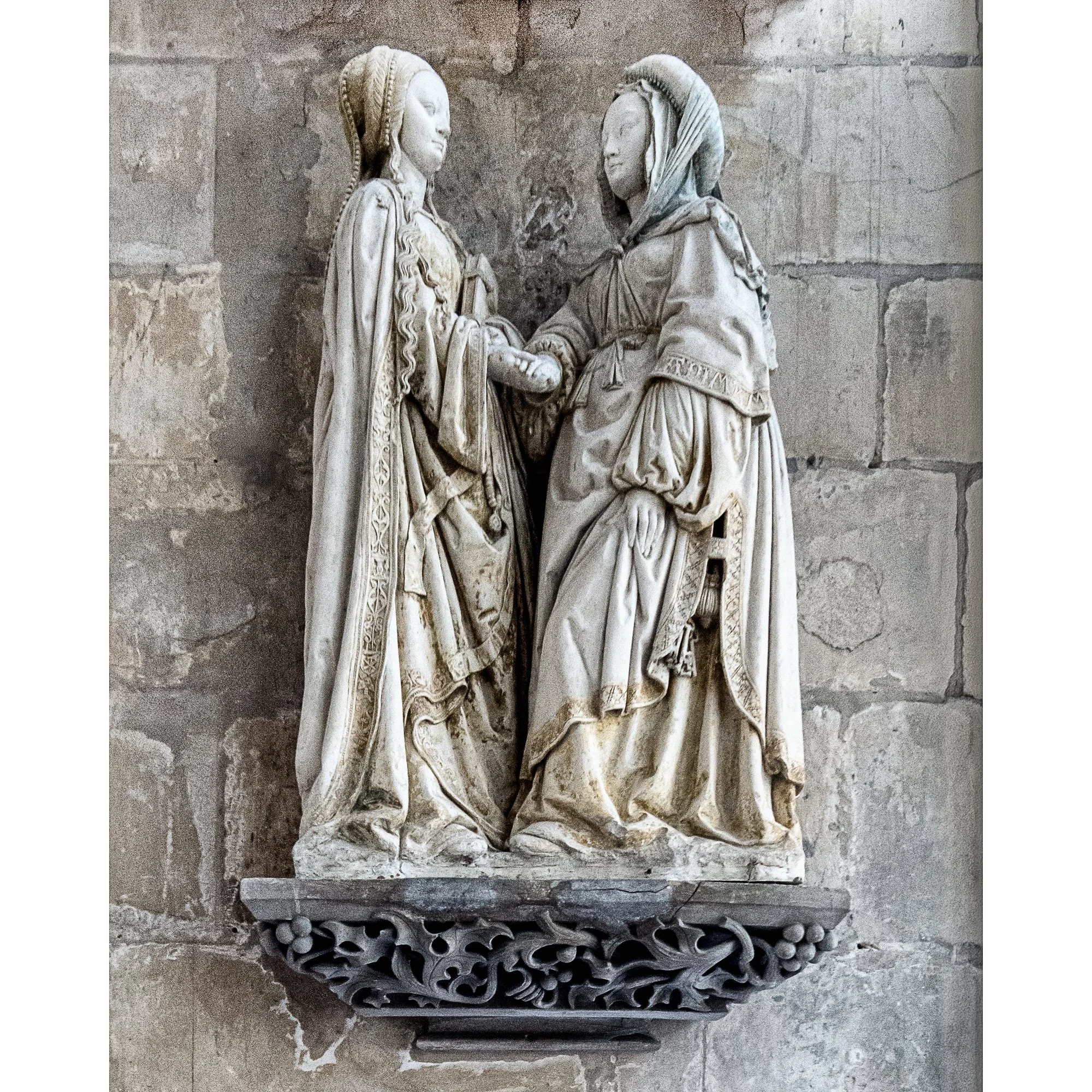
In a quiet corner of the Église Saint-Jean-au-Marché in Troyes stands a sculpture that does not impress through scale, but through intimacy. Two women face each other, leaning in slightly. Their hands meet, their eyes connect. Nothing dramatic unfolds, yet the moment feels charged with meaning.
This is the Visitation, described in the Gospel of Luke. Mary, pregnant with Christ, visits her cousin Elizabeth, who is carrying John the Baptist. When they meet, recognition happens before anything is spoken. Elizabeth senses who Mary carries; even the unborn child responds. It is a moment of awareness before history fully begins.
Mary Visits Elizabeth (Luke 1:39-45)
At that time Mary got ready and hurried to a town in the hill country of Judea, where she entered Zechariah’s home and greeted Elizabeth. When Elizabeth heard Mary’s greeting, the baby leaped in her womb, and Elizabeth was filled with the Holy Spirit. In a loud voice she exclaimed: “Blessed are you among women, and blessed is the child you will bear! But why am I so favored, that the mother of my Lord should come to me? As soon as the sound of your greeting reached my ears, the baby in my womb leaped for joy. Blessed is she who has believed that the Lord would fulfill his promises to her!
This is the Visitation, described in the Gospel of Luke. Mary, pregnant with Christ, visits her cousin Elizabeth, who is carrying John the Baptist. When they meet, recognition happens before anything is spoken. Elizabeth senses who Mary carries; even the unborn child responds. It is a moment of awareness before history fully begins.
What makes the sculpture in Troyes remarkable is how human this encounter feels. There is no theatrical gesture, no exaggerated emotion. Instead, the artist captures something quieter: the kind of understanding that passes between people without words.
The Art of the “Beau XVIe”
The sculpture was created in the early sixteenth century, during a flourishing period in Troyes known as the Beau XVIe. The city was thriving through trade, and after a devastating fire in 1524, it rebuilt itself with renewed artistic ambition. Workshops developed a distinctive style—later called the École troyenne—that blended Northern realism with early Renaissance elegance.
You can see this clearly in the figures. Their faces are soft and attentive, their presence almost tangible. The heavy folds of their garments fall naturally, catching light and shadow with a painterly sensitivity influenced by Flemish art.
Yet the composition remains simple. Two figures, nothing more. The power of the work lies not in complexity, but in focus.
Recognition, Not Spectacle
At its core, the Visitation is about recognition. Not a miracle in the visible sense, but an inner realization. Elizabeth understands, Mary responds, and something profound is acknowledged without display.
This makes the scene unusual. In a tradition often dominated by grand narratives and male figures, here we see two women at the center of a decisive moment. Their pregnancy is not symbolic decoration but essential to the story: the divine is not descending from above, but growing within.
The sculpture stands between Gothic and Renaissance worlds. It still carries a sense of inward spirituality, yet it also embraces a new attention to the human body and emotional presence. That balance gives it its lasting power.
Even today, the scene feels immediate. You do not need to know the theology to understand it. Two people meet, and something important passes between them.
In a world full of noise, that quiet recognition may be the most striking message of all.