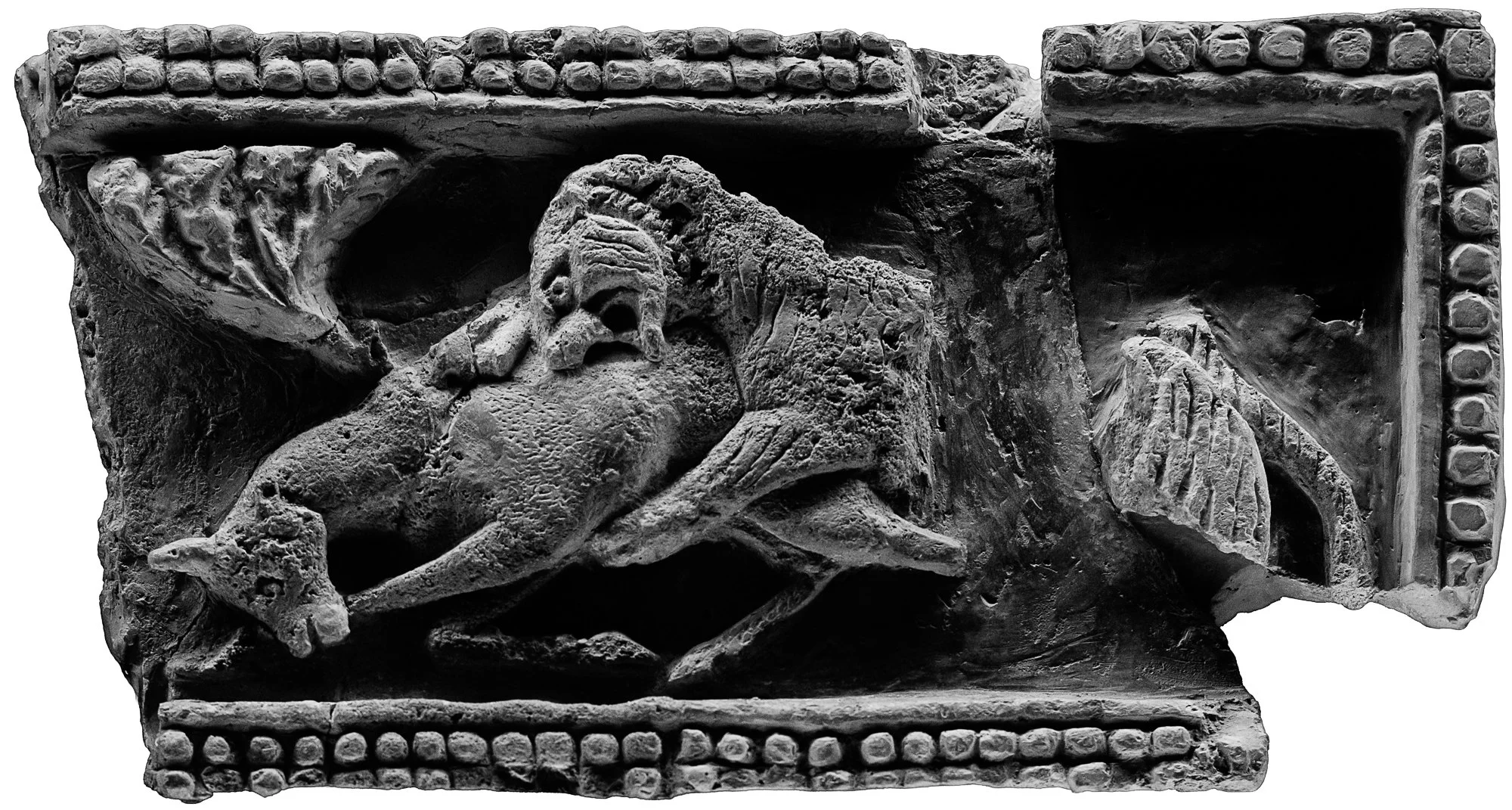
Stucco medallion showing a lion attacking a deer or gazelle, made from a mould and dated to the 3rd–4th century AD; found at Torre de la Cruz / Xauxelles (Villajoyosa) and displayed at the Museo Arqueológico de Alicante (MARQ).
A small stucco medallion shows a simple, brutal scene: a lion attacking a deer—or perhaps a gazelle. The object was made using a mould and dates to the 3rd–4th century AD. It was found at Torre de la Cruz / Xauxelles, near modern Villajoyosa on Spain’s Mediterranean coast.
Scenes like this were common in Roman art. They appear in mosaics, wall decorations, and reliefs across the empire. The theme is straightforward: strength over weakness, predator over prey. It reflects a worldview in which nature is ordered, but not gentle.
Decoration and context
Stucco was widely used in Roman interiors. It allowed for repeated decorative elements at relatively low cost. Medallions like this were likely part of wall or ceiling decoration in:
villas
reception rooms
or possibly funerary spaces
The use of moulds suggests a standardized visual repertoire, rather than a unique artwork.
Villajoyosa in the Roman period
The findspot lies in the territory of the Roman settlement of Allon. This coastal area was economically active, with agriculture, fish processing, and trade connections across the western Mediterranean. Even in the later Roman period—often described as a time of crisis—local elites continued to invest in buildings and decoration. This medallion fits within that pattern. The specific site of Xauxelles is today largely hidden, incorporated into later structures. The original building to which this piece belonged has not survived in a visible form.
A recurring motif
Animal combat scenes were not random decoration. They appear frequently in Roman visual culture, especially in domestic settings. The imagery connects to:
hunting as a marker of elite identity
the display of control and order
a broader symbolic language shared across the empire
The absence of human figures does not weaken the message. The action itself is enough.